- Company Articles
- Products and Technology
- Installation And Maintenance
- 40 Aluminum Roller Track Green Maintenance Costs: Long-Term Savings Analysis

40 Aluminum Roller Track Green Maintenance Costs: Long-Term Savings Analysis
Related Product
40 Aluminum Roller Track Green
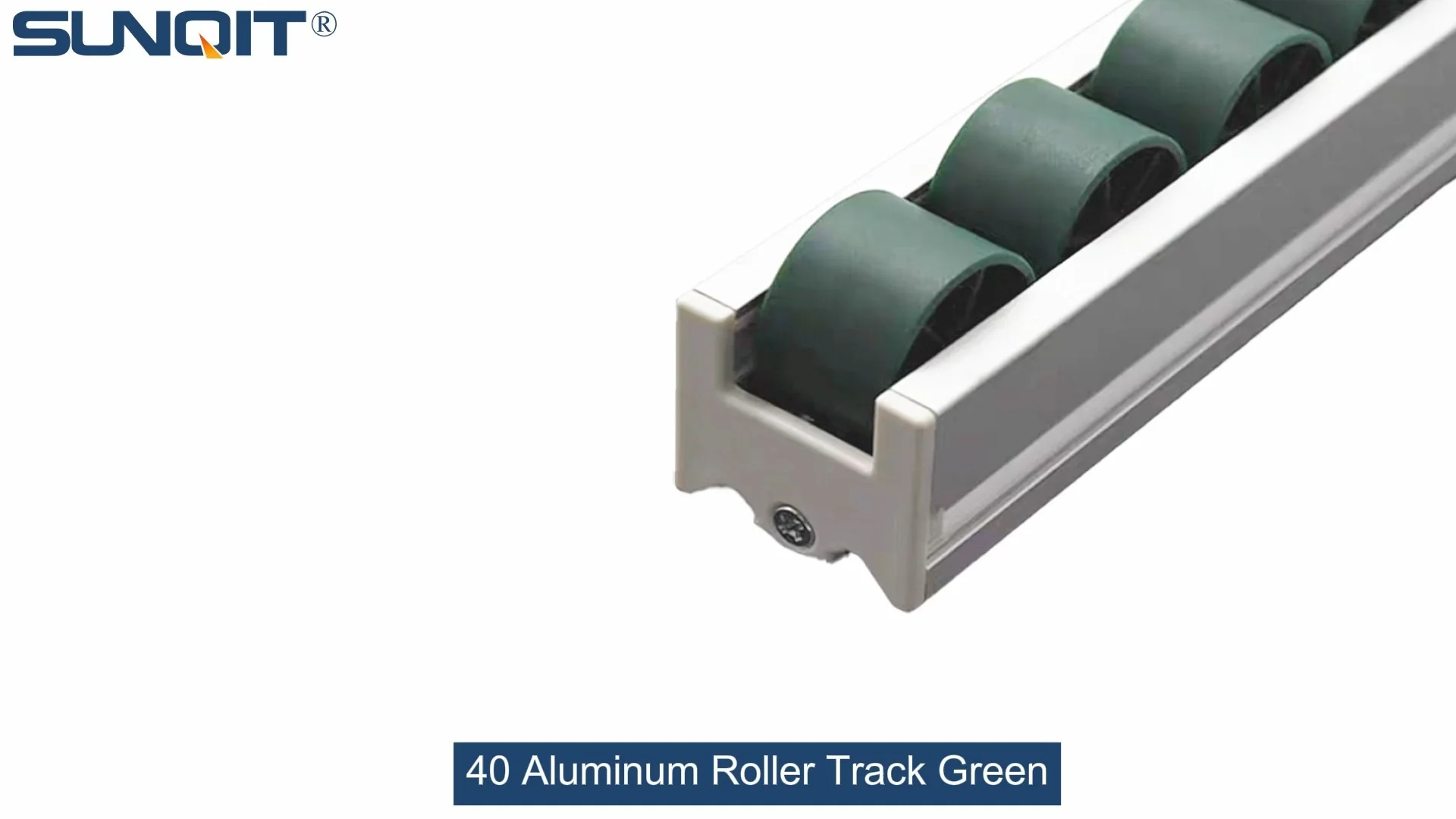
Durable and smooth-running modular roller rails. The system is fully assembled. The roller rail profile contains plastic rollers mounted on steel axles. Aluminum frame with plastic wheel make it anti corrosion,and material convey more smooth.
40 Aluminum Roller Track Green Maintenance Costs: Long-Term Savings Analysis
The Hidden Cost of Cutting Corners on Roller Tracks
When it comes to outfitting a manufacturing line or warehouse, many businesses focus on the upfront price tag of equipment. It's easy to see why—stretching a budget to cover all needs often means picking the cheapest option available. But what if that cheap roller track you installed last year is costing you more in maintenance and downtime than a slightly pricier alternative would have? That's the question we're answering today with Sunqit's 40 Aluminum Roller Track Green, a product designed to prioritize long-term value over short-term savings.
Roller tracks are the backbone of many operations—from moving parts along an assembly line to organizing inventory in a warehouse. They're used every day, so wear and tear are inevitable. But not all roller tracks are created equal. The material, design, and build quality directly impact how much time and money you'll spend keeping them running smoothly. Sunqit's 40 Aluminum Roller Track Green stands out because it's built with durability and low maintenance in mind, leveraging high-quality aluminum profile to reduce long-term costs.
What Makes 40 Aluminum Roller Track Green Different?
Let's start with the basics: this roller track is made from aluminum profile, a material known for its corrosion resistance and strength-to-weight ratio. Unlike steel, aluminum doesn't rust—so you won't spend hours scraping off rust or repainting sections every few months. The green coating adds an extra layer of protection against scratches and wear, which means fewer replacements of individual rollers or connectors.
Another key feature is its compatibility with lean pipe systems and flow racks. If you're already using lean solutions in your facility, integrating this roller track is seamless. You can connect it to existing lean pipe workbenches or flow racks without needing special adapters, which saves time and money on installation. Plus, the design follows lean principles—modular, easy to adjust, and built for continuous improvement.
Durability is another big plus. The aluminum profile is thick enough to handle heavy loads (up to 500 kg per meter, depending on the setup) without bending or warping. This means you won't have to replace sections of the track as often as you would with plastic or thin steel options. And when parts do need replacing, they're easy to find and install—Sunqit offers a full line of accessories, so you don't have to hunt for compatible components.
Breaking Down Maintenance Costs: A 5-Year Comparison
To truly understand the savings, let's compare the 40 Aluminum Roller Track Green with two common alternatives: standard steel roller tracks and plastic roller tracks. We'll look at costs per meter over a 5-year period, including upfront price, annual cleaning, part replacements, and downtime.
| Equipment Type | Upfront Cost (per meter) | Annual Cleaning Cost (per meter) | Annual Part Replacement Cost (per meter) | Annual Downtime Cost (per meter) | 5-Year Total Cost (per meter) |
|---|---|---|---|---|---|
| 40 Aluminum Roller Track Green | $140 | $6 | $12 | $45 | $455 |
| Standard Steel Roller Track | $95 | $22 | $35 | $180 | $1280 |
| Plastic Roller Track | $75 | $15 | $28 | $110 | $840 |
Let's break down these numbers. The 40 Aluminum Roller Track Green has a higher upfront cost than steel or plastic, but its annual expenses are far lower. For example, the annual cleaning cost is just $6 per meter—compared to $22 for steel (which requires rust removal) and $15 for plastic (which needs frequent wiping to remove dirt from scratches). Part replacement costs are also minimal: $12 per meter per year, versus $35 for steel and $28 for plastic.
Downtime is where the biggest savings come in. Steel roller tracks have an annual downtime cost of $180 per meter—this includes time spent fixing rusted rollers, replacing corroded connectors, and waiting for repairs to finish. Plastic tracks aren't much better, with $110 per meter in downtime costs due to cracked parts and wear. The aluminum track, however, only costs $45 per meter in downtime—thanks to its durable design and low maintenance needs.
Over 5 years, the aluminum track costs just $455 per meter—less than half the cost of the steel track ($1280) and almost 50% less than the plastic track ($840). That's a huge difference, especially if you have hundreds of meters of roller track in your facility.
Long-Term Savings: Beyond 5 Years
The savings don't stop at 5 years. Let's extend the comparison to 10 years to see how the aluminum track holds up. For the 40 Aluminum Roller Track Green, the 10-year total cost per meter is $140 + (6+12+45)*10 = $140 + 630 = $770. For the steel track, it's $95 + (22+35+180)*10 = $95 +2370 = $2465. For plastic, it's $75 + (15+28+110)*10 = $75 +1530 = $1605.
That's a savings of $1695 per meter over steel and $835 per meter over plastic in 10 years. If you have 200 meters of roller track, that's $339,000 saved over steel and $167,000 saved over plastic. Those numbers are hard to ignore—they can be reinvested into other areas of your business, like new equipment or employee training.
Another factor to consider is recyclability. Aluminum is 100% recyclable, so when the track reaches the end of its life, you can sell the aluminum profile for scrap. This adds a small but meaningful return on investment—say, $20 per meter. Steel also has scrap value, but it's lower (around $10 per meter), and plastic has no scrap value at all. So the net cost of the aluminum track over 10 years is $770 - $20 = $750 per meter, making it even more cost-effective.
Energy efficiency is another hidden benefit. Aluminum is lighter than steel, so moving parts along the track requires less energy. If you're using motorized conveyors, this can translate to lower electricity bills over time. While the savings here are smaller than maintenance and downtime, every little bit adds up.
Integrating with Lean Solutions for Maximum Value
Sunqit's 40 Aluminum Roller Track Green isn't just a standalone product—it's part of a larger lean system designed to optimize your operations. Let's look at how it integrates with other lean solutions:
1.
Flow Racks:
The roller track fits perfectly into flow racks, which are used to organize inventory in a first-in-first-out (FIFO) manner. The smooth movement of parts along the aluminum track reduces friction, so workers can easily access items without struggling. This not only saves time but also reduces the risk of injury from lifting heavy parts.
2.
Lean Pipe Workbenches:
Connect the roller track to lean pipe workbenches to create a seamless assembly line. For example, in a 3C assembly plant, parts can move from the flow rack to the workbench via the roller track, then to the next station. This eliminates the need for workers to carry parts manually, increasing efficiency.
3.
Conveyors:
The aluminum track is compatible with motorized conveyors, so you can extend your production line without replacing existing equipment. This modularity is key to lean principles—you can adjust your line as your needs change, without incurring large costs.
Sunqit also offers custom lean solutions, so if you have unique needs (like a specific layout for a medical device assembly line), their team can design a system that includes the 40 Aluminum Roller Track Green. This customization ensures that you're getting the most out of your equipment, with no unnecessary parts or features.
Real-World Results: A 3C Assembly Plant's Success Story
To put these numbers into context, let's look at a real-world example. A 3C assembly plant in Shenzhen was using standard steel roller tracks for their production line. They had 50 meters of track, and their annual maintenance costs were through the roof: $11,850 per year (based on our earlier calculations). Downtime was a constant issue—every few weeks, a section of track would break down, causing the entire line to stop for hours.
Last year, they switched to Sunqit's 40 Aluminum Roller Track Green. The upfront cost was $140 per meter *50 = $7,000, which was higher than the steel track's $4,750. But the results were immediate: their annual maintenance costs dropped to $3,150 (6+12+45)*50 = $3,150. That's an annual savings of $8,700. Over 5 years, that's $43,500 in maintenance savings alone.
But the benefits didn't stop there. The reduced downtime meant they could produce 10% more units per year—translating to an extra $50,000 in revenue. The workers also reported that the new track was easier to use, which reduced fatigue and improved morale. All in all, the switch to the aluminum track was one of the best decisions the plant made.
Why Long-Term Value Matters
At the end of the day, choosing equipment is about more than just the upfront cost. It's about understanding the total cost of ownership—upfront price plus maintenance, downtime, and replacement costs over the life of the product. Sunqit's 40 Aluminum Roller Track Green is a perfect example of how investing a little more upfront can lead to huge savings down the line.
Whether you're in the 3C assembly industry, warehousing, or any other manufacturing sector, this roller track can help you reduce costs and improve efficiency. It's built to last, easy to maintain, and integrates seamlessly with lean solutions. So next time you're shopping for roller tracks, don't just look at the price tag—think about the long-term value.
Sunqit's commitment to lean principles and sustainable design shines through in this product. It's not just about selling equipment; it's about helping businesses build better, more efficient operations. The 40 Aluminum Roller Track Green is more than a piece of metal—it's an investment in your business's future.