- Company Articles
- Products and Technology
- Product knowledge
- 40 Aluminum Roller Track Yellow with Brake Mechanisms: Controlling Material Flow Speed

40 Aluminum Roller Track Yellow with Brake Mechanisms: Controlling Material Flow Speed
Related Product
40 Aluminum Roller Track Yellow
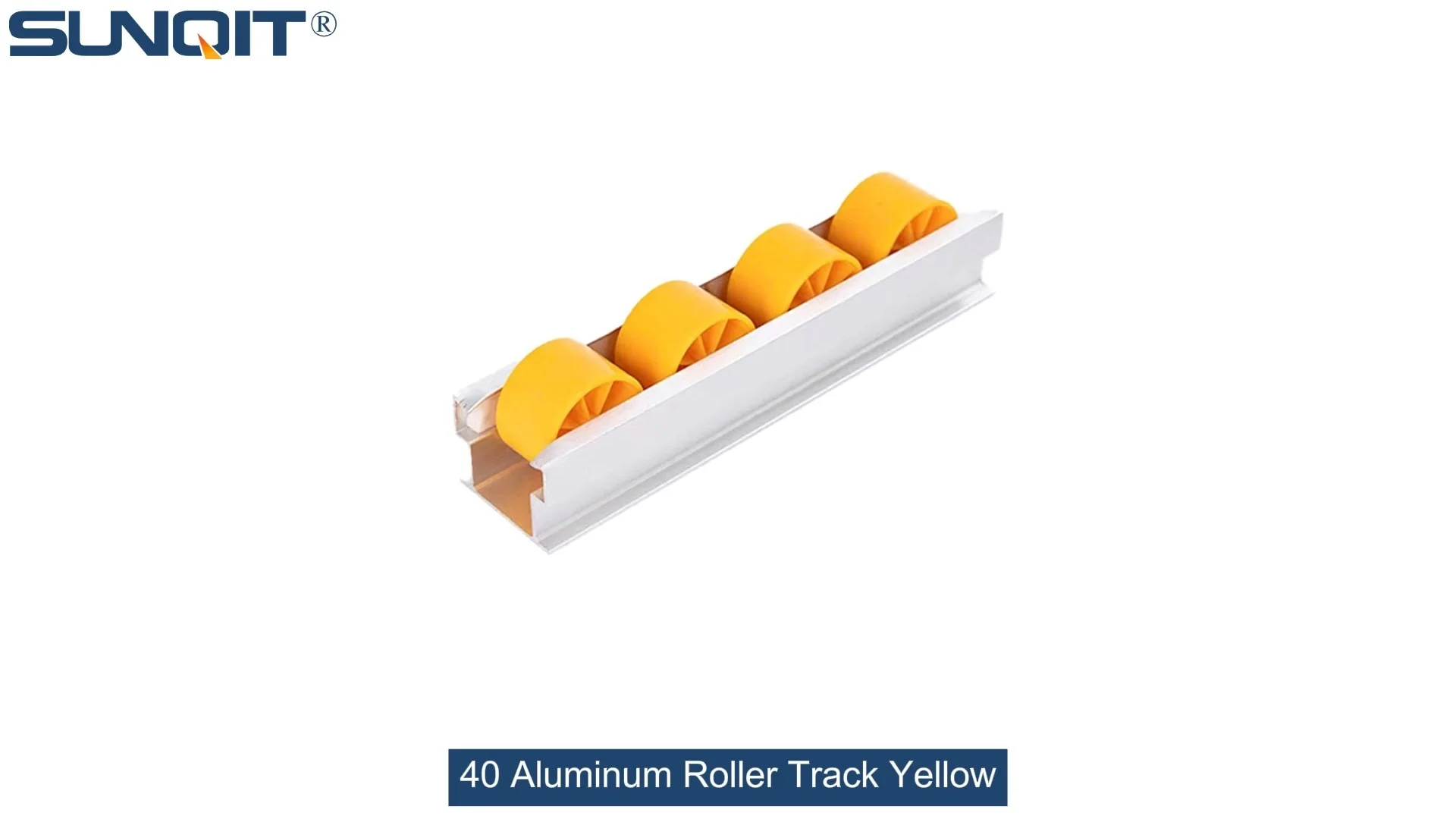
Durable and smooth-running modular roller rails. The system is fully assembled. The roller rail profile contains plastic rollers mounted on steel axles. Aluminum frame with plastic wheel make it anti corrosion,and material convey more smooth.
Walk into any busy manufacturing plant, warehouse, or assembly facility, and you'll quickly notice the unsung heroes keeping operations moving: the systems that transport materials from point A to point B. These aren't just metal tracks or rollers—they're the circulatory system of production, ensuring parts, components, and products flow smoothly, on time, and in the right condition. But here's the thing: not all material flow is created equal. When parts slide too fast, they collide, scratch, or even fall off the line. When they move too slowly, workers wait, bottlenecks form, and deadlines creep closer. It's a delicate balance—one that the 40 Aluminum Roller Track Yellow with Brake Mechanisms was designed to master.
In this article, we're diving deep into this innovative tool: what it is, how it works, and why it's becoming a game-changer for facilities that refuse to settle for "good enough" material flow. We'll explore its design, its brake mechanisms, and how it integrates with existing systems like aluminum profiles and roller track connectors. We'll also hear from real-world users who've transformed their workflows by taking control of material speed. Whether you're running a small workshop or a large-scale production line, by the end, you'll understand why this roller track isn't just a piece of equipment—it's a partner in precision.
The Cost of Uncontrolled Material Flow: Stories from the Shop Floor
Before we talk about solutions, let's talk about the problem. For decades, many facilities have relied on basic roller tracks—simple setups with metal or plastic rollers that let gravity do the work. They're cheap, easy to install, and get the job done… until they don't. Take the example of GreenTech Electronics, a mid-sized manufacturer of circuit boards. A few years back, their assembly line used standard steel roller tracks to feed components to workbenches. The tracks sloped gently downward, and for the most part, parts glided along nicely. But during peak hours, when workers loaded more components onto the track, the added weight made parts accelerate. By the time they reached the end of the track, they'd often slam into the stop, damaging delicate circuit boards or scattering small screws across the floor.
"We were losing 5-10% of our circuit boards to damage every week," recalls Raj Patel, GreenTech's production manager. "And it wasn't just the cost of the parts—it was the time. Workers would have to stop, clean up the mess, and reorder components. We were falling behind schedule, and morale was dropping because no one likes dealing with preventable mistakes."
Then there's the flip side: tracks that move too slowly. At BuildRight Furniture, a manufacturer of office chairs, their old plastic roller tracks had worn down over time, causing rollers to stick. Workers often had to manually push stacks of fabric or metal frames along the track, leading to fatigue and repetitive strain injuries. "We had a stretch where three employees went on medical leave in a month because of back pain from pushing heavy loads," says Sarah Lopez, BuildRight's operations director. "The track was supposed to make their jobs easier, but it was doing the opposite."
These stories aren't outliers. Uncontrolled material flow costs facilities time, money, and even employee well-being. It's why more and more operations managers are seeking out tools that offer control —not just movement. And that's where the 40 Aluminum Roller Track Yellow with Brake Mechanisms comes in.
Meet the 40 Aluminum Roller Track Yellow: More Than Just a Track
At first glance, the 40 Aluminum Roller Track Yellow might look like any other roller track. It's a long, flat section of aluminum with evenly spaced rollers, designed to sit on a frame or mount to a workbench. But look closer, and you'll notice the details that set it apart: the vibrant yellow color, the precision-engineered rollers, and most importantly, the small but mighty brake mechanisms integrated into its design.
Let's start with the basics: the "40" in its name refers to its width—40mm, or about 1.57 inches. This makes it versatile enough to handle a range of materials, from small components like screws and washers to larger items like toolboxes or small parts bins. The track itself is made from high-grade aluminum, chosen for three key reasons: strength, lightweight, and resistance to corrosion. Unlike steel, which can rust in humid environments or chip over time, aluminum holds up to daily wear and tear, even in busy facilities. It's also easy to clean—just a quick wipe with a damp cloth removes dust, oil, or debris that could gum up the rollers.
Then there's the color: bright yellow. This isn't just for aesthetics (though it does look sharp on the production floor). Yellow is a high-visibility color, making the track easy to spot in cluttered environments. This reduces the risk of workers tripping over or accidentally damaging the track, and it also helps new employees quickly identify material flow paths. "In our warehouse, we use color-coding to separate 'inbound' and 'outbound' zones," says Mike Torres, logistics manager at a regional distribution center. "The yellow track stands out like a beacon, so even temporary staff know exactly where materials should go."
Key Design Features at a Glance:
-
Material:
High-grade aluminum (lightweight, corrosion-resistant, durable)
-
Width:
40mm (versatile for small to medium-sized materials)
-
Color:
High-visibility yellow (enhances safety and workflow clarity)
-
Rollers:
Precision-engineered plastic (quiet, smooth, and non-marring)
-
Brake Mechanisms:
Adjustable tension controls (manual or semi-automatic options)
-
Compatibility:
Works with standard roller track connectors and aluminum profiles

The Star of the Show: How the Brake Mechanisms Work
If the aluminum frame and yellow color are the track's "bones," the brake mechanisms are its "brains." These small, unassuming components are what give users control over material speed—and they're surprisingly simple in concept, yet sophisticated in execution.
Most basic roller tracks rely solely on gravity and track slope to control speed. Tilt the track steeper, and materials go faster; flatten it, and they slow down. But this is a one-size-fits-all approach, and it doesn't account for variables like material weight (a heavy bin will slide faster than a light one) or surface conditions (oily rollers make materials glide more quickly). The 40 Aluminum Roller Track Yellow solves this with built-in brake pads that can be adjusted to apply gentle friction to the rollers, slowing material flow to a precise speed.
There are two main types of brake mechanisms available for this track: manual and semi-automatic. Manual brakes are controlled by a small dial or lever on the side of the track. A worker can twist the dial to increase or decrease tension—tightening it slows the rollers, loosening it lets them spin more freely. This is ideal for facilities where material types change frequently; for example, a workshop that alternates between metal parts (heavy) and plastic components (light). "I love the manual brakes because I can tweak them on the fly," says Juanita Gomez, a production line lead at a toy manufacturer. "One minute we're running small plastic wheels, the next we're moving metal axles. A quick turn of the dial, and the speed adjusts perfectly."
Semi-automatic brakes, on the other hand, use sensors to detect the weight or speed of materials on the track and adjust tension automatically. This is great for high-volume facilities where materials are consistent in size or weight, like a warehouse shipping the same-sized boxes all day. The sensors "read" the material as it enters the track and apply just enough brake pressure to keep it moving at the desired speed—no human intervention needed. "We installed semi-automatic brakes on our order-picking line, and it's cut down on errors by 30%," says Torres. "No more boxes zooming past pickers or getting stuck halfway—they just glide by at the exact speed our team needs to grab items and go."
Both types of brakes are designed to be low-maintenance. The brake pads are made from a durable rubber compound that wears slowly, and when they do need replacing, they pop out easily—no special tools required. "We've had our track for two years, and we've only replaced the brake pads once," says Patel from GreenTech Electronics. "It was a 10-minute job, and the parts cost less than $20. Compared to the cost of damaged circuit boards, that's nothing."

Integrating with Your Workflow: Aluminum Profiles and Roller Track Connectors
A great tool is only as good as its ability to work with the tools you already have. The 40 Aluminum Roller Track Yellow was designed with integration in mind, playing nicely with common facility systems like aluminum profiles and roller track connectors. This means you don't have to overhaul your entire workflow to use it—you can add it to existing setups or build new systems around it.
Aluminum profiles are the backbone of many modern material handling systems. These extruded aluminum rails have T-slots that let you attach brackets, shelves, workbenches, and yes—roller tracks. The 40 Aluminum Roller Track Yellow can be mounted directly to aluminum profiles using specialized roller track placon mounts, which are small brackets that slide into the T-slots and secure the track in place. This makes it easy to adjust the track's height, angle, or position as your needs change. For example, if you need to raise the track to align with a new workbench, you simply loosen the placon mounts, slide the track up, and tighten them again. No drilling, no welding, no hassle.
Roller track connectors are another essential component for building custom material flow systems. These small, often plastic or metal pieces let you join multiple sections of roller track together, creating longer paths, turns, or even switches. The 40 Aluminum Roller Track Yellow is compatible with standard connectors like the roller track placon mount for rail connection (used to join two straight sections) or the roller track placon mount center support bracket (used to add extra stability to long tracks). This flexibility means you can design a system that fits your facility's unique layout—whether you need a straight line from receiving to shipping, a zig-zag path around workstations, or a spiral track for vertical material movement.
To illustrate just how versatile this integration can be, let's look at a real example: Precision Auto Parts, a manufacturer of car door handles. They wanted to connect their assembly workbench to a nearby storage rack, so workers could easily access raw materials without leaving their stations. Using aluminum profiles, they built a frame that extended from the rack to the workbench, then mounted the 40 Aluminum Roller Track Yellow on top. They added a 90-degree roller track connector to navigate around a support beam, and a manual brake mechanism to slow materials as they approached the workbench. "Now, when a worker needs a new batch of handles, they just pull a lever, and the bin slides down the track at a speed that's safe and easy to catch," says Tom Wilson, Precision's plant manager. "No more walking to the rack, no more lifting heavy bins—just smooth, controlled flow."

A Closer Look: How It Stacks Up Against Other Roller Tracks
With so many roller tracks on the market, you might be wondering: What makes the 40 Aluminum Roller Track Yellow with Brake Mechanisms stand out? To answer that, let's compare it to three common alternatives: standard steel roller tracks, plastic roller tracks, and non-brake aluminum tracks.
| Feature | 40 Aluminum Roller Track Yellow with Brakes | Standard Steel Roller Track | Plastic Roller Track | Non-Brake Aluminum Track |
|---|---|---|---|---|
| Material | High-grade aluminum | Mild steel | PVC or polypropylene | Aluminum (similar grade) |
| Weight Capacity | Up to 50kg/m (110 lbs/ft) | Up to 80kg/m (176 lbs/ft) | Up to 20kg/m (44 lbs/ft) | Up to 50kg/m (110 lbs/ft) |
| Speed Control | Adjustable brake mechanisms | None (gravity only) | None (gravity only) | None (gravity only) |
| Corrosion Resistance | High (aluminum doesn't rust) | Low (prone to rust without coating) | High (plastic resists moisture) | High (same as above) |
| Noise Level | Low (aluminum + plastic rollers) | High (metal-on-metal contact) | Low (plastic rollers) | Low (same as above) |
| Compatibility with Aluminum Profiles | Yes (via placon mounts) | Limited (requires custom brackets) | Yes (via plastic brackets) | Yes (same as above) |
| Cost (per meter) | Mid-range ($40–$60) | Low ($20–$30) | Low ($15–$25) | Mid-range ($30–$50) |
As the table shows, the 40 Aluminum Roller Track Yellow with Brake Mechanisms strikes a balance between strength, versatility, and cost. While steel tracks can handle heavier loads, they lack speed control and are prone to rust. Plastic tracks are cheap but flimsy, and non-brake aluminum tracks, while durable, still leave you at the mercy of gravity. For most facilities, the ability to control speed—paired with aluminum's durability and compatibility—makes this track the clear winner.
Applications: Where the 40 Aluminum Roller Track Yellow Shines
This roller track isn't a one-trick pony. Its versatility makes it useful in a wide range of industries and applications. Let's explore a few of the most common:
Assembly Lines
In assembly environments—whether automotive, electronics, or appliances—workers rely on a steady stream of components. The 40 Aluminum Roller Track Yellow ensures that parts arrive at the workbench at a pace that matches the worker's speed. For example, in a smartphone assembly line, small parts like screws or microchips can be fed down the track with the brake set to "slow," so the worker can pick them up without fumbling. Larger items like screens or batteries can have the brake loosened, allowing faster but still controlled flow.
Warehouses and Distribution Centers
Order picking is a race against time, and anything that slows down pickers costs money. In warehouses, this roller track is often used to create "pick lanes," where bins of products slide down to pickers at a speed that lets them grab items quickly without stopping. The high-visibility yellow also helps pickers spot the track in busy aisles, reducing errors and improving efficiency.
Workbenches and Packing Stations
Packing stations often have limited space, so material flow needs to be tight and efficient. By mounting the 40 Aluminum Roller Track Yellow to the side of a workbench (using aluminum profiles), workers can receive empty boxes, packing materials, or finished products without cluttering their workspace. The brake mechanisms ensure boxes don't slide off the track as they're being packed, and the lightweight aluminum keeps the setup from feeling bulky.
Clean Rooms and ESD Environments
In sensitive environments like clean rooms or electronics manufacturing (where electrostatic discharge, or ESD, can damage components), the track's aluminum construction is a plus. Aluminum is conductive, which means it can be grounded to prevent static buildup. While the track itself isn't ESD-rated, it can be paired with ESD workbench setups to create a safe, controlled flow of sensitive materials.
Maintenance Tips: Keeping Your Track Running Smoothly
Like any tool, the 40 Aluminum Roller Track Yellow works best when it's well-maintained. The good news? It doesn't require a lot of upkeep—just a few simple habits to keep it in top shape.
1. Clean the Rollers Regularly: Dust, oil, and debris can build up on the rollers over time, making them sticky or uneven. Wipe them down with a dry cloth once a day, and use a mild soap and water solution if there's heavy grime. Avoid harsh chemicals, as they can damage the roller material.
2. Check the Brake Mechanisms: Every week, test the brakes to ensure they're working properly. For manual brakes, twist the dial to its tightest and loosest settings to make sure there's no resistance or slipping. For semi-automatic brakes, run a test bin down the track to confirm the speed stays consistent.
3. Tighten Connectors and Mounts: Vibration from daily use can loosen roller track connectors and placon mounts. Once a month, go along the track and tighten any loose screws or brackets. This prevents the track from shifting or wobbling, which can cause materials to jam.
4. replace Worn Brake Pads: Over time, brake pads will wear down, reducing their effectiveness. If you notice materials starting to speed up even with the brake tightened, it's time for new pads. Most suppliers sell replacement pads in packs, and they're easy to install with a screwdriver.
5. Inspect for Damage: Every few months, give the track a thorough once-over. Look for dents, bends, or cracks in the aluminum frame, and check that all rollers spin freely. If you spot damage, contact your lean pipe supplier for repairs or replacement parts. Catching issues early prevents them from turning into costly breakdowns.
Why Choosing the Right Lean Pipe Supplier Matters
You could have the best roller track in the world, but if it's supplied by a company that cuts corners on quality or offers poor customer support, you're setting yourself up for frustration. That's why choosing a reputable lean pipe supplier is just as important as choosing the track itself.
A good lean pipe supplier will offer high-quality products that meet industry standards, backed by warranties and certifications. They'll also provide expert advice to help you design your material flow system—whether you need help choosing the right brake mechanism, figuring out which roller track connectors to use, or troubleshooting installation issues. Look for suppliers with a track record of working with businesses similar to yours, and don't be afraid to ask for references or case studies.
Another sign of a reliable supplier is a commitment to customization. Every facility is different, and a one-size-fits-all approach rarely works. The best suppliers will work with you to modify products—like adding custom brake tension settings or adjusting the track's length—to fit your specific needs. They'll also stock a wide range of accessories, so you can get everything you need (rollers, connectors, placon mounts) in one place, saving time and money.
Conclusion: Taking Control of Your Material Flow
Material flow might not be the sexiest topic in manufacturing, but it's one of the most critical. When it works well, it's invisible—just a smooth, steady rhythm that keeps operations humming. When it doesn't, it's a constant source of frustration, delays, and waste. The 40 Aluminum Roller Track Yellow with Brake Mechanisms is more than just a tool to move materials—it's a way to take control of that rhythm, to turn chaos into order, and to transform "good enough" into "excellent."
Whether you're dealing with damaged components from fast-moving tracks, worker fatigue from slow-moving ones, or simply want to streamline your workflow, this roller track offers a solution that's durable, versatile, and easy to use. Its aluminum construction, high-visibility yellow color, and adjustable brake mechanisms make it a standout choice for facilities that value precision, safety, and efficiency.
So, what's next? If you're ready to take control of your material flow, start by assessing your current system. Where are the bottlenecks? Where do materials move too fast or too slow? Then, reach out to a trusted lean pipe supplier to discuss how the 40 Aluminum Roller Track Yellow can fit into your workflow. With the right setup, you'll be amazed at how much smoother, safer, and more productive your facility can be.
After all, in manufacturing, as in life, it's not just about moving forward—it's about moving forward with control.