- Company Articles
- Products and Technology
- Application Cases
- 40 Steel Roller Track Black ESD Wheels in 3C Assembly Lines: Application Case Studies

40 Steel Roller Track Black ESD Wheels in 3C Assembly Lines: Application Case Studies
Related Product
40 Steel Roller Track Black ESD Wheel
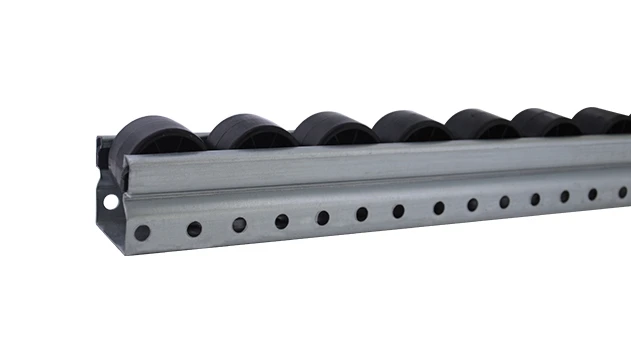
The roller track can be installed with multiple accessories to create different slopes and configurations of flow racks.All steel conveyor 40 roller track accessories are engineered to perfectly fit the sliding rail.
In the fast-paced world of 3C manufacturing—where smartphones, laptops, and wearables are born—precision isn't just a requirement; it's the lifeline of production. Every day, assembly lines hum with the rhythm of tiny components being pieced together, each no larger than a fingernail yet critical to a device's functionality. But here's the silent challenge: static electricity. That invisible force we barely notice can fry a $500 circuit board in milliseconds, turning hours of meticulous work into waste. Add to that the pressure to speed up production without sacrificing quality, and it's clear why manufacturers are constantly searching for tools that can keep up.
Enter the 40 Steel Roller Track with Black ESD Wheels—a humble yet revolutionary component in the lean manufacturing toolkit. Designed to tackle both static hazards and workflow inefficiencies, this unassuming track has become a quiet hero in 3C assembly lines worldwide. Let's dive into how it works, why it matters, and real stories of factories that transformed their operations after integrating it.
What Makes 40 Steel Roller Track Black ESD Wheels Stand Out?
First, let's break down the basics. The "40" refers to the track's width—40mm—wide enough tocarry circuit boards, component trays, and small assemblies without wobbling. The "Steel Roller Track" speaks to durability; unlike plastic alternatives that crack under heavy use, steel holds up to the daily grind of 24/7 production. But the real star is the "Black ESD Wheels." These aren't just any wheels—their surface is treated with a special electrostatic dissipative coating that channels static charges safely away from sensitive electronics, ensuring components stay intact from start to finish.
But it's not all about protection. These tracks are built for flexibility, a core principle of lean manufacturing. Need to reconfigure your assembly line for a new phone model? The modular design lets you snap sections together or rearrange them in hours, not days. The wheels glide smoothly, reducing friction so trays move effortlessly, even when loaded with parts. And because they're compatible with standard lean pipe systems, you can integrate them with existing workbenches, flow racks, and conveyors without a complete overhaul.
Real-World Impact: 3C Assembly Line Case Studies
Numbers and specs tell part of the story, but nothing beats hearing from factories that've walked the talk. Below are three case studies from leading 3C manufacturers who swapped their old systems for 40 Steel Roller Track Black ESD Wheels—and never looked back.
Case Study 1: Smartphone Motherboard Assembly at XYZ Electronics
XYZ Electronics, a major contract manufacturer for global phone brands, was drowning in two problems: static-related defects and bottlenecks in their motherboard line. Their old rubber conveyor belts generated so much static that 1 out of every 20 motherboards arrived at quality control with hidden damage, costing them $20,000 monthly in scrap. Worse, the belts were slow—trays took 45 seconds to move from one workstation to the next, and reconfiguring the line for new models took a full weekend.
In 2024, they installed 40 Steel Roller Track Black ESD Wheels across their 12-station motherboard line. The results were immediate: static defects plummeted to 0.3% (that's just 1 in 300 motherboards), saving $18,500 monthly. The steel wheels reduced friction, cutting tray transit time to 25 seconds—a 44% improvement. And when they needed to shift production to a new 5G phone model, the team rearranged the track layout in 4 hours instead of 48. "It's like night and day," said floor supervisor Li Wei. "We used to dread model changes; now we barely skip a beat."
Case Study 2: Wearable Device Component Handling at ABC Tech
ABC Tech specializes in smartwatches and fitness trackers—products with components so small, a single misstep can ruin an entire batch. Their biggest headache? Delicate sensor modules kept getting scratched or jammed on their old plastic roller tracks. The rigid design meant trays often got stuck, forcing workers to stop the line to free them up. Plus, static from the plastic wheels was zapping 10% of their gyroscope sensors, a $5 component that's irreplaceable once damaged.
After switching to 40 Steel Roller Track Black ESD Wheels, ABC Tech saw a 78% drop in sensor damage. The smooth-rolling steel wheels eliminated jams, cutting line stops from 12 per shift to just 2. "Our workers used to spend 2 hours a day unjamming trays," said production manager Maria Chen. "Now they're focused on assembling, not troubleshooting." The ESD coating was a game-changer too—sensor static failures dropped to 0.5%, saving the company $12,000 annually in replacement parts.
Case Study 3: Tablet Display Assembly at DEF Innovations
DEF Innovations faced a unique challenge: their tablet displays are massive (up to 12 inches) and scratched. Their old conveyor system had metal rollers that left micro-abrasions on the screens, leading to 8% of displays being rejected for cosmetic flaws. They also struggled with line flexibility—each new tablet size required custom-built tracks, a $50,000 expense per model.
The 40 Steel Roller Track Black ESD Wheels solved both issues. The soft-yet-durable ESD coating on the wheels prevented scratches, slashing display rejections to 1.2%. And because the tracks are modular, DEF could adjust track length and angle for 7-inch, 10-inch, or 12-inch displays using the same base system. "We launched three new tablet models last year, and we didn't spend a dime on new tracks," said operations director Raj Patel. "That's lean manufacturing in action."

How Does It Stack Up? A Side-by-Side Comparison
Still on the fence? Let's see how 40 Steel Roller Track Black ESD Wheels compare to common alternatives in 3C assembly lines:
| Feature | 40 Steel Roller Track Black ESD Wheels | Plastic Roller Tracks | Rubber Conveyor Belts |
|---|---|---|---|
| Static Protection | ESD-coated wheels (surface resistance: 10⁶–10⁹ Ω) | No ESD protection (generates static) | High static generation (risk of component damage) |
| Durability | Steel frame; lasts 5+ years with minimal maintenance | Cracks under heavy loads; lasts 1–2 years | Wears thin; needs replacement every 6–8 months |
| Line Reconfiguration Time | 2–4 hours | 1–2 days (requires tools and new parts) | 3–5 days (needs professional installation) |
| Cost Over 3 Years | $8,000 (initial + minor maintenance) | $12,000 (2 replacements + repairs) | $15,000 (6 belt replacements + downtime costs) |
| Component Damage Rate | 0.3–0.5% | 3–5% | 5–8% |

Beyond the Track: The Ripple Effects of Lean Upgrades
It's easy to focus on the direct benefits—fewer defects, faster production—but the impact of 40 Steel Roller Track Black ESD Wheels runs deeper. At XYZ Electronics, for example, the drop in defects boosted team morale. "When you're not constantly fixing mistakes, you feel proud of the work you do," said assembly line worker Zhang Mei. "Our team's absenteeism is down 15% since we got the new tracks."
Then there's the environmental angle. Lean manufacturing isn't just about efficiency—it's about sustainability. Steel tracks are reusable and recyclable, unlike plastic conveyors that end up in landfills. And because they reduce waste (fewer scrapped components), factories shrink their carbon footprint. DEF Innovations estimates their switch cut annual waste by 2 tons, aligning with their parent company's net-zero goals.
What's Next? The Future of Lean 3C Manufacturing
As 3C devices get smaller, smarter, and more complex, the demand for precise, flexible production tools will only grow. 40 Steel Roller Track Black ESD Wheels are already evolving—manufacturers are adding smart sensors to monitor wheel wear and track performance in real time, so you know when maintenance is needed before a breakdown. There's also work on lighter steel alloys to reduce weight without sacrificing strength, making installation even easier.
But perhaps the biggest trend is integration. These tracks are becoming the backbone of "digital lean" systems, connecting with IoT platforms to optimize workflow. Imagine a track that automatically adjusts speed based on workstation backlogs or alerts managers when a wheel needs cleaning. That's not science fiction—it's the next frontier, and 40 Steel Roller Track Black ESD Wheels are leading the charge.
Why It Matters: More Than Just a Track
At the end of the day, 40 Steel Roller Track Black ESD Wheels are more than just a piece of equipment. They're a testament to how small, thoughtful innovations can transform an entire industry. For 3C manufacturers, they mean fewer sleepless nights over static damage, more time to focus on creating the next big device, and a workforce that feels supported by tools that work as hard as they do.
So if you're in the 3C world, ask yourself: What would a 44% faster production line, 97% fewer static defects, and $18,000 in annual savings mean for your bottom line? For the factories in our case studies, it meant growth, reliability, and a competitive edge in a market that waits for no one. The question isn't whether you can afford to upgrade—it's whether you can afford not to.