
- Company Articles
- Products and Technology
- Product knowledge
- 40 Steel Roller Track Grey: How to Calculate Required Length for Your Facility
Ever stepped into a bustling manufacturing plant or a well-organized warehouse and marveled at how materials glide effortlessly from one point to another? Behind that seamless flow is often a network of roller tracks, quietly powering efficient material handling. Today, we're focusing on a workhorse in this space: the 40 Steel Roller Track Grey. Whether you're building a flow rack for order picking, setting up a conveyor line for production assembly, or refining your lean system to cut waste, knowing exactly how much of this roller track you need is critical. It's not just about avoiding overspending—though that's important—it's about creating a system that works in harmony with your operations, keeping things moving smoothly and keeping your team productive.
What Makes 40 Steel Roller Track Grey Stand Out?
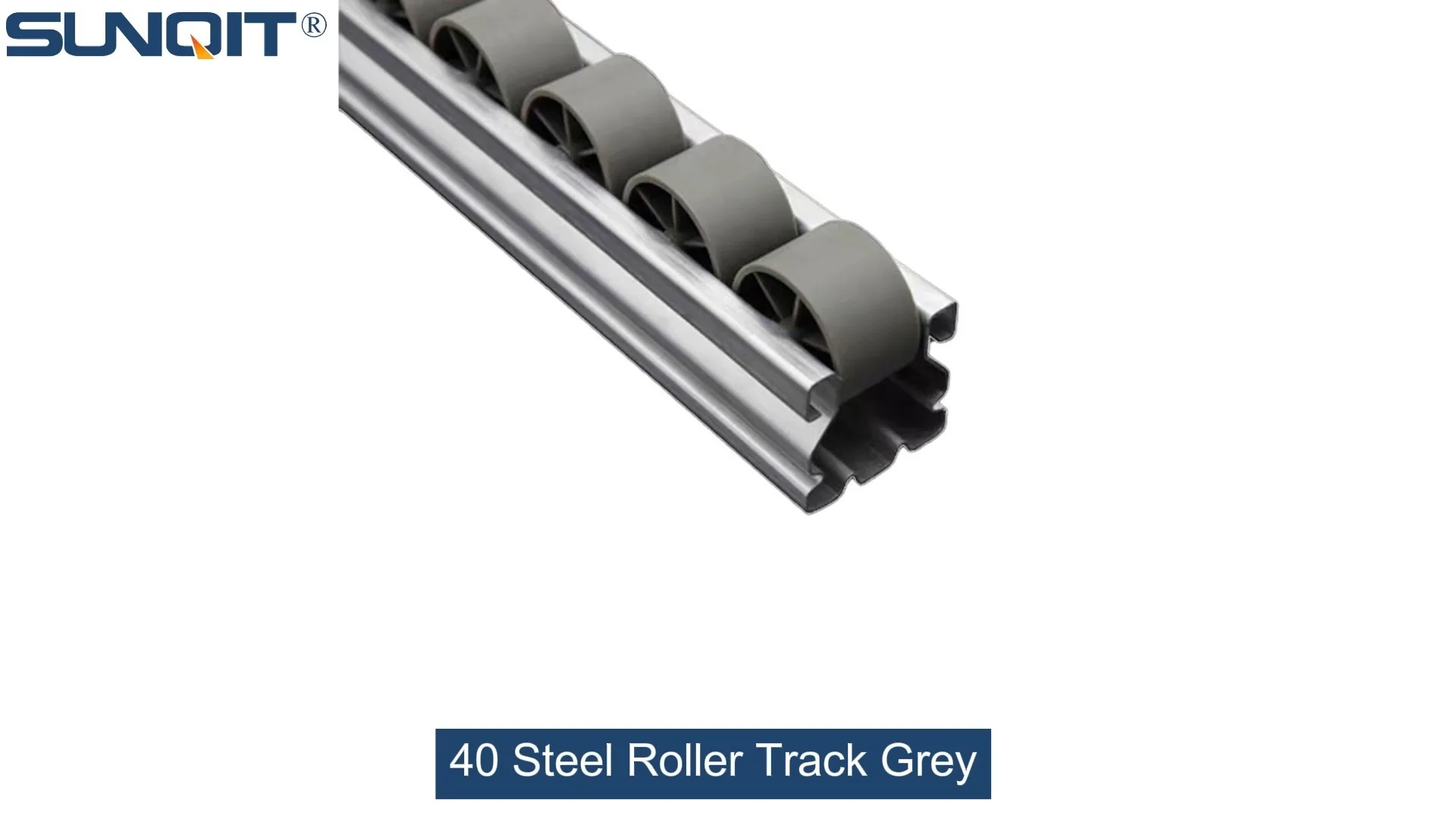
The 40 Steel Roller Track Grey isn't just another industrial component; it's a carefully engineered solution designed for durability and flexibility. Let's break down its key features:
- Material Quality: Made from high-strength carbon steel, this roller track can handle loads up to 50kg per meter (depending on configuration). The steel is treated with a corrosion-resistant grey coating that stands up to daily wear, spills, and industrial environments—perfect for sectors like automotive, 3C assembly, and medical device manufacturing where hygiene and durability matter.
- Width and Compatibility: At 40mm wide, it's a versatile size that fits most standard material handling setups. It works seamlessly with roller track connectors, caster wheels, and flow rack components, making it easy to integrate into existing lean systems or build custom solutions from scratch.
- Smooth Operation: The rollers are precision-machined to ensure consistent, low-friction movement. This means your materials slide without jams, reducing downtime and keeping your lines running efficiently.
Whether you're moving small electronic parts, boxes of medical supplies, or automotive components, this roller track is up to the task. Its neutral grey color also blends into most industrial settings, giving your facility a clean, professional look.
Where Is 40 Steel Roller Track Grey Used?
To calculate the right length, you first need to understand where this roller track fits into your operations. Here are some of its most common applications:
- Flow Racks for Warehousing: In distribution centers, flow racks use roller tracks to enable FIFO (First-In-First-Out) inventory management. Products slide forward as items are picked, reducing the need for manual handling and speeding up order fulfillment.
- Conveyor Lines in Manufacturing: In production lines—like those for 3C devices or medical equipment—conveyors with 40 Steel Roller Track Grey move parts between stations. For example, a smartphone component might travel from the assembly station to the testing station on a conveyor, with the roller track ensuring a steady, reliable flow.
- Lean Workstations: Lean workstations often incorporate roller tracks to bring materials directly to the worker's hands. This reduces unnecessary movement (a key lean principle) and boosts productivity. For instance, a medical device assembly workstation might use a short section of roller track to feed parts to the operator, eliminating the need to reach for supplies.
- Custom Lean Solutions: For unique needs—like a curved conveyor for a tight space or a multi-level flow rack for small parts—the 40 Steel Roller Track Grey can be cut to length and configured with adjustable connectors, making it a flexible choice for custom projects.
Understanding these applications will help you better assess your own needs and make more accurate calculations.

Step-by-Step Guide to Calculating Required Length
Calculating the right length of 40 Steel Roller Track Grey involves four key steps: assessing your needs, measuring your space, accounting for overlaps, and adding flexibility. Let's dive into each step with actionable details.
Step 1: Define Your Material Handling Requirements
Before you pick up a tape measure, you need to know what you're moving. Answer these questions to guide your calculations:
- Item Specifications: What's the size (length, width, height) and weight of the items you'll be moving? Heavier items may require more tracks per level to distribute weight evenly. For example, a 20kg box might need three parallel tracks, while a 5kg part could use two.
- Volume and Frequency: How many items will pass through the track daily? High-volume operations may need more durable tracks or additional support to handle constant use.
- Flow Direction: Will materials move from back to front (like in flow racks) or from one station to another (like in conveyors)? This affects the path length and configuration.
Let's say you're setting up a flow rack for 3C assembly parts: small boxes (15cm wide, 5kg each) that need to be picked 500 times a day. This tells you that two parallel tracks per level will suffice, and the track needs to handle frequent use.
Step 2: Measure the Path or Rack Dimensions Precisely
Accurate measurements are the foundation of correct calculations. Here's how to measure for common setups:
For Flow Racks:
Flow racks are typically multi-level structures where items slide from the back to the front. To calculate track length:
- Measure the depth of the rack (distance from the back storage area to the front picking face). For example, if your rack is 1.5 meters deep, each track per level will need to be at least 1.5 meters long.
- Determine the number of tracks per level . This depends on the width of your items. If your boxes are 15cm wide, two 40mm tracks (with a 7cm gap between) will support them without tipping.
- Calculate length per level : Depth × Number of Tracks per Level. For 1.5m depth × 2 tracks = 3m per level.
- Multiply by the number of levels to get total length for the rack. For 5 levels: 3m ×5 =15m.
For Conveyor Systems:
Conveyors can be straight, curved, or have multiple segments. Here's how to measure:
- Measure straight segments : Distance between two stations (e.g., from packaging to shipping is 10 meters).
- Measure curved segments : For right-angle turns, use the length of the 90° connector (usually 20mm overlap). For curved tracks, measure the radius of the curve and calculate the arc length (Arc Length = 2πr × (angle/360)).
- Add all segments together: Straight length + Curved length + Connector overlaps.
Step 3: Account for Overlaps and Connectors
When joining multiple track sections, you need to factor in overlaps where connectors attach. This ensures a secure, seamless join. Here's a table of standard overlaps for common connectors:
| Connector Type | Overlap Length (mm) | Use Case |
|---|---|---|
| Straight Male-Female Connector | 15 | Joining two straight track sections end-to-end |
| 90° Right-Angle Connector | 20 | Connecting tracks at a 90° turn (e.g., conveyor corner) |
| Adjustable Angle Connector (10°-45°) | 10-25 | Custom angles for unique layouts |
| End Cap | 5 | Closing the end of a track to prevent items from falling off |
Example: If you have 6 straight track sections (each 2m long) connected with straight connectors, you'll have 5 connectors. Total overlap: 5 ×15mm =75mm (0.075m). So total length of sections is 6×2=12m, plus 0.075m overlap =12.075m.
Step 4: Add a Buffer for Flexibility
Lean systems are built for continuous improvement, so you need to plan for future changes. Add a 5-10% buffer to your calculated length. This buffer covers:
- Future expansions (e.g., adding a level to your flow rack).
- Unexpected adjustments (e.g., repositioning a conveyor segment).
- Replacement parts (having extra track on hand reduces downtime).
For example, if your calculated length is 15m, a 10% buffer adds 1.5m, making the total 16.5m.

Real-World Calculation Examples
Let's put these steps into practice with two detailed examples:
Example 1: Flow Rack for Medical Device Parts
Your facility needs a flow rack for small medical device components (10cm wide, 3kg each) with 4 levels, 1.2m depth per level, and 2 tracks per level. Let's calculate:
| Parameter | Calculation | Result |
|---|---|---|
| Depth per level | — | 1.2m |
| Tracks per level | — | 2 |
| Length per level | 1.2m ×2 | 2.4m |
| Total levels | — | 4 |
| Total length (no overlaps) | 2.4m ×4 | 9.6m |
| Overlaps (4 levels ×2 tracks ×1 connector each ×15mm) | 8 ×0.015m | 0.12m |
| Buffer (10% of 9.72m) | 9.72 ×0.1 | 0.972m |
| Final Required Length | 9.72 +0.972 | 10.692m ≈10.7m |
Example 2: Conveyor Line for Automotive Assembly
You need a conveyor line with 2 straight segments (5m and 7m) and one 90° turn. Let's calculate:
| Parameter | Calculation | Result |
|---|---|---|
| Straight Segment 1 | — | 5m |
| Straight Segment 2 | — | 7m |
| 90° Connector Overlap | — | 0.02m |
| Total Length (no buffer) | 5+7+0.02 | 12.02m |
| Buffer (5% of 12.02m) | 12.02 ×0.05 | 0.601m |
| Final Required Length | 12.02 +0.601 | 12.621m ≈12.6m |

Pro Tips for Installation and Longevity
Once you have the right length, proper installation and maintenance will keep your system running smoothly:
- Level Installation: Use a spirit level to ensure tracks are flat. Uneven tracks cause jams and wear out rollers faster.
- Secure Connectors: Tighten all roller track connectors with a torque wrench to the manufacturer's specs (usually 10-15 Nm) to prevent loosening.
- Regular Cleaning: Wipe tracks weekly with a dry cloth to remove dust and debris. For sticky residues, use a mild detergent (avoid harsh chemicals that damage the coating).
- Lubrication: Apply a light silicone lubricant to rollers every 3 months. This reduces friction and extends roller life.
- Inspect Monthly: Check for bent rollers, loose connectors, or worn coatings. replace damaged parts immediately to avoid disruptions.
Choosing the Right Supplier for Your Roller Track Needs
Not all suppliers are equal. When selecting a provider for 40 Steel Roller Track Grey, look for:
- Customization: Can they cut tracks to your exact length? Do they offer custom connectors for unique layouts?
- Quality Certifications: Look for ISO 9001 certification to ensure consistent quality.
- Accessory Range: Do they supply roller track connectors, caster wheels, and flow rack components? A one-stop shop saves time and ensures compatibility.
- Support: Do they offer installation guidance or after-sales support? This is critical for complex setups.
Final Takeaways
Calculating the required length of 40 Steel Roller Track Grey is a mix of precision and foresight. By defining your needs, measuring carefully, accounting for overlaps, and adding a buffer, you'll get a system that fits your facility perfectly. This roller track is more than just a component—it's a tool to optimize your lean system, reduce waste, and boost productivity. Whether you're in 3C assembly, medical manufacturing, or warehousing, it's a reliable choice that will serve your operations for years.
Remember, the goal of lean systems is continuous improvement. Your roller track setup should grow with your business, and the 40 Steel Roller Track Grey's flexibility makes that easy. With the right length and care, you'll have a material handling system that works as hard as your team does.