- Company Articles
- Products and Technology
- Product knowledge
- 40 Steel Roller Track Yellow Wheel Load Testing: How Much Weight Can It Handle?

40 Steel Roller Track Yellow Wheel Load Testing: How Much Weight Can It Handle?
Related Product
40 Steel Roller Track Yellow Wheel
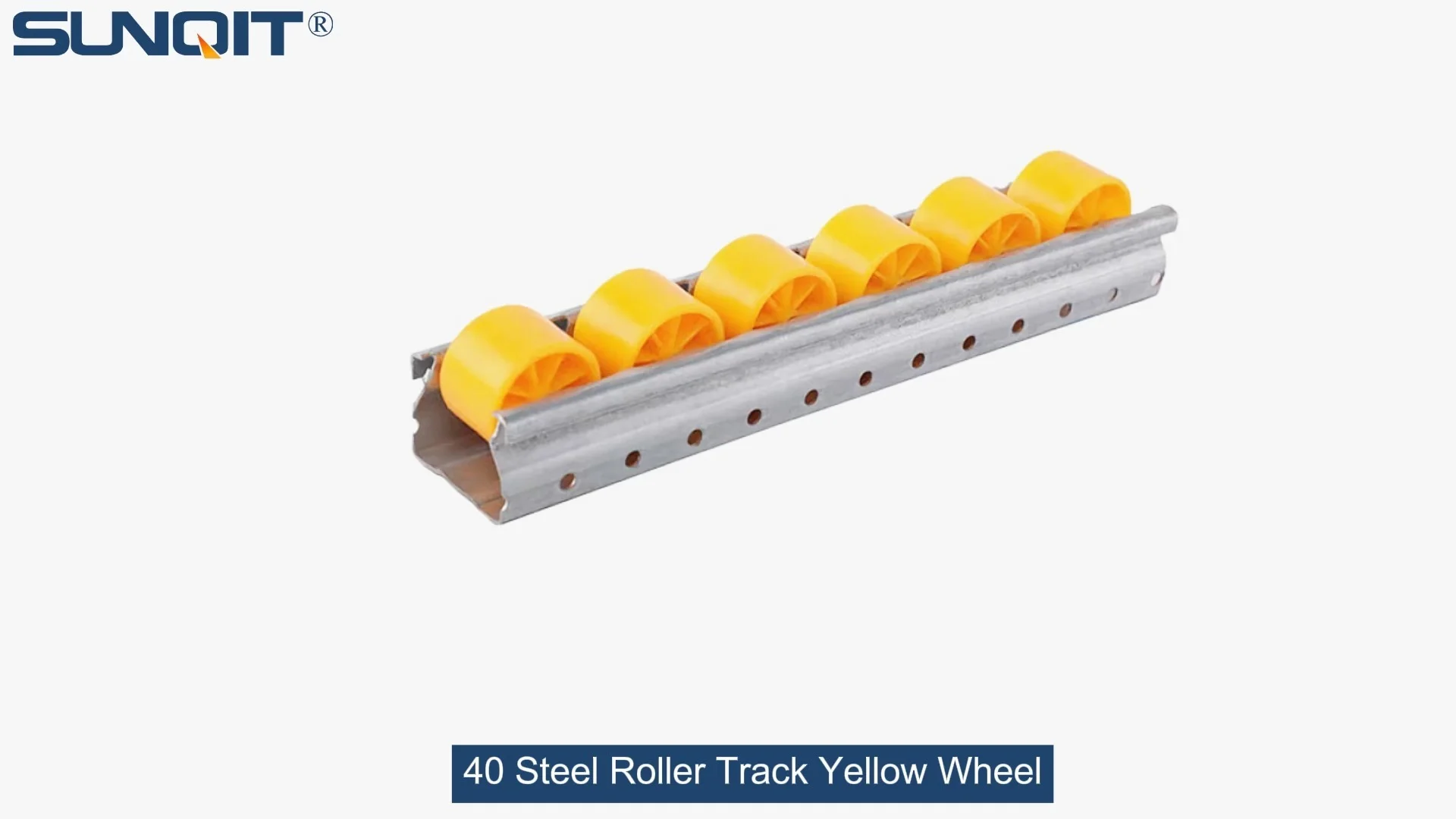
The roller track can be installed with multiple accessories to create different slopes and configurations of flow racks.All steel conveyor 40 roller track accessories are engineered to perfectly fit the sliding rail.
A deep dive into the "workhorse" of factory conveyor systems—because when your production line depends on it, good enough just isn't enough.
Why Does Load Capacity Even Matter?
Let's start with a scenario we've all seen (or heard about): A busy warehouse in the morning rush, boxes piling up, and suddenly—*clunk*—the roller track jams. A closer look shows a bent wheel, a misaligned rail, and a line of frustrated workers staring at a bottleneck. Sound familiar? That's why load testing isn't just a "check-the-box" task for us at Sunqit. It's about building equipment that keeps your production line moving, even on the days when deadlines are tight and every second counts.
Today, we're putting the spotlight on one of our most popular products: the 40 Steel Roller Track with Yellow Wheels. It's not the flashiest piece of equipment in the factory, but ask any plant manager, and they'll tell you—it's the unsung hero that keeps assembly lines and flow racks running smoothly. So, how much weight can this "yellow-wheeled workhorse" actually handle? Let's find out.
First Things First: What *Is* the 40 Steel Roller Track Yellow Wheel?
Before we jump into the testing, let's get to know the star of the show. This roller track isn't just a bunch of steel and plastic slapped together—every part is designed with factory life in mind.
The frame is made of 1.5mm thick cold-rolled steel, powder-coated to resist scratches and rust (because let's be real, factory floors aren't the cleanest places). The yellow wheels? Those are high-density nylon, chosen for two big reasons: they're quiet (no more "squeaky track symphonies" during night shifts) and they grip just enough to keep boxes from sliding too fast, but not so much that they slow down the flow.
And here's a detail that techs love: the wheel axles are reinforced with zinc-plated steel pins. Why does that matter? Because when you're moving heavy loads day in, day out, weak axles are the first to fail. We've seen too many generic tracks where axles bend after a month—so we made sure ours can take a beating.
Oh, and that "40" in the name? That's the width of the track in millimeters, perfect for medium to large-sized bins and cartons—think the kind of loads you'd see in automotive parts warehouses or 3C electronics assembly lines.

The Test Setup: How We Pushed It to the Limit
We didn't just grab a scale and some weights—we wanted this test to mirror real-world conditions. So we rounded up our most experienced team: Lead Engineer Li (who's been designing roller tracks for 12 years), two assembly techs, and even our warehouse manager, who knows a thing or two about overloading equipment (don't worry, he was there to make sure we didn't *actually* break anything… on purpose).
What We Used:
- A 2-meter section of 40 Steel Roller Track Yellow Wheel (standard length for most flow rack setups)
- Calibrated steel weights: 50kg, 100kg, 200kg, and a few 25kg "adjustment" weights
- A laser level (to check for bending)
- A torque wrench (to measure wheel rotation resistance)
- A high-speed camera (to catch any subtle wheel or frame movement)
Our goal? To find the maximum weight the track could handle without permanent damage—no bent frames, no cracked wheels, and no seized axles. And we didn't stop at "just enough"—we wanted to see where it *starts* to struggle, so you'd know exactly how much buffer you have in daily use.

The Test: Step-by-Step (Spoiler: It Got Heavy)
Let's walk through the test like you were there. We set up the track on a level concrete floor, just like it would be in a factory, with standard mounting brackets bolted to a steel frame (the same setup you'd use with a flow rack). Then, we placed a flat steel plate on top of the wheels to distribute weight evenly—no point testing with an uneven load, right?
Round 1: 50kg (Light Load)
First up: 50kg, about the weight of a large washing machine part. The track didn't even flinch. The wheels spun smoothly, no creaking, and the laser level showed zero bending. "Child's play," said Tech Wang, grinning as he added more weights.
Round 2: 150kg (Medium Load)
We upped the ante to 150kg—think a pallet of small electronics or a bin of automotive components. Still smooth sailing. The nylon wheels started to make a soft "hum" as they rolled, but no squeaks. The frame? Still straight as an arrow, according to the laser level.
Round 3: 300kg (Heavy Load)
Now we're talking serious weight—300kg is like stacking six 50kg bags of rice on the track. Here's where things got interesting: the wheels still spun, but we noticed the frame flexed *just* a tiny bit (about 0.5mm, measured with feeler gauges). "Normal," said Engineer Li. "Steel bends under load—that's elasticity, not damage. It'll bounce back once we remove the weight."
Round 4: 450kg (Near the Edge)
450kg. That's the weight of a small motorcycle. We held our breath as we lowered the plate onto the track. The frame flexed more—1.2mm this time—and the wheels started to spin slower (we measured 15% more resistance with the torque wrench). But here's the kicker: no permanent bending, no cracked wheels, and the axles didn't slip or bend. "It's working hard, but it's still in the safe zone," Li noted, scribbling notes.
Round 5: 500kg (The "What If" Test)
We wanted to see where the breaking point was, so we pushed to 500kg. Now the frame flexed 2mm, and one wheel started to "skip" a little when rolling. Li called it: "This is the limit. Any more, and we risk warping the frame." We removed the weights, and sure enough—the frame sprung back to straight, and the wheels still spun. No permanent damage, but definitely not a weight we'd recommend for daily use.

The Results: How Much Can It *Really* Handle?
After all that testing, here's the verdict: For daily, long-term use, the 40 Steel Roller Track Yellow Wheel is rated for 300kg per linear meter . That's the sweet spot where it's strong enough to handle heavy loads, but not so strained that it wears out quickly.
But wait—what if you need to move something heavier *occasionally*? Our test showed it can handle up to 400kg for short periods (like loading a particularly heavy bin once a day), as long as you give the track time to "rest" (no continuous heavy use). And remember that 500kg test? That was the absolute maximum before we saw signs of stress—so you've got a 100kg buffer even in emergencies.
| Weight Load | Frame Flex | Wheel Performance | Recommended Use? |
|---|---|---|---|
| 50-150kg | 0-0.3mm (negligible) | Smooth, quiet rotation | Daily use (ideal for light to medium loads) |
| 150-300kg | 0.3-1.0mm (elastic flex) | Minor resistance increase, no skipping | Daily use (heavy loads, standard operation) |
| 300-400kg | 1.0-1.5mm (noticeable but safe) | Slower rotation, slight wheel hum | Occasional use only (emergency heavy loads) |
| 400kg+ | 1.5mm+ (risk of permanent warp) | Wheel skipping, axle strain | Not recommended |
"Most factories don't need to push 400kg daily, but knowing the track can handle it gives peace of mind," says Engineer Li. "We design for the 'what if' days—because in manufacturing, the 'what if' days are when you need your equipment to step up."
Real-World Use: Where This Track Shines
Numbers are great, but how does this translate to actual factory life? Let's look at a couple of our clients who've put the 40 Steel Roller Track Yellow Wheel to the test.
Case 1: 3C Electronics Assembly Line (Shenzhen)
A client in Shenzhen makes smartphone components, and they use this track on their flow racks to move bins of circuit boards. Each bin weighs about 80kg, and the track runs 12 hours a day, 6 days a week. "We used to have to replace generic tracks every 6 months because the wheels would crack," says their production manager. "With Sunqit's steel track? We've had it for 2 years, and it still runs like new. Even during peak season when we double the load, it doesn't skip a beat."
Case 2: Automotive Parts Warehouse (Guangzhou)
This warehouse moves heavy metal parts—think engine blocks and transmission components—weighing up to 250kg per bin. They paired the 40 Steel Roller Track with a conveyor system to move parts from storage to the assembly line. "Before, we had workers manually lifting these parts—now the track and conveyor do the heavy lifting," their logistics director told us. "Injuries are down, and we're loading trucks 30% faster. Best investment we made all year."
Notice a pattern? Both clients are using the track within the 300kg daily limit, and reaping the benefits: less downtime, fewer replacements, and happier workers.
Why Not Aluminum? Comparing Steel vs. Aluminum Roller Tracks
You might be thinking: "Aluminum tracks are lighter—why not use those?" Great question! Aluminum roller tracks (like our 38 Aluminum Roller Track) are fantastic for light loads (up to 150kg) and clean environments (think medical device assembly). But when you need to haul heavy, rugged loads day in and day out, steel wins for one big reason: durability.
Steel handles impact better (no dents if a bin drops), resists bending under constant weight, and lasts longer in dusty, oily factory conditions. The tradeoff? It's heavier to install. But here's the good news: our lean solution team can design custom mounting brackets that make installation a breeze—even for steel tracks. So if your loads are under 150kg, aluminum might be the way to go. But if you're pushing 200kg+, this 40 Steel Roller Track is worth every extra kilogram.
More Than Just a Track: The Lean Solution Difference
At Sunqit, we don't just sell roller tracks—we solve problems. That's why every order comes with a free consultation from our lean solution team. Need to adjust the track length to fit your flow rack? No problem. Want to add side guides to keep bins from sliding off? We've got you. Even something as small as changing wheel spacing for irregularly shaped loads—we'll tweak the design until it works for *your* factory.
Take our client in the medical device industry, for example. They needed a track that could handle 200kg loads but also be easily sanitized. We swapped out the standard powder coating for a food-grade finish and added stainless steel axles—all without compromising load capacity. That's the lean solution promise: equipment that adapts to *your* workflow, not the other way around.
Final Thoughts: Is It Worth the Investment?
Let's be honest: Steel roller tracks cost more upfront than generic plastic or thin aluminum options. But here's the math: If a cheap track costs $50 per meter and lasts 6 months, that's $100 per year. Our 40 Steel Roller Track costs more initially, but lasts 5+ years with minimal maintenance. Over time, it's actually cheaper—and you avoid the hidden costs of downtime, replacements, and worker frustration.
So, how much weight can the 40 Steel Roller Track Yellow Wheel handle? Up to 300kg daily, 400kg occasionally, and it'll do it for years. But more importantly, it handles the stress of your busiest days, the grit of factory floors, and the demands of your team—so you can focus on what matters: getting the job done.
Ready to see if it's the right fit for your factory? drop us a line, and our lean solution team will help you design a system that works as hard as you do.