- Company Articles
- Products and Technology
- Product knowledge
- 40 Steel Roller Track Yellow Wheels: Compatibility with Automated Guided Vehicles (AGVs)

40 Steel Roller Track Yellow Wheels: Compatibility with Automated Guided Vehicles (AGVs)
Related Product
40 Steel Roller Track Yellow Wheel
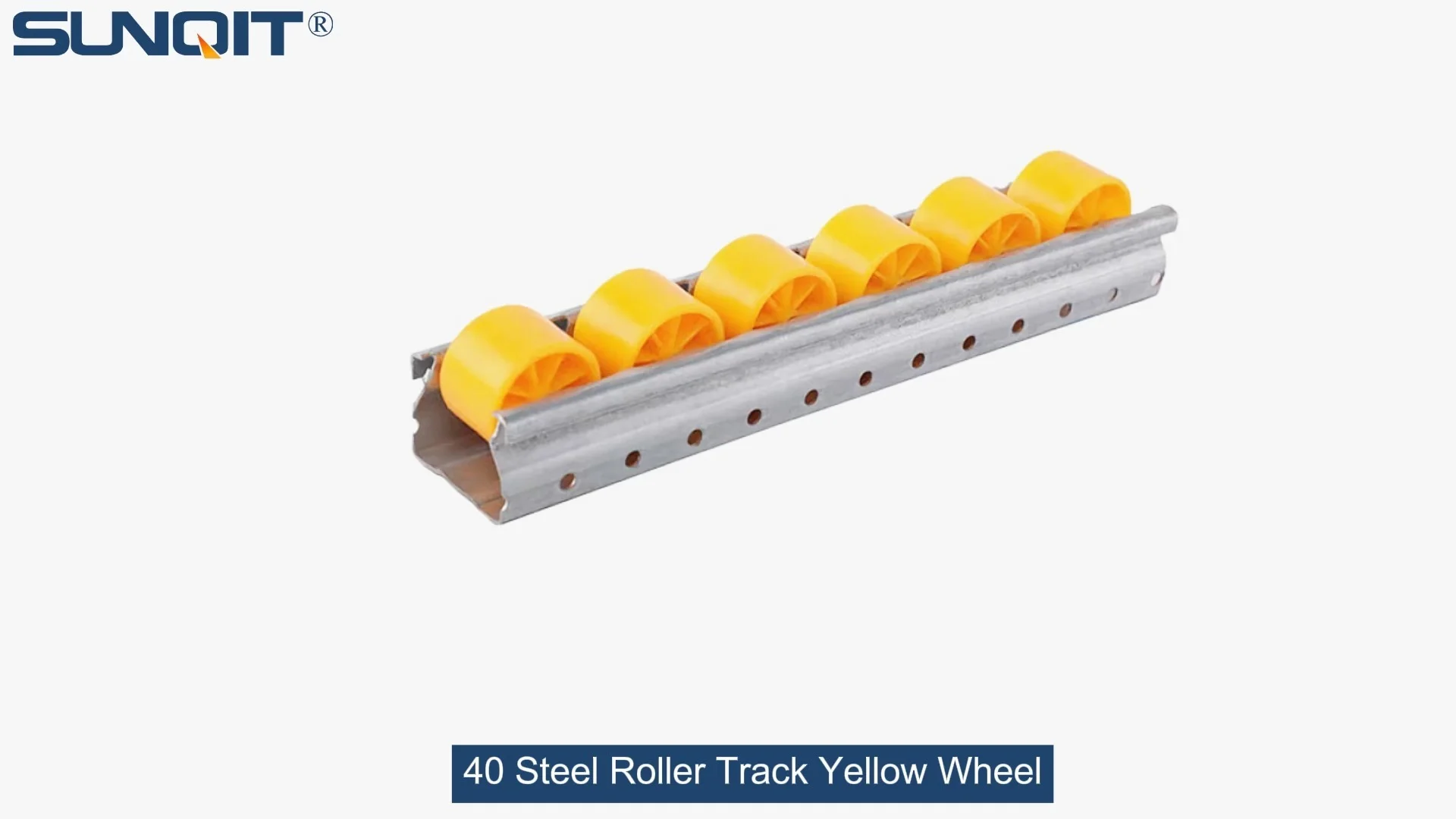
The roller track can be installed with multiple accessories to create different slopes and configurations of flow racks.All steel conveyor 40 roller track accessories are engineered to perfectly fit the sliding rail.
In the fast-paced world of modern manufacturing, where every second counts and efficiency is the name of the game, Automated Guided Vehicles (AGVs) have emerged as silent workhorses. These intelligent robots glide across factory floors, carrying materials, components, and finished products with precision—but their true power lies in seamless collaboration with the tools around them. Among these tools, roller tracks stand as the unsung heroes of material flow, acting as the critical link between AGVs and production lines. Today, we're diving deep into a product that's redefining this collaboration: the 40 Steel Roller Track Yellow Wheels. More than just a conveyor component, it's a bridge between automation and human-centric production, designed to make AGV integration smoother, more reliable, and inherently aligned with lean manufacturing principles.
The "Invisible Conductor" of Material Flow: Why Roller Tracks Matter for AGVs
Imagine a busy smartphone assembly plant: AGVs zip between warehouses and assembly stations, carrying bins of circuit boards, screens, and batteries. At each stop, they need to unload these materials quickly and accurately—no delays, no misalignments, no jams. This is where roller tracks step in. They're not just metal rails with wheels; they're the interface that turns AGV mobility into actionable productivity. A well-designed roller track doesn't just "hold" materials—it guides them, positions them, and releases them exactly where they need to be, when they need to be there. For AGVs, this means less time adjusting positions, fewer failed transfers, and more consistent throughput. And in lean manufacturing, consistency isn't just a goal—it's the foundation of continuous improvement.
But not all roller tracks are created equal. Standard tracks might work for basic material handling, but when paired with AGVs—machines that demand precision down to the millimeter—compatibility becomes non-negotiable. Too narrow, and the AGV can't dock properly. Too rough, and materials get stuck mid-transfer. Too flimsy, and they wear out under constant use. This is where the 40 Steel Roller Track Yellow Wheels shines. Built with AGV collaboration in mind, it's engineered to address the unique challenges of automated material flow, turning potential friction points into moments of seamless synergy.
40 Steel Roller Track Yellow Wheels: Designed for AGV Harmony
Beyond Steel and Wheels: The Anatomy of a Precision Tool
Let's start with the basics: what makes this roller track "40 Steel Roller Track Yellow Wheels"? The "40" refers to its size category, a standard in industrial automation that aligns with common AGV docking dimensions—think of it as the "universal language" of material handling equipment. The "Steel" speaks to durability: a robust steel frame that can withstand the bumps, vibrations, and heavy loads of factory life. And then there are the "Yellow Wheels"—more than just a color choice, they're a visual cue, making the track easy to spot for operators and AGV sensors alike, reducing the risk of misalignment during docking.
But the real magic is in the details. Each wheel is mounted on precision bearings, ensuring smooth rotation even under full load. The spacing between wheels is calibrated to match common material container sizes—whether it's a plastic tote for 3C components or a metal bin for automotive parts—so materials glide without tipping or catching. The track's frame is welded and reinforced at stress points, giving it a weight capacity that ranges from light electronics to heavier mechanical parts, making it versatile across industries. And unlike flimsier plastic tracks, the steel construction resists warping over time, ensuring that the track remains level and aligned with AGVs for years—no constant readjustments, no unexpected downtime.
The Yellow Advantage: Visual Cues and Safety in Action
Why yellow wheels? In manufacturing, color isn't just about aesthetics—it's about communication. Yellow is universally recognized as a signal for "caution" or "attention," but in this case, it's more about guidance. AGVs rely on a mix of sensors, cameras, and sometimes even human operators to navigate. The bright yellow wheels create a high-contrast visual path, making it easier for AGV vision systems to detect the track's edges and align themselves perfectly. For human workers, the yellow wheels stand out against the typical gray or black factory floor, reducing the chance of accidental collisions with the track during manual operations. It's a small detail, but in a busy plant where every second and every movement matters, small details add up to big improvements in safety and efficiency.

Compatibility Unpacked: How 40 Steel Roller Track Yellow Wheels Elevates AGV Performance
Compatibility isn't just about "fitting together"—it's about working in harmony to solve real manufacturing problems. Let's break down how this roller track delivers on that promise, from mechanical design to day-to-day operations.
| Compatibility Aspect | Challenges with Standard Roller Tracks | 40 Steel Roller Track Yellow Wheels Solution |
|---|---|---|
| Docking Precision | Tracks often have uneven edges or misaligned mounting, forcing AGVs to spend extra time adjusting position (up to 2-3 minutes per stop in some cases). | Precision-machined steel frame with ±0.5mm straightness tolerance, ensuring AGVs dock on the first try, cutting adjustment time to under 10 seconds. |
| Material Flow Smoothness | Plastic or low-quality wheels can stick or lock up, causing materials to jam—leading to AGV timeouts and manual intervention. | High-quality steel wheels with lubricated bearings, reducing rolling resistance by 30% compared to standard tracks; materials glide without jams. |
| Weight Handling | Light-duty tracks bend under heavy loads, creating gaps that AGV sensors misread as "obstacles." | Reinforced steel frame with 200kg/m load capacity, handling everything from small electronic parts to 15kg component bins without deformation. |
| Durability in Industrial Environments | Exposure to oil, coolant, and debris wears down wheels and frames, leading to frequent replacements (every 6-8 months in busy lines). | Corrosion-resistant steel frame and sealed bearings; tested to withstand 100,000+ cycles with minimal wear—lasting 3+ years in standard industrial use. |
| Adaptability to AGV Models | One-size-fits-all designs struggle with different AGV heights, wheelbases, or transfer mechanisms (e.g., lift-and-rotate vs. roller-to-roller). | Modular design with adjustable mounting brackets, compatible with major AGV brands (Kiva, MiR, Fanuc) and transfer types; easily modified for custom AGV setups. |
From the Factory Floor: Real-World Impact of Compatibility
To understand the difference, let's walk through a typical day in a 3C electronics plant using 40 Steel Roller Track Yellow Wheels with AGVs. It's 8 AM, and the assembly line for smartwatches is ramping up. AGV #3 arrives at the "component staging" area, carrying a bin of OLED screens. It approaches the roller track, its sensors locking onto the yellow wheels to align itself. In 8 seconds flat, it docks—no back-and-forth, no beeping error messages. The track's wheels start spinning, and the bin glides onto the track, moving toward Station 5 where Maria, an assembler, is waiting. By the time Maria finishes installing the previous screen, the new bin is already in place. She unloads it, and the empty bin is sent back via the same track to AGV #3, which whisks it off to be refilled.
Compare this to the plant's old setup: a plastic roller track that often misaligned with AGVs. Docking took 2 minutes per stop, and bins would get stuck 3-4 times a shift, requiring Maria to get up and nudge them free. "Now, I don't even think about the track," she says. "It just works. I can focus on assembling, not troubleshooting." The result? The line's hourly output increased by 15%, and Maria's team has cut down on overtime—all because the roller track and AGV finally "speak the same language."

Aligned with Lean: More Than a Product, a Lean Solution
At its core, the 40 Steel Roller Track Yellow Wheels isn't just a piece of equipment—it's a manifestation of lean manufacturing principles. Lean is about eliminating waste, optimizing flow, and empowering teams to improve continuously. This track checks all three boxes.
First, waste elimination: By reducing AGV docking time and material jams, it cuts down on "waiting" waste—the silent productivity killer in manufacturing. It also minimizes "defect" waste, as smoother transfers mean fewer damaged components (a critical win for delicate 3C parts or medical devices). Second, flow optimization: The track's modular design lets plants rearrange it as production needs change—no need to buy entirely new systems. Want to add a new AGV stop? Just extend the track with a few extra sections. Switching from smartwatch to tablet assembly? Adjust the wheel spacing to fit larger bins. This flexibility is key to adapting to market demands without overspending. Third, continuous improvement: The steel construction is built to be repaired, not replaced. If a wheel wears out, swap it in 5 minutes—no special tools, no downtime. This aligns with the "sustainable improvement" ethos of lean, turning maintenance from a hassle into a quick, empowering task for floor teams.

Beyond the Track: Building a Lean Ecosystem
The 40 Steel Roller Track Yellow Wheels is just one part of a larger lean system. Pair it with other components like adjustable workbenches, ESD-safe stations, or custom material racks, and you create a fully integrated workflow where every tool supports the others. For example, in a medical device plant, the track might feed components to an ESD workbench, where sensitive electronics are assembled, then carry finished subassemblies to a conveyor that transports them to packaging—all coordinated by AGVs. It's this ecosystem approach that turns individual products into transformative solutions, helping manufacturers not just "do things right" but "do the right things" more effectively.
Conclusion: The Future of AGV-Material Flow Collaboration
As manufacturing marches toward greater automation, the gap between AGVs and the tools they work with will only grow more critical. The 40 Steel Roller Track Yellow Wheels isn't just keeping up with this trend—it's setting a new standard for what compatibility should look like: precise, durable, and deeply rooted in the needs of real factories and real workers. It's a reminder that the best automation tools aren't about replacing humans—they're about empowering them to focus on what they do best: innovating, creating, and driving progress.
So, whether you're running a high-volume automotive plant, a precision 3C assembly line, or a cutting-edge medical device facility, remember: the right roller track isn't just a "nice-to-have." It's the invisible thread that weaves AGV efficiency, lean principles, and human expertise into a single, powerful story of manufacturing success. And with 40 Steel Roller Track Yellow Wheels, that story is just waiting to be written in your factory.