- Company Articles
- Products and Technology
- Installation And Maintenance
- 40 Steel Roller Track Yellow Wheels Maintenance Cost: Long-Term Savings Analysis

40 Steel Roller Track Yellow Wheels Maintenance Cost: Long-Term Savings Analysis
Related Product
40 Steel Roller Track Yellow Wheel
The roller track can be installed with multiple accessories to create different slopes and configurations of flow racks.All steel conveyor 40 roller track accessories are engineered to perfectly fit the sliding rail.
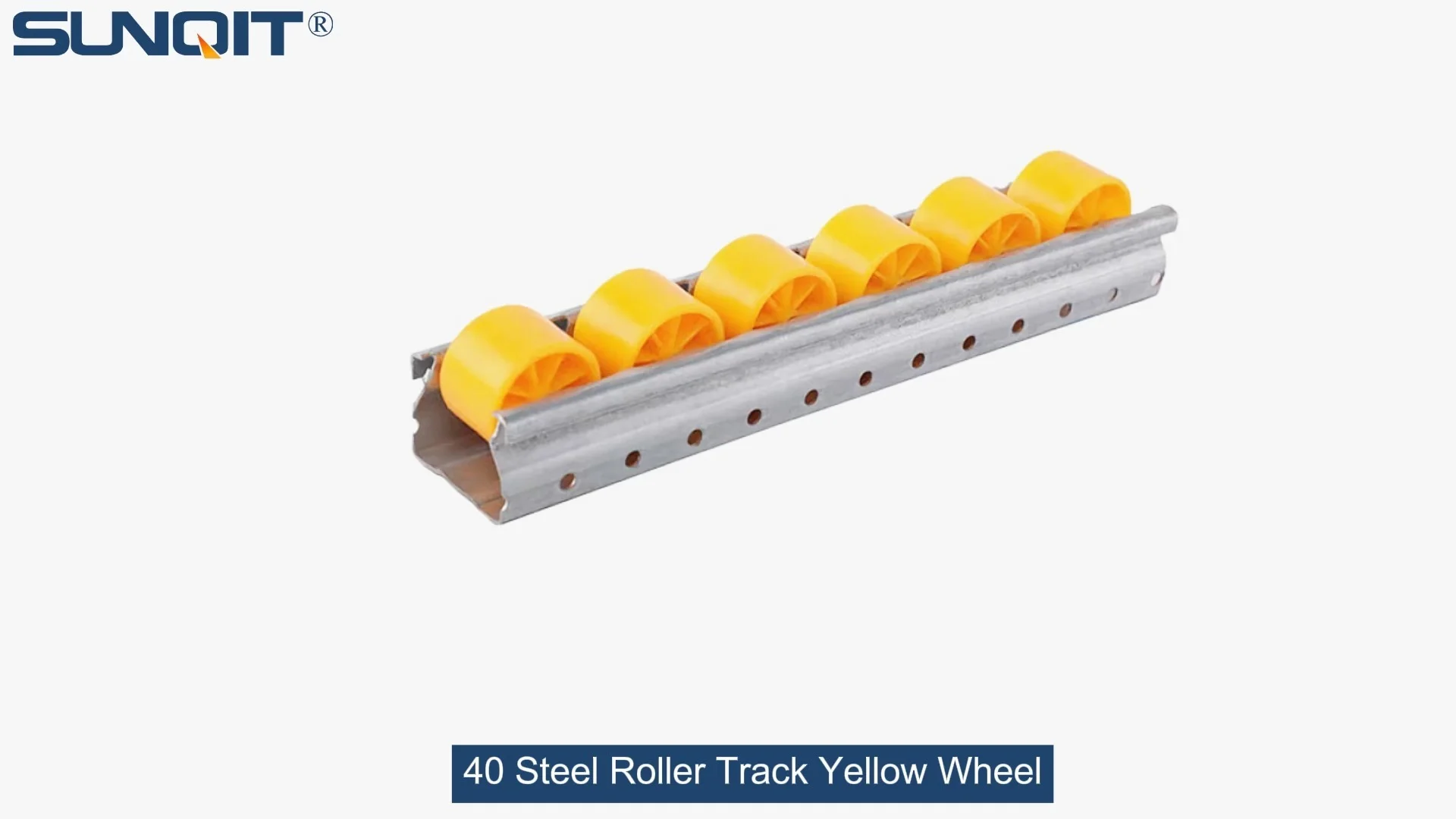
In the bustling landscape of manufacturing, where every second of production time counts, the unsung heroes often lie in the details of your equipment. Take a walk through any automotive assembly line or 3C electronics workshop, and you'll notice a common sight: material gliding smoothly from flow racks onto conveyors, eventually reaching workbenches where skilled hands turn components into finished products. At the heart of this seamless movement? The 40 Steel Roller Track Yellow Wheels. These small but critical parts bear the weight of your production efficiency—but like any workhorse, they demand care. In this analysis, we'll break down why skimping on maintenance today could cost you thousands tomorrow, and how strategic upkeep aligns with the lean philosophy of "sustainable improvement" we build into every lean solution.
Why 40 Steel Roller Track Yellow Wheels Matter in Your Production Line
Before diving into maintenance costs, let's clarify why these yellow wheels deserve special attention. Unlike plastic or standard steel alternatives, the 40 Steel Roller Track Yellow Wheels are engineered for heavy-duty use—think daily transportation of metal parts, electronic components, and even semi-finished appliances. Their bright yellow hue isn't just for visibility; it's a marker of durability: a high-carbon steel core, corrosion-resistant coating, and precision bearings designed to withstand 10,000+ hours of continuous rotation under load. In facilities using lean pipe systems, these wheels become the "joints" connecting your flow racks, conveyors, and workstations into a unified, efficient network. When they fail, the entire line stalls—like a kink in a garden hose, stopping the flow of productivity.
Consider this: A typical automotive parts plant uses over 500 meters of roller track across its warehouse and assembly areas. If just 10% of those yellow wheels seize up due to poor maintenance, material flow slows by 20%, leading to bottlenecks at workbenches and missed delivery deadlines. As we often remind clients during lean solution consultations, "A production line is only as strong as its weakest roller."
The Hidden Costs of Neglecting Maintenance
Many factory managers focus solely on upfront equipment costs, treating maintenance as an afterthought. But in the world of lean manufacturing, "savings" aren't just about cutting expenses—they're about avoiding unnecessary losses. Let's break down the three main cost buckets affected by poor 40 Steel Roller Track Yellow Wheels maintenance:
1. Unplanned Downtime: The Silent Profit Killer
Imagine this scenario: On a Monday morning, your 3C assembly line is running at full speed, with circuit boards moving from the flow rack to the ESD workstation. Suddenly, a yellow wheel jams, causing a pileup of components. By the time a technician replaces it, 45 minutes have passed—and with your line producing 20 units per minute, that's 900 units lost. At $50 per unit, that's $45,000 in missed revenue from a single wheel failure. Multiply that by three or four such incidents a year, and the numbers quickly spiral.
2. Premature Replacement: Throwing Money Away
A well-maintained 40 Steel Roller Track Yellow Wheel can last up to 5 years. Without regular cleaning and lubrication, that lifespan drops to just 18 months. Let's do the math: A single wheel costs $25. If you have 200 wheels in your facility, replacing them every 1.5 years costs $3,333 annually. With proper maintenance, replacing every 5 years costs just $1,000 annually—a 67% savings. And that's not counting the labor cost of swapping out wheels: $80 per hour for a technician, and each replacement taking 15 minutes. For 200 wheels, that's 50 hours of labor, or $4,000 every 1.5 years versus $1,200 every 5 years.
3. Secondary Damage: When One Wheel Takes Others Down
A seized wheel doesn't just stop working—it can damage adjacent components. The extra friction strains the roller track frame, wears down connecting joints, and even scratches the material being transported (costly for high-value medical devices or polished automotive parts). In one case we encountered, a food packaging plant ignored a sticking yellow wheel, leading to a bent track that required replacing an entire 10-meter section of conveyor—costing $2,000 instead of $25 for a wheel and $50 for lubrication.

Long-Term Savings: The ROI of Regular Maintenance
Now, let's flip the script. What happens when you invest in proactive maintenance? The numbers tell a compelling story. Below is a real-world analysis based on data from our clients across (home appliance) and automotive industries, comparing facilities with "reactive" (break-fix) maintenance versus those following our lean solution-recommended "preventive" schedule.
| Metric | Reactive Maintenance (No Regular Checks) | Preventive Maintenance (Monthly Inspections + Quarterly Lubrication) | Annual Savings |
|---|---|---|---|
| Wheel Replacement Frequency | Every 1.5 years | Every 5 years | - |
| Annual Wheel Replacement Cost (200 wheels) | $3,333 | $1,000 | $2,333 |
| Annual Labor for Replacements | $2,667 | $800 | $1,867 |
| Unplanned Downtime (Hours/Year) | 24 hours | 3 hours | $42,000* |
| Secondary Damage Costs | $1,500 | $200 | $1,300 |
| Total Annual Maintenance Cost | $7,500 | $2,000 | $47,500 |
*Based on average production value of $3,500/hour for a mid-sized assembly line
The standout number here? The $42,000 saved from reduced downtime. That's not just money in the bank—it's the ability to fulfill more orders, meet tight deadlines, and keep your team from scrambling to catch up. As one of our long-term clients, a leading automotive parts manufacturer, put it: "We used to view maintenance as a cost center. Now, thanks to the lean approach, we see it as a profit driver."

Why Yellow Wheels? Comparing with Other Roller Track Options
You might be wondering: Are yellow wheels really worth the focus? Let's compare them to two common alternatives—plastic wheels and standard black steel wheels—to see why they're a smart investment, especially when paired with proper maintenance.
Plastic Roller Track Wheels
Pros: Lower upfront cost, lightweight.
Cons: Prone to cracking under heavy loads; UV exposure causes brittleness; maintenance costs spike after 1 year. Not ideal for automotive or heavy machinery lines.
Standard Black Steel Wheels
Pros: Durable, widely available.
Cons: No corrosion-resistant coating; require more frequent lubrication (bi-monthly vs. quarterly for yellow wheels); higher risk of rust in humid environments like medical device workshops.
40 Steel Roller Track Yellow Wheels
Pros: Zinc-plated yellow coating resists rust; precision bearings reduce friction (less lubrication needed); designed for 5,000+ kg load capacity. Perfect for 3C assembly and (warehousing logistics) where material weight varies.
Cons: Slightly higher upfront cost than plastic wheels—but maintenance savings offset this in 6 months.
The takeaway? Yellow wheels aren't just a color choice—they're an engineering decision built for longevity. When maintained properly, they outperform alternatives in total cost of ownership, making them a cornerstone of efficient lean pipe systems.

Case Study: A 3C Assembly Plant's 2-Year Transformation
Let's bring this to life with a story from one of our clients—a 3C electronics manufacturer in Shenzhen producing smartwatch components. Before partnering with us, their facility struggled with frequent line stoppages due to roller track issues. Their maintenance team was stuck in a cycle of replacing wheels, fixing bent tracks, and apologizing for delayed orders.
We started by auditing their production line, which relied heavily on flow racks, conveyors, and workbenches connected by 40 Steel Roller Track Yellow Wheels. The diagnosis? Inconsistent maintenance: some tracks hadn't been lubricated in 8 months, and 15% of wheels showed signs of bearing wear.
Our lean solution included three steps: (1) A one-time "deep clean" of all roller tracks, replacing only the most damaged wheels; (2) Training their team on monthly inspections (checking for debris, wheel wobble, and lubricant levels); (3) Scheduling quarterly lubrication using our recommended high-temp grease.
The results, tracked over two years, were striking:
- Line downtime due to roller track issues dropped from 12 hours/month to 0.5 hours/month—a 96% reduction.
- Wheel replacement costs fell from $4,200/year to $900/year.
- Production output increased by 8% as material flow bottlenecks disappeared.
"We used to think maintenance was just a cost," said the plant manager. "Now, every time we do our monthly checks, we're not just fixing wheels—we're protecting our ability to meet customer deadlines. It's become part of our lean culture."
The Bottom Line: Maintenance as an Investment, Not an Expense
In the fast-paced world of manufacturing, it's easy to prioritize the next big purchase—a new conveyor, a upgraded workbench, or a fancy flow rack. But as the data shows, the true efficiency gains often lie in caring for what you already have. The 40 Steel Roller Track Yellow Wheels may seem small, but their impact on your bottom line is anything but.
At the end of the day, lean manufacturing isn't just about eliminating waste—it's about maximizing value from every component. By investing 30 minutes a month in inspections and a few hours each quarter in lubrication, you're not just maintaining wheels; you're ensuring your entire production line runs like a well-oiled machine (pun intended). And in an industry where margins are tight and competition is fierce, that's the kind of edge that turns good factories into great ones.
Ready to build a maintenance plan that aligns with your lean goals? Whether you're in automotive, (medical devices), or (consumer electronics), our team of lean solution experts is here to help. After all, in the world of manufacturing, the best savings aren't just measured in dollars—they're measured in the trust of customers who know you'll never miss a delivery.