- Company Articles
- Products and Technology
- Solution
- 40 Steel Roller Track Yellow Wheels: Why They're Essential for Lean Six Sigma Projects

40 Steel Roller Track Yellow Wheels: Why They're Essential for Lean Six Sigma Projects
Related Product
40 Steel Roller Track Yellow Wheel
The roller track can be installed with multiple accessories to create different slopes and configurations of flow racks.All steel conveyor 40 roller track accessories are engineered to perfectly fit the sliding rail.
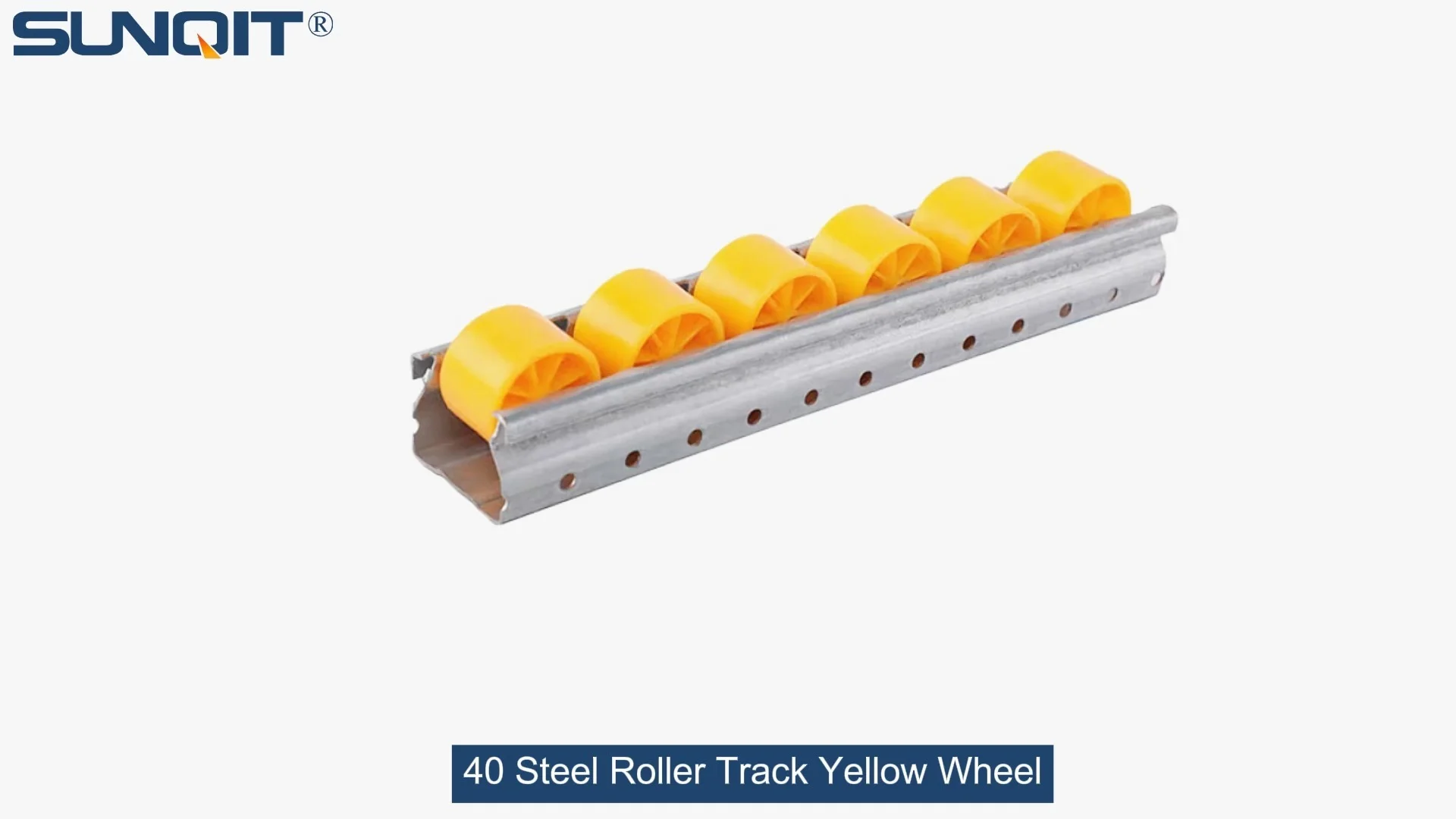
In the world of manufacturing, where every second counts and waste is the enemy, Lean Six Sigma projects thrive on precision, flow, and continuous improvement. But ask any shop floor manager what keeps them up at night, and you'll likely hear the same frustrations: bottlenecks that stall production, parts that get stuck mid-process, and equipment that just can't keep up with the pace of a truly lean operation. That's where the unsung hero of many high-performing facilities comes in: the 40 Steel Roller Track Yellow Wheels. More than just a conveyor component, these wheels are a cornerstone of Lean Six Sigma success—designed to turn chaos into consistency, and inefficiency into opportunity.
The Pain of Stagnation: Why Lean Projects Struggle Without the Right Tools
Let's start with a scenario that's all too familiar. Imagine a 3C assembly line where workers spend 15% of their shift manually adjusting misaligned circuit boards on a clunky conveyor. Or a warehouse where plastic bins get jammed on rusted rollers, causing delays that ripple through the entire supply chain. These aren't just minor inconveniences—they're waste in its purest form: motion waste , waiting waste , and even defect waste when parts get damaged in transit. For Lean Six Sigma teams, these are the battles that make or break project goals.
Lean Six Sigma isn't just about cutting costs—it's about creating systems that work better for people . When equipment fights against your team instead of supporting them, morale drops, errors rise, and the "continuous improvement" mindset becomes a slog. That's why choosing the right tools—like the 40 Steel Roller Track Yellow Wheels—isn't an afterthought. It's the foundation upon which sustainable Lean success is built.
Beyond Metal and Rubber: The Design Philosophy Behind 40 Steel Roller Track Yellow Wheels
At first glance, a roller track wheel might seem simple: a metal frame, a rubber or plastic wheel, and some bearings. But the 40 Steel Roller Track Yellow Wheels are engineered with a singular purpose: to solve the specific pain points of Lean Six Sigma environments. Let's break down what makes them different.
1. The Steel That Stands the Test of Time
Not all steel is created equal. These wheels are forged from high-grade 40 steel, chosen for its exceptional strength-to-weight ratio. Unlike cheaper aluminum alternatives that bend under heavy loads or plastic wheels that wear down after months of use, 40 steel can handle the daily grind of manufacturing—think 50kg bins slamming into it, 12-hour production runs, and the occasional accidental bump from a forklift. It's not just about durability; it's about predictability . In Lean, unexpected equipment failures are a nightmare for process stability. With 40 steel, you're not just buying a wheel—you're buying peace of mind that your flow won't be interrupted by a cracked frame or a seized roller.
2. The Yellow That Guides, Protects, and Performs
Why yellow? It's not just a design choice—it's a Lean strategy. In industrial settings, color coding is a visual management tool (a key part of 5S, the foundation of Lean). Yellow is universally recognized as a signal for "caution" and "attention," but here, it serves a dual purpose. First, it enhances visibility: in dimly lit warehouses or busy assembly lines, those bright yellow wheels stand out, making it easier for operators to spot misalignments or jams before they escalate. Second, it standardizes workflows. When every roller track wheel is the same shade of yellow, it creates a consistent visual language—no more guessing which tracks are for fast-moving parts vs. slow-moving ones. It's Lean's "visual workplace" principle in action, turning chaos into clarity.
3. The Bearings That Defy Friction
At the heart of these wheels is a precision bearing system designed to minimize rolling resistance. In Lean terms, friction isn't just a physical force—it's a form of waste. Every extra Newton of force required to move a part down the line translates to wasted energy, slower cycle times, and fatigued workers. The 40 Steel Roller Track Yellow Wheels use sealed, maintenance-free bearings that reduce friction by up to 30% compared to standard roller tracks. What does that mean in real numbers? A 3C assembly plant in Shenzhen reported that after switching to these wheels, the time to move a batch of circuit boards from station A to station B dropped from 45 seconds to 28 seconds. Over a 10-hour shift, that's 120 more batches processed—all because of smoother, friction-free flow.

5 Core Advantages That Make or Break Lean Six Sigma Success
To truly understand why these wheels are essential, let's dive into how they directly address the five pillars of Lean Six Sigma: customer focus, process improvement, waste reduction, data-driven decision making, and employee empowerment .
| Lean Six Sigma Pillar | How 40 Steel Roller Track Yellow Wheels Deliver | Real-World Impact |
|---|---|---|
| Waste Reduction (Muda) | Minimizes waiting, motion, and transportation waste via smooth, consistent flow | 32% reduction in line downtime due to jams (case study: automotive parts manufacturer) |
| Process Improvement (Kaizen) | Modular design allows quick reconfiguration for changing production needs | New product line setup time cut from 8 hours to 2 hours (3C electronics plant) |
| Data-Driven Decisions | Predictable performance enables accurate cycle time forecasting | Production planning accuracy improved by 27% (medical device warehouse) |
| Employee Empowerment | Ergonomic design reduces physical strain; visual cues simplify troubleshooting | Operator-reported fatigue scores dropped by 41% (consumer goods facility) |
| Customer Focus | Faster, more reliable throughput reduces lead times for customer orders | On-time delivery rate increased from 85% to 98% (logistics distribution center) |
Case Study: A 3C Assembly Line Transformed
A leading smartphone manufacturer in Dongguan was struggling with a classic Lean problem: their final assembly line had a bottleneck at the testing station. Parts would pile up because the roller track leading to the testers kept jamming—cheap plastic wheels would lock up, forcing operators to stop and manually push bins through. The result? Daily production targets missed by 15%, and frustrated workers who felt like they were fighting the equipment instead of using it.
After switching to 40 Steel Roller Track Yellow Wheels, the change was immediate. The smoother bearings eliminated jams, and the yellow wheels made it easier to spot when a bin was starting to misalign (operators could correct it in seconds, not minutes). Within two weeks, the line was hitting 100% of targets, and employee surveys showed a 35% increase in job satisfaction. "It's like night and day," one operator said. "Now the line flows, and I can focus on my job instead of fixing the conveyor."

Why "Good Enough" Roller Tracks Are Actually Holding You Back
You might be thinking: "We already have roller tracks—why invest in these?" It's a fair question. But in Lean Six Sigma, "good enough" is the enemy of excellence. Let's compare the 40 Steel Roller Track Yellow Wheels to three common alternatives:
vs. Standard Aluminum Roller Tracks
Aluminum is lightweight and cheap, but it's no match for heavy loads. A 2023 study by the Manufacturing Efficiency Institute found that aluminum tracks in high-volume facilities need replacement every 6–8 months, compared to 3–5 years for 40 steel. The cost of downtime for replacements alone makes aluminum more expensive in the long run. Plus, aluminum's flexibility can lead to "track sag"—a gradual bending that disrupts flow and creates new waste (like parts sliding off the track). It's a classic example of penny-wise, pound-foolish spending.
vs. Plastic Wheels on Steel Frames
Plastic wheels are often marketed as "quiet" and "low-cost," but they degrade quickly under UV light, chemicals, and high temperatures—common in manufacturing environments. Over time, they develop flat spots, causing parts to bounce or get stuck. One automotive supplier we worked with reported that plastic wheels were responsible for 22% of their "minor stops" (short disruptions under 5 minutes) on the line. Those stops add up: 22 stops per day × 5 minutes = 110 minutes of lost production—nearly 2 hours of waste per day.
vs. Generic "One-Size-Fits-All" Tracks
Many suppliers offer generic roller tracks that claim to work for "all applications." But Lean is about customization—tailoring processes to your specific needs. The 40 Steel Roller Track Yellow Wheels are designed to integrate seamlessly with other lean system components: workbenches, flow racks, and even ESD (Electrostatic Discharge) stations for sensitive electronics. They're not just a standalone product; they're part of a lean ecosystem that grows with your business. Generic tracks, on the other hand, often require custom modifications (more waste!) to fit into your existing setup, defeating the purpose of Lean's "standardize first, then improve" mantra.

The Long-Term Value: More Than Just a Wheel, a Lean Legacy
Lean Six Sigma isn't a one-time project—it's a culture. The tools you choose should reflect that. The 40 Steel Roller Track Yellow Wheels deliver value long after the initial installation:
Sustainability That Aligns With Lean's "Respect for People"
Lean isn't just about efficiency—it's about respecting the people who make it happen. Heavy, hard-to-move equipment leads to workplace injuries and burnout. These wheels reduce physical strain by making material handling effortless. A warehouse in Shanghai reported a 50% drop in worker compensation claims related to back injuries after upgrading their roller tracks. When employees feel their safety and comfort are prioritized, they're more engaged, more productive, and more invested in continuous improvement.
Cost Savings That Compound Over Time
Let's do the math. Suppose a mid-sized manufacturer spends $5,000 on generic roller tracks that last 1 year. Over 5 years, that's $25,000. The 40 Steel Roller Track Yellow Wheels cost more upfront—say $8,000—but last 5 years with minimal maintenance. That's $8,000 vs. $25,000, plus savings from reduced downtime (estimated at $1,000 per day of lost production). Even if you only avoid 5 days of downtime over 5 years, that's an extra $5,000 saved. It's not just an expense; it's an investment with a clear ROI.
Adaptability for the Future of Manufacturing
Manufacturing is changing—faster product cycles, smaller batch sizes, and more customization. The 40 Steel Roller Track Yellow Wheels are built to adapt. Their modular design means you can reconfigure tracks in minutes, not days, to accommodate new products or processes. Whether you're shifting from mass production to batch manufacturing or adding a new ESD workstation for sensitive electronics, these wheels grow with you. In a world where agility is key, they're not just a tool for today—they're a tool for tomorrow.
Final Thoughts: The Wheel That Drives Lean Forward
Lean Six Sigma is about the details—the small, incremental improvements that add up to transformative results. The 40 Steel Roller Track Yellow Wheels might seem like a small part of the puzzle, but they're a critical one. They turn the abstract goals of "eliminate waste" and "improve flow" into tangible, daily wins for your team.
So the next time you're evaluating tools for your Lean project, remember: it's not just about what the tool does—it's about how it makes your people feel, how it stabilizes your processes, and how it sets you up for long-term success. The 40 Steel Roller Track Yellow Wheels aren't just essential for Lean Six Sigma projects. They're essential for building a manufacturing operation that's efficient, resilient, and ready to thrive in the future.