- Company Articles
- Products and Technology
- Product knowledge
- 4040B EU Standard Aluminum Profile for Lean Management Accessories Integration

4040B EU Standard Aluminum Profile for Lean Management Accessories Integration
Related Product
4040B EU Standard Aluminum Profile
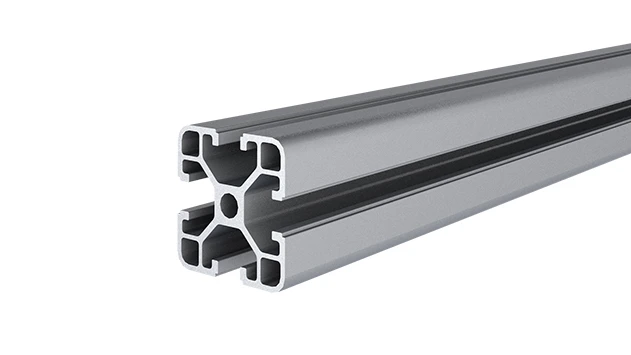
4040B is a 4.00x4.00 CM fractional 40 series square extrusion T-slot profile with four open T-slots, each side with 4.00cm face. The profile has align-a-grooves to assist in aligning connecting profiles.
In the world of lean management, where every second counts and waste is the enemy, the tools we use to build our workspaces matter more than we often realize. Imagine a factory floor where workers spend less time searching for tools, where materials glide smoothly from one station to the next, and where reconfiguring a workstation takes hours instead of weeks. That's the promise of lean systems—and at the heart of making that promise a reality lies a humble yet powerful component: the 4040B EU Standard Aluminum Extrusion Profile. Let's dive into how this unassuming piece of aluminum is quietly revolutionizing how businesses build, adapt, and thrive in the age of efficiency.
What Even Is the 4040B EU Standard Aluminum Extrusion Profile?
Let's start with the basics. The 4040B is part of a family of aluminum extrusion profiles—those long, sleek bars with grooves and channels that you've probably seen in workshops, labs, or even office furniture. But not all profiles are created equal. The "4040" in its name tells you the cross-section dimensions: 40mm by 40mm, a sweet spot that balances strength, versatility, and space efficiency. The "B" denotes a specific design variant within the 4040 series, fine-tuned for compatibility with a wide range of accessories and EU manufacturing standards.
Made from high-grade aluminum alloy, this profile is extruded—pulled through a die to create its precise shape—resulting in a lightweight yet surprisingly sturdy structure. It's anodized to resist corrosion, giving it a smooth, matte finish that stands up to the daily grind of factory floors, warehouses, and assembly lines. And because it's EU-standard, you can trust that it meets strict criteria for quality, safety, and environmental responsibility—no cutting corners here.
Quick fact: Aluminum extrusion is like squeezing toothpaste through a tube, but with industrial precision. The process allows for complex cross-sectional shapes, which is why the 4040B has those signature T-slots—those grooves running along its length that make it so adaptable.
Aluminum Profile Accessories: The "Lego Bricks" of Lean Systems
If the 4040B profile is the backbone of a lean workspace, then aluminum profile accessories are the joints, muscles, and nerves that bring it to life. Think of them as the Lego bricks of industrial design: connectors, brackets, end caps, casters, and even specialized parts like roller track placon mounts or internal rotary aluminum joints. These accessories turn a simple aluminum bar into just about anything you need—a workbench, a flow rack, a conveyor system, or a mobile trolley.
What makes the 4040B so special here is its universal compatibility. Those T-slots we mentioned? They're standardized, meaning you can mix and match accessories from different suppliers without worrying about fit. Need to add a shelf to your workbench? Slide a bracket into the T-slot and tighten a screw. Want to attach a roller track for sliding materials? A few connectors and you're done. This modularity is gold for lean management because it lets you adapt —no more waiting for custom-built furniture or ripping out entire systems when your needs change.
Take, for example, the 90° aluminum profile connector. It's a small, unassuming piece, but it lets you join two 4040B profiles at a perfect right angle in seconds. No welding, no drilling, no messy adhesives. Just slide, tighten, and you've got a corner for your workbench or a frame for a material rack. Multiply that by dozens of accessory types, and you've got a system that grows and changes with your business. That's the beauty of it—lean isn't just about efficiency today; it's about staying efficient tomorrow, next month, and next year.

4040B in Action: Real-World Lean Systems at Work
Let's move beyond theory and talk about how the 4040B profile actually shows up in day-to-day operations. Walk into any forward-thinking manufacturing plant or warehouse, and you'll spot it everywhere—but let's zoom in on three key applications where it truly shines: workbenches, flow racks, and turnover trolleys.
Workbenches: Where the Magic (and the Work) Happens
A workbench isn't just a table—it's a command center. And with the 4040B, you can build one that fits your team like a glove. Picture this: an electronics assembly line where precision is everything. The workbench needs to be height-adjustable to reduce back strain, have built-in ESD (electrostatic discharge) protection to safeguard sensitive components, and enough shelf space for tools and parts. With 4040B profiles as the frame, you can attach an anti-slip adjustable leveling feet to stabilize it, add an aluminum honeycomb panel top for a smooth, static-free surface, and mount small shelves using aluminum profile brackets. If the team switches to a larger product next quarter? Swap out the top panel, adjust the height, and add a few more shelves—no need to buy a whole new bench.
One plant manager I spoke with recently put it this way: "Before we switched to 4040B workbenches, our workers were hunched over too-low tables, and we'd spend weeks waiting for custom setups. Now, if someone says, 'This bench isn't working,' we can reconfigure it over lunch. Morale's up, errors are down—it's like night and day."
Flow Racks: Let Gravity Do the Heavy Lifting
In lean systems, "flow" is everything. Materials should move to where they're needed with minimal effort, and flow racks—those sloped shelves with roller tracks—are designed to do just that. And yes, you guessed it: 4040B profiles are the go-to for building these racks. Here's why: they're strong enough to hold heavy boxes of parts but lightweight enough to mount at an angle for gravity-fed flow. Pair the profiles with plastic roller track guide rails (yellow or grey, depending on your color-coding system) and roller track placon mounts, and you've got a setup where materials slide gently to the front, so workers never have to reach or bend to grab what they need.
A warehouse using 4040B flow racks recently shared a win: they reduced the time spent restocking parts by 30% because the racks were so easy to adjust. When a new product line required smaller boxes, they simply swapped out the roller tracks for narrower ones—no tools, no downtime. That's the flexibility lean dreams are made of.
Turnover Trolleys: Mobility Without the Headache
Ever tried moving a heavy steel trolley across a factory floor? It's clunky, noisy, and if it gets stuck, you're either calling for help or risking a strained back. Enter turnover trolleys built with 4040B profiles. Aluminum is lighter than steel, so even fully loaded trolleys are easier to push. Add a set of high-quality casters (swivel wheels with brakes, of course) and you've got a mobile unit that glides smoothly, stops securely, and can be customized with shelves, bins, or tool holders using—you guessed it—aluminum profile accessories.
A small electronics manufacturer I visited uses these trolleys to move circuit boards between stations. "Before, we had to carry trays by hand, and we'd drop things or get tired halfway," one operator told me. "Now, we load up the trolley, roll it over, and unload. It's not just faster—it's less stressful. I go home with more energy, honestly."
Why 4040B Stands Out: It's Not Just About Aluminum
You might be thinking, "Okay, aluminum profiles are cool, but why specifically the 4040B?" Great question. Let's break down the benefits that make it a standout choice for lean system integration.
- Durability that lasts (but isn't overkill): Aluminum is naturally resistant to rust and corrosion, so the 4040B holds up in dusty warehouses, humid factories, or even cleanrooms. It's strong enough to support heavy loads (we're talking hundreds of kilograms per meter) but not so heavy that it's a hassle to work with. Steel might be stronger, but it's heavier and prone to rust—overkill for most lean applications.
- Cost-effective in the long run: Sure, aluminum profiles might cost a bit more upfront than, say, wood or plastic. But wood warps, plastic cracks, and steel rusts. The 4040B? It'll outlast all of them, and when you need to change your setup, you can reuse the profiles and accessories. No more throwing away old furniture—just reconfigure and repurpose. That's a win for your budget and the planet.
- Safety first (and second, and third): Aluminum is non-sparking, which is crucial in environments with flammable materials. It's also lightweight, reducing the risk of injury when moving or adjusting components. Plus, the smooth, anodized finish means no sharp edges—no more scraped knuckles during setup.
- EU standards mean peace of mind: The "EU Standard" label isn't just a marketing buzzword. It means the 4040B meets strict regulations for material safety, dimensional accuracy, and environmental impact. For businesses exporting to Europe or aiming for global quality certifications, this compliance is non-negotiable.
How Does 4040B Compare to Other Profiles? Let's Look at the Numbers
To really understand the 4040B's sweet spot, let's compare it to two common alternatives: the 4040A (another 40x40mm profile) and the 3030 EU Standard Profile (30x30mm). This table breaks down key factors like load capacity, accessory compatibility, and best use cases:
| Profile Type | Dimensions (mm) | Max Load Capacity (kg/m) | Accessory Compatibility | Best For |
|---|---|---|---|---|
| 4040B EU Standard | 40x40 | 300-400 | Most 40-series accessories; universal T-slot design | Workbenches, flow racks, conveyors, heavy-duty trolleys |
| 4040A EU Standard | 40x40 | 250-350 | Limited to specific 4040A accessories; narrower T-slots | Light to medium-duty shelving, simple frames |
| 3030 EU Standard | 30x30 | 150-250 | 30-series accessories; smaller T-slots | Lightweight carts, small workstations, display racks |
As you can see, the 4040B strikes a balance: it's stronger than the 4040A, more versatile than the 3030, and compatible with a wider range of accessories. For lean systems that need to handle everything from small parts to heavy machinery, that flexibility is invaluable.
The Bottom Line: 4040B isn't Just a Profile—It's a Lean Mindset
At the end of the day, the 4040B EU Standard Aluminum Extrusion Profile is more than just a piece of metal. It's a physical manifestation of the lean mindset: the belief that efficiency isn't about cutting corners, but about building smarter, adapting faster, and putting people first. When you use 4040B and its accessories, you're not just buying a workbench or a rack—you're investing in a system that grows with your team, reduces frustration, and turns "this is how we've always done it" into "what if we tried this instead?"
Whether you're a small workshop just starting your lean journey or a large manufacturer looking to optimize an existing system, the 4040B offers a simple, scalable way to build the workspace your team deserves. It's not flashy, but it works—quietly, reliably, and adaptably. And in the world of lean management, sometimes the best innovations are the ones that let you focus on what really matters: creating great products, supporting your people, and growing your business.
Final thought: Lean systems are about more than eliminating waste—they're about creating joy in work. When your tools work with you instead of against you, when you can adjust your space as easily as you adjust your plans, that's when magic happens. And the 4040B? It's the wand that makes that magic possible.