- Company Articles
- Products and Technology
- Product knowledge
- 4040C EU Standard Aluminum Profile for Automated Guided Vehicle (AGV) Frames

4040C EU Standard Aluminum Profile for Automated Guided Vehicle (AGV) Frames
Related Product
4040C EU Standard Aluminum Profile
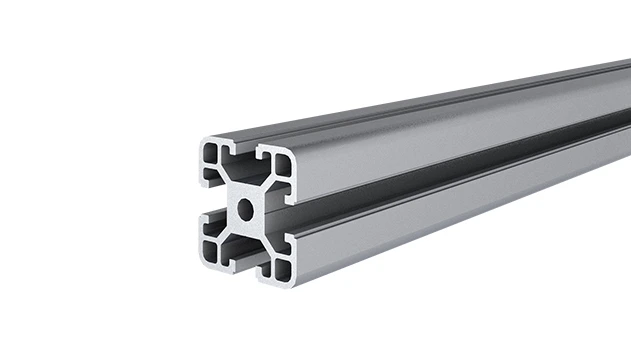
4040C is a 4.00x4.00 CM fractional 40 series square extrusion T-slot profile with four open T-slots, each side with 4.00cm face. The profile has align-a-grooves to assist in aligning connecting profiles.
Walk into any advanced manufacturing facility today, and you'll likely see a symphony of motion: robotic arms assembling components, conveyor belts gliding with precision, and small, boxy vehicles zipping across the floor—no drivers, no remote controls, just smooth, autonomous movement. These are Automated Guided Vehicles (AGVs), the unsung heroes of industrial automation. They ferry materials from warehouses to assembly lines, transport finished products to shipping bays, and even assist in intricate tasks like picking and placing components. But behind every AGV's seamless operation lies a critical foundation: its frame. Think of it as the vehicle's skeleton—supporting motors, batteries, sensors, and payloads while enduring the daily grind of factory floors. And when it comes to building AGV frames that balance strength, flexibility, and efficiency, one material stands out: the aluminum extrusion profile . Specifically, the 4040C EU Standard Aluminum Profile has emerged as a top choice for engineers and manufacturers worldwide. Let's dive into why this unassuming 40x40mm profile has become the backbone of AGV design.
Why AGV Frames Matter: More Than Just a "Box on Wheels"
Before we get into the specifics of the 4040C profile, let's take a moment to appreciate why AGV frames are so crucial. An AGV isn't just a mobile platform—it's a precision tool. Its frame must:
• Support heavy payloads (sometimes up to 500kg or more) without bending or warping.
• Keep sensitive components like sensors and circuit boards stable to ensure accurate navigation.
• Withstand vibrations from motors and uneven floor surfaces.
• Be lightweight enough to maximize battery life (since AGVs run on rechargeable batteries).
• Allow for easy customization, as factories often tweak AGV designs to fit new tasks or layouts.
• Resist corrosion from coolants, oils, or humidity common in manufacturing environments.
In short, the frame is the AGV's unsung hero. A poorly designed frame can lead to frequent breakdowns, inaccurate navigation, or shortened battery life—all of which disrupt production and eat into profits. So, when manufacturers choose materials for AGV frames, they're not just picking metal; they're investing in reliability and efficiency.
Steel vs. Aluminum: The Case for Aluminum Extrusion Profiles
Traditionally, many AGV frames were made from steel. Steel is strong, affordable, and familiar to most manufacturers. But as factories push for faster, more agile automation, steel's limitations have become harder to ignore. Steel is heavy, which drains AGV batteries faster. It's prone to rust if not painted or treated, adding maintenance costs. And cutting, welding, or modifying steel frames is time-consuming—critical in an industry where production lines change overnight.
Enter aluminum. Aluminum has long been prized for its strength-to-weight ratio, but it's the aluminum extrusion profile that truly revolutionized AGV design. Extrusion is a manufacturing process where aluminum alloy is forced through a die to create complex cross-sectional shapes—like the 4040C's iconic 40x40mm square with T-slots. This process allows for precision, consistency, and designs that are both strong and lightweight. Compared to steel, aluminum extrusion profiles offer:
•
Lightweight Construction:
Aluminum is about 30% the weight of steel, which directly translates to longer battery life for AGVs. A lighter frame means the AGV's motors don't have to work as hard, extending run times between charges.
•
Natural Corrosion Resistance:
Aluminum forms a protective oxide layer when exposed to air, so it resists rust and corrosion without extra treatments—perfect for factories with humid or chemical-heavy environments.
•
Modularity:
The T-slot design of extrusion profiles lets engineers attach components (like sensors, brackets, or panels) using bolts, nuts, or specialized
aluminum profile accessories
—no welding required. This makes it easy to reconfigure AGVs as needs change.
•
Precision:
Extrusion ensures tight tolerances, so every 4040C profile is identical. This consistency is key when building fleets of AGVs that need to work in sync.
But not all aluminum profiles are created equal. The 4040C EU Standard, in particular, has become a favorite for AGV frames—and for good reason.

What Is the 4040C EU Standard Aluminum Profile?
The "4040C" in its name gives away the basics: it's a square profile with 40mm sides. The "C" denotes its specific design within EU standard aluminum profile series, which are defined by strict quality and dimensional standards set by European organizations. These standards ensure that profiles from different suppliers are compatible—so a bracket made for a 4040C profile from one manufacturer will fit a 4040C from another. That interoperability is a game-changer for global manufacturers.
At its core, the 4040C is made from 6063-T5 aluminum alloy, a grade known for its excellent extrudability, strength, and surface finish. The "T5" refers to its heat treatment—artificially aged to enhance hardness without sacrificing ductility. This makes the profile tough enough to handle heavy loads but still malleable enough for intricate extrusion.
The real magic, though, is in its T-slot design. Most 4040C profiles have four T-slots (one on each side), though some variants may have additional slots on the corners. These slots are grooves that run the length of the profile, allowing bolts, nuts, or specialized connectors to slide in and lock into place. Imagine building with LEGO bricks, but for industrial machinery—that's the flexibility T-slots provide. Whether you need to mount a motor bracket, attach a sensor housing, or add a side panel, the T-slot lets you do it in minutes, not hours.
Key Features of 4040C EU Standard Aluminum Profiles
To understand why the 4040C is ideal for AGV frames, let's break down its standout features:
1. Optimized T-Slot Configuration
The T-slots on the 4040C are designed for versatility. Typically, they have a slot width of 8mm or 10mm (depending on the supplier), which works with standard aluminum profile accessories like T-nuts, slider nuts, and brackets. This means engineers aren't limited to proprietary parts—they can mix and match components from different suppliers to get the job done. For AGV frames, this translates to easy integration of wheels, motors, battery compartments, and safety bumpers.
2. Strength-to-Weight Ratio That Delivers
Don't let its lightweight fool you: the 4040C is surprisingly strong. Thanks to the 6063-T5 alloy and extrusion process, it can handle bending loads of up to 1500N/m (newtons per meter) and axial loads of 5000N or more, depending on length. For context, a typical medium-duty AGV with a 300kg payload would need a frame that can support its own weight plus the payload, motors, and batteries—something the 4040C handles with ease. And because it's lighter than steel, the AGV uses less energy, extending battery life by 10-15% in many cases.
3. Precision Engineering for Tight Tolerances
EU standards demand strict dimensional accuracy, and the 4040C delivers. Its width and height are held to within ±0.2mm, and straightness is typically ±0.5mm per meter. This precision ensures that when you assemble an AGV frame with 4040C profiles, the parts align perfectly. No more gaps between panels, no misaligned sensors, and no vibrations from uneven weight distribution—all critical for AGV navigation systems that rely on precise movement.
4. Compatibility with a Wide Range of Accessories
What good is a great profile if you can't attach anything to it? The 4040C works seamlessly with hundreds of aluminum profile accessories , from simple brackets to complex joints. Need to connect two profiles at a 90° angle? Use an internal straight aluminum joint. Want to add a caster wheel for stability? Bolt a caster mount directly into the T-slot. Need to mount a control panel? Slide a panel bracket into the slot and tighten. This compatibility turns the 4040C from a static frame into a modular system that can evolve with your AGV's needs.
Why 4040C Profiles Are Perfect for AGV Frames: Real-World Benefits
Now that we've covered the features, let's look at how they translate to real-world advantages for AGV manufacturers and end-users:
1. Faster Design Iterations and Prototyping
In manufacturing, time-to-market is everything. With 4040C profiles, engineers can build AGV prototypes in days, not weeks. Instead of waiting for custom steel parts to be welded, they can cut profiles to length, connect them with aluminum profile accessories , and test the frame immediately. If a design flaw is found, it's easy to disassemble and reconfigure—no grinding or rewelding required. This agility lets manufacturers respond quickly to customer demands or changing industry standards.
2. Reduced Maintenance and Downtime
Factories can't afford AGV downtime. Steel frames often require regular painting to prevent rust, and welded joints can crack under stress, leading to costly repairs. The 4040C's aluminum construction resists corrosion, so it stays looking and performing like new for years. Its modular design also makes maintenance a breeze: if a component fails, you can replace just the damaged part (like a bent bracket) instead of the entire frame. This reduces downtime and keeps production lines running smoothly.
3. Improved Energy Efficiency
Battery life is a top concern for AGV operators. A heavier frame means more energy is spent moving the vehicle, which shortens run times and increases charging frequency. The 4040C's lightweight design directly addresses this. For example, a 500kg AGV with a steel frame might run for 4 hours on a charge, while the same AGV with a 4040C aluminum frame could run for 4.5-5 hours. Over a year, that extra 30-60 minutes per day adds up to significant savings in energy costs and increased productivity.
4. Support for Lean Manufacturing Principles
Modern factories thrive on lean system methodologies—eliminating waste, optimizing processes, and adapting quickly to change. The 4040C profile aligns perfectly with lean principles. Its modularity means you can reconfigure AGVs as production needs shift (e.g., adding a second shelf for larger payloads or removing a panel to fit through tighter spaces). There's no need to buy new frames—just repurpose existing profiles and accessories. This reduces waste and keeps costs low, making it easier for factories to stay competitive.
Comparing 4040C with Other EU Standard Aluminum Profiles
The 4040C isn't the only 40x40mm EU standard profile—so how does it stack up against similar options like the 4040A and 4040B? Let's compare key specs to see why the 4040C is often the top pick for AGVs:
| Profile Type | Dimensions (WxH) | Wall Thickness | Typical Load Capacity (kg/m) | Key Features | Best For |
|---|---|---|---|---|---|
| 4040A | 40x40mm | 1.5mm | 200-300 | 2 T-slots (opposite sides), lightweight | Light-duty AGVs, small carts |
| 4040B | 40x40mm | 2.0mm | 300-400 | 4 T-slots (one per side), standard strength | General-purpose machinery, workbenches |
| 4040C | 40x40mm | 2.5mm | 400-500 | 4 T-slots, reinforced corners, higher wall thickness | Medium-to-heavy-duty AGVs, industrial robots |
As the table shows, the 4040C offers the highest load capacity in its class, thanks to its thicker walls (2.5mm vs. 2.0mm for the 4040B) and reinforced corners. This makes it ideal for AGVs carrying heavy payloads or operating in demanding environments. While the 4040A and 4040B are great for lighter applications, the 4040C strikes the perfect balance of strength and weight for most AGV designs.
Real-World Example: How a Manufacturer Upgraded AGVs with 4040C Profiles
To put this in perspective, let's look at a case study (fictional but representative of real-world scenarios). A European automotive parts manufacturer was struggling with their fleet of steel-framed AGVs. The AGVs were slow, their batteries lasted only 3 hours, and reconfiguring them for new tasks took weeks. The company decided to switch to 4040C aluminum frames, and the results were striking:
•
Battery life increased by 40%:
The lighter frames reduced energy consumption, extending run times from 3 hours to 4.2 hours.
•
Reconfiguration time dropped by 75%:
Using T-slots and
aluminum profile accessories
, the team reconfigured an AGV for a new payload in just 2 hours, compared to 8 hours with steel.
•
Maintenance costs fell by 30%:
No more repainting or welding—corrosion-resistant aluminum meant fewer repairs and longer AGV lifespans.
•
Payload capacity increased by 15%:
Despite being lighter, the 4040C's strength allowed the AGVs to carry heavier loads without compromising stability.
This manufacturer isn't alone. Across industries—from electronics to logistics—companies are swapping steel for 4040C profiles and reaping similar benefits.
Choosing the Right 4040C Supplier: What to Look For
Not all 4040C profiles are created equal. To ensure you're getting a high-quality product, look for suppliers who:
• Adhere strictly to EU standards (ask for certification documents).
• Use high-grade aluminum alloys (6063-T5 is the gold standard for AGVs).
• Offer a wide range of compatible
aluminum profile accessories
(connectors, brackets, fasteners).
• Provide custom cutting and machining services (so you get profiles pre-cut to your AGV's exact length).
• Have a track record of serving the automation or AGV industry (they'll understand your unique needs).
A reliable supplier won't just sell you profiles—they'll partner with you to optimize your AGV design, recommend accessories, and troubleshoot issues. Don't underestimate the value of this expertise.
The Future of AGV Frames: Why 4040C Will Remain a Staple
As automation advances, AGVs are becoming more sophisticated—smarter, faster, and capable of handling more complex tasks. But no matter how advanced the technology gets, the frame will always be the foundation. The 4040C EU Standard Aluminum Profile is poised to remain a top choice because it's future-proof: its modularity can adapt to new sensors, larger batteries, or heavier payloads. As factories adopt Industry 4.0 principles (smart manufacturing, IoT integration), the ability to quickly modify AGVs will only grow more important—and the 4040C's T-slot design makes that modification possible.
Final Thoughts: Building AGVs That Last
At the end of the day, an AGV is only as good as its frame. The 4040C EU Standard Aluminum Profile checks all the boxes: strong yet lightweight, flexible yet precise, durable yet easy to maintain. It's a material that doesn't just build frames—it builds confidence. Confidence that your AGVs will run smoothly, adapt to change, and keep your factory productive for years to come. So the next time you see an AGV gliding across a factory floor, take a moment to appreciate the 40x40mm profile that's making it all possible. In the world of automation, sometimes the smallest components make the biggest difference.