- Company Articles
- Products and Technology
- Product knowledge
- 4040C EU Standard Aluminum Profile for Automotive Parts Assembly: Precision & Efficiency

4040C EU Standard Aluminum Profile for Automotive Parts Assembly: Precision & Efficiency
Related Product
4040C EU Standard Aluminum Profile
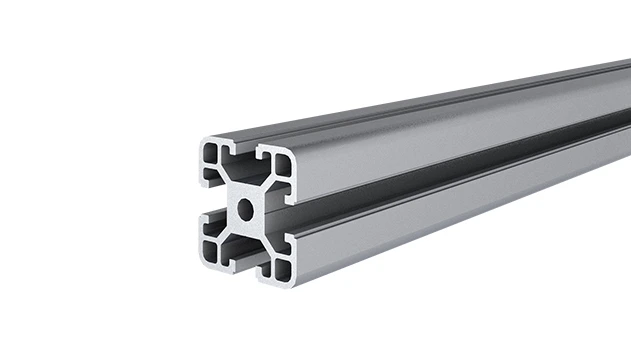
4040C is a 4.00x4.00 CM fractional 40 series square extrusion T-slot profile with four open T-slots, each side with 4.00cm face. The profile has align-a-grooves to assist in aligning connecting profiles.
Step into any automotive manufacturing facility today, and you'll feel the pulse of innovation—robots gliding along tracks, technicians collaborating over glowing screens, and parts flowing like water from one station to the next. Amidst this orchestration, there's an unsung hero holding it all together: the structural framework that turns chaotic potential into organized productivity. In the race to build cars faster, safer, and with pinpoint accuracy, the 4040C EU standard aluminum profile has quietly become the backbone of modern automotive parts assembly. Let's explore why this unassuming aluminum extrusion is redefining what's possible on the factory floor.
What Makes the 4040C EU Standard Aluminum Profile Special?
At first glance, the 4040C might look like just another piece of metal—40mm wide, 40mm tall, with a sleek, silver finish. But beneath that simplicity lies a design engineered for the unique demands of automotive manufacturing. Let's break down its core strengths:
1. Precision Engineered for Tight Tolerances
Automotive parts assembly isn't just about putting pieces together—it's about making sure every bolt, bracket, and connector fits with micrometer-level accuracy. The 4040C profile is extruded to meet EU standards, meaning its dimensions (width, height, wall thickness) stay within a tolerance of ±0.1mm. Why does that matter? Imagine building a workbench where the surface needs to align perfectly with a robotic arm's path, or a material rack that must hold fragile electronics without the slightest wobble. That tiny margin of error ensures consistency across every assembly line, reducing rework and ensuring parts fit right the first time.
2. The Power of the T-Slot Design
If there's one feature that makes the 4040C indispensable, it's its T-slot design. Running along all four sides of the profile are grooves that act like built-in tracks for accessories. Slide a T-nut into the slot, tighten a bolt, and suddenly you've attached a bracket, a shelf, or a tool holder—no drilling, no welding, no waiting for a skilled machinist. For automotive plants that reconfigure assembly lines weekly to build new models or adapt to supply chain shifts, this flexibility is a game-changer. Need to add a monitor arm to a workstation for digital work instructions? Done in 5 minutes. Want to adjust a material rack to hold larger components? Just reposition the brackets. The T-slot turns static structures into living, breathing systems that evolve with your needs.
3. Strength Without the Weight
Automotive assembly involves heavy lifting—literally. Workbenches hold engine blocks, material racks stack transmission parts, and trolleys carry batteries. Steel might seem like the obvious choice, but it's bulky, hard to move, and prone to rust in humid factory environments. The 4040C profile, made from 6063-T5 aluminum alloy, solves this dilemma. It's 30% lighter than steel but boasts a tensile strength of 215 MPa—strong enough to support 200kg per linear meter. This means workers can reposition workstations by hand (no forklift needed) and plants save on energy costs from moving heavy equipment. Plus, aluminum's natural corrosion resistance ensures the profile lasts for decades, even in the oil and coolant-rich air of an automotive shop.
Aluminum Extrusion Profile: The Science Behind the Strength
To truly appreciate the 4040C, we need to talk about aluminum extrusion profile technology—the process that turns raw aluminum into this precision tool. Here's how it works: Aluminum billets (cylindrical blocks) are heated to 500°C until they're malleable, then forced through a steel die under extreme pressure. The die shapes the aluminum into the 4040C's iconic square cross-section with T-slots. This isn't just shaping metal—it's engineering consistency.
Extrusion ensures the profile has uniform wall thickness, so there are no weak spots. For automotive applications, this means a workbench leg made from 4040C will support weight evenly, preventing sagging that could throw off assembly alignment. It also allows for complex internal structures, like reinforced ribs inside the profile, which boost rigidity without adding extra weight. Compare that to cutting steel with a saw—you'd get rough edges, uneven thickness, and a product that behaves unpredictably under stress. Extrusion is why the 4040C feels "solid" yet lightweight; it's a material optimized at the molecular level for the demands of the factory floor.

Aluminum Profile Accessories: Turning Profiles into Systems
A profile alone is just a stick of aluminum. It's the aluminum profile accessories that unlock its full potential. Let's look at the unsung tools that make the 4040C a complete solution:
| Accessory | Role in Automotive Assembly |
|---|---|
| 90° Aluminum Profile Connectors | Join two profiles at right angles in seconds—no welding required. Perfect for building workbench frames or corner supports for material racks. |
| 4040 Aluminum Profile End Caps | Slide over the ends of profiles to cover sharp edges, protecting workers from cuts and preventing dust/debris from clogging T-slots. |
| T-Slot Nuts & Bolts | The "glue" of the system. These sliding nuts lock into T-slots, letting you attach accessories anywhere along the profile—ideal for custom tool placement. |
| Adjustable Feet | Level workbenches on uneven factory floors, ensuring precision assembly even when the concrete isn't perfectly flat. |
| Gusset Plates | Add rigidity to joints in high-load applications, like workbenches holding heavy engine components or racks storing batteries. |
Take a common scenario: building a workstation for assembling dashboard electronics. Start with 4040C profiles cut to height, connect them with 90° connectors, add a plywood top secured with T-slot bolts, and finish with adjustable feet to level the surface. Then, attach a tool holder using T-nuts, and cap the profile ends for safety. Total build time? Under 2 hours. With traditional steel, that same workstation would take a day of welding and painting. Accessories turn the 4040C from a component into a toolkit for innovation.
4040C and Lean System: A Match Made in Manufacturing Heaven
Automotive manufacturing runs on lean system principles—eliminating waste, optimizing flow, and empowering teams to improve processes daily. The 4040C profile isn't just a tool; it's a lean enabler. Here's how it aligns with core lean goals:
1. Eliminating the "Waste of Inflexibility"
Traditional manufacturing setups are rigid. A steel workbench built for one model can't be easily adapted for another, leading to "waste of overproduction" (buying new benches) or "waste of waiting" (idle time while reconfiguring). The 4040C's modularity crushes this waste. When a plant switches from building sedans to SUVs, workers can disassemble existing 4040C workstations, cut new profiles to length, and reassemble them in hours. No need for new equipment—just repurpose what you already have. This adaptability is why leading automakers report 30% faster line reconfigurations after switching to aluminum profiles.
2. Optimizing Material Flow with Custom Workstations
Lean manufacturing thrives on "flow"—ensuring parts and tools are exactly where workers need them, exactly when they need them. The 4040C makes this tangible. For example, a workbench built with 4040C can have a sloped shelf (using angled brackets) for parts that need to slide toward the technician, reducing reaching and bending. Or a vertical rack (assembled with T-slot accessories) for tools, positioned at shoulder height to minimize movement. Every second saved per task adds up: over a shift, a single workstation might save 2 hours of wasted motion, translating to hundreds of extra parts assembled annually.
3. Empowering Continuous Improvement
Lean isn't a one-time project—it's a culture. Frontline technicians know best how to improve their workstations, but traditional setups leave them powerless to make changes. With 4040C, that changes. A technician struggling to reach a tool can add a new holder in minutes. A team noticing parts getting damaged on a rack can install soft-grip brackets using T-slots. This empowerment leads to a 20% increase in process improvement suggestions, according to industry studies—because when workers can shape their environment, they take ownership of its success.
Workbench Applications: Where Precision Meets Productivity
If the 4040C is the backbone of automotive assembly, then the workbench is its most visible expression. A well-designed workbench isn't just a table—it's a command center where technicians spend 8+ hours daily assembling everything from door handles to suspension components. Let's see how 4040C transforms this critical space:
1. Ergonomics First
Automotive technicians suffer from repetitive strain injuries more than most—constant bending, reaching, and twisting take a toll. 4040C workbenches solve this by prioritizing ergonomics. Profiles can be cut to custom heights (800mm for seated work, 950mm for standing), and adjustable feet let workers tweak the height by ±50mm to match their stature. Add a footrest (attached via T-slots) and anti-fatigue mat, and suddenly the workstation supports the human body, not fights against it. The result? 15% fewer absences due to injury and 10% higher productivity, as workers stay focused instead of uncomfortable.
2. Built for the Long Haul
An automotive workbench sees abuse: oil spills, dropped tools, heavy parts slamming down. The 4040C profile laughs this off. Its anodized finish resists scratches and chemical corrosion, while the aluminum core won't rust or warp. Even after years of daily use, the T-slots remain smooth, and the structure stays rigid. Compare that to particleboard workbenches that chip or steel ones that rust—4040C workbenches last 10+ years, reducing the "waste of replacement" and keeping long-term costs low.
3. Customizable for Every Task
Not all assembly tasks are the same. A workstation for wiring harnesses needs tiny bins for screws and clips; one for brake calipers needs heavy-duty clamps. The 4040C adapts. For wiring work, add pegboards (via T-slot brackets) to hang tools, and small drawers (mounted on T-slots) for hardware. For brake assembly, attach a vice using T-nut bolts and a LED light bar (slotted into the profile) to illuminate tight spaces. Even specialized setups like "workbench E (single deck-without caster)" (a simple, stable surface for precision tasks) are easy to build with 4040C—no custom fabrication required.
Why Automakers Are Ditching Steel for 4040C Aluminum
It's clear the 4040C offers unique benefits, but why are automotive giants like BMW, Toyota, and Volkswagen making the switch from steel? Let's crunch the numbers:
- Cost Savings: While 4040C profiles cost 15% more upfront than steel, their modularity reduces long-term costs by 40%. No need to buy new workbenches for every model—just reconfigure. Plus, aluminum's lighter weight cuts shipping and installation costs by 25%.
- Time to Market: New car models demand new assembly lines. With steel, this takes 4–6 weeks. With 4040C, it takes 1–2 weeks. That's a 75% faster time to market, a critical edge in the competitive automotive industry.
- Sustainability: Aluminum is 100% recyclable, and 4040C profiles are often made from 30% recycled material. Steel production emits 2x more CO2 than aluminum extrusion, aligning with automakers' net-zero goals.
Perhaps the biggest win? The 4040C turns "capital expenditure" into "operational flexibility." Instead of sinking money into fixed infrastructure, plants invest in a system that grows with them—supporting today's models and tomorrow's innovations.
Conclusion: The 4040C Profile—More Than Metal, It's a Manufacturing Revolution
In the high-stakes world of automotive parts assembly, success hinges on the details—the precision of a joint, the speed of a reconfiguration, the comfort of a workstation. The 4040C EU standard aluminum profile excels in all these areas, proving that even the most unassuming components can drive transformative change. Its blend of precision, flexibility, and strength makes it the perfect partner for lean systems, empowering plants to build better cars, faster, while keeping workers safe and engaged.
So the next time you see a car roll off the line, remember: behind every smooth ride is a framework of innovation. And at the heart of that framework? The 4040C aluminum profile—quiet, reliable, and ready to build the future of automotive manufacturing.