- Company Articles
- Products and Technology
- Product knowledge
- 4040C EU Standard Aluminum Profile in the Production of Electric Vehicle Components

4040C EU Standard Aluminum Profile in the Production of Electric Vehicle Components
Related Product
4040C EU Standard Aluminum Profile
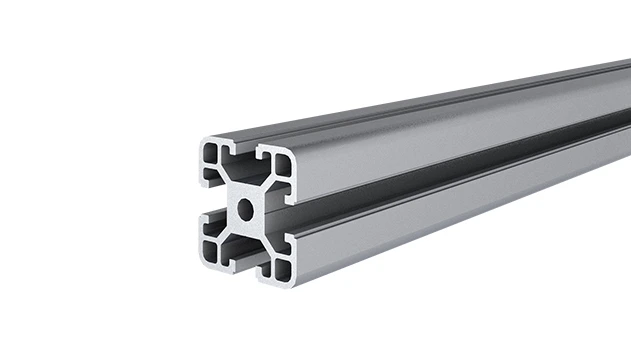
4040C is a 4.00x4.00 CM fractional 40 series square extrusion T-slot profile with four open T-slots, each side with 4.00cm face. The profile has align-a-grooves to assist in aligning connecting profiles.
The global shift toward electric vehicles (EVs) isn't just a trend—it's a revolution. As automakers race to meet soaring demand for cleaner, more efficient transportation, the pressure to optimize production lines has never been higher. Behind every sleek EV battery, motor, and control system lies a manufacturing process that demands precision, flexibility, and sustainability. Enter the 4040C EU Standard Aluminum Profile —a quiet workhorse that's quickly becoming the backbone of modern EV component production. Far more than just metal framing, this aluminum extrusion profile is redefining how factories build, adapt, and scale, proving that the right materials can turn production challenges into opportunities for innovation.
Understanding 4040C: More Than Just a Piece of Aluminum
Before diving into its role in EV manufacturing, let's unpack what makes the 4040C EU Standard Aluminum Profile unique. At its core, it's a product of advanced aluminum extrusion profile technology—a process where heated aluminum alloy is forced through a die to create consistent, complex cross-sections. The "4040C" designation refers to its dimensions: 40mm in width and 40mm in height, with a "C" suffix indicating compliance with EU standards for material quality, tolerances, and performance. But numbers alone don't tell the story. What truly sets it apart is its blend of strength, lightness, and adaptability—traits that make it ideal for the dynamic world of EV production.
Material Matters: Why Aluminum? Why 4040C?
Aluminum has long been favored in manufacturing for its high strength-to-weight ratio, but the 4040C takes this further. Made from 6063-T5 aluminum alloy—a grade known for excellent extrudability and corrosion resistance—it balances durability with malleability. Unlike steel, which is heavy and rigid, 4040C profiles are lightweight enough to be reconfigured by hand (no heavy machinery needed) yet strong enough to support the weight of EV components like battery modules or motor housings. This duality is critical in EV factories, where production lines must frequently adapt to new models, component designs, or regulatory changes.
Another key advantage is precision. The extrusion process ensures every 4040C profile has uniform dimensions and a smooth surface finish, eliminating the inconsistencies that plague cut-to-size steel or plastic alternatives. This precision translates to tighter tolerances in assembly, reducing errors and rework—both of which are costly in high-volume EV production. Add in aluminum's natural resistance to rust and its ability to dissipate heat (a boon for electronics-heavy EV components), and it's clear why manufacturers are making the switch.
4040C in Action: Transforming EV Component Production Lines
To understand the 4040C's impact, let's walk through a typical EV component production facility. From battery pack assembly to motor testing stations, this profile plays a role in nearly every stage—often behind the scenes, but indispensable nonetheless.
Building Workstations That Keep Up with Innovation
Imagine a workstation where technicians assemble EV battery management systems (BMS)—delicate electronics that require steady, ergonomic workspaces. Here, the 4040C profile shines as the frame for custom workbench setups. Unlike fixed wooden or steel workbenches, 4040C-based workstations are modular: using aluminum profile accessories like brackets, hinges, and end caps, factories can adjust height, add tool holders, or integrate ESD (electrostatic discharge) protection in hours, not days. When a new BMS design requires extra workspace, workers simply add extension rails; if a tool layout becomes inefficient, they reposition components without welding or drilling. This flexibility is a game-changer in EV production, where model cycles are shorter and component designs evolve rapidly.
Take, for example, a European EV manufacturer that recently shifted from producing 40kWh to 60kWh battery packs. The larger packs required wider work surfaces and additional shelving for tools. By using 4040C profiles, the factory reconfigured 12 workstations in a single weekend—minimizing downtime and avoiding the cost of replacing entire workbenches. "We used to dread design changes," says a production manager at the facility. "Now, with 4040C, we see them as a chance to improve. The workbench adapts to us, not the other way around."
Streamlining Material Flow with Roller Tracks
Efficiency in EV production isn't just about assembling components—it's about moving them seamlessly from storage to assembly to testing. This is where roller track systems, often built with 4040C profiles, become invaluable. Roller tracks are the arteries of the factory, transporting everything from raw circuit boards to finished motor assemblies. And when paired with 4040C frames, they offer unmatched reliability and adaptability.
Unlike traditional steel roller tracks, which are heavy and prone to rust, 4040C-based systems are lightweight yet sturdy. The aluminum profiles resist corrosion, even in humid factory environments, and their smooth surfaces reduce friction, allowing components to glide with minimal effort. What's more, aluminum profile accessories like adjustable connectors let factories customize track angles and lengths to fit tight spaces—critical in modern, space-efficient EV plants. For instance, a battery module might start on a roller track at the cell sorting station, move to a welding workstation, then onto a testing area—all on a single, continuous system built with 4040C rails and plastic roller guides. If production needs shift, the track can be disassembled and rebuilt elsewhere, avoiding the waste of permanent steel structures.
Supporting Lean Systems: Doing More with Less
At the heart of successful EV manufacturing lies the principle of lean system thinking—eliminating waste, reducing downtime, and maximizing value. The 4040C profile aligns perfectly with this philosophy. Its modularity means factories buy only what they need, avoiding over-ordering of custom parts. Its durability reduces maintenance costs (aluminum doesn't rust or warp like steel), and its recyclability supports sustainability goals—critical for EV brands marketing themselves as eco-friendly.
Consider a lean initiative at a U.S.-based EV motor manufacturer. By replacing fixed steel racks with 4040C-based material racks, the factory cut inventory storage space by 30%. Workers could now adjust shelf heights to fit different motor sizes, reducing the need for multiple rack types. "We used to have racks for small motors, racks for large motors, even racks for prototypes," recalls the plant's lean coordinator. "Now, one 4040C rack does it all. And when we phase out a motor model, we don't scrap the rack—we reconfigure it for the next project. That's lean manufacturing in action."

4040C vs. the Competition: Why It's the Profile of Choice
To truly appreciate the 4040C's value, it helps to compare it with other common materials and profiles. Let's look at how it stacks up against steel, plastic, and even other aluminum profiles in key areas critical to EV production:
| Feature | 4040C Aluminum Profile | Steel Profile (Comparable Size) | Plastic Extrusion | Other Aluminum Profiles (e.g., 3030) |
|---|---|---|---|---|
| Weight (kg/m) | 1.8–2.2 | 7.8–8.5 | 0.9–1.2 | 1.2–1.5 |
| Tensile Strength (MPa) | 215+ | 370+ | 40–60 | 180–200 |
| Corrosion Resistance | High (natural oxide layer) | Low (requires coating) | High | High |
| Modularity | Excellent (compatible with standard accessories) | Poor (requires welding/drilling) | Limited (brittle, hard to modify) | Good (but smaller size limits load capacity) |
| Cost (per meter) | Moderate | Low initial, high long-term (maintenance) | Low initial, high replacement cost | Similar to 4040C, but less versatile |
| Sustainability | Highly recyclable (95%+ recycled content possible) | Recyclable but energy-intensive | Limited recyclability | Highly recyclable |
The table tells a clear story: while steel offers higher tensile strength, its weight and lack of modularity make it impractical for dynamic EV lines. Plastic is lightweight but too weak for heavy components. Other aluminum profiles, like the 3030, are useful for smaller projects but lack the 4040C's load capacity and accessory compatibility. For EV production, where strength, flexibility, and sustainability are equally critical, the 4040C strikes the perfect balance.
Beyond the Factory Floor: 4040C and the EV Sustainability Promise
EVs are marketed as a greener alternative to gas-powered cars, but their sustainability credentials depend on more than just zero tailpipe emissions—they hinge on eco-friendly manufacturing, too. Here, the 4040C profile delivers in spades. Aluminum is one of the most recyclable materials on the planet, with recycled aluminum requiring 95% less energy to produce than primary aluminum. For EV brands, using 4040C profiles made from recycled aluminum allows them to reduce their carbon footprint while meeting consumer demand for transparency.
Take Sweden's Volvo Cars, which aims to be climate-neutral by 2040. The automaker's EV production plants now use 4040C profiles made from 100% recycled aluminum in workbenches and material racks. "Every ton of recycled aluminum saves 9 tons of CO2 emissions," notes a Volvo sustainability report. "By choosing 4040C, we're not just building better cars—we're building a better process."
The Future of 4040C in EV Production: What's Next?
As EV technology evolves, so too will the role of the 4040C profile. Innovations in aluminum alloys could boost its strength further, while advances in aluminum profile accessories (think smart sensors integrated into profiles to monitor workstation usage) may make it even more connected. Some manufacturers are already experimenting with 4040C frames for collaborative robot (cobot) workstations, where the profile's light weight and precision make it ideal for safely housing cobot arms alongside human workers.
There's also potential for customization. As EV components become more specialized (e.g., solid-state batteries, advanced motor designs), 4040C profiles could be extruded with unique cross-sections to support specific tools or cooling systems. And as factories adopt Industry 4.0 technologies, 4040C may play a role in "digital twin" simulations—where virtual replicas of production lines (built using 3D models of 4040C setups) allow for testing before physical changes are made.
Conclusion: The Unsung Hero of EV Manufacturing
In the grand narrative of electric vehicles, the 4040C EU Standard Aluminum Profile may not get the headlines—but it deserves the credit. From powering flexible workbenches to streamlining material flow with roller tracks, this aluminum extrusion profile is the quiet innovator that's helping factories keep pace with the EV revolution. Its blend of strength, flexibility, and sustainability makes it more than a material choice; it's a strategic asset for automakers looking to build the future of transportation.
As one EV production engineer put it: "When you're building something as complex as an electric vehicle, every detail matters. The 4040C profile isn't just a detail—it's the foundation. And with a strong foundation, the possibilities are endless."