- Company Articles
- Products and Technology
- Product knowledge
- 4040F EU Standard Aluminum Profile in Flexible Production Lines: Assembly & Reconfiguration

4040F EU Standard Aluminum Profile in Flexible Production Lines: Assembly & Reconfiguration
Related Product
4040F EU Standard Aluminum Profile
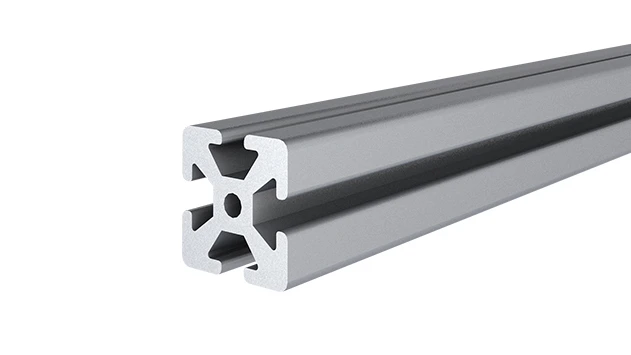
4040F is a 4.00x4.00 CM fractional 40 series square extrusion T-slot profile with four side open T-slots, each side with 4.00cm face. The profile has align-a-grooves to assist in aligning connecting profiles.
Walk into any modern manufacturing facility today, and you'll likely notice a shift away from rigid, one-size-fits-all production setups. The days of building permanent steel workbenches or fixed conveyor systems that gather dust when product lines change are fading fast. Instead, there's a quiet revolution happening—one driven by flexibility. Factories, warehouses, and workshops are now leaning on modular solutions that adapt as quickly as market demands do. At the heart of this revolution? The 4040F EU Standard Aluminum Profile.
If you've ever wondered how a small electronics plant can switch from assembling smartwatches to fitness trackers in a week, or how a automotive parts supplier reconfigures its workstations to handle new component sizes overnight, the answer often lies in this unassuming yet powerful building block. The 4040F isn't just a piece of metal; it's a catalyst for agility. Let's dive into why this aluminum extrusion profile has become indispensable in flexible production lines, how it assembles into functional structures, and why reconfiguring it is as simple as rearranging Lego bricks—only sturdier, more precise, and built to withstand the chaos of daily manufacturing.
What Makes the 4040F EU Standard Aluminum Profile Unique?
First, let's get the basics straight: What is a 4040F EU Standard Aluminum Profile? The name breaks down simply: "4040" refers to its cross-sectional dimensions—40mm by 40mm, a sweet spot for balance between strength and versatility. "F" denotes its specific slot configuration, designed to meet EU manufacturing standards for compatibility and load-bearing capacity. And "EU Standard" ensures it aligns with strict European norms for material quality, dimensional accuracy, and safety—critical for businesses operating in global supply chains.
Material Matters: The Science Behind the Strength
Unlike flimsy plastic or heavy steel, the 4040F is crafted from 6063-T5 aluminum alloy—a material prized in manufacturing for its rare combination of properties. T5 tempering (a heat-treatment process) gives it rigidity without brittleness, so it can support heavy tools or stacks of materials without warping. At the same time, aluminum's natural lightness makes it easy for a single worker to handle, even when cutting or repositioning 3-meter lengths. This matters because in fast-paced environments, downtime spent waiting for a forklift to move a steel beam is downtime lost.
Then there's the finish: most 4040F profiles come anodized, a process that coats the surface with a protective oxide layer. This isn't just for shine—it's a shield against the oils, coolants, and occasional spills that are part of factory life. Unlike steel, which rusts when exposed to moisture, anodized aluminum stays corrosion-free for decades, even in humid or dusty settings. For facilities that run 24/7, this durability translates to lower replacement costs and fewer disruptions from unexpected equipment failures.
The T-Slot Design: Flexibility Built In
The real magic, though, is in the T-slots. Run your finger along the length of a 4040F profile, and you'll feel evenly spaced grooves (typically 8mm wide) along each of its four sides. These slots aren't just for show—they're the reason the 4040F is so adaptable. They accept a universe of aluminum profile accessories: brackets, connectors, panels, shelves, and even casters. Unlike welded steel structures, which require cutting torches and grinders to modify, T-slots let you attach, detach, and reattach components in minutes using nothing more than a hex key. It's like building with a toolkit that never runs out of options.
Pro Tip: When shopping for 4040F profiles, check the slot depth and width. EU standards ensure consistency, but some budget options skimp on slot precision. A poorly cut slot can make it hard to tighten bolts or cause accessories to slip—avoid those! Look for profiles with smooth, debris-free slots and tight dimensional tolerances (±0.1mm is ideal).
Assembling 4040F Structures: From Parts to Productivity
Assembling a 4040F-based structure is refreshingly straightforward—even if you're not a seasoned engineer. Let's walk through building a basic workbench, a staple in any production line. We'll use common aluminum profile accessories to show how the process works, step by step.
Tools You'll Need (Spoiler: Not Many)
Forget about welding machines or angle grinders. The beauty of 4040F assembly is its simplicity. Here's your toolkit: a set of hex keys (metric, since we're dealing with EU standards), a torque wrench (to avoid over-tightening), a rubber mallet (for gentle adjustments), a tape measure, and a deburring tool (to smooth sharp edges after cutting). That's it. No special training, no expensive equipment—just basic hand tools most workshops already have.
Step 1: Plan Your Structure (Measure Twice, Cut Once)
Before you pick up a profile, sketch your design. For our workbench example, let's say we need a 1200mm long, 600mm deep, 850mm high station with a plywood top and a lower shelf for storage. Using 4040F profiles, we'll need:
- 4 vertical legs: 850mm each
- 4 horizontal front/back rails: 1200mm each (top and bottom)
- 4 horizontal side rails: 600mm each (top and bottom)
- 4 shelf supports: 600mm each (to hold the lower shelf)
Measure and mark each profile with a pencil. If you're cutting profiles to length (many suppliers offer pre-cut options, but custom lengths are common), use a miter saw with a fine-tooth blade for clean edges. After cutting, deburr the ends to avoid snags on wires or clothing later.
Step 2: Connecting Profiles with Connectors
Now, it's time to join the pieces. For 90° corners (like the legs to the rails), we'll use 90° aluminum profile connectors—small, L-shaped brackets that fit into the T-slots. Here's how:
- Slide a T-slot nut into the slot of the horizontal rail (the 1200mm piece). These nuts have a spring-loaded ball that keeps them in place while you work—no fumbling!
- Align the 90° connector with the nut, then thread a bolt through the connector's hole and into the nut. Tighten by hand until it's snug.
- Repeat for the vertical leg (850mm piece), sliding another T-slot nut into its slot and attaching the other end of the connector.
- Use the torque wrench to tighten the bolt to the manufacturer's specs (usually 4-6 Nm for M5 bolts). You'll feel it "click" when it's tight enough—no guesswork.
Pro tip: For extra stability, add gusset alp 4040 brackets at each corner. These triangular plates reinforce the joint, crucial if your workbench will hold heavy tools or materials. Just attach them the same way—T-slot nuts, bolts, and a quick tighten.
Step 3: Adding the Work Surface and Extras
Once the frame is assembled (four legs, four top rails, four bottom rails), it's time to add the work surface. Cut a plywood or aluminum panel to 1200mm x 600mm, then use panel-mounting brackets (another aluminum profile accessory) to secure it to the top rails. These brackets slide into the T-slots and clamp the panel from below—no screws through the top surface, keeping it smooth for delicate assemblies.
Need mobility? Add caster wheels to the bottom legs using caster mounting plates. Want a lower shelf for bins or tools? Attach shelf supports (the 600mm pieces) between the legs at your desired height, then add another panel. The possibilities are endless, and every step is reversible. If next month you need the workbench taller, just swap out the legs for longer 4040F profiles—no need to buy a whole new bench.

Reconfiguration: The 4040F's Superpower
In manufacturing, change is the only constant. A product line might shrink, expand, or pivot entirely based on customer demand, seasonal trends, or new regulations. A rigid setup would crumble under this pressure, but the 4040F thrives. Reconfiguring a 4040F structure is so easy, it's almost fun—and it's why lean system managers swear by it.
Why Reconfiguration Matters for Lean Manufacturing
Lean manufacturing, all about minimizing waste and maximizing value, relies on "just-in-time" adaptability. If your production line is fixed, you're stuck with waste: wasted space when demand drops, wasted time when you need to rearrange workflows, or wasted money when you have to buy new equipment for a product change. The 4040F eliminates this by letting you repurpose existing structures. A workbench today can become a material rack tomorrow, or a conveyor section next week—all without cutting, welding, or throwing anything away.
Real-World Reconfiguration: A Case Study
Let's take a hypothetical (but realistic) example: a small medical device manufacturer that produces two products: insulin pumps and glucose monitors. In Q1, demand for insulin pumps spikes, so they need 10 dedicated workstations. By Q3, monitors are hot, and they need 8 monitor workstations instead. With 4040F, here's how they adapt:
- Disassemble: Workers use hex keys to remove the top panels and accessories from 2 insulin pump workstations. The 4040F frames are kept intact—no cutting needed.
- Repurpose Frames: The 2 extra frames are shortened (by cutting the vertical legs to 700mm instead of 850mm) and fitted with smaller work surfaces (800mm x 500mm) to save space for monitor assembly.
- Add New Accessories: Monitor assembly requires anti-static mats, so they attach ESD-safe panels using T-slot nuts. They also add small shelves for monitor components using aluminum guide rail A, which slides into the T-slots and locks in place.
- Reconfigure Layout: The remaining 8 insulin pump workstations are rearranged into a U-shape to improve workflow, with flow racks (built from 4040F and roller track) feeding parts to each station. The 2 new monitor workstations are placed near the testing area, reducing material movement.
Total time to reconfigure: 8 hours. Total cost: $200 in new accessories (casters, ESD panels, guide rails). Compare that to buying 8 new workstations for $5,000+ and losing days of production—no contest.
Tips for Smooth Reconfiguration
Reconfiguring 4040F structures is simple, but a little planning goes a long way:
- Label Parts: When disassembling, label profiles with tape (e.g., "Leg, 850mm, Station 3") to avoid mix-ups later.
- Keep Spare Accessories: Stock extra T-slot nuts, bolts, and connectors—they're cheap insurance against lost parts during reconfiguration.
- Test Loads: If repurposing a structure for heavier loads, check the 4040F's load rating (typically 200-300kg per meter for horizontal spans). Add extra supports if needed.
Aluminum Profile Accessories: Expanding Possibilities
The 4040F profile is powerful on its own, but it's the ecosystem of aluminum profile accessories that turns it into a Swiss Army knife of manufacturing. Let's explore a few game-changers that take your 4040F structures from "basic" to "brilliant."
Connectors: The Glue That Holds It All Together
Connectors are the unsung heroes of 4040F assembly. Beyond the basic 90° connector, there's a connector for every angle and scenario: 45° aluminum profile connector for sloped surfaces (like inclined flow racks), 135° connectors for corner joints that aren't square, and even three-way connectors for building T-shaped structures. The internal rotatary aluminum joint is a standout—it lets you pivot one profile relative to another, perfect for adjustable workbench heights or tilting conveyor sections.
Roller Tracks and Flow Racks: Keeping Materials Moving
In lean systems, stagnant materials are wasted materials. Roller track and accessories turn 4040F profiles into gravity-fed flow racks, where parts glide smoothly from storage to assembly. Attach plastic roller track guide rail yellow (or grey, if you prefer) to 4040F frames using roller track placon mount brackets, and suddenly you've got a system that delivers components exactly where they're needed—no more walking back and forth to fetch parts.
Casters and Mobility: Take Your Work Where It's Needed
Caster wheel and accessories transform static structures into mobile workstations. Locking casters keep things stable during use, while swivel casters make it easy to move heavy loads (like a fully loaded material rack) with minimal effort. For cleanrooms or sensitive environments, opt for ESD-safe casters to prevent static damage to electronics—a small detail that saves big headaches.
The Bottom Line: Why 4040F Drives Competitive Advantage
At the end of the day, the 4040F EU Standard Aluminum Profile isn't just about building structures—it's about building resilience. In a world where customer demands shift overnight and production lines need to pivot at a moment's notice, flexibility isn't a luxury; it's survival. The 4040F delivers that flexibility without sacrificing strength, durability, or cost-effectiveness.
Think about it: traditional steel setups require custom fabrication, which takes time and money. When you need to change, you either live with inefficiency or start from scratch. The 4040F, by contrast, is modular by design. It grows with your business, adapts to your challenges, and lets you turn "we can't" into "we can—tomorrow."
Whether you're a small workshop owner looking to maximize space or a large manufacturer aiming to streamline lean operations, the 4040F EU Standard Aluminum Profile is more than a tool. It's a partner in productivity, a enabler of innovation, and proof that in manufacturing, the best solutions are the ones that can change with you.
So the next time you walk through a factory and see those sleek, silver 40mm x 40mm frames holding up workbenches, moving materials, or supporting assembly lines, remember: what looks like simple metal is actually the backbone of a smarter, more adaptable way to make things. And that's a game-changer.