- Company Articles
- Products and Technology
- Product knowledge
- 4040F EU Standard Aluminum Profile in Robotics Workstations: Stability & Precision Requirements

4040F EU Standard Aluminum Profile in Robotics Workstations: Stability & Precision Requirements
Related Product
4040F EU Standard Aluminum Profile
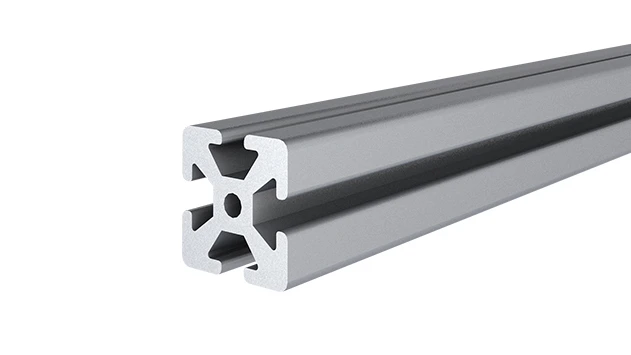
4040F is a 4.00x4.00 CM fractional 40 series square extrusion T-slot profile with four side open T-slots, each side with 4.00cm face. The profile has align-a-grooves to assist in aligning connecting profiles.
In the high-stakes world of robotics, where a fraction of a millimeter can mean the difference between a flawless assembly and a costly error, the materials that form the workstation's foundation are far more than just building blocks. They are the silent architects of precision, the unsung guardians of stability, and the enablers of seamless automation. Among these critical materials, the 4040F EU Standard Aluminum Profile stands out as a cornerstone of modern robotic workstations. Its unique blend of strength, adaptability, and meticulous engineering makes it a go-to choice for engineers and manufacturers who refuse to compromise on either stability or precision. Let's dive into why this aluminum extrusion profile has become indispensable, and how it shapes the future of robotic efficiency.
Understanding the 4040F EU Standard Aluminum Profile
Before we explore its role in robotics workstations, let's demystify the 4040F itself. At its core, this is an aluminum extrusion profile—meaning it's crafted by forcing heated aluminum alloy through a die to create a consistent, complex cross-section. The "4040" in its name refers to its dimensions: a 40mm x 40mm square cross-section, a size that strikes a perfect balance between compactness and load-bearing capability. The "F" denotes its adherence to specific EU manufacturing standards, which govern everything from dimensional accuracy to material composition, ensuring uniformity and reliability across every piece.
EU standards are not just a stamp of approval; they're a promise of quality. For the 4040F, this means tight tolerances on straightness (often within ±0.5mm per meter), consistent wall thickness (typically 2.0mm for structural integrity), and strict alloy purity (most commonly 6063-T5, known for its excellent strength-to-weight ratio and corrosion resistance). Unlike generic aluminum profiles, the 4040F is engineered to perform in environments where precision is non-negotiable—exactly the kind of environments where robots thrive.
But what truly sets this aluminum profile apart is its versatility. Along its length, it features T-slots—longitudinal grooves that run the full length of the profile. These slots aren't just design flourishes; they're the key to its modularity. Using specialized aluminum profile accessories like T-nuts, bolts, and brackets, engineers can attach everything from workbench surfaces to robotic arm mounts, cable management systems to sensor brackets—all without welding or drilling new holes. This flexibility is a game-changer in robotics, where workstations often need to evolve as tasks, tools, or robot models change.
Stability: The Foundation of Robotic Reliability
Robots are dynamic machines. They move, lift, twist, and repeat—often at high speeds. Every movement generates forces: vibrations, torque, and lateral stress. A workstation that flexes or shifts under these forces isn't just unstable; it's a threat to precision. Here's where the 4040F's stability shines, addressing three critical stability challenges in robotics workstations:
1. Vibration Dampening: Quieting the "Shake"
High-speed robotic arms, especially those used in pick-and-place or assembly tasks, can generate significant vibrations. Over time, these vibrations can loosen components, misalign tools, or even throw off robotic calibration. The 4040F's aluminum alloy composition and rigid cross-section act as a natural dampener. Aluminum's inherent density and the profile's square shape distribute vibrational energy evenly, reducing resonance and minimizing "shake." This is particularly crucial for delicate tasks, like electronics assembly, where a robot might be placing 0.1mm components—vibrations here could mean missed placements or damaged parts.
2. Load-Bearing: Supporting the Weight of Automation
Robotic workstations don't just hold the robot itself; they often support tool changers, grippers, vision systems, and even the workpieces being processed. A typical collaborative robot (cobot) might weigh 50kg, but when a heavy gripper and a 10kg payload, the total load on the workstation's frame can exceed 100kg. The 4040F is built to handle this. Thanks to its 2.0mm wall thickness and 6063-T5 alloy, it boasts a load capacity of up to 250kg per linear meter when properly supported—more than enough for most mid-sized robotic setups. Even in multi-robot workstations, where multiple arms operate in tandem, a frame built with 4040F profiles remains steady, ensuring no sagging or bending over time.
3. Rigidity: Maintaining Alignment, Always
Robots rely on precise coordinates to perform tasks. If the workstation frame twists or warps, those coordinates shift, leading to errors. The 4040F's extrusion process ensures a uniform grain structure in the aluminum, making it highly resistant to torsional (twisting) forces. When assembled into a frame using high-quality aluminum profile accessories—like 90° connectors or gusset plates—the structure becomes a rigid unit that maintains alignment even under dynamic loads. This rigidity is why automotive manufacturers, for example, use 4040F-based frames for robotic welding cells: the robot's torch must stay perfectly aligned with the weld seam, and any frame movement would ruin the joint.

Precision Requirements: Why Every Micrometer Counts
Robotics workstations demand precision on two fronts: the precision of the robot itself, and the precision of the workstation that guides it. The 4040F plays a starring role in the latter, addressing four key precision requirements that are non-negotiable in modern automation:
1. Dimensional Accuracy: Consistency Across Every Profile
Imagine building a workstation with profiles that vary slightly in width—one 40.1mm, another 39.9mm. The result? Misaligned T-slots, uneven joints, and a frame that's "off" from the start. The 4040F's EU standard compliance eliminates this risk. Every profile is extruded to within ±0.1mm of its 40mm x 40mm dimensions, ensuring that when you connect two pieces, their T-slots line up perfectly. This consistency is critical for attaching accessories like linear rails or sensor mounts, which require precise positioning to function correctly.
2. Thermal Stability: Minimizing Expansion and Contraction
Robotic workstations often operate in environments with temperature fluctuations—think factory floors where heating, cooling, or nearby machinery can cause ambient temperatures to rise or fall. Aluminum, like all metals, expands when heated and contracts when cooled. However, the 4040F's 6063-T5 alloy has a predictable coefficient of thermal expansion (about 23.6 x 10^-6 per °C), allowing engineers to account for these changes in their designs. Unlike steel, which expands more slowly but is heavier, aluminum's expansion is linear and manageable, ensuring that the workstation's dimensions remain within acceptable limits even as temperatures shift. This predictability is vital for robots that rely on fixed reference points, like vision systems that calibrate using markers on the workstation frame.
3. Modular Precision: Adapting Without Sacrificing Accuracy
One of the biggest advantages of using aluminum profile systems is their modularity—and the 4040F excels here. Thanks to its T-slots and compatible aluminum profile accessories, components can be added, removed, or repositioned with pinpoint accuracy. Need to move a robot's control panel 100mm to the left? Simply loosen the T-nuts, slide the panel, and retighten—no drilling, no welding, no loss of precision. This is a cornerstone of lean system principles, where waste (like time spent reconfiguring workstations) is minimized. For example, a electronics manufacturer using a 4040F-based workbench can quickly retool the station from assembling smartphones to tablets by adjusting the position of fixtures and guides, all while maintaining the sub-millimeter precision required for tiny components.
4. Surface Finish: Ensuring Smooth Interactions
The 4040F's surface isn't just about aesthetics. Its anodized finish (typically clear or black) provides a smooth, low-friction surface that's ideal for mounting sliding components like drawer slides or linear bearings. Unlike rough, unprocessed aluminum, the anodized layer resists scratches and wear, ensuring that moving parts glide consistently over time. This is especially important for robotic workstations with manual or semi-automatic elements, like a workbench where operators load parts onto a conveyor—smooth surfaces reduce jams and ensure parts feed into the robot's grasp with reliability.
Integration with Workbenches and Lean Systems
A robotics workstation isn't just a frame for the robot—it's a complete ecosystem that includes workbenches, material racks, and tool storage. The 4040F's modular design makes it seamless to integrate these elements into a unified, efficient system. Let's take the workbench, for example: a staple in almost every robotic setup, where operators prep parts, inspect outputs, or monitor controls. A workbench built with 4040F profiles isn't just sturdy; it's customizable. Using aluminum profile accessories like angle brackets and tabletop mounts, you can attach a phenolic resin top for chemical resistance, add LED task lighting above, or install under-shelf storage—all without compromising the workbench's structural integrity.
This modularity aligns perfectly with lean system principles, which focus on maximizing value while minimizing waste. In a lean environment, workstations must be adaptable to changing production needs, and the 4040F delivers. Need to add a second level to a material rack to accommodate more parts? Simply bolt on additional 4040F profiles. Want to reposition a robot's feeder to reduce cycle time? Loosen the T-nuts, shift the frame, and you're done. This flexibility reduces downtime during retooling, cuts costs associated with custom fabrication, and ensures the workstation evolves alongside the production line—all hallmarks of a lean system.
Perhaps the most compelling example of this integration is in collaborative robot (cobot) workstations. Cobots work alongside humans, so their workstations must be safe, ergonomic, and flexible. A 4040F frame can be configured to include a height-adjustable workbench (using telescoping profile legs), soft-padding along edges to prevent injury, and quick-change tool holders that let operators swap grippers in seconds. This isn't just about convenience; it's about empowering teams to work smarter, faster, and more safely—all while maintaining the precision that robots demand.
Comparing 4040F to Other Profiles: Why Size and Standard Matter
To truly appreciate the 4040F's value, it helps to see how it stacks up against other common aluminum profiles. Below is a comparison of the 4040F with two alternatives: the smaller 3030 profile (30mm x 30mm) and the larger 4080 profile (40mm x 80mm).
| Feature | 3030 Standard Aluminum Profile | 4040F EU Standard Aluminum Profile | 4080 Standard Aluminum Profile |
|---|---|---|---|
| Cross-Section (mm) | 30x30 | 40x40 | 40x80 |
| Wall Thickness (mm) | 1.5 | 2.0 | 2.5 |
| Load Capacity (kg/m) | 150 | 250 | 400 |
| Weight (kg/m) | 1.2 | 1.8 | 3.2 |
| Best For | Light-duty shelving, small enclosures | Robotics workstations, mid-load frames, workbenches | Heavy robotic arms, large machinery frames |
| EU Standard Compliance | Not always (varies by manufacturer) | Yes (strict tolerances) | Yes (but overkill for most robotics tasks) |
The 3030 profile, while lighter and cheaper, lacks the load capacity and rigidity needed for most robotic workstations—great for a small parts bin, but not for supporting a 50kg robot. The 4080, on the other hand, is overkill for all but the heaviest applications, adding unnecessary weight and cost. The 4040F hits the sweet spot: enough strength for mid-sized robots, enough flexibility for modular workbenches, and enough precision for lean system integration.
Aluminum Profile Accessories: The Unsung Enablers of Precision
A profile is only as good as the accessories that bring it to life—and the 4040F's ecosystem of aluminum profile accessories is second to none. These small but critical components turn a simple extrusion into a fully functional workstation. Let's highlight a few must-have accessories:
T-Slot Nuts and Bolts
These are the backbone of the modular system. T-slot nuts slide into the profile's grooves, and bolts (typically M5 or M6) secure components to the nut. High-quality versions feature nylon inserts to prevent loosening from vibration—essential for robotics, where constant movement could otherwise shake bolts free.
90° Connectors
Used to join two profiles at a right angle, these connectors come in various designs, from simple corner brackets to heavy-duty internal connectors that sit inside the T-slots for a clean look. The best ones feature precision-machined surfaces to ensure a square, wobble-free joint—critical for maintaining frame alignment.
Adjustable Feet
Even the most level factory floors have imperfections. Adjustable feet with rubber pads let you fine-tune the workstation's height (typically by ±10mm) and dampen vibrations. Some models even include swivel plates to accommodate uneven surfaces, ensuring the frame remains perfectly horizontal.
End Caps
These plastic or aluminum caps fit over the ends of the profile, preventing dust, debris, or moisture from entering the T-slots. They also add a finished look and reduce the risk of cuts from sharp edges—an important safety feature for workbenches.
Together, these accessories transform the 4040F from a static piece of metal into a dynamic, adaptable system. And because they're standardized, you can mix and match brands without compatibility issues—a huge plus for manufacturers who source components globally.
Installation, Maintenance, and Longevity
The 4040F isn't just about performance—it's also about practicality. Installing a workstation with these profiles is straightforward, even for teams without specialized training. Unlike steel, which requires welding or heavy tools, aluminum profiles can be cut with a miter saw (equipped with a carbide blade), deburred with a file, and assembled with basic hand tools. This reduces installation time by up to 50% compared to traditional steel frames, getting robots up and running faster.
Maintenance is equally hassle-free. Aluminum's natural corrosion resistance means the 4040F holds up well in humid or dusty environments, and its anodized finish resists stains and scratches. A quick wipe with a damp cloth is usually enough to keep it clean. For high-vibration applications, a quarterly check of bolts (to ensure they're tight) and T-slots (to remove any debris) is recommended—but that's about it. With proper care, a 4040F workstation can last 10+ years, outliving multiple robot generations and providing an excellent return on investment.
Conclusion: The 4040F—Where Stability Meets Precision
In the world of robotics, every component has a role to play, but few are as foundational as the workstation itself. The 4040F EU Standard Aluminum Profile doesn't just support the robot; it elevates its performance. Its EU-standard precision ensures dimensional accuracy, its robust design delivers unwavering stability, and its modularity empowers lean system principles that keep manufacturing agile and efficient. Whether you're building a small cobot workbench or a large-scale robotic assembly line, the 4040F brings together the best of aluminum extrusion profile technology to create a workstation that's not just built to work—but built to excel.
As robotics continues to evolve—with faster speeds, smaller components, and higher demands for flexibility—the 4040F will undoubtedly remain a staple. It's more than a profile; it's a promise: that stability and precision don't have to be trade-offs. In the end, that's the real power of the 4040F: it lets robots be robots—fast, accurate, and relentless—while it quietly, reliably, holds it all together.