- Company Articles
- Products and Technology
- Product knowledge
- 4040F EU Standard Aluminum Profile: Reducing Assembly Time in Production Line Construction

4040F EU Standard Aluminum Profile: Reducing Assembly Time in Production Line Construction
Related Product
4040F EU Standard Aluminum Profile
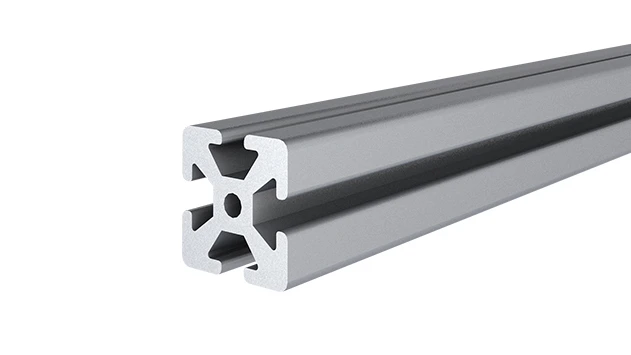
4040F is a 4.00x4.00 CM fractional 40 series square extrusion T-slot profile with four side open T-slots, each side with 4.00cm face. The profile has align-a-grooves to assist in aligning connecting profiles.
Picture this: A manufacturing floor where workers spend hours welding steel frames, cutting custom wooden boards, or waiting for pre-fabricated parts to arrive. Every minute lost in assembly is a minute that could've been spent producing goods, serving clients, or innovating. For production managers, the battle against time is constant—and the tools they use can make or break their efficiency. Enter the 4040F EU standard aluminum profile : a quiet revolution in how production lines, workbenches, and material racks come to life. More than just a piece of metal, it's a modular solution designed to cut through the chaos of traditional assembly, turning days of work into hours and hours into minutes. Let's dive into how this unassuming aluminum extrusion is reshaping the way factories build, adapt, and thrive.
The Hidden Cost of "Traditional" Assembly: Why Time Slips Through the Cracks
Before we talk about solutions, let's face the problem head-on: Traditional production line construction is a time trap. For decades, factories relied on steel pipes, wooden frames, or custom-welded metal structures. While these materials are durable, they're also inflexible, labor-intensive, and slow. Imagine building a simple material rack—say, a 3-row, 3-floor setup (like Material Rack B from many suppliers). With steel, you'd start by cutting pipes to exact lengths, hauling them to a welding station, and spending hours fusing joints together. Then comes sanding down rough edges, painting to prevent rust, and finally moving the heavy structure to its spot on the floor. If a measurement is off by even an inch? You start over. If the production line needs to expand next month? You'd likely have to weld new sections or build an entirely new rack from scratch.
Wood isn't much better. It warps over time, can't handle heavy loads, and requires constant maintenance. And both steel and wood share a fatal flaw for modern manufacturing: they're permanent . In an era where product lines change quarterly (or even monthly), a "set-it-and-forget-it" approach to assembly is a recipe for waste. Workers waste time waiting for custom parts. Managers waste budget on over-ordering materials "just in case." And the factory floor? It becomes a maze of rigid structures that resist adaptation—exactly the opposite of what lean manufacturing preaches.
The numbers tell the story. A recent survey of small to mid-sized manufacturers found that assembly and reconfiguration of production line structures (like workbenches, racks, and trolleys) accounted for 15-20% of total downtime each month. That's nearly a full workweek lost to building and rebuilding the very tools that are supposed to enable production. It's no wonder so many managers are asking: There has to be a better way.
4040F Aluminum Profile: The Modular Game-Changer
The 4040F EU standard aluminum profile isn't just another building material—it's a system built on three principles: precision, flexibility, and speed. Let's start with the basics: what is it? The "4040" refers to its dimensions: 40mm by 40mm, a sweet spot for balancing strength and versatility. "F" denotes its specific groove design (part of EU standards), which ensures compatibility with a wide range of accessories. And "aluminum extrusion" means it's formed by pushing molten aluminum through a die, creating a consistent, high-strength shape with built-in T-slots along its length. Those T-slots are the secret sauce—they let you attach brackets, connectors, and accessories without drilling, welding, or cutting. Just slide, tighten, and done.
But why aluminum? Unlike steel, it's lightweight (about 1/3 the weight, making it easy to handle without heavy machinery), corrosion-resistant (no need for painting or rust-proofing), and infinitely recyclable (a win for sustainability goals). And because it's extruded, every 4040F profile is identical—no more guessing if a pipe from Batch A will fit with a joint from Batch B. That precision alone cuts down on assembly errors, which are a major time-drain in traditional builds.
Let's take a real example: building a basic workbench, say Workbench E (single deck, without casters). With traditional wood or steel, you'd need to: measure and cut the tabletop, cut four legs to height, drill holes for screws or weld the legs to the top, add bracing for stability, and sand/paint the finished product. Even for a skilled worker, that's a half-day project—4 hours, easy. With 4040F? You grab four 4040F profiles for the legs, two for the front/back rails, two for the side rails, and a pre-cut tabletop (wood, metal, or plastic—whatever fits your needs). Then, using 90° aluminum profile connectors , you attach the rails to the legs in minutes. Slide the tabletop into place, secure it with T-slot bolts, and you're done. Total time? Under an hour . No welding, no cutting, no waiting for paint to dry. Just assemble, tighten, and start using it.

Aluminum Profile Accessories: The Unsung Heroes of Speed
A profile is only as good as the accessories that bring it to life. The 4040F system shines here, thanks to a ecosystem of aluminum profile accessories designed to make assembly feel less like construction and more like building with premium Lego bricks. Let's break down the stars of the show:
90° Aluminum Profile Connectors: These L-shaped brackets are the backbone of any 4040F structure. They slide into the T-slots of two perpendicular profiles, and a simple bolt tightens them in place—no welding, no drilling. Need a right angle? Snap on a 90° connector. Done.
4040 Aluminum Profile End Caps: Think of these as the finishing touch. They pop onto the ends of profiles to cover sharp edges (safety first!), prevent dust from getting into T-slots, and give the structure a clean, professional look. No more sanding down rough steel edges or dealing with splintered wood.
T-Slot Bolts and Nuts: These specialized fasteners are designed to slide along the T-slots, letting you attach accessories (like shelves, lights, or tool hooks) anywhere along the profile—no pre-drilled holes required. Loosen the nut, slide to the perfect spot, tighten, and you're locked in.
Angle Brackets and Supports: For extra stability—say, on a heavy-duty material rack—these brackets reinforce joints, distributing weight evenly across the structure. They're especially handy for racks holding bulky items, like the 3-row, 3-floor Material Rack B we mentioned earlier.
Here's the magic: All these accessories are standardized. That means a 90° connector from one supplier works with a 4040F profile from another. No more hunting for "compatible" parts or custom-ordering brackets. Walk into any industrial supply store, grab a handful of connectors and bolts, and you're ready to build. It's modularity at its finest—and modularity equals speed.
Lean System Integration: Waste Less, Produce More
Lean manufacturing isn't just a buzzword—it's a philosophy centered on eliminating waste (time, materials, effort) to create more value. The 4040F system aligns perfectly with this mindset, turning lean principles from theory into daily practice. Let's see how:
Eliminating Overproduction Waste: Traditional assembly often requires ordering custom-cut steel or wood, leading to excess materials (and cost) when projects change. With 4040F, you buy profiles in standard lengths (1m, 2m, 3m) and cut them to size on-site with a simple hacksaw or chop saw—no need to over-order "just in case." And if you make a mistake? Cut a new section from the same profile. Minimal waste, maximum flexibility.
Reducing Setup Time: In lean terms, "setup time" is the time between finishing one task and starting the next. With traditional structures, reconfiguring a production line (say, from assembling Product A to Product B) could take days. With 4040F? Loosen the bolts, reposition the profiles, add or remove sections, and tighten. A workbench that once took 4 hours to rebuild now takes 30 minutes. That's setup time slashed by 87%—time that goes straight back into production.
Adapting to "Pull" Production: Lean factories thrive on "pull" systems, where production is driven by customer demand, not forecasts. This means lines need to shift quickly—today's small batch of high-end parts might become tomorrow's large batch of standard components. 4040F structures adapt on the fly. Need more shelf space for parts? Add a few profiles and brackets. Want to lower a workbench height for ergonomics? Swap out the leg profiles for shorter ones. No redesign, no delays.
One factory in Germany put this to the test. They switched their entire assembly line to 4040F profiles and accessories, and within six months, they reported a 22% reduction in non-value-added time (the time workers spend on tasks that don't directly contribute to production). That's not just a number—that's more products out the door, happier workers, and a bigger bottom line.
From Workbench to Warehouse: Real-World Time Savings
Let's get concrete. How much time does 4040F actually save in day-to-day operations? Let's compare traditional assembly (steel/wood) vs. 4040F aluminum profile across three common factory structures: a workbench, a material rack, and a turnover trolley.
| Structure Type | Traditional Assembly (Steel/Wood) | 4040F Aluminum Profile Assembly | Time Saved |
|---|---|---|---|
| Workbench (Single Deck, No Casters) | 4 hours (cutting, welding, painting, drying) | 45 minutes (connectors, bolts, tabletop attachment) | 77% |
| Material Rack (3 Rows, 3 Floors) | 6 hours (welding frames, installing shelves, finishing) | 1.5 hours (profiles, connectors, shelf brackets) | 75% |
| Turnover Trolley (Basic Design) | 3 hours (cutting steel, welding frame, attaching casters) | 40 minutes (profiles, casters, handle attachment) | 83% |
These numbers aren't outliers. A case study from a automotive parts manufacturer in the U.S. found that switching to 4040F for their workbenches and material racks cut assembly time by an average of 72% across all structures. And it's not just initial assembly—reconfiguration time dropped even more. When they needed to adjust a workbench height to accommodate a new machine, the traditional steel bench took 2 hours to modify (cutting, rewelding). The 4040F bench? 10 minutes. Just loosen the bolts, swap the leg profiles for shorter ones, and retighten.
Why It's Not Just About Time: The Hidden Benefits
Time savings are the headline, but 4040F brings more to the table. Let's talk about the perks that don't show up on a stopwatch but matter just as much:
Ergonomics: Workers spend hours at workbenches—uncomfortable setups lead to fatigue and injuries. With 4040F, adjusting height, adding footrests, or tilting surfaces is easy, keeping workers happy and healthy.
Sustainability: Aluminum is 100% recyclable, and the modular design means structures can be disassembled and reused instead of thrown away. One factory reported a 40% reduction in waste after switching to 4040F.
Scalability: As your business grows, so can your 4040F structures. Need a longer conveyor? Add more profiles. Want to expand a rack? Bolt on new sections. No need to rebuild from scratch.
The Future of Production Line Construction: 4040F Leading the Way
As manufacturing evolves—with smaller batches, faster product cycles, and a focus on agility—the days of rigid, one-size-fits-all assembly are numbered. The 4040F EU standard aluminum profile isn't just keeping up; it's setting the pace. It's a tool that empowers factories to build smarter, adapt quicker, and focus on what matters: making great products.
So, to the production managers, the factory workers, and the innovators out there: If you're still wrestling with steel and wood, watching time slip away on assembly, it might be time to take a closer look at 4040F. It's not just a profile—it's a promise: less time building, more time producing. And in manufacturing, time isn't just money. It's the difference between falling behind and leading the pack.