- Company Articles
- Products and Technology
- Product knowledge
- 4040F EU Standard Aluminum Profile vs Carbon Steel: Weight-to-Strength Ratio Comparison

4040F EU Standard Aluminum Profile vs Carbon Steel: Weight-to-Strength Ratio Comparison
Related Product
4040F EU Standard Aluminum Profile
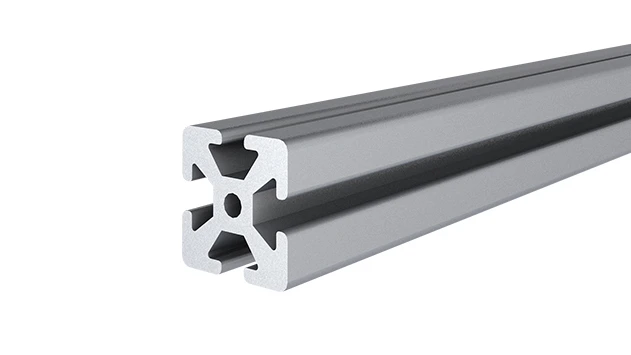
4040F is a 4.00x4.00 CM fractional 40 series square extrusion T-slot profile with four side open T-slots, each side with 4.00cm face. The profile has align-a-grooves to assist in aligning connecting profiles.
Introduction: The Material Dilemma in Modern Manufacturing
Walk into any manufacturing facility today, and you'll notice a silent but critical battle unfolding: the choice between materials that drive efficiency, durability, and cost-effectiveness. For decades, carbon steel has been the workhorse of industrial settings, prized for its raw strength and affordability. But in recent years, a new contender has emerged: aluminum profiles, particularly the 4040F EU standard aluminum profile . This isn't just a trend—it's a shift driven by the need to balance strength with agility, especially in lean manufacturing environments where every pound saved translates to smoother workflows, lower energy costs, and faster reconfigurations.
At the heart of this debate lies a key metric: the weight-to-strength ratio. It's a simple concept with profound implications. A material with a high weight-to-strength ratio delivers more strength per unit of weight, making it ideal for applications where mobility, installation ease, and long-term sustainability matter. In this article, we'll dive deep into how the 4040F aluminum profile stacks up against carbon steel in this crucial area. We'll explore their properties, real-world applications, and why aluminum extrusion profile technology has become a game-changer for industries ranging from automotive to electronics. Along the way, we'll also touch on how aluminum profile accessories enhance the versatility of these systems, and why they're becoming indispensable in modern lean system setups.
Understanding the 4040F EU Standard Aluminum Profile: More Than Just Metal
Before we pit it against carbon steel, let's get to know the 4040F EU standard aluminum profile. First, the "4040" refers to its dimensions: 40mm by 40mm, a common size for structural frameworks. The "F" denotes its specific extrusion design—typically featuring T-slots along all four sides, which allow for easy attachment of accessories like brackets, panels, and connectors. This isn't just a random shape; it's the result of precision aluminum extrusion profile manufacturing, where molten aluminum is forced through a die to create consistent, complex cross-sections.
What makes this profile stand out? For starters, aluminum itself is a lightweight metal—about one-third the density of steel. But don't let that fool you: when alloyed with elements like magnesium and silicon (common in 6000-series aluminum, which the 4040F often uses), it gains impressive strength. Tensile strengths of 200-300 MPa are standard, which is more than enough for most industrial applications like workbenches, material racks, and conveyor frames. Add to that aluminum's natural corrosion resistance—no need for painting or coating—and you have a material that's built to last in harsh factory environments.
But the 4040F's true power lies in its versatility, thanks in large part to aluminum profile accessories . These include everything from end caps that protect workers from sharp edges to corner brackets that simplify 90-degree connections, and even adjustable feet that level uneven work surfaces. Want to build a custom workbench? Attach a honeycomb panel to the T-slots. Need a mobile material rack? Add casters via bracket adapters. This modularity is why it's a cornerstone of lean system design—manufacturers can quickly reconfigure their setups as production needs change, without welding or heavy machinery.

Carbon Steel: The Old Reliable, But at What Cost?
Carbon steel, on the other hand, is the veteran in the room. Made by alloying iron with carbon (and sometimes other elements like manganese), it's been the backbone of construction and manufacturing for centuries. Its claim to fame? Raw strength. Mild carbon steel has a tensile strength of around 400-500 MPa, and high-carbon steel can reach up to 1500 MPa—far exceeding aluminum in absolute terms. This makes it the go-to for applications where maximum load-bearing capacity is non-negotiable, like bridge girders or heavy machinery frames.
But there's a catch: density. Carbon steel clocks in at about 7.85 g/cm³, compared to aluminum's 2.7 g/cm³. That means a carbon steel beam with the same strength as an aluminum one will weigh roughly three times as much. This weight penalty manifests in several ways: higher shipping costs, more labor-intensive installation, and increased wear and tear on equipment like forklifts and conveyor motors. Then there's corrosion: carbon steel rusts easily, so it often requires painting, galvanizing, or powder-coating to survive in damp or chemical-exposed environments—adding time and cost to the production process.
Another downside? Rigidity. Carbon steel is strong, but it's not easy to modify. Welding is often required to make changes, which is time-consuming and permanent. In a lean manufacturing context, where flexibility is key, this can be a major drawback. Imagine needing to rearrange a production line to accommodate a new product—with carbon steel, you're looking at days of work; with aluminum profiles, it might take hours, thanks to those T-slots and quick-connect accessories.
Weight-to-Strength Ratio: The Ultimate Performance Metric
Now, let's talk about the star of the show: weight-to-strength ratio. Simply put, it's a measure of how much strength a material offers per unit of weight. Mathematically, it's often expressed as tensile strength divided by density (units like MPa/(g/cm³)). The higher the ratio, the better the material is at delivering strength without excess weight.
Why does this matter? Think about a factory workbench. If it's made of carbon steel, it might be rock-solid, but moving it across the floor requires a forklift or multiple workers. An aluminum workbench of the same strength would weigh a third as much—one person could reposition it. Multiply that by dozens of workbenches, racks, and conveyors in a facility, and the cumulative effect on productivity is staggering. Lower weight also reduces strain on floors and foundations, extends the life of equipment like casters and rollers, and cuts down on energy use during transportation and installation.
Let's crunch some numbers. For the 4040F aluminum profile (6063-T5 alloy), typical values are: density ≈ 2.7 g/cm³, tensile strength ≈ 215 MPa. Its weight-to-strength ratio is thus 215 / 2.7 ≈ 79.6 MPa/(g/cm³). For low-carbon steel (mild steel), density ≈ 7.85 g/cm³, tensile strength ≈ 370 MPa. Its ratio is 370 / 7.85 ≈ 47.1 MPa/(g/cm³). That's a 69% higher ratio for the aluminum profile . In other words, to get the same strength as a 1kg aluminum beam, you'd need a steel beam that weighs 1.7kg—and even then, the aluminum would still be lighter for the same strength.
Head-to-Head Comparison: 4040F Aluminum vs. Carbon Steel
To make this concrete, let's compare key properties in a table. Remember, this isn't about declaring a "winner"—it's about choosing the right material for the job. But when weight-to-strength ratio is the priority, the results are clear:
| Property | 4040F EU Standard Aluminum Profile (6063-T5) | Low-Carbon Steel (Mild Steel) |
|---|---|---|
| Density | ~2.7 g/cm³ | ~7.85 g/cm³ |
| Tensile Strength | 215-250 MPa | 370-450 MPa |
| Weight-to-Strength Ratio | 79.6-92.6 MPa/(g/cm³) | 47.1-57.3 MPa/(g/cm³) |
| Corrosion Resistance | Excellent (natural oxide layer) | Poor (requires coating) |
| Thermal Conductivity | High (160 W/m·K) – good for heat dissipation | Moderate (50 W/m·K) |
| Modularity (with Accessories) | High – T-slots compatible with hundreds of aluminum profile accessories | Low – requires welding or drilling for modifications |
| Cost (Per Unit Length) | Higher upfront (~$3-5/m for 4040F) | Lower upfront (~$1-2/m for equivalent steel angle) |
| Installation Time | Fast (bolted connections, no welding) | Slow (welding, heavy lifting required) |
The table tells a clear story: while carbon steel has higher absolute strength, the 4040F aluminum profile delivers far more strength per pound. Its corrosion resistance and modularity are additional perks that make it a smarter choice for dynamic environments. The only area where steel wins is upfront cost—but as we'll see, that's often a false economy.
Real-World Applications: Where Aluminum Shines in Lean Systems
Let's step out of the lab and into the factory. How does the 4040F aluminum profile's weight-to-strength ratio translate to real-world lean system success? Take automotive manufacturing, where production lines are constantly retooled for new models. A car parts assembly line might use 4040F profiles to build workstations, with aluminum profile accessories like tool holders and LED light brackets attached via T-slots. When the next model comes in, workers can swap out accessories or reconfigure the frame in hours, not days. Carbon steel workstations would require cutting, welding, and repainting—disrupting production for weeks.
Another example: material flow racks. In electronics manufacturing, sensitive components need to move smoothly from one station to the next. A flow rack built with 4040F aluminum and roller tracks is lightweight enough to adjust for ergonomics (raising or lowering shelves to reduce worker strain) but strong enough to hold hundreds of pounds of components. Carbon steel racks of the same capacity would be too heavy to adjust, leading to fixed, inefficient layouts that increase worker fatigue and errors.
Even in heavy-duty scenarios, aluminum holds its own. Take a turnover trolley used to transport engine parts. A steel trolley might handle the weight, but its high mass makes it hard to maneuver around tight corners. An aluminum trolley with a 4040F frame and reinforced corners (using angle brackets from aluminum profile accessories ) is just as strong but easy to push, reducing the risk of workplace injuries and speeding up material delivery.
Cost vs. Value: The Hidden Savings of Aluminum
Critics of aluminum often point to its higher upfront cost. It's true: a meter of 4040F aluminum profile might cost $3-5, while a similar steel angle is $1-2. But that's only part of the story. Let's factor in the full lifecycle costs:
Transportation: Aluminum's lower weight cuts shipping costs by 50-60%. A truckload of aluminum profiles carries 3x more linear footage than steel, reducing per-unit delivery fees.
Installation: No welding means fewer labor hours. A team can assemble an aluminum workbench in 30 minutes; a steel one might take 2 hours (plus welding time). Multiply by 100 workbenches, and you're saving weeks of labor.
Maintenance: Aluminum doesn't rust. Steel requires periodic painting or coating (every 2-3 years), adding $50-100 per structure. Over a 10-year lifespan, that's $200-500 in maintenance costs avoided per aluminum structure.
Reusability: When a project ends, aluminum profiles can be disassembled and reused. Steel structures are often cut up and scrapped, losing most of their value.
A case study from a German automotive supplier illustrates this. They replaced 50 carbon steel workstations with 4040F aluminum ones. Upfront cost was $20,000 higher, but they saved $15,000 in shipping, $30,000 in installation labor, and $10,000 in maintenance over 5 years—netting a $35,000 gain. Plus, they reduced production downtime during reconfiguration by 80%.
Environmental Impact: Aluminum's Green Edge
In an era of sustainability, material choice also affects a company's carbon footprint. Aluminum is 100% recyclable, and recycling it uses just 5% of the energy needed to produce new aluminum. Carbon steel is recyclable too, but its production emits more CO2—about 1.8 tons of CO2 per ton of steel, vs. 0.5 tons per ton of aluminum (when recycled).
The 4040F aluminum profile's lightweight nature also reduces fuel consumption during transportation. A delivery truck carrying aluminum profiles emits 66% less CO2 per mile than one carrying steel, since it's hauling less weight. In factory operations, lighter equipment means lower energy use for conveyors and lifting tools. Over time, these savings add up to a significant reduction in a company's environmental impact.
Conclusion: The Case for 4040F Aluminum in Modern Manufacturing
Carbon steel has served industry well for generations, but the 4040F EU standard aluminum profile represents the future of manufacturing materials. Its unbeatable weight-to-strength ratio, combined with corrosion resistance, modularity (thanks to aluminum profile accessories ), and long-term cost savings, makes it the ideal choice for lean system design and beyond.
Is aluminum right for every application? No. If you need to build a skyscraper or a battleship, carbon steel's raw strength is irreplaceable. But for the vast majority of industrial applications—workbenches, material racks, conveyors, and assembly lines—the 4040F aluminum profile delivers more value, more flexibility, and more sustainability. It's not just a material upgrade; it's a productivity revolution.
So the next time you're designing a factory layout or upgrading your equipment, ask yourself: Do I need brute strength, or do I need smart strength? For most of us, the answer is clear. The 4040F aluminum profile isn't just lighter—it's better.