- Company Articles
- Products and Technology
- Product knowledge
- 4040r EU Standard Aluminum Profile Assembly Time: Efficiency Compared

4040r EU Standard Aluminum Profile Assembly Time: Efficiency Compared
Related Product
4040R EU Standard Aluminum Profile
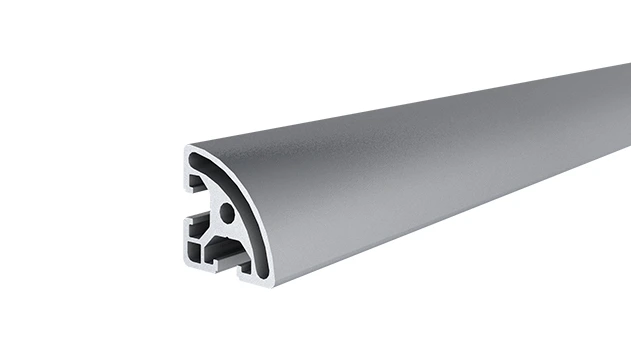
4040R is a 4.00x4.00 CM fractional 40 series square extrusion T-slot profile with two side open T-slots, each side with 4.00cm face,the other side is round face. The profile has align-a-grooves to assist in aligning connecting profiles.
If you've ever spent a morning staring at a pile of metal parts, wondering if you'll finish assembling that workbench before lunch, you know the frustration of slow, clunky processes. In factories, workshops, and production lines around the world, assembly time isn't just a minor inconvenience—it's a silent budget-eater, a deadline-delayer, and a creativity-killer. That's why today, we're diving into a material that's quietly revolutionizing how teams build, adapt, and rebuild: the 4040r EU Standard Aluminum Profile. Specifically, we're going to talk about its assembly time efficiency—how quickly it comes together, why that matters, and how it stacks up against other common materials. Whether you're a production manager, a workshop foreman, or just someone who appreciates a well-designed tool, this one's for you.
What Even Is 4040r EU Standard Aluminum Profile?
First things first: Let's demystify the name. "4040r" refers to the profile's dimensions and design—40mm by 40mm in cross-section, with a rounded ("r") edge, which is gentler on hands and less likely to catch on materials. The "EU Standard" part means it adheres to strict European manufacturing specs, ensuring consistency in size, strength, and compatibility across brands. This isn't just any aluminum extrusion profile; it's a workhorse designed for industrial use—think assembly line workbenches, material racks, machine guards, and even custom conveyor systems.
What makes it stand out? Unlike generic aluminum pipes, the 4040r profile features precision-engineered T-slots running along its length. These slots are like built-in highways for aluminum profile accessories—connectors, brackets, panels, and more—allowing you to attach components without drilling or welding. It's modular by design, which is a big hint at why assembly time might be a strong suit here.
Why Assembly Time Actually Matters (Spoiler: It's Not Just About Speed)
Let's get real: If you're only building one workbench, saving 10 minutes on assembly might not seem like a big deal. But in industrial settings, where you're assembling dozens of racks, reconfiguring production lines quarterly, or scaling up a new facility, those minutes add up—to hours, then days, then thousands of dollars in labor costs. Slow assembly also means more downtime. Imagine your team needs to shift a material rack from one corner of the factory to another to accommodate a new machine. If taking it apart and rebuilding takes half a day, that's half a day your production line isn't moving. And in today's fast-paced manufacturing world, flexibility is key—customers want custom solutions, and markets change overnight. Being able to adapt quickly isn't a luxury; it's survival.

What Makes 4040r Assembly So Efficient? Let's Break It Down
So, why do engineers and production managers rave about how quickly 4040r profiles go together? It's a mix of smart design, quality accessories, and user-friendly features. Let's unpack the key factors:
1. T-Slots and "Click-and-Go" Accessories
The T-slots we mentioned earlier are game-changers. Instead of hunting for pre-drilled holes or measuring where to weld, you can slide aluminum profile accessories directly into the slots. Take the 90° aluminum profile connector, for example. It's a small, lightweight piece that fits snugly into the T-slot, and with a quick turn of a hex key, it locks into place—no welding, no drilling, no mess. I've seen a team of two assemble a basic 6-foot workbench using 4040r profiles and these connectors in under 30 minutes. Compare that to traditional steel frames, where you'd need to measure, drill, bolt, and maybe even grind down rough edges—easily a 2-hour job.
2. No Specialized Tools Required
You don't need a welding certification or a workshop full of power tools to work with 4040r. A basic hex key set, a rubber mallet (for gentle adjustments), and maybe a measuring tape are all you need. This lowers the skill barrier—new team members can be trained to assemble components in minutes, whereas stainless steel or iron frames might require experienced welders or mechanics. Fewer tools also mean less time spent fetching equipment or waiting for a specialist to become available.
3. Consistency and Compatibility
Since 4040r follows EU standards, every piece—whether it's from Brand A or Brand B—fits together seamlessly. There's no guessing if a connector from one supplier will work with a profile from another. This consistency eliminates the "trial and error" time that plagues assembly with non-standard materials. I once worked with a client who switched from generic aluminum pipes to 4040r, and they mentioned that the biggest time-saver wasn't just the assembly itself, but the lack of frustration from parts that didn't fit. "No more arguing with a pipe that's 1mm too thick or a connector that won't seat properly," they said. "It just works."
How Does It Stack Up? A Side-by-Side Comparison
To really see if 4040r is a time-saver, let's compare it to three common alternatives in industrial setups: 3030 EU Aluminum Profile (a smaller cousin), traditional stainless steel pipe (2.0mm thick), and classic PE coated lean pipe (often used in older lean manufacturing systems). The table below breaks down assembly time and other key factors based on real-world feedback from manufacturers and workshop teams.
| Material Type | Avg. Assembly Time (per linear meter) | Required Tools | Skill Level Needed (1=Beginner, 5=Expert) | Reusability Score (1-5) |
|---|---|---|---|---|
| 4040r EU Aluminum Profile | 10–15 minutes | Hex keys, measuring tape, rubber mallet | 2 (Basic training) | 5 (Fully modular, no damage on disassembly) |
| 3030 EU Aluminum Profile | 8–12 minutes | Same as 4040r | 2 | 5 |
| Stainless Steel Pipe (2.0mm) | 45–60 minutes | Welder, grinder, drill, wrench set | 4 (Welding certification) | 2 (Welded joints are permanent; cutting required for reconfiguration) |
| PE Coated Lean Pipe | 25–35 minutes | Pipe cutter, clamp tool, hex keys | 3 (Requires precise cutting) | 3 (Clamps can wear out; pipes may bend) |
The numbers speak for themselves. While the smaller 3030 profile is slightly faster to assemble, it can't handle the same weight loads as 4040r, making it less versatile for heavy-duty applications. Stainless steel, on the other hand, is incredibly strong but requires specialized skills and equipment, doubling or tripling assembly time. PE coated lean pipe, a staple in older lean systems, is slower than aluminum profiles and less reusable—clamps degrade over time, and pipes can warp, making reconfiguration a hassle.
Real-World Wins: When 4040r Assembly Time Made a Difference
Let's ground this in a real example. A mid-sized automotive parts manufacturer in Germany recently decided to upgrade their production line workbenches. Previously, they'd used stainless steel frames, which took their maintenance team 4 hours to assemble per bench (including welding and finishing). With 4040r aluminum extrusion profiles and aluminum profile accessories, the same team assembled each bench in 45 minutes—an 87.5% reduction in time. For a project that required 20 workbenches, that's 62.5 hours saved—time they redirected to repairing machinery and training new staff. "We didn't just save labor costs," the plant manager noted. "We got our production line up and running three days earlier than planned."
Another example: a electronics assembly plant that reconfigures its material racks quarterly to match new product launches. With PE coated lean pipe, each reconfiguration took a full day (8 hours) for a team of three. After switching to 4040r and using 90° aluminum profile connectors, the same team now finishes in 2 hours. Over a year, that's 24 hours saved—an entire workweek—just from quarterly reconfigurations.
Is 4040r Right for Every Job? Probably Not—but It's Worth Considering
Let's be clear: 4040r isn't a magic bullet. If you need something ultra-lightweight (like for a temporary display), the 3030 profile might be better. If you're building something that needs to withstand extreme heat or corrosive chemicals, stainless steel could still be the way to go. But for most industrial applications—workbenches, material racks, assembly lines, machine guards—4040r offers a rare balance of strength, flexibility, and speed. Its assembly efficiency isn't just about putting parts together quickly; it's about empowering teams to adapt, innovate, and focus on what really matters: creating great products.
Wrapping Up: Time Well Spent
At the end of the day, assembly time is about more than just speed—it's about respect for your team's time, flexibility for your business, and efficiency for your bottom line. The 4040r EU Standard Aluminum Profile, with its smart design, compatible aluminum profile accessories, and user-friendly assembly, isn't just a material choice; it's a decision to work smarter, not harder. So the next time you're staring at a pile of parts and a tight deadline, ask yourself: What could my team accomplish with an extra hour, an extra day, or an extra week? With 4040r, you might just find out.