- Company Articles
- Products and Technology
- Product knowledge
- 4040r EU Standard Aluminum Profile Connectors: Inner Rotary Joint Compatibility

4040r EU Standard Aluminum Profile Connectors: Inner Rotary Joint Compatibility
Related Product
4040R EU Standard Aluminum Profile
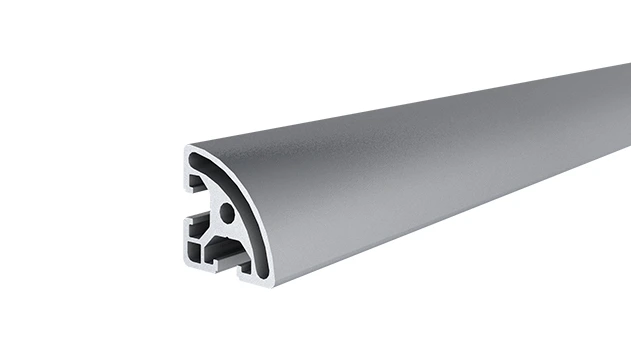
4040R is a 4.00x4.00 CM fractional 40 series square extrusion T-slot profile with two side open T-slots, each side with 4.00cm face,the other side is round face. The profile has align-a-grooves to assist in aligning connecting profiles.
Walk into any modern factory, warehouse, or assembly line, and you'll likely spot a common thread tying everything together: aluminum profiles. These unassuming metal frames are the unsung heroes of lean manufacturing, quietly workbenches, material racks, conveyor systems, and even custom machinery. But what makes them truly indispensable isn't just their strength or durability—it's their ability to adapt. And at the heart of that adaptability? Connectors. Today, we're zeroing in on one of the most versatile combinations in the industry: the 4040r EU Standard Aluminum Profile and its inner rotary aluminum joint. If you've ever struggled with rigid, one-size-fits-all workspaces, or wished your assembly line could flex with changing production needs, this is the deep dive you've been waiting for.
Understanding 4040r EU Standard Aluminum Profile: What Makes It Stand Out?
Before we get to the connectors, let's talk about the star of the show: the 4040r EU Standard Aluminum Profile. If you're new to the world of aluminum extrusion, "4040r" might sound like a random code, but it's actually a roadmap to its design. The "4040" refers to its cross-section—40mm by 40mm—making it a mid-sized profile that strikes a sweet spot between portability and load capacity. The "r" stands for "rounded," a subtle but important detail: its edges are slightly curved, reducing the risk of snags or injuries in busy work environments. But what really sets the 4040r apart is its adherence to EU standards, which means consistency. Whether you're sourcing from Germany, Poland, or a trusted supplier halfway across the globe, a 4040r profile will fit with other EU-standard components—no guesswork, no mismatched parts.
Material-wise, the 4040r is typically made from 6063-T5 aluminum alloy, a blend prized for its lightweight nature and impressive strength-to-weight ratio. It's corrosion-resistant, too, thanks to anodizing—a process that forms a protective oxide layer on the surface—making it suitable for both indoor and semi-outdoor use (think warehouse loading bays or factory floors with occasional moisture). But the real magic lies in its T-slot design. Run your finger along the length of the profile, and you'll notice long, narrow grooves (T-slots) that run the entire way. These slots are where the adaptability begins: they let you attach accessories—connectors, brackets, panels, even tools—anywhere along the profile, without drilling or welding. Need to add a shelf to your workbench? Slide a bracket into the T-slot. Want to reposition a light above your assembly station? Loosen the screws, adjust, and tighten. It's this flexibility that makes the 4040r a favorite in lean manufacturing setups, where efficiency and quick reconfiguration are non-negotiable.
So, where do you typically see 4040r profiles in action? Everywhere. They're the backbone of workbenches in electronics assembly lines, where precision and organization matter. They form the frames of material racks in warehouses, holding everything from small components to heavy toolboxes. They're even used in custom machinery guards, ensuring safety without sacrificing visibility. And because of its balanced size, it's equally at home in small-scale workshops (think a local maker space building prototype tables) and large factories (a automotive plant's assembly line workstations). In short, if your workspace needs to be strong, light, and ready to evolve, the 4040r is probably already there—or should be.
The Heart of Connectivity: Inner Rotary Aluminum Joints Explained
Now, let's zoom in on the component that turns a static profile into a dynamic system: the inner rotary aluminum joint. If the 4040r profile is the skeleton of your workspace, connectors are the joints that let that skeleton move. And inner rotary joints? They're the ballerinas of the connector world—graceful, flexible, and surprisingly strong. Unlike fixed-angle connectors (which lock profiles at 90° or 45° and call it a day), inner rotary joints do exactly what their name suggests: they rotate. This might sound simple, but in a production environment, that rotation is a game-changer.
So, how do they work? Picture this: an inner rotary joint is a small, cylindrical component with a hollow center, designed to fit snugly inside the T-slot of the 4040r profile. On one end, it has a threaded hole or a bolt that secures it to the profile; on the other, a rotating mechanism (often a ball bearing or a friction-fit sleeve) that allows another profile or accessory to pivot. Some models even have a locking lever—flip it, and the joint stays put at your desired angle; flip it back, and you can adjust again. This means you're not stuck with a rigid 90° angle between two profiles. Need a workbench shelf that tilts for easier access to tools? Inner rotary joints can do that. Want a material rack that angles downward to let parts slide gently into a bin? They've got you covered. Or maybe you need a temporary barrier that folds flat when not in use—yep, inner rotary joints make that possible too.
But flexibility doesn't mean fragility. These joints are built tough, usually from the same 6063-T5 aluminum alloy as the 4040r profile, so they match its strength and corrosion resistance. Many also have reinforced stress points, like thicker walls at the pivot, to handle repeated adjustments and heavy loads. And because they're designed for the 4040r's T-slot, installation is a breeze: no special tools, no welding, just slide, tighten, and rotate. It's this combination of strength, simplicity, and adaptability that makes inner rotary joints a go-to for anyone looking to build workspaces that can keep up with change.

Compatibility 101: Which Components Pair Seamlessly with 4040r and Inner Rotary Joints?
Okay, so we know the 4040r is a solid foundation, and inner rotary joints add flexibility. But a system is only as good as the parts that connect to it. The last thing you want is to invest in a 4040r setup, grab a handful of connectors, and realize they don't fit. That's where compatibility comes in—and luckily, the 4040r and inner rotary joints play well with a whole crew of aluminum profile accessories. Let's break down the most common (and most useful) pairings.
1. Aluminum Profile Accessories: The Supporting Cast
First up: the unsung heroes of any aluminum profile system—accessories. These are the small parts that turn a bare profile into a functional workspace. For the 4040r, the most critical accessories are end caps, gussets, and guide rails. Let's start with end caps: the 4040 aluminum profile end cap is a simple plastic or rubber plug that fits into the open ends of the profile. Why does this matter for compatibility? Because without it, debris (dust, metal shavings, even small tools) can fall into the T-slot, gumming up the works and making it hard to attach inner rotary joints later. End caps keep the slots clean and ready for action, ensuring your joints slide in smoothly every time.
Next, gussets—specifically, the gusset alp 4040. Gussets are triangular brackets that reinforce connections between profiles, adding stability to right angles. You might be thinking, "But inner rotary joints are for flexibility—why would I need a rigid gusset?" Great question. Even the most flexible systems need stability in key areas. For example, if you're using inner rotary joints to adjust a shelf on your workbench, the legs of the workbench (connected at 90° to the top frame) still need to stay solid. That's where gusset alp 4040 comes in: it bolts into the T-slots of the 4040r profiles, reinforcing the fixed joints so the flexible parts (your inner rotary-adjusted shelf) can move without wobbling. It's the perfect balance of rigidity and adaptability.
2. Aluminum Guide Rail A: Adding Linear Motion
Now, let's talk about aluminum guide rail A—a long, narrow rail designed to work with the 4040r and inner rotary joints to add linear motion to your setup. Imagine you're building a workbench where operators need to slide tools or parts from one end to the other. Instead of manually lifting and carrying, you could mount aluminum guide rail A along the edge of the workbench (using inner rotary joints to angle it slightly downward for gravity feed). The rail's smooth surface and integrated rollers let parts glide effortlessly, cutting down on fatigue and speeding up production. But why is it compatible with inner rotary joints? Because the rail itself can be attached to the 4040r profile via the joints, letting you adjust its angle or height as needed. Need to slow down the glide? Tilt the rail up slightly with the inner rotary joint. Switching to smaller parts that need a steeper angle? Rotate the joint to increase the slope. It's a partnership that turns static workbenches into dynamic, self-feeding stations.
3. Workbench E (Single Deck—Without Caster): A Real-World Example
Let's put this all together with a practical example: Workbench E, a single-deck workbench without casters (a common setup in electronics assembly, where stability is key). The frame of Workbench E is built from 4040r profiles, connected at the corners with fixed 90° connectors. But here's where inner rotary joints shine: the top deck (the surface where operators work) isn't just bolted down. Instead, it's attached to the frame using inner rotary joints, allowing it to tilt up to 15° for ergonomic comfort. If one operator prefers a flat surface and another needs a slight incline to reduce neck strain? No problem—each can adjust their section of the bench independently. And to keep tools within reach, aluminum guide rail A is mounted along the back edge of the bench, again using inner rotary joints to angle it toward the operator. End caps keep the T-slots clean, and gusset alp 4040 brackets reinforce the frame where the legs meet the top, ensuring the whole setup stays steady even when tilted. It's a small example, but it shows how 4040r, inner rotary joints, and compatible accessories come together to solve real, everyday problems.
Compatibility Table: Quick Reference for 4040r and Inner Rotary Joint Pairings
| Component | Type | Compatibility Feature | Ideal Application |
|---|---|---|---|
| Inner Rotary Aluminum Joint | Connector | Fits 4040r T-slot; 360° rotation with locking lever | Tilting shelves, adjustable workbench surfaces, angled material racks |
| 4040 Aluminum Profile End Cap | Accessory | Snaps into 4040r open ends; protects T-slots from debris | Any 4040r setup (workbenches, racks, frames) to maintain clean T-slots |
| Gusset Alp 4040 | Reinforcement Bracket | Bolts into 4040r T-slots; reinforces 90° connections | Workbench legs, rack corners, or any fixed-angle joint needing extra stability |
| Aluminum Guide Rail A | Linear Motion Rail | Mounts to 4040r via inner rotary joints; smooth surface for part sliding | Gravity-fed assembly lines, tool slides, material transfer stations |
| Workbench E (Single Deck—Without Caster) | Workstation | Frame built with 4040r; top deck adjustable via inner rotary joints | Electronics assembly, precision manufacturing, ergonomic workstations |
Troubleshooting Compatibility: When Things Don't Fit
Even with EU standards and well-designed components, compatibility hiccups can happen. Let's say you order an inner rotary joint, slide it into your 4040r profile, and… it's loose. Or maybe it won't rotate smoothly. Before you panic (or blame the supplier), let's troubleshoot the most common issues.
First, check the T-slot size. EU standard 4040 profiles typically have T-slots with a 8mm or 10mm width (the "slot opening"). Most inner rotary joints are designed for 8mm slots, but if you accidentally ordered a 10mm joint, it won't grip properly. The fix? Double-check the product specs—your 4040r should list the T-slot size (often in the product name, like "4040r-8" for 8mm slots), and the joint should match. If they don't, reach out to your supplier for an exchange.
Another common issue: debris in the T-slot. Remember those end caps we talked about? If you skipped them, dust, metal shavings, or even small screws can accumulate in the slot, preventing the inner rotary joint from seating correctly. The solution is simple: grab a soft brush or compressed air and clean out the slot before installing the joint. It's a quick step that can save you a lot of frustration.
Finally, if the joint rotates but feels stiff, it might be a lubrication issue. Inner rotary joints have moving parts (bearings or sleeves) that need a little grease to glide smoothly. A drop of machine oil or silicone lubricant (avoid WD-40, which can attract dust) should do the trick. Just be careful not to over-lubricate—you don't want grease dripping onto your workbench.
Why Compatibility Matters: Beyond Just "Fitting Together"
At this point, you might be thinking, "Okay, compatibility is important—but why does it matter so much?" The answer is simple: time and money. In lean manufacturing, downtime is the enemy. If your inner rotary joint doesn't fit your 4040r profile, you're not just stuck with a useless part—you're delaying production while you wait for a replacement. If your guide rail won't attach to the joint, you're wasting hours trying to MacGyver a solution instead of building the efficient workspace you need. Compatibility isn't just about parts fitting; it's about keeping your operation running smoothly, your team productive, and your budget intact.
But it's also about scalability. Today, you might need a simple workbench; tomorrow, you might need to add a material rack above it, or a conveyor system beside it. With compatible components, that growth is easy: just grab another 4040r profile, an inner rotary joint, and a guide rail, and you're off. No redesigning, no retooling, no starting from scratch. It's this scalability that makes the 4040r and inner rotary joint combo a long-term investment, not just a short-term fix.
Conclusion: Building Better, Together
The 4040r EU Standard Aluminum Profile and inner rotary aluminum joint are more than just parts—they're partners in productivity. They turn static workspaces into dynamic, adaptable systems that grow with your needs, reduce downtime, and keep your team focused on what matters: making great products. Whether you're assembling electronics, managing a warehouse, or building custom machinery, the key is to prioritize compatibility. Start with the 4040r as your foundation, choose inner rotary joints for flexibility, and pair them with the right accessories (end caps, gussets, guide rails) to create a system that works as hard as you do.
So, the next time you look at your workspace, ask yourself: Is it keeping up? Or is it stuck in a rigid, outdated design? With the 4040r and inner rotary joints, the answer can be "keeping up—easily." After all, in manufacturing, the best systems aren't just built—they evolve. And with compatible components, evolution has never been simpler.