- Company Articles
- Products and Technology
- Product knowledge
- 4040r EU Standard Aluminum Profile Custom Lengths: Tailoring to Project Needs

4040r EU Standard Aluminum Profile Custom Lengths: Tailoring to Project Needs
Related Product
4040R EU Standard Aluminum Profile
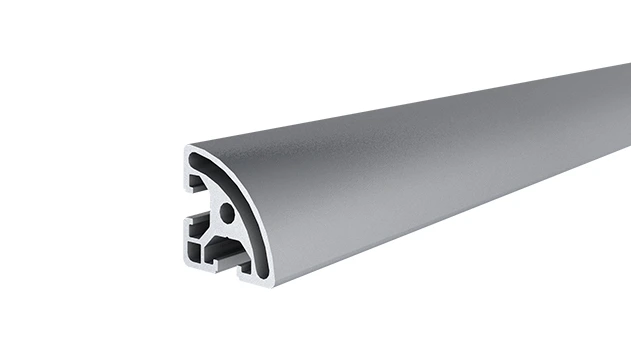
4040R is a 4.00x4.00 CM fractional 40 series square extrusion T-slot profile with two side open T-slots, each side with 4.00cm face,the other side is round face. The profile has align-a-grooves to assist in aligning connecting profiles.
If you've ever tackled a workspace renovation, production line upgrade, or custom equipment build, you know the frustration of one-size-fits-all materials. You order a standard aluminum profile, unbox it, and realize it's either 10cm too long—forcing you to hack it with a saw, leaving a ragged edge that weakens the structure—or 5cm too short, requiring an extra connector that throws off alignment. It's wasteful, time-consuming, and a barrier to creating the efficient, tailored space you need. That's where 4040r EU Standard Aluminum Profile custom lengths come in: a solution designed to fit your project, not the other way around.
Understanding 4040r EU Standard Aluminum Profile
Before diving into custom lengths, let's break down what makes the 4040r EU Standard Aluminum Profile a staple in industrial and commercial projects. The "4040" refers to its cross-sectional dimensions: 40mm in width and 40mm in height, a versatile size that balances strength and flexibility. The "r" denotes rounded edges, a critical detail that enhances safety (no sharp corners for workers to bump against) and gives the profile a clean, professional look. As an EU standard product, it adheres to strict quality controls for material purity, dimensional accuracy, and durability—so you know you're working with a reliable, consistent base.
Most 4040r profiles are made from aluminum alloy 6063-T5, a material prized for its lightweight nature (about 1/3 the weight of steel), excellent corrosion resistance, and impressive strength-to-weight ratio. This makes it ideal for everything from workbenches and shelving to machine guards and production line frames. Unlike generic aluminum, EU-standard profiles undergo rigorous testing to ensure they meet load-bearing requirements—typically 150-200kg per linear meter for static loads—so you can trust them to support tools, materials, and even heavy equipment without bending or warping.
Why Custom Lengths Matter: Beyond "Good Enough"
Standard aluminum profiles are usually sold in fixed lengths: 1m, 2m, 3m, or 6m. While convenient for bulk orders, they're a poor fit for projects with unique dimensions. Let's say you're building a material rack for a warehouse with a ceiling height of 2.7m. A standard 3m profile would require cutting off 30cm—scrapping valuable material and creating extra work. A 2m profile would leave a 70cm gap, forcing you to add a middle support that reduces shelf space and complicates assembly. Custom lengths eliminate this compromise by letting you order profiles cut to the exact millimeter you need: 2.7m, 1.85m, 3.22m—whatever your project demands.
The benefits go beyond convenience. Custom lengths reduce waste: no more piles of aluminum scraps cluttering your workshop or driving up material costs. They also improve structural integrity: cutting a profile on-site with a handheld saw often leaves uneven edges, which can loosen connectors over time. Custom-cut profiles, by contrast, are precision-cut using CNC machines, ensuring clean, straight edges that fit seamlessly with accessories like 90° connectors or end caps. This attention to detail translates to sturdier, longer-lasting structures—whether it's a workbench that supports daily tool use or a conveyor frame that withstands constant vibration.
Cost efficiency is another key advantage. While custom lengths may have a slightly higher upfront cost than standard sizes, they save money in the long run. Think about it: less material waste means fewer orders for extra profiles. Fewer on-site cuts mean less labor time (and frustration) for your team. And a better-fitting structure requires fewer connectors and supports, reducing accessory costs. For businesses focused on lean manufacturing or sustainable practices, this waste reduction aligns perfectly with eco-friendly goals—making custom profiles a smart choice for both your budget and the planet.

The Role of Aluminum Extrusion Profile in Customization
At the heart of 4040r EU Standard Aluminum Profile's customizability is the aluminum extrusion process. Extrusion involves heating aluminum billets to a malleable state, then forcing the material through a die to create the 40mm x 40mm cross-section with rounded edges. This process ensures consistent dimensions across every meter of profile—no warping, no variations in thickness, just uniform quality. But what makes extrusion truly powerful for customization is its compatibility with precision cutting.
After extrusion, profiles are cooled, straightened, and then cut to length. For standard sizes, this is done in bulk. For custom orders, suppliers use CNC cutting machines to trim profiles to exact measurements, often with tolerances as tight as ±0.5mm. This level of accuracy is impossible to achieve with manual cutting, where even a steady hand can drift by 2-3mm. The result? Profiles that fit together like puzzle pieces, whether you're building a simple shelf or a complex production line.
Extrusion also allows for consistent wall thickness—typically 1.5mm to 3mm in 4040r profiles—ensuring that custom lengths maintain the same strength and load capacity as their standard counterparts. There's no weakening at the cut end, no thinning of the material that could compromise structural integrity. This reliability is why industries like automotive manufacturing, electronics assembly, and aerospace rely on extruded aluminum profiles for critical components: they know each custom length will perform exactly as expected.
Integrating with Aluminum Profile Accessories: A Seamless Fit
A custom-length aluminum profile is only as good as its ability to work with accessories—and 4040r EU Standard profiles excel here. Aluminum profile accessories, from 90° connectors and T-joints to end caps and shelf brackets, are designed to fit the 40mm x 40mm cross-section precisely. When your profile is cut to the right length, these accessories attach cleanly, with no gaps or misalignments that could weaken the structure.
Take, for example, building a modular workbench. You need vertical legs (let's say 85cm tall) and horizontal rails (120cm wide). With standard 1m legs, you'd cut 15cm off each, leaving rough edges that might not seat properly in floor brackets. With custom 85cm legs, the brackets slide on smoothly, and the legs stand perfectly straight. The horizontal rails, cut to 120cm, connect to the legs with 90° corner brackets—no extra spacers needed, no wobbly joints. Even small accessories like cable management clips or tool hooks align exactly where you need them, since the profile length matches your layout.
Another example: material racks. Suppose you're designing a rack with three shelves, each 60cm deep. Standard 2m profiles would require cutting two 60cm sections from one 2m length, leaving 80cm of scrap. Custom 60cm profiles eliminate the scrap, and when paired with shelf brackets, they create a stable surface with no overhang. Add aluminum profile accessories like label holders or dividers, and you've got a rack tailored to your materials—no wasted space, no awkward gaps.
Applications in Workbenches: Building for People, Not Just Processes
Workbenches are the backbone of any productive workspace, and one-size-fits-all designs rarely account for the people using them. A 1.2m deep workbench might be perfect for a tall technician but a strain for someone shorter, forcing them to hunch over tools. A standard 2m width could leave unused space in a small workshop or feel cramped in a busy assembly area. Custom 4040r profiles let you build workbenches that adapt to your team's needs—height, width, depth, and layout included.
Consider a electronics assembly workshop where workers alternate between sitting and standing. A custom workbench with adjustable-height legs (using telescoping 4040r profiles cut to 75cm and 90cm) lets each technician set their ideal height, reducing fatigue and improving focus. The desktop, made from aluminum honeycomb panels mounted on custom-length 4040r rails, can be sized to fit the workspace: 1.8m wide for a solo station, 3.2m for a collaborative team setup. Add accessories like LED light bars, power strips, and tool trays—all mounted on precisely cut profiles—and you've got a workbench that feels like it was designed for your team, not just the tasks they perform.
Even specialized workbenches, like ESD (electrostatic discharge) workstations for sensitive electronics, benefit from custom lengths. ESD workbenches require conductive materials and grounding components, which must be positioned exactly to meet safety standards. A custom 4040r frame ensures grounding straps attach at the right height, while the desktop (cut to fit the available space) eliminates the need for extra joints that could disrupt ESD protection. The result? A workspace that's both compliant and efficient.
Enhancing Lean Systems: Streamlining Workflows with Tailored Profiles
Lean systems—focused on eliminating waste, improving flow, and maximizing value—thrive on adaptability. A production line that works for one product may need reconfiguration when a new model is introduced. Standard aluminum profiles, with their fixed lengths and rigid layouts, can slow this process down. Custom 4040r profiles, by contrast, make lean systems more agile, letting you adjust workflows on the fly without sacrificing efficiency.
Take a automotive parts assembly line. When switching from a small component to a larger one, the conveyor system may need to widen by 30cm. With standard 2m conveyor rails, this would require adding two 1.15m sections (cut from 2m profiles) and extra connectors, creating weak points and potential jams. Custom 2.3m rails, however, fit perfectly, reducing the number of joints and ensuring smooth material flow. The same logic applies to material racks: a lean system demands that tools and parts be stored "at point of use," so a custom-length rack positioned exactly between two workstations eliminates unnecessary movement and speeds up production.
Custom profiles also support "5S" principles—sort, set in order, shine, standardize, sustain—by letting you design storage solutions that fit the available space. For example, a warehouse with a narrow aisle (1.2m wide) can use custom 1.1m deep shelving units (cut from 4040r profiles) to maximize storage without blocking access. No more wasted space, no more cluttered walkways—just a streamlined, organized environment that keeps workflows moving.
Standard vs. Custom Lengths: A Practical Comparison
Still on the fence about custom lengths? Let's compare standard and custom 4040r profiles side by side to see how they stack up in real-world scenarios:
| Aspect | Standard Lengths (1m, 2m, 3m, 6m) | Custom Lengths (e.g., 1.23m, 2.78m, 3.55m) |
|---|---|---|
| Waste Generation | High: 10-30% of material may be scrapped due to cutting. | Low: Minimal to no waste—profiles are cut to exact needs. |
| Assembly Time | Longer: Requires on-site cutting, deburring, and adjusting for misalignments. | Shorter: Profiles fit together immediately; no extra tools needed. |
| Structural Integrity | Lower: Hand-cut edges can loosen connectors over time. | Higher: CNC-cut edges ensure tight, secure fits with accessories. |
| Design Flexibility | Limited: Tied to fixed sizes; may require compromising on layout. | Unlimited: Adapt to odd spaces, unique heights, and custom layouts. |
| Long-Term Cost | Higher: Extra material, labor, and replacement costs from wear and tear. | Lower: Reduced waste, faster assembly, and longer-lasting structures. |
The Customization Process: From Idea to Installation
Ordering custom-length 4040r EU Standard Aluminum Profiles is simpler than you might think. Most reputable suppliers (like those specializing in aluminum profile systems) have streamlined the process to ensure quick turnaround and accuracy. Here's how it typically works:
1. Measure Twice, Order Once: Start by mapping your project's dimensions. Whether it's the height of a workbench leg, the length of a conveyor rail, or the depth of a shelf, precise measurements are key. Use a laser measure for accuracy, and note any obstacles (like wall studs or existing equipment) that might affect length.
2. Consult with Your Supplier: Share your measurements with a supplier who offers custom cutting. Many suppliers have online tools or CAD software to help visualize the design, ensuring your custom lengths will work with the accessories you plan to use. They can also advise on load capacities—for example, a 3m custom profile may need a thicker wall than a 1m profile if it's supporting heavy loads.
3. Precision Cutting: Once approved, the supplier uses CNC saws to cut the profiles to your exact length. This step takes 1-3 days for most orders, depending on volume. Some suppliers even offer additional services, like deburring (smoothing cut edges) or anodizing (adding a protective finish) for extra durability.
4. Delivery and Installation: Custom profiles arrive ready to install. Since they're pre-cut, assembly is as simple as attaching accessories and connecting sections—no saws, no grinders, no mess. Most projects that would take a day with standard profiles can be completed in half the time with custom lengths.
Overcoming Common Concerns About Custom Lengths
If you're hesitant to switch from standard to custom lengths, you're not alone. Here are answers to common concerns:
"Custom lengths will take too long to deliver." Not anymore. Many suppliers keep 4040r profiles in stock and offer same-day or next-day cutting for small orders. Even large orders (100+ profiles) typically ship within 3-5 business days—faster than waiting for a standard length to arrive and then cutting it yourself.
"They'll cost more than standard profiles." While custom lengths may have a small premium (5-10% more per meter), the savings in material waste and labor often offset this. For example, a 3m standard profile costs $20; cutting it to 2.5m wastes 0.5m ($3.33 in scrap). A custom 2.5m profile might cost $22, but you save $3.33 on scrap and $15 on labor (assuming 1 hour of cutting time at $15/hour). Net savings: $16.33.
"I'm worried about accuracy—what if the length is wrong?" Reputable suppliers guarantee ±0.5mm tolerance on custom cuts, and many offer returns or re-cuts if there's an error. It's rare, but it's good to choose a supplier with a clear quality guarantee.
Conclusion: Build for Your Project, Not the Status Quo
In a world where efficiency and customization are key to success, 4040r EU Standard Aluminum Profile custom lengths offer a simple yet powerful solution. They eliminate waste, save time, and let you build structures that fit your space, your team, and your goals—whether it's a lean production line, a ergonomic workbench, or a modular storage system. By choosing custom lengths, you're not just buying aluminum; you're investing in a project that works for you, not against you.
So the next time you're planning a build, skip the standard lengths and ask for custom. Your workspace, your team, and your bottom line will thank you.