- Company Articles
- Products and Technology
- Product knowledge
- 4040r EU Standard Aluminum Profile Material Rack B vs. Traditional Racks

4040r EU Standard Aluminum Profile Material Rack B vs. Traditional Racks
Related Product
4040R EU Standard Aluminum Profile
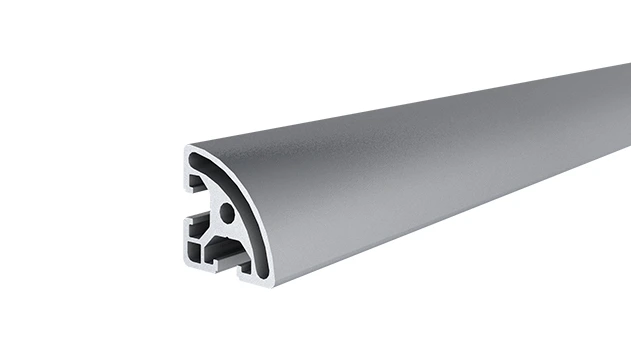
4040R is a 4.00x4.00 CM fractional 40 series square extrusion T-slot profile with two side open T-slots, each side with 4.00cm face,the other side is round face. The profile has align-a-grooves to assist in aligning connecting profiles.
Walk into any busy warehouse, manufacturing plant, or distribution center, and you'll likely be greeted by a familiar sight: rows of metal racks stretching toward the ceiling, each holding boxes, parts, or tools. For decades, these traditional storage racks have been the backbone of inventory management, relied upon to keep operations running smoothly. But if you take a closer look, you'll start to notice the cracks in the system—racks that can't be adjusted when product sizes change, rusted metal edges that scratch items (and workers), and the all-too-common struggle of trying to fit a square peg into a round hole when your storage needs evolve. It's a scenario that's costing businesses time, money, and efficiency every single day.
Enter the 4040r EU Standard Aluminum Profile Material Rack B—a modern solution designed to address the shortcomings of traditional racks. Built around the 4040r EU standard aluminum profile, this rack isn't just a storage unit; it's part of a lean system that prioritizes flexibility, durability, and adaptability. In this article, we'll dive deep into how this innovative rack stacks up against its traditional counterparts, exploring everything from design and assembly to cost-effectiveness and real-world performance. By the end, you'll understand why more and more facilities are making the switch—and why you might want to too.
The Problem with Traditional Racks: A Closer Look
Before we jump into the benefits of the 4040r aluminum rack, let's first unpack why traditional racks have become a pain point for so many businesses. Traditional storage racks are typically made from heavy steel, welded or bolted together in fixed configurations. They're built to last, sure—but "last" often comes with a catch: rigidity. Once installed, these racks are difficult (if not impossible) to reconfigure. Need to lower a shelf to fit shorter boxes? You'll likely need to call in a welder or buy a whole new rack. Have a sudden surge in inventory that requires adding more levels? Good luck—traditional racks are designed with a set number of shelves, and altering that means major overhauls.
Then there's the issue of weight. Steel is strong, but it's also heavy, making traditional racks difficult to move or relocate. If your facility rearranges its layout to improve workflow, you're looking at hours (or days) of disassembly, transportation, and reassembly—not to mention the risk of damaging the racks (or your floors) in the process. And let's not forget about corrosion. In humid environments—like warehouses near the coast or facilities with temperature fluctuations—steel racks are prone to rust. Over time, that rust weakens the structure, reducing load capacity and increasing the risk of collapse. Even in dry environments, scratches from daily use can expose the metal to moisture, starting the corrosion process all over again.
Durability aside, traditional racks often lack the precision needed for modern inventory management. Shelves are rarely perfectly level, leading to items sliding off or becoming misaligned. Sharp edges on steel racks can tear packaging, damage delicate parts, or even injure workers who brush against them. And when it comes to customization? Forget about it. Traditional racks come in standard sizes, and if your needs don't fit those sizes, you're forced to compromise—either by wasting space with oversized racks or cramming items into undersized ones, which risks damage and inefficiency.
Meet the 4040r EU Standard Aluminum Profile Material Rack B: A New Era of Storage
Now, let's turn our attention to the star of the show: the 4040r EU Standard Aluminum Profile Material Rack B. At first glance, it might look like just another rack, but under the surface, it's a masterclass in modern engineering. Let's start with the basics: the 4040r EU standard aluminum profile. This isn't your average aluminum tube—it's an extruded profile with a specific cross-section designed for strength and versatility. The "4040r" refers to its dimensions (40mm x 40mm) and rounded edges (the "r" stands for "rounded"), which not only add a sleek look but also enhance safety by reducing sharp corners.
The Material Rack B itself is a prime example of how this profile shines. Specifically designed as a 3 row and 3 floor unit, it's built to maximize vertical and horizontal space without sacrificing accessibility. Each row and floor can be adjusted independently, thanks to the aluminum profile accessories that make up its framework—think brackets, connectors, and shelf supports that slide into the T-slots of the 4040r profile. This means you're not stuck with fixed shelf heights; if you need to store taller items on one level and shorter ones on another, you can tweak the configuration in minutes, not days.
But what really sets this rack apart is its integration into a lean system. Lean manufacturing (and lean storage, by extension) is all about eliminating waste—whether that's wasted space, wasted time, or wasted effort. The 4040r aluminum rack embodies this philosophy by being modular. Need to add more rows? Just attach additional 4040r profiles using compatible connectors. Want to convert part of the rack into a mobile unit? Swap out fixed feet for casters (though Material Rack B is typically stationary, the design allows for such modifications). It's a storage solution that grows with your business, not against it.

Design & Flexibility: Traditional Racks vs. 4040r Aluminum Racks
When it comes to design and flexibility, the gap between traditional racks and the 4040r aluminum rack is like night and day. Let's break it down.
Traditional Racks: One Size Fits (Almost) No One
Traditional steel racks are designed with a "set it and forget it" mindset. They're built in fixed lengths, widths, and heights, with shelves spaced at standard intervals (often 12 or 18 inches apart). This might work if your inventory never changes—if you're storing the same size boxes, with the same weight, forever. But in reality, businesses evolve. A manufacturer might introduce a new product line with larger components; a warehouse might start handling smaller, more frequent orders that require more accessible shelving. When that happens, traditional racks become a liability.
Take, for example, a bakery that uses traditional steel racks to store ingredients. Initially, they stock 50-pound flour bags, so the shelves are spaced 24 inches apart to fit the bags standing upright. But when they start offering gluten-free options, the gluten-free flour comes in 25-pound bags that are shorter—suddenly, there's 12 inches of wasted space above each bag. To fix this, the bakery would need to either buy a whole new rack with closer spacing or live with the inefficiency, losing valuable storage space that could be used for other ingredients. Over time, that wasted space adds up, forcing businesses to rent additional storage or expand their facilities prematurely.
4040r Aluminum Racks: Adaptable by Design
The 4040r EU Standard Aluminum Profile Material Rack B, by contrast, is built for change. Let's start with its core component: the 4040r aluminum profile. This profile features T-slots—longitudinal grooves running along its length—that allow aluminum profile accessories to be attached anywhere along the profile, not just at pre-drilled holes. This might sound like a small detail, but it's revolutionary. Shelf brackets, dividers, and even custom accessories can be slid into these slots and secured with bolts, giving you infinite adjustability.
Consider the Material Rack B's 3 row and 3 floor design. Each floor (or shelf) is supported by brackets that fit into the T-slots of the vertical 4040r profiles. To adjust a shelf height, you simply loosen the bolts holding the brackets, slide the brackets up or down to the desired position, and retighten. No drilling, no welding, no guesswork. Need to create a shelf that's 15 inches high for small parts bins? Done. Want to set the next shelf at 30 inches for larger toolboxes? Just as easy. This level of flexibility means the rack can adapt to virtually any item size, from tiny electronic components to bulky machinery parts.
But flexibility isn't just about vertical adjustment. The 4040r profile's modular design also allows for horizontal customization. Need to widen a row to accommodate longer items? Attach extension profiles using aluminum connectors. Want to add dividers to separate different product lines on the same shelf? Snap in T-slot dividers that can be positioned anywhere along the shelf. Even specialized features, like label holders for inventory tracking or hooks for hanging tools, can be added using off-the-shelf aluminum profile accessories. Traditional racks, with their fixed layouts, simply can't compete—you're either stuck with the manufacturer's design or forced to hack together solutions that never quite work.
A Side-by-Side Comparison: Design & Flexibility
| Feature | Traditional Steel Racks | 4040r EU Standard Aluminum Profile Material Rack B |
|---|---|---|
| Configuration | Fixed; pre-drilled holes or welded joints limit adjustments to preset intervals. | Modular; T-slot design allows infinite shelf height/width adjustments via aluminum profile accessories. |
| Reconfiguration Time | Days to weeks (requires welding, drilling, or new rack purchase). | Minutes to hours (basic tools and minimal labor needed). |
| Space Optimization | Poor; fixed spacing leads to wasted vertical/horizontal space. | Excellent; adjustable shelves eliminate gaps, maximizing storage density. |
| Customization Options | Limited to manufacturer-provided add-ons (e.g., wire shelves, label holders). | Unlimited; T-slots support endless accessories (dividers, hooks, lighting, etc.). |
Durability & Load Capacity: Built to Last (and Then Some)
Critics of aluminum racks often raise the same concern: "Isn't aluminum weaker than steel? How can it hold as much weight?" It's a fair question—steel has long been synonymous with strength in industrial settings. But here's the truth: modern aluminum alloys, especially those used in structural applications like the 4040r profile, are engineered to be both lightweight and incredibly strong. When combined with the T-slot design, which distributes weight evenly across the profile, the 4040r aluminum rack holds its own against traditional steel racks—often with added benefits.
Material Matters: Steel vs. Aluminum
Traditional steel racks are typically made from carbon steel, which is strong but dense and prone to corrosion. Even with powder coating or paint, steel racks in humid, damp, or chemical-exposed environments will eventually rust. This rust doesn't just look bad—it weakens the metal, creating cracks and reducing load capacity over time. For businesses that handle food, beverages, or chemicals, this is a critical flaw; rust can contaminate products, leading to recalls or health violations.
Aluminum, by contrast, is naturally corrosion-resistant. When exposed to air, it forms a thin, invisible layer of aluminum oxide that acts as a protective barrier, preventing further oxidation. This means the 4040r aluminum rack can withstand humid warehouses, washdown areas, and even outdoor storage (with proper covering) without rusting. For pharmaceutical or food processing facilities, this is a game-changer—no more worrying about rust stains on inventory or weakened structural integrity.
But what about load capacity? Let's get specific. A typical traditional steel rack might have a load capacity of 500-800 kg per shelf, depending on its design and steel gauge. The 4040r aluminum rack, while lighter, isn't far behind. Thanks to the 4040r profile's robust cross-section (40mm x 40mm) and high-quality aluminum alloy (often 6063-T5, a common structural alloy known for its strength and weldability), each shelf can comfortably support 400-600 kg—more than enough for most industrial, warehouse, or manufacturing needs. And because the weight is distributed evenly across the T-slot accessories (like shelf brackets and support beams), there's less risk of stress points that can cause bending or failure.
Longevity: The Gift That Keeps on Giving
Durability isn't just about how much weight a rack can hold—it's about how long it can hold that weight. Traditional steel racks, when meticulously maintained (regular cleaning, repainting, rust treatment), can last 10-15 years. But "meticulously maintained" is the key phrase here. Without ongoing care, their lifespan drops to 5-7 years, especially in harsh environments. The 4040r aluminum rack, by contrast, requires almost no maintenance. No rust to treat, no paint to touch up—just an occasional wipe-down with a damp cloth to remove dust or debris. This lack of upkeep means the aluminum rack can easily last 15-20 years, outperforming traditional racks in the long run.
Another factor in longevity is impact resistance. In busy facilities, racks take a beating—forklifts nudge them, boxes get dropped against them, and workers accidentally bump into them. Traditional steel racks can dent or bend under impact, weakening their structure and creating sharp edges. Aluminum is more malleable than steel, meaning it can absorb minor impacts without permanent damage. And if a 4040r profile or accessory does get damaged (say, a bracket bends), it's easy to replace—just swap out the damaged part, no need to replace the entire rack. Traditional racks, once bent or dented, are often beyond repair and must be replaced entirely.
Assembly & Customization: From Box to Functionality in Hours
Anyone who's ever installed traditional steel racks knows the drill: heavy lifting, specialized tools, and a whole lot of time. Traditional racks often come in large, cumbersome pieces that require at least two people to maneuver. Welding is frequently involved, which means hiring a certified welder or having trained staff on hand—adding cost and complexity. Even bolt-together steel racks require wrenches, ratchets, and sometimes power tools to tighten the heavy-duty bolts, turning assembly into a multi-hour (or multi-day) project.
The 4040r aluminum rack, by comparison, is a breeze to assemble. Thanks to its lightweight aluminum profiles (a 2-meter 4040r profile weighs just 1.8 kg, compared to 4-5 kg for a steel profile of the same size) and intuitive T-slot design, most assemblies can be handled by one or two people with basic tools. The key is the aluminum profile accessories: brackets, connectors, and shelf supports that slide into the T-slots and secure with simple bolts or set screws. No welding, no drilling, no guesswork—just align the accessories, tighten the fasteners, and you're done.
Let's put this into perspective. A traditional steel rack of similar size to the Material Rack B (3 row, 3 floor) might take a team of two people 4-6 hours to assemble, including time for welding, aligning, and bolting. The 4040r aluminum rack? That same team could have it up and running in 1-2 hours. For a facility installing 10 racks, that's a difference of 30-50 hours of labor—time that could be spent on more productive tasks, like organizing inventory or training staff.
Customization is where the 4040r rack truly shines. Traditional racks might offer a few token options—like adding a wire mesh shelf or a plastic bin divider—but that's about it. The 4040r rack, however, can be customized to fit almost any need, thanks to the vast ecosystem of aluminum profile accessories. Need to add LED lighting to the rack for better visibility in dimly lit warehouses? Attach T-slot light fixtures. Want to integrate barcode scanners or small tools? Use tool holders designed for T-slots. Even specialized needs, like ESD (electrostatic discharge) protection for electronics manufacturing (though Material Rack B isn't inherently ESD-rated, you could add ESD mats or conductive accessories), can be accommodated with the right add-ons.
And if you ever need to disassemble the rack—whether to move it to a new location, reconfigure it, or repurpose it—disassembly is just as easy as assembly. No cutting or grinding required; just loosen the bolts, remove the accessories, and pack up the profiles. Traditional racks, once welded, are practically permanent—disassembling them often means cutting them apart with torches or angle grinders, rendering them unusable for future reassembly and creating safety hazards in the process.
Cost-Effectiveness: The Long Game vs. Short-Term Savings
Let's talk money—a topic that's always top of mind for businesses. At first glance, traditional steel racks might seem like the more cost-effective option. A basic steel rack can cost anywhere from $100 to $300 per unit, depending on size and load capacity. The 4040r aluminum rack, with its premium materials and modular design, often starts at a higher price point—maybe $200 to $400 per unit. On paper, that's a 50-100% increase in upfront cost. But here's the thing: cost-effectiveness isn't just about what you pay today; it's about what you pay over the lifetime of the product. And when you factor in long-term costs, the aluminum rack starts to look like the smarter investment.
Upfront Cost vs. Lifecycle Cost
Let's break it down with a hypothetical scenario. Suppose you run a mid-sized warehouse and need 10 storage racks. Traditional steel racks cost $200 each, so your upfront cost is $2,000. The 4040r aluminum racks cost $300 each, so upfront you're looking at $3,000—a $1,000 difference. Now, fast-forward five years. During that time, your business has grown, and your storage needs have changed. With traditional racks, you've had to replace three of them because they couldn't be reconfigured for new product sizes, costing another $600 ($200 x 3). You've also spent $200 per year on rust treatment and repainting, totaling $1,000 over five years. So total cost over five years: $2,000 + $600 + $1,000 = $3,600.
With the 4040r aluminum racks, you haven't needed to replace any—you've just reconfigured the existing ones using aluminum profile accessories, which cost $50 total (for brackets and connectors). Maintenance? Zero, since there's no rust to treat. So total cost over five years: $3,000 + $50 = $3,050. Already, the aluminum racks are cheaper. Now extend to 15 years—the typical lifespan of an aluminum rack. With traditional racks, you'd likely replace 8-10 racks (due to rust, damage, or obsolescence) and spend $3,000 on maintenance, totaling $2,000 + $2,000 (replacements) + $3,000 (maintenance) = $7,000. The aluminum racks? Still going strong, with $200 in reconfiguration accessories over 15 years. Total cost: $3,000 + $200 = $3,200. The aluminum racks save you $3,800 over 15 years—a massive difference that more than justifies the higher upfront cost.
Downtime: The Hidden Cost of Traditional Racks
Another hidden cost of traditional racks is downtime. When you need to reconfigure or replace a traditional rack, you often have to shut down part of your facility. Welders need space to work, workers can't access inventory on or near the rack, and forklifts are tied up moving the old rack out and the new one in. For a facility that operates 8 hours a day at $150 per hour in labor and productivity costs, a day of downtime costs $1,200. Over 15 years, with multiple reconfigurations, this adds up to tens of thousands of dollars in lost revenue. The 4040r aluminum rack's quick assembly and reconfiguration mean minimal downtime—often just an hour or two, compared to a full day for traditional racks. It's a savings that's hard to quantify but impossible to ignore.
Safety: Protecting Your Team and Your Inventory
In any workplace, safety should never be an afterthought. Traditional racks, while sturdy, can pose a number of safety risks that often go unaddressed until an accident happens. The 4040r aluminum rack, by contrast, is designed with safety in mind from the ground up.
Let's start with sharp edges. Traditional steel racks often have rough, welded edges or exposed bolt heads that can scratch, cut, or snag clothing. In a busy warehouse, this isn't just a nuisance—it's a hazard. A worker rushing to grab a part could catch their arm on a sharp edge, leading to cuts or even more serious injuries like lacerations or infections. The 4040r aluminum profile, with its rounded edges (the "r" in 4040r), eliminates this risk. Every corner is smooth, and aluminum profile accessories are designed with matching rounded edges, ensuring the entire rack is safe to be around.
Stability is another key concern. Traditional steel racks, when overloaded or improperly installed, can become unstable, leading to tipping or collapse. The 4040r aluminum rack's modular design, with its secure T-slot connections and wide base, provides superior stability. Each accessory is locked into place with bolts, leaving no room for wobble or shifting. And because the rack is lightweight, there's less kinetic energy if it does tip (though with proper installation, tipping is highly unlikely). Additionally, the 4040r profile's uniform construction ensures weight is distributed evenly, reducing the risk of overloading individual components.
Ergonomics also play a role in safety. Traditional racks with fixed shelf heights can force workers to stretch, bend, or climb to reach items—movements that increase the risk of strains, sprains, or falls. The 4040r rack's adjustable shelves allow you to set heights at ergonomic levels (typically 75-150 cm from the ground for easy access), reducing the need for stretching or climbing. This not only makes the workplace safer but also reduces fatigue, leading to more productive and alert workers.
Real-World Applications: How Businesses Are Thriving with the 4040r Rack
To truly understand the impact of the 4040r EU Standard Aluminum Profile Material Rack B, let's look at a real-world example. Meet GreenTech Manufacturing, a mid-sized producer of renewable energy components with a 15,000 sq. ft. warehouse. Five years ago, their facility was filled with 30 traditional steel racks, each in fixed configurations. As they expanded into solar panel production, they quickly ran into problems: solar cells and inverters came in larger boxes than their existing racks could handle, leading to overcrowding and unsafe stacking. They also struggled with wasted space—smaller components like wiring harnesses were stored on shelves with too much vertical clearance, leaving valuable space unused.
In 2019, GreenTech decided to invest in 20 units of the 4040r aluminum Material Rack B. The initial cost was higher than replacing their steel racks, but they were drawn to the flexibility and durability. Within three months, they noticed a dramatic difference. By adjusting shelf heights to fit each component size, they reduced wasted space by 30%, allowing them to store 40% more inventory in the same warehouse footprint. Reconfiguration time dropped from days to hours—when they introduced a new line of battery storage systems, they were able to adjust five racks in an afternoon, with no downtime.
Maintenance costs also plummeted. Previously, they spent $1,800 per year on rust treatment and repainting for their steel racks; with the aluminum racks, that cost disappeared. Worker satisfaction improved too—employees reported less strain from reaching items, and the smooth, rounded edges reduced minor injuries like cuts and scrapes by 50%. "It's not just a storage solution," says their warehouse manager. "It's a productivity booster. We no longer dread product launches because we know our racks can keep up."
Conclusion: The Future of Storage Is Here
Traditional storage racks have served businesses well for decades, but in an era where flexibility, efficiency, and safety are more important than ever, they're starting to show their age. The 4040r EU Standard Aluminum Profile Material Rack B represents a new way of thinking about storage—one that prioritizes adaptability, durability, and long-term value. Built around the 4040r EU standard aluminum profile and integrated into a lean system, this rack isn't just a place to put things; it's a tool that helps businesses work smarter, not harder.
From its modular design and easy assembly to its corrosion resistance and low maintenance, the 4040r aluminum rack addresses nearly every pain point of traditional racks. It's a solution that grows with your business, adapts to your changing needs, and saves you money in the long run. And when paired with aluminum profile accessories, the possibilities for customization are endless—making it suitable for everything from small workshops to large-scale warehouses.
So, if you're still relying on traditional racks and finding yourself frustrated by wasted space, high maintenance costs, or the inability to keep up with changing inventory, it might be time to consider the switch. The 4040r EU Standard Aluminum Profile Material Rack B isn't just a storage upgrade; it's an investment in your business's efficiency, safety, and future. And in today's fast-paced world, that's an investment worth making.