- Company Articles
- Products and Technology
- Product knowledge
- 4040r EU Standard Aluminum Profile Weight-to-Strength Ratio: Engineering Insights

4040r EU Standard Aluminum Profile Weight-to-Strength Ratio: Engineering Insights
Related Product
4040R EU Standard Aluminum Profile
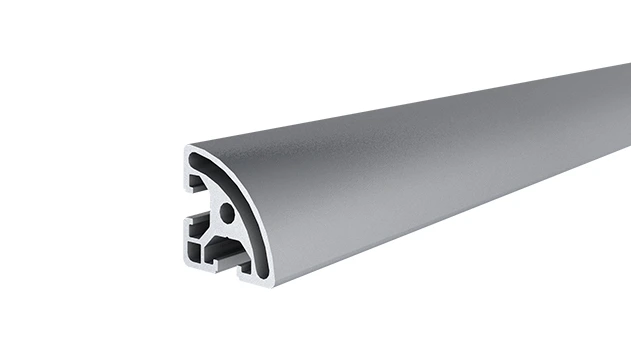
4040R is a 4.00x4.00 CM fractional 40 series square extrusion T-slot profile with two side open T-slots, each side with 4.00cm face,the other side is round face. The profile has align-a-grooves to assist in aligning connecting profiles.
Walk into any modern factory, warehouse, or workshop, and you'll likely spot a silent workhorse holding everything together: aluminum profiles. These unassuming structures—sleek, lightweight, and surprisingly strong—are the backbone of countless industrial setups, from assembly lines to workbenches. But not all aluminum profiles are created equal. Among the many options, the 4040r EU Standard Aluminum Profile stands out, particularly for its impressive weight-to-strength ratio. In this article, we'll dive into what makes this profile a favorite among engineers and manufacturers, exploring its design, applications, and the real-world impact of its unique balance of heft and durability.
Why Weight-to-Strength Ratio Matters in Engineering
Before we zoom in on the 4040r, let's talk about the star of the show: weight-to-strength ratio. Simply put, this metric measures how much strength a material offers relative to its weight. For engineers, it's not just a number—it's a game-changer. A high weight-to-strength ratio means a material can support heavy loads without adding unnecessary bulk, which translates to easier transportation, lower installation costs, and more flexibility in design.
Think about it: If you're building a workbench for a factory floor, you want it to hold heavy tools and components without wobbling. But if that bench is too heavy, moving it (say, to reconfigure the production line) becomes a hassle—requiring extra or equipment. Similarly, in material handling systems like racks or trolleys, excess weight can slow down workflows and increase energy use. This is where aluminum, and specifically well-designed aluminum extrusion profiles, shine. Unlike steel, which is strong but dense, aluminum offers a rare combination of lightness and resilience—making it ideal for dynamic industrial environments.
Meet the 4040r EU Standard Aluminum Profile
The 4040r is part of the EU standard aluminum extrusion profile family, a set of specifications designed to ensure consistency, safety, and quality across European manufacturing. The "4040" refers to its cross-section dimensions: 40mm by 40mm, a common size for medium-duty applications. The "r" stands for "rounded," indicating its smooth, curved edges—a detail that enhances safety (fewer sharp corners to bump into) and gives it a clean, modern look.
But the 4040r isn't just about looks. Its real claim to fame is its composition. Made from 6063-T5 aluminum alloy—a popular choice for extrusions—this profile undergoes a precise heat treatment process that strengthens its molecular structure. The result? A material that can handle tensile strengths of around 180-220 MPa (megapascals) while weighing in at just 2.2-2.5 kg per meter (depending on wall thickness). To put that in perspective: a 2-meter length of 4040r weighs roughly the same as a small backpack but can support hundreds of kilograms when properly braced.

Engineering Insights: How the 4040r Achieves Its Ratio
The Extrusion Process: Shaping Strength
Aluminum extrusion is often called the "magic" behind profiles like the 4040r. Here's how it works: heated aluminum billets are pushed through a die (a custom-shaped mold) under high pressure, forming the profile's cross-section. This process aligns the metal's grains in the direction of extrusion, boosting its strength. For the 4040r, the die is engineered to create a hollow core with strategically placed internal ribs. These ribs add rigidity without thickening the walls, keeping weight low while maximizing structural integrity.
Design Nuances: Rounded Edges and Wall Thickness
You might wonder: do rounded edges affect strength? Surprisingly, yes. The 4040r's curved corners distribute stress more evenly than sharp angles, reducing weak points that could crack under load. Additionally, its wall thickness—typically 1.5-2mm—is optimized. Too thin, and the profile would flex; too thick, and it would gain unnecessary weight. Engineers balance these factors to hit the sweet spot for medium-duty tasks, like supporting workbenches or light material racks.
Comparing the 4040r to Other Profiles: A Data Breakdown
To truly appreciate the 4040r, let's see how it stacks up against similar EU standard aluminum profiles. The table below compares key metrics: weight per meter, tensile strength, and common applications.
| Profile Type | Dimensions (mm) | Weight per Meter (kg) | Tensile Strength (MPa) | Typical Applications |
|---|---|---|---|---|
| 4040r EU Standard Aluminum Profile | 40x40 (rounded edges) | 2.3 | 200 | Workbenches, lean system frames, medium-duty racks |
| 4040a EU Standard Aluminum Profile | 40x40 (square edges) | 2.5 | 210 | Heavy-duty machinery frames, fixed shelving |
| 3030r EU Standard Aluminum Profile | 30x30 (rounded edges) | 1.5 | 190 | Lightweight trolleys, small workstations |
| 2020 EU Standard Aluminum Profile | 20x20 | 0.8 | 180 | Electronics assembly, mini-racks, display stands |
Notice the 4040r's sweet spot: it's lighter than the square-edged 4040a (which prioritizes maximum strength) but stronger than the smaller 3030r. This balance makes it versatile—equally at home as a workbench frame or part of a lean system's modular setup.
Practical Applications: Where the 4040r Shines
Numbers tell part of the story, but real-world use cases bring it to life. Let's explore how manufacturers and engineers are putting the 4040r to work.
Workbenches: Stability Without the Strain
A well-built workbench is the heart of any workshop, and the 4040r is a top choice here. Imagine a mechanic's bench in an auto shop: it needs to hold heavy engine parts, tools, and maybe even a diagnostic computer. A 4040r frame, paired with a sturdy tabletop (like aluminum honeycomb panel), provides the stability to keep everything steady during repairs. Yet, because the profile is lightweight, the entire bench can be moved with just two people when the shop needs a layout change. This flexibility is a game-changer for small businesses where space and adaptability matter.
Lean Systems: Modularity Meets Durability
Lean manufacturing is all about minimizing waste and maximizing efficiency—and modularity is key. Lean systems often require quick reconfigurations: adding a new station, adjusting a conveyor path, or scaling up production. The 4040r's weight-to-strength ratio makes it perfect for these dynamic setups. Its lightness means workers can assemble or disassemble frames without heavy equipment, while its strength ensures the system stays rigid under daily use. Pair it with aluminum profile accessories like 90° aluminum profile connectors or gusset alp 4040 brackets, and you've got a setup that can evolve with your needs—no welding or custom fabrication required.
Material Racks and Trolleys: Moving Heavy Loads with Ease
Material handling is another area where the 4040r excels. Consider a warehouse rack used to store boxes of components. A 4040r frame can support multiple shelves loaded with goods, but because it's not overly heavy, installing the rack is a one-person job (or a quick team task). Similarly, trolleys built with 4040r are easy to push around the factory floor, even when loaded—reducing worker fatigue and speeding up material transport.
Aluminum Profile Accessories: Enhancing the 4040r's Versatility
A profile is only as good as the accessories that bring it to life. The 4040r works seamlessly with a range of aluminum profile accessories, turning a simple extrusion into a fully functional system. Let's highlight a few key players:
Connectors and Joints: Building Blocks of Modularity
90° aluminum profile connectors are the unsung heroes of 4040r setups. These small, sturdy pieces lock profiles together at right angles, creating frames, shelves, or workbench legs in minutes. Unlike welding, which is permanent and time-consuming, connectors allow for quick adjustments. Need to raise a shelf by 10cm? Just loosen the connector, reposition, and tighten—done.
Aluminum Foot Base: Stability from the Ground Up
Even the strongest profile needs a solid foundation. Aluminum foot bases attach to the bottom of 4040r legs, distributing weight evenly and preventing the frame from sinking into soft floors (like concrete that's seen better days). They also add a layer of vibration dampening—useful for workbenches where precision matters, like electronics assembly.
End Caps and Gussets: Finishing Touches with Purpose
End caps might seem like a minor detail, but they're essential. These plastic or metal caps fit over the ends of 4040r profiles, keeping out dust and debris that could jam connectors. Gusset alp 4040 brackets, on the other hand, add extra reinforcement at joints—critical for setups that bear heavy loads, like industrial workbenches or material racks.
Challenges and Considerations: When to Choose the 4040r (and When Not To)
While the 4040r is versatile, it's not a one-size-fits-all solution. For ultra-heavy-duty applications—like supporting tons of machinery—you might need a beefier profile, such as the 4040a or even steel. Conversely, for tiny, lightweight projects (like a small display shelf), the 2020 EU standard aluminum profile would be more cost-effective. The key is matching the profile to the load: engineers often calculate expected weight, vibration, and usage frequency to ensure the 4040r (or any profile) is up to the task.
Another consideration is cost. Aluminum extrusion profiles are generally more expensive than steel upfront, but their longevity, low maintenance, and energy savings (from reduced transportation and handling) often make them a better long-term investment. The 4040r, with its balanced performance, hits a sweet spot here—offering enough durability to justify the cost without overspending on unnecessary strength.
Looking Ahead: The Future of Aluminum Profiles in Manufacturing
As manufacturing evolves—with trends like automation, sustainability, and flexible production—materials like the 4040r will only grow in importance. Its lightweight nature aligns with sustainability goals (less energy to transport, recyclable aluminum), while its modularity fits the demand for adaptable workspaces. We might even see advancements in extrusion technology, further improving weight-to-strength ratios or adding features like integrated wiring channels for smart factories.
For now, though, the 4040r remains a reliable staple—a testament to the power of thoughtful engineering. It's not just a piece of metal; it's a tool that helps businesses work smarter, adapt faster, and build better. The next time you walk through a factory or workshop, take a closer look at those aluminum frames. Chances are, you'll spot the 4040r—quietly doing its job, proving that sometimes, the best solutions are the ones that balance strength and simplicity.
Final Thoughts
The 4040r EU Standard Aluminum Profile isn't just another industrial component. It's a masterclass in engineering balance—offering the strength to support heavy loads, the lightness to enable flexibility, and the durability to stand up to daily wear and tear. Whether you're building a workbench, a lean system, or a material rack, this profile delivers where it counts: in real-world performance. For engineers and manufacturers, that's more than just a good product—it's a partner in progress.