- Company Articles
- Products and Technology
- Product knowledge
- 4080A EU Standard Aluminum Profile for Battery Production Lines: Safety & Conductivity

4080A EU Standard Aluminum Profile for Battery Production Lines: Safety & Conductivity
Related Product
4080A EU Standard Aluminum Profile
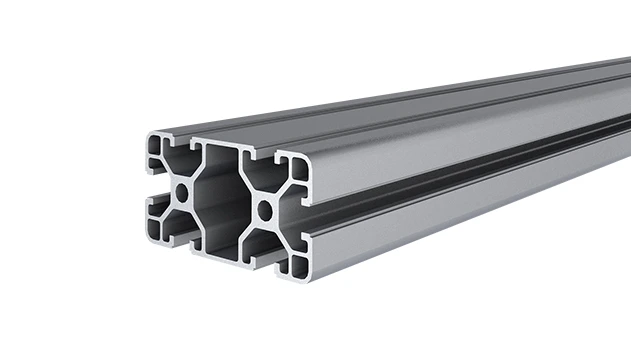
4080A is a 4.00x8.00 CM fractional 40 series square extrusion T-slot profile with two side open T-slots, each side with 4.00cm face, two side with 8.00cm face. The profile has align-a-grooves to assist in aligning connecting profiles.
In the fast-paced world of battery manufacturing, where precision meets pressure, every component in your production line matters. From the smallest connector to the framework of your workstations, the right tools can mean the difference between smooth operations and costly delays—or worse, safety risks. Today, we're diving into a workhorse of modern manufacturing: the 4080A EU Standard Aluminum Profile. If you're running a battery production line, this isn't just another piece of metal. It's a foundation for safety, a booster for efficiency, and a silent partner in keeping your operations lean and compliant. Let's break down why this aluminum extrusion profile has become a go-to choice for engineers and plant managers who refuse to compromise on quality.
First Things First: What *Is* the 4080A EU Standard Aluminum Profile?
Let's start with the basics. The 4080A is part of the EU standard aluminum extrusion profile family—a group of modular, T-slot aluminum structures designed for flexibility and strength. The numbers "4080" tell you its dimensions: 40mm in width and 80mm in height. That might sound like just numbers on a spec sheet, but in the context of battery production, those dimensions are carefully engineered to balance two critical needs: sturdiness and adaptability .
Unlike generic steel frames or flimsy plastic structures, aluminum extrusion profiles like the 4080A are created through a process where aluminum alloy is forced through a die, resulting in a consistent, high-strength shape. This method ensures every meter of 4080A profile has the same load-bearing capacity, the same conductivity, and the same resistance to wear—no weak spots, no surprises. And because it's aluminum, it's lightweight enough to reconfigure when your production needs change, but tough enough to handle the daily grind of a busy battery line.
But what really sets the 4080A apart? Its T-slot design. Those grooves running along its length aren't just for show. They're the reason you can attach aluminum profile accessories—like connectors, brackets, shelves, or even ESD-safe work surfaces—in minutes, without welding or drilling. For battery manufacturers, where production lines often need to shift between cell types, sizes, or assembly steps, that modularity is a game-changer. You're not stuck with a fixed workstation; you're building a system that grows with you.
Safety First: Why 4080A is a Lifesaver in Battery Production
Battery production is a high-stakes environment. We're talking about handling sensitive components—lithium-ion cells, circuit boards, delicate wiring—where a single static discharge or structural failure could lead to short circuits, equipment damage, or even fires. That's why safety isn't just a buzzword here; it's the backbone of every decision. Let's unpack how the 4080A profile addresses two of the biggest safety risks in your line: electrostatic discharge (ESD) and structural instability.
ESD Protection: Keeping Static at Bay
Ever walked across a carpet and gotten a shock when touching a doorknob? That's static electricity. Now imagine that tiny spark in a room full of lithium-ion batteries. Even a small electrostatic discharge can damage battery cells, reduce their lifespan, or in extreme cases, trigger thermal runaway—a catastrophic chain reaction that's dangerous and costly. This is where ESD workstations and conductive materials become non-negotiable.
The 4080A profile, when paired with the right accessories, acts as a natural ESD solution. Aluminum is inherently conductive, meaning it doesn't trap static charge—it dissipates it. When you build your workstation frames, material racks, or conveyor rails with 4080A, you're creating a grounded pathway for static electricity to flow safely away from your batteries. No more random sparks, no more damaged cells, no more late-night calls about production halts due to ESD-related issues.
But here's the catch: Not all aluminum profiles are created equal. Some cheaper alternatives might skimp on alloy quality, leading to inconsistent conductivity. The 4080A, as an EU standard profile, meets strict conductivity benchmarks. It's not just "conductive enough"—it's engineered to provide a reliable, low-resistance path for static dissipation, ensuring your ESD workstation setup actually works when it matters most.
Structural Safety: Built to Handle the Load (and Then Some)
Battery production lines aren't gentle. You've got heavy battery packs moving along conveyors, tools hanging from overhead racks, and workers leaning on workstations for hours. A flimsy frame can bend, warp, or even collapse under that pressure—putting workers at risk and grinding production to a halt.
The 4080A profile is built to withstand this abuse. Thanks to its extrusion process and alloy composition (typically 6063-T5, a workhorse in industrial aluminum), it offers impressive load-bearing capacity. We're talking about supporting hundreds of kilograms per linear meter—enough to hold stacked battery modules, heavy testing equipment, or even automated machinery components. And because it's corrosion-resistant (unlike steel, which rusts), it holds up in the humid, sometimes chemical-exposed environments common in battery manufacturing. No more worrying about rust weakening the frame over time or flaking off into sensitive battery components.
Another structural win? The 4080A's width and height make it inherently stable. When you build a workstation or material rack with 4080A, it's less likely to wobble or tip, even when loaded unevenly. That stability isn't just about preventing accidents; it's about precision. In battery assembly, where components need to align perfectly, a stable frame ensures your tools and fixtures stay in place, reducing errors and rework.

Conductivity: More Than Just ESD—A Hidden Efficiency Boost
We've talked about conductivity in terms of ESD safety, but its benefits go beyond static dissipation. In battery production, where heat management and consistent grounding matter, the 4080A's conductive properties offer hidden efficiency boosts that add up over time.
Let's start with heat. Battery testing and charging stations generate heat, and excess heat can warp components or affect battery performance. Aluminum is an excellent thermal conductor, meaning the 4080A profile can help dissipate heat away from sensitive areas. For example, if you're using 4080A to build the frame for a battery testing station, the profile acts like a heat sink, pulling warmth away from the testing equipment and into the air. This keeps your tools running cooler, extending their lifespan and reducing the risk of overheating-related downtime.
Then there's grounding. In automated battery lines, sensors, robots, and machinery rely on consistent electrical grounding to communicate and operate accurately. A poorly grounded frame can lead to signal interference, causing robots to misalign or sensors to give false readings. The 4080A's conductivity ensures a solid, low-resistance ground connection across your entire workstation or rack system. No more "ghost signals" or mysterious equipment glitches—just smooth, reliable operation.
And let's not forget about maintenance. Steel frames often require grounding straps or additional conductive coatings to achieve the same ESD and grounding benefits as aluminum. Those straps wear out, coatings chip, and suddenly your "safe" frame isn't safe anymore. With 4080A, conductivity is built-in. It doesn't fade, wear off, or need replacement. That's one less thing to check during your maintenance rounds—and one less opportunity for human error.
Lean System Integration: How 4080A Makes Your Line More Agile
Lean manufacturing isn't just a buzzword; it's a mindset that focuses on eliminating waste, streamlining workflows, and making every square foot of your facility count. In battery production, where margins are tight and demand is volatile, lean systems are critical to staying competitive. The 4080A profile, with its modular design and compatibility with aluminum profile accessories, is a lean manager's dream come true.
Let's start with flexibility. Traditional production lines are often built with fixed, welded steel structures. If you need to reconfigure a workstation to accommodate a new battery size, you're looking at days of work: cutting, welding, repainting. With 4080A, it's a different story. Thanks to T-slot connectors, brackets, and end caps, you can disassemble and rebuild a workstation in hours. Need to add a shelf for new tools? Slide in a bracket. Want to shorten a conveyor rail? Unbolt the sections and remove what you don't need. This agility lets you adapt to changing production needs without halting operations for days on end.
Then there's waste reduction. In lean systems, "waste" includes excess inventory, unnecessary movement, and unused space. The 4080A's modularity helps you design workstations and material racks that fit your exact needs—not too big, not too small. For example, a material rack B (3 row and 3 floor) built with 4080A can be customized to hold exactly the number of battery modules you need for the day, reducing overstock and clutter. Conveyor rails made with 4080A and roller track accessories can be routed to minimize worker movement, cutting down on time spent walking between stations.
And let's talk about scalability. As your battery production grows, you don't need to tear down and rebuild your entire line. The 4080A profile is designed to scale with you. Add more workstations, extend conveyor lines, or build new material racks using the same profiles and accessories you already have. This not only saves money on new equipment but also ensures consistency across your expanded line—no more mismatched frames or incompatible systems.
The Right Accessories: Making 4080A Work Even Harder for You
A profile is only as good as the accessories that bring it to life. The 4080A's T-slot design is a blank canvas, but it's the aluminum profile accessories that turn it into a fully functional part of your battery line. Let's highlight a few must-have accessories and how they enhance safety, efficiency, and flexibility.
Connectors: The Glue That Holds It All Together
Without reliable connectors, your modular system falls apart—literally. 90° aluminum profile connectors, 45° connectors, and three-way connectors are the backbone of any 4080A setup. These accessories lock profiles together securely, ensuring your workstation or rack doesn't wobble, even under heavy loads. Look for connectors with anti-slip grips or locking mechanisms; they'll keep your frame stable during vibrations from machinery or foot traffic.
End Caps and Rubber Strips: Safety and Cleanliness in One
Sharp edges on aluminum profiles are a hazard—both for workers (cuts, scrapes) and for delicate battery components (snagged wiring, damaged casings). 4080A aluminum profile end caps snap onto the ends of the profile, covering sharp edges and giving your workstation a polished, professional look. Pair them with T-slot rubber seal covers, and you'll also keep dust, debris, and liquids out of the T-slots, preventing jams when adding new accessories later.
Casters and Leveling Feet: Mobility and Stability, On Demand
Sometimes you need your workstation to stay put; other times, you need to roll it out of the way for maintenance or reconfiguration. Caster wheels and leveling feet let you have both. Heavy-duty casters with brakes turn a fixed workstation into a mobile cart, perfect for moving tools between stations. When you need stability, adjustable leveling feet (like suction cup anti-slip foot adjusters) keep the frame steady, even on uneven factory floors—no more rocking workbenches or sliding racks.
Roller Tracks and Guide Rails: Smoother Material Flow
In lean systems, material flow is everything. Roller tracks and plastic roller track guide rails (yellow or grey, depending on your facility's color-coding) turn 4080A profiles into gravity-fed conveyor systems. Imagine battery modules gliding smoothly from one workstation to the next, no manual lifting required. This not only reduces worker fatigue but also speeds up production by eliminating bottlenecks caused by slow material transfer.
How 4080A Stacks Up: A Quick Comparison with Other Profiles
You might be thinking, "Why 4080A specifically? There are other aluminum profiles out there—3030, 4040, even 2020. What makes 4080A the best fit for battery lines?" Let's break it down with a quick comparison table. We'll focus on specs that matter most for battery production: load capacity, ESD compatibility, accessory range, and flexibility.
| Profile Type | Dimensions (WxH) | Max Load Capacity (kg/m) | ESD Compatibility | Accessory Range | Best For |
|---|---|---|---|---|---|
| 4080A EU Standard | 40mm x 80mm | 600-800 | Excellent (conductive alloy) | Extensive (all T-slot accessories) | Heavy-duty workstations, material racks, ESD-critical areas |
| 4040 EU Standard | 40mm x 40mm | 300-500 | Good (conductive, but lower surface area) | Extensive | Light to medium workstations, small conveyors |
| 3030 EU Standard | 30mm x 30mm | 150-300 | Fair (conductive, but limited load capacity) | Moderate | Light-duty shelving, small tool holders |
| Steel Frame (Generic) | Varies | 800-1000+ | Poor (requires ESD coatings/straps) | Limited (welded, not modular) | Fixed, high-load applications (no flexibility) |
As you can see, the 4080A hits the sweet spot for battery production lines. It offers nearly the load capacity of steel but with the flexibility and ESD benefits of aluminum. It outperforms smaller profiles like 3030 or 4040 when it comes to handling heavy battery modules, and its extensive accessory range means you won't be limited in how you design your line. For ESD workstations and high-stakes assembly areas, there's really no comparison.
Real-World Impact: How One Battery Manufacturer Upgraded with 4080A
Let's move from theory to practice. A mid-sized lithium-ion battery manufacturer in Germany was struggling with two major issues: frequent ESD-related cell failures and a production line that couldn't keep up with changing battery sizes. Their old setup used a mix of steel frames (prone to rust and poor ESD performance) and plastic shelving (flimsy and hard to reconfigure). After researching solutions, they switched their main assembly workstations and material racks to 4080A EU standard profiles with ESD-compatible accessories.
The results? Within three months, ESD-related failures dropped by 72%. Workers reported fewer "shocks" when handling components, and quality control checks found fewer damaged cells. The modularity of 4080A also paid off: when the company landed a contract for a new battery size, they reconfigured three workstations in a single day—something that would have taken a week with their old steel frames. Production downtime decreased by 15%, and employee satisfaction (measured via surveys) went up, too—no more struggling with heavy, fixed equipment.
This isn't an isolated case. Across the industry, manufacturers are realizing that the right foundation—like the 4080A profile—isn't just a cost; it's an investment in reliability, safety, and agility. When you're building a battery production line that needs to scale, adapt, and stay safe, cutting corners on your frame material is a risk you can't afford.
Choosing the Right Supplier: Why It Matters
So, you're sold on the 4080A profile. Now what? The next step is finding a reliable aluminum profile supplier. This might seem like a small detail, but it's critical. Not all suppliers are created equal, and the quality of your profile and accessories can make or break your production line.
First, look for a supplier that specializes in EU standard profiles. The EU has strict manufacturing standards for aluminum extrusions, ensuring consistency in dimensions, alloy quality, and conductivity. A supplier that cuts corners on these standards might offer lower prices, but you'll pay for it later with inconsistent profiles, poor conductivity, or accessories that don't fit properly.
Second, check their accessory range. A good supplier should offer not just profiles, but the full suite of aluminum profile accessories: connectors, end caps, casters, roller tracks, and ESD-safe add-ons. This one-stop shopping saves you time and ensures compatibility—no more ordering a profile from one supplier and accessories from another, only to find they don't work together.
Third, ask about customization. Every battery line is unique, and sometimes you need a custom length, a specific finish, or a specialized accessory. A supplier with in-house fabrication capabilities can meet these needs without long lead times or exorbitant costs.
Finally, look for technical support. Building a lean, safe battery line with 4080A is easier with a supplier who can help you design your workstations, recommend the right accessories, or troubleshoot issues. Avoid suppliers who just ship you a box of profiles and disappear—you need a partner, not just a vendor.
Wrapping It Up: Why 4080A is More Than a Profile—It's a Production Partner
Battery production is a complex, high-pressure industry. Every decision you make affects safety, efficiency, and your bottom line. The 4080A EU Standard Aluminum Profile might seem like just another component in your line, but it's so much more. It's a foundation for safety, thanks to its ESD conductivity and structural stability. It's a tool for efficiency, with modularity that lets you adapt to changing needs. And it's a partner in lean manufacturing, helping you eliminate waste and streamline workflows.
Whether you're building a new battery line from scratch or upgrading an existing one, don't overlook the importance of your frame material. Steel is heavy and rigid, plastic is flimsy and static-prone, and generic aluminum might not meet the standards you need. The 4080A profile, paired with the right aluminum profile accessories and a reliable supplier, gives you the best of all worlds: strength, flexibility, and safety—exactly what you need to stay competitive in today's battery market.
So, the next time you walk through your production line, take a look at those frames. Are they working for you, or against you? If the answer is the latter, maybe it's time to make the switch to 4080A. Your batteries, your workers, and your bottom line will thank you.