
If you've ever worked in electronics manufacturing, you know the frustration of a product failing a final test—not because of a design flaw, but because of invisible interference. That's where electronic enclosures come in, acting as the first line of defense against electromagnetic interference (EMI). But not all enclosures are created equal. The material you choose can make or break your shielding effectiveness, and today, we're diving into one that's been gaining traction in factories and labs worldwide: the 4080A EU Standard Aluminum Profile. Let's unpack why this aluminum extrusion profile is becoming a go-to for engineers who refuse to compromise on protection, durability, or efficiency.
Why Aluminum Extrusion Profile Leads the Pack for Enclosures
Before we zoom in on the 4080A specifically, let's talk about why aluminum has become the darling of enclosure design. When it comes to blocking EMI, conductivity is king—and aluminum delivers. It's not just a good conductor of electricity; it's also lightweight, which matters when you're building enclosures that might need to be moved or integrated into tight spaces. Unlike steel, which can be heavy and prone to rust, aluminum resists corrosion, making it ideal for both indoor and controlled outdoor environments. And here's the kicker: aluminum extrusion profile is incredibly customizable. Extrusion allows manufacturers to create complex cross-sections with precision, meaning you can design an enclosure that fits your exact needs—no more one-size-fits-all solutions that leave gaps (literal or figurative) in your shielding.
But what really sets aluminum apart is its balance of performance and cost. Copper might be a better conductor, but it's expensive and much heavier. Plastic? It's cheap, but it offers almost no EMI shielding on its own, requiring additional layers of conductive material that add complexity and cost. Aluminum hits that sweet spot: effective, affordable, and adaptable. That's why when engineers talk about building reliable electronic enclosures, aluminum extrusion profile is usually at the top of the list.
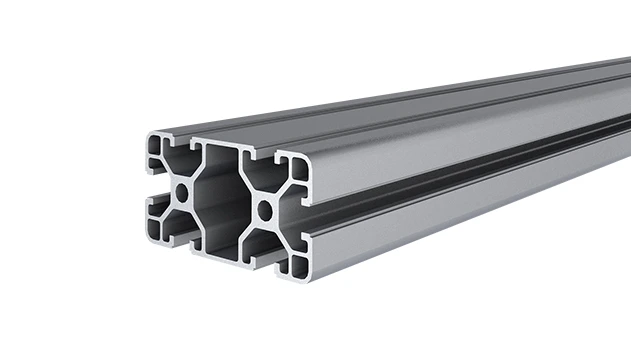
Meet the 4080A EU Standard Aluminum Profile: More Than Just a Shape
Now, let's get specific. The 4080A EU Standard Aluminum Profile isn't just any piece of aluminum—it's a meticulously engineered solution designed to meet strict European standards for quality and performance. Let's break down what "4080A" means. The numbers refer to the profile's cross-section: 40mm in width and 80mm in height. That extra height gives it a sturdier frame, which is crucial for enclosures housing larger or heavier components. The "A" denotes a specific design variant within the 4080 series, often featuring T-slots along its length—those handy grooves that make it easy to attach accessories like brackets, panels, or handles without welding or drilling.
Compliance with EU standards is non-negotiable here. These standards ensure the profile meets rigorous criteria for material purity, dimensional accuracy, and mechanical strength. For example, the aluminum used in the 4080A is typically 6063-T5 alloy, known for its excellent extrudability and strength-to-weight ratio. This isn't just about checking a box; it's about reliability. When you're building an enclosure for medical devices or aerospace electronics, you can't afford to use subpar materials that might warp, crack, or fail under stress. The 4080A's EU certification gives engineers peace of mind that they're working with a material they can trust.
| Feature | Specification |
|---|---|
| Cross-Section Dimensions | 40mm (width) x 80mm (height) |
| Alloy Type | 6063-T5 Aluminum |
| T-Slot Configuration | 2 slots (lengthwise), M8 compatible |
| Surface Treatment | Anodized (clear or black options) |
| EMI Shielding Effectiveness | Up to 80 dB (30 MHz – 1 GHz) |

EMI Shielding Capabilities: How 4080A Protects Sensitive Electronics
Let's get to the heart of the matter: how does the 4080A actually shield against EMI? To understand this, think of EMI as a noisy neighbor. Just as thick walls block sound, conductive materials block electromagnetic waves. Aluminum, being highly conductive, acts like a "wall" for EMI, absorbing and redirecting those unwanted signals away from the sensitive components inside the enclosure.
The 4080A's design amplifies this effect. Its large surface area (thanks to the 40x80mm cross-section) provides more material to intercept and dissipate EMI. Thickness matters too—while the exact wall thickness can vary by manufacturer, most 4080A profiles have walls thick enough to ensure minimal signal penetration. But here's where the extrusion process really shines: the profile's seamless, continuous structure eliminates gaps that could let EMI leak through. Unlike enclosures made from multiple welded parts, which can have weak points at the seams, extruded aluminum profiles are uniform, creating a solid barrier.
Anodization, the surface treatment applied to most 4080A profiles, also plays a role. While anodizing is primarily done to corrosion resistance, the thin oxide layer it creates doesn't hinder conductivity—meaning the aluminum's EMI-shielding properties remain intact. In fact, some manufacturers offer conductive coatings for added protection in high-interference environments, though the base aluminum itself is often sufficient for most applications.
To put this in perspective: imagine a factory floor where robotic arms, power tools, and other machinery are all emitting electromagnetic signals. Without proper shielding, a nearby enclosure housing a circuit board could pick up those signals, causing glitches or data errors. The 4080A enclosure would act like a Faraday cage, ensuring the circuit board inside stays "quiet" and functional. That's the difference between a product that works reliably and one that frustrates users with intermittent issues.
Aluminum Profile Accessories: The Unsung Heroes of Enclosure Design
No profile is an island—and the 4080A is no exception. Aluminum profile accessories might seem like small details, but they play a big role in enhancing both EMI shielding and overall functionality. Let's start with end caps. These simple pieces snap or screw onto the ends of the 4080A profile, sealing off open ends that could be potential EMI entry points. They also protect against dust and debris, which can degrade performance over time.
Connectors are another essential accessory. When building larger enclosures, you'll likely need to join multiple 4080A profiles together. Using high-quality aluminum profile connectors ensures a tight, continuous connection—no gaps, no loose joints. Look for connectors designed specifically for the 4080A, like 90° aluminum profile connectors or T-slot brackets, which lock into the profile's T-slots for a secure fit. A loose connector isn't just a structural risk; it can create tiny gaps where EMI can sneak through. That's why investing in well-engineered accessories is just as important as choosing the right profile.
Then there are things like gaskets and conductive tapes. While the 4080A itself is a strong shield, adding a conductive gasket between panels or around doors ensures a complete seal. These gaskets, often made from materials like nickel-coated foam, compress when the enclosure is closed, filling any microscopic gaps. It's like adding weatherstripping to a window—small, but effective at keeping the elements (or in this case, EMI) out.
Even something as simple as a 4080 aluminum profile end cap contributes to the enclosure's longevity. By covering exposed edges, it prevents accidental scratches or dents that could compromise the aluminum's surface, which in turn could affect conductivity. When every detail counts, these accessories transform a basic profile into a fully functional, EMI-resistant enclosure.
Integrating with Lean Systems: Efficiency Meets Protection
Here's where the 4080A really shines for manufacturers: its compatibility with lean systems. Lean manufacturing is all about minimizing waste, streamlining workflows, and maximizing efficiency—and the 4080A fits right into that philosophy. Let's say you're setting up a production line for smart home devices. You need workbenches, test stations, and enclosures that can be reconfigured as your needs change. The 4080A's modular design makes this a breeze.
Workbenches built with 4080A profiles are sturdy enough to support heavy equipment but lightweight enough to be moved or adjusted. Add casters (another accessory!) and you've got a mobile workbench that can shift with your production line. This flexibility reduces downtime when retooling and eliminates the need to build custom enclosures from scratch every time your process changes. It's lean in action: adaptability without sacrificing performance.
Lean systems also prioritize organization, and the 4080A's T-slots are perfect for that. Mount tool holders, cable management clips, or small shelves directly to the profile, keeping everything within arm's reach. No more wasted time searching for tools or untangling cables. When your workspace is organized, your team works faster—and happier. And because the 4080A is part of a larger ecosystem of aluminum profile accessories, you can mix and match components to create exactly what you need, without overbuying or underutilizing resources.
Think about it: a traditional steel enclosure might be strong, but it's heavy and hard to modify. If you need to add a new sensor or rearrange internal components, you're looking at drilling new holes or welding brackets—time-consuming and messy. With the 4080A, you simply slide a new bracket into the T-slot and tighten a screw. Done. That's the kind of efficiency lean systems thrive on, and it's why more and more manufacturers are swapping rigid materials for modular aluminum profiles.
Real-World Applications: Where 4080A Makes a Difference
So, where is the 4080A EU Standard Aluminum Profile actually being used today? Let's take a walk through a few industries to see it in action.
Medical Devices: Hospitals and clinics rely on sensitive equipment like MRI machines, patient monitors, and diagnostic tools. These devices can't afford EMI interference—imagine a heart monitor glitching because of nearby radio waves. Enclosures made with 4080A profiles ensure these devices operate accurately, protecting both patients and medical staff.
Aerospace: From avionics systems in planes to satellite components, aerospace electronics demand the highest levels of reliability. The 4080A's lightweight design is a huge plus here—every pound saved in an aircraft translates to fuel efficiency. Its EMI shielding ensures that navigation systems and communication tools aren't disrupted by the plane's own electrical systems or external signals.
Consumer Electronics: Ever wondered why your smartphone charger doesn't interfere with your laptop? Part of that is thanks to well-shielded internal components. Manufacturers of routers, smart speakers, and other consumer tech use 4080A enclosures in their testing labs to simulate real-world EMI conditions, ensuring products work as intended in crowded electromagnetic environments.
Automotive: Modern cars are rolling computers, packed with sensors, infotainment systems, and driver-assistance tech. These systems generate and are susceptible to EMI. Enclosures made with 4080A profiles help isolate critical components, preventing interference that could affect everything from GPS accuracy to brake sensors.
In each of these cases, the 4080A isn't just a material choice—it's a reliability choice. It's about building products that users can trust, whether they're in a hospital, a cockpit, or their own living room.
Why 4080A Stands Out: Comparing Materials
To truly appreciate the 4080A, let's compare it to other common enclosure materials. Steel is often the first alternative that comes to mind—it's strong and conductive, so it shields EMI well. But steel is heavy. A steel enclosure of the same size as a 4080A aluminum one could weigh twice as much, making it harder to transport and install. Steel also rusts, which means it needs additional coatings (like paint or galvanization) to survive in humid or corrosive environments—adding cost and complexity.
Plastic is another option, but it's a poor EMI shield on its own. To make plastic enclosures shielded, manufacturers have to add conductive layers (like metal plating or carbon fiber), which drives up the price. Even then, plastic lacks the structural rigidity of aluminum; it can warp in high temperatures, which is a problem in factories or outdoor settings. The 4080A, by contrast, offers natural conductivity, light weight, and temperature resistance without extra steps.
What about other aluminum profiles? The 3030 EU standard aluminum profile, for example, is smaller (30x30mm) and better suited for lightweight applications. But for larger enclosures or those housing heavy components, the 4080A's 40x80mm cross-section provides superior strength. It's like choosing between a 2x4 and a 4x4 for a deck—both are wood, but the 4x4 can support more weight.
Cost is another factor. While aluminum can be pricier than plastic upfront, its durability and low maintenance costs make it more cost-effective over time. A plastic enclosure might need replacement after a few years, but a 4080A enclosure could last decades with minimal upkeep. And when you factor in the reduced risk of product failures due to poor EMI shielding, the investment in 4080A pays off in customer trust and fewer warranty claims.
Wrapping Up: The 4080A Advantage
At the end of the day, the 4080A EU Standard Aluminum Profile isn't just a piece of metal—it's a solution to a common problem: how to protect sensitive electronics from EMI while keeping enclosures lightweight, customizable, and efficient. Its combination of EMI shielding effectiveness, modular design, and compatibility with lean systems makes it a standout choice for engineers and manufacturers across industries.
Whether you're building a medical device enclosure, a production line workbench, or a test station for consumer electronics, the 4080A delivers where it counts: reliability, flexibility, and peace of mind. Paired with the right aluminum profile accessories, it becomes more than just an enclosure—it's a foundation for innovation.
So the next time you're tasked with designing an electronic enclosure, remember: the material you choose matters. And if you want something that balances performance, efficiency, and cost, the 4080A EU Standard Aluminum Profile is worth a closer look. After all, in a world where electronics are getting smarter and more sensitive, the right shield can make all the difference.