- Company Articles
- Products and Technology
- Product knowledge
- 4080A EU Standard Aluminum Profile in Furniture Manufacturing: Industrial & Office Use

4080A EU Standard Aluminum Profile in Furniture Manufacturing: Industrial & Office Use
Related Product
4080A EU Standard Aluminum Profile
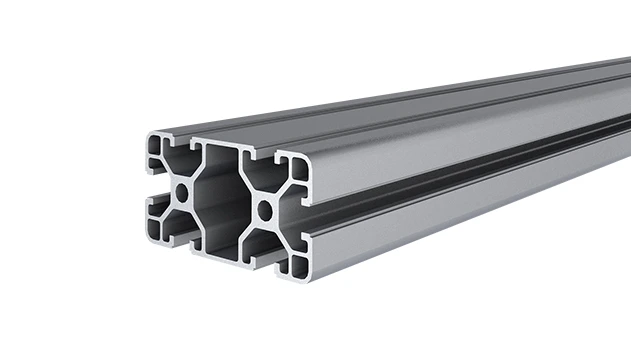
4080A is a 4.00x8.00 CM fractional 40 series square extrusion T-slot profile with two side open T-slots, each side with 4.00cm face, two side with 8.00cm face. The profile has align-a-grooves to assist in aligning connecting profiles.
The Unsung Hero of Modern Furniture: Why Aluminum Profiles Matter
Walk into any bustling factory or sleek modern office today, and you'll notice something subtle but powerful: the furniture isn't just furniture anymore. It's a silent partner in productivity—workbenches that withstand heavy machinery, desks that adapt to team changes, storage racks that keep chaos at bay. Behind much of this hardworking furniture is a material that's quietly revolutionizing the industry: aluminum profiles. Lightweight yet tough, customizable yet consistent, aluminum profiles have become the backbone of furniture design, especially in industrial and office settings where durability and flexibility aren't just nice-to-haves—they're essential.
But not all aluminum profiles are created equal. Among the many options available, one stands out for its versatility and reliability: the 4080A EU standard aluminum profile . If you're a manufacturer, designer, or even just someone curious about what makes modern workspaces tick, this profile deserves your attention. Let's dive into why it's become a go-to choice, how it's used, and why those three little letters—"EU standard"—matter more than you might think.
What Exactly is 4080A EU Standard Aluminum Profile?
Let's start with the basics. The "4080A" in its name isn't just a random code—it tells you exactly what you're getting. The numbers refer to the profile's cross-section: 40mm in width and 80mm in height. Picture a rectangular tube, but with precision-engineered T-slots running along its length. These slots are the secret sauce—they let you attach accessories, brackets, and components without welding or drilling, making assembly and reconfiguration a breeze.
Now, the "EU standard" part. In an industry where consistency is key, EU standards act as a quality guarantee. They ensure the aluminum used is pure (typically 6063-T5, a grade known for strength and corrosion resistance), the extrusion process meets strict tolerances, and the finish—whether anodized, powder-coated, or raw—is uniform. For manufacturers, this means less guesswork: when you order 4080A from a reputable supplier, you know it will fit, function, and last exactly as expected, batch after batch.
But why 40mm x 80mm? Why not a square 40x40 or a slimmer 30x60? The answer lies in balance. At 40x80, this profile hits a sweet spot: it's wide enough to provide stability for larger structures (think industrial workbenches or heavy-duty shelving) but not so bulky that it becomes cumbersome. The extra height (80mm) adds rigidity, making it ideal for vertical supports, while the width (40mm) keeps it manageable for horizontal beams. It's like the Swiss Army knife of aluminum profiles—versatile enough to handle a wide range of tasks without overcomplicating things.

From Raw Aluminum to Ready-to-Use: The Magic of Aluminum Extrusion
To truly appreciate 4080A, you need to understand how it's made. The process is called aluminum extrusion , and it's nothing short of industrial artistry. Here's a simplified breakdown: imagine taking a solid aluminum billet (a cylindrical block), heating it until it's malleable (but not molten), then forcing it through a custom die under extreme pressure. The die, shaped like the 4080A cross-section, transforms the billet into a long, continuous profile with those signature T-slots and smooth edges.
Why does extrusion matter? For starters, it allows for incredibly precise shapes. The T-slots on 4080A aren't just etched on—they're part of the profile's DNA, ensuring consistent dimensions that make accessories fit perfectly every time. Extrusion also keeps costs in check: it's efficient, produces minimal waste, and can create complex profiles in one step, eliminating the need for expensive secondary machining.
But the real benefit for furniture makers? Flexibility. Because extrusion is a continuous process, profiles can be cut to any length—from a few centimeters for a small bracket to several meters for a workstation frame. This means you're never limited by "standard sizes." Need a 2.1-meter workbench leg? Just cut a 4080A profile to length. A 1.8-meter shelf beam? Done. It's customization without the custom price tag.
Industrial Furniture: Where 4080A Shines Brightest
Let's talk about the tough jobs first—industrial settings. Factories, workshops, and manufacturing plants need furniture that can take a beating. We're talking workbenches where heavy tools are dropped, material racks holding hundreds of kilograms, and assembly lines that run 24/7. This is where 4080A truly earns its keep.
Take workbenches , for example. A typical industrial workbench needs to support drills, grinders, and even small machinery, all while staying stable. 4080A's 40x80mm cross-section provides the rigidity needed to handle loads up to 500kg or more (depending on the frame design). Add in a plywood or steel top, and you've got a surface that won't warp or sag, even under daily abuse. But what really sets it apart is how easy it is to customize. Need a vice on one corner? Use T-slot nuts to bolt it directly to the profile. Want overhead lighting or a tool rack? Attach brackets to the T-slots. Even power strips can be mounted cleanly, keeping cords out of the way and reducing tripping hazards.
Then there are material racks—like the material rack b (3 row and 3 floor) you might see in a warehouse. These racks need to hold boxes, components, or raw materials without bending. 4080A makes an excellent frame here: vertical supports in 4080A provide the height and strength, while horizontal beams (often paired with lighter profiles like 4040A) create sturdy shelves. And because it's aluminum, the whole structure is lighter than steel, making installation and repositioning easier—no need for a forklift just to move a rack a few feet.
Even conveyor systems benefit from 4080A. The profile's T-slots are perfect for mounting aluminum guide rail A or B, which keep products moving smoothly along the line. Whether it's a gravity-fed roller track or a powered conveyor, 4080A provides a stable base that can handle the constant vibration and impact of material flow.
Office Furniture: Sleek, Smart, and Surprisingly Strong
Now, let's shift gears to the office. Modern offices aren't just about desks and chairs anymore—they're dynamic spaces where teams collaborate, grow, and adapt. Furniture here needs to be as flexible as the people using it, and 4080A delivers that in spades, all while looking sleek and professional.
Take office desks, for example. Traditional wooden desks are heavy, hard to modify, and often end up as permanent fixtures—even when teams shrink or expand. 4080A desks, though? They're modular by design. Need to add a section for a new team member? Just bolt on another 4080A beam and a tabletop. Want to create a collaborative island? Combine several desk units using 90° aluminum profile connectors. The T-slots even let you integrate cable management systems, so those messy charger wires and monitor cables can be routed cleanly through the desk frame—no more unsightly tangles.
Storage is another area where 4080A shines. Open shelving units, filing cabinets, and bookcases built with 4080A are lightweight enough to move (with the addition of caster wheel accessories) but strong enough to hold books, binders, and office supplies. And because the profile comes in various finishes—silver anodized, black powder-coated, or even custom colors—it can match any office aesthetic, from minimalist to industrial-chic.
Ergonomics matter too. Standing desks, for instance, rely on sturdy frames that can adjust smoothly. 4080A's strength-to-weight ratio makes it ideal here: it can support the desk surface and mechanism without adding unnecessary bulk, so adjusting heights is effortless. Even height-adjustable workbenches in office settings (think design studios or tech labs) use 4080A for this reason—it's tough enough to handle the movement but light enough to keep the adjustment mechanism from overworking.
It's All in the Extras: Aluminum Profile Accessories That Make 4080A Shine
A profile is only as good as the accessories that go with it, and 4080A has a whole ecosystem of aluminum profile accessories designed to unlock its full potential. Let's break down the essentials:
Connectors: These are the glue that holds everything together. 90° connectors let you join profiles at right angles (perfect for desk corners or shelf frames), while 45° connectors add angled support. There are even swivel connectors for adjustable components, like tilt-top workbenches. Best of all, most connectors use T-slot nuts and bolts, so assembly is tool-friendly—no welding required.
End Caps and Covers: Nothing ruins a clean look like sharp, exposed profile ends. End caps snap into place, covering rough edges and adding a polished finish. For T-slots that aren't in use, rubber covers keep out dust and debris, ensuring they're ready when you need to add an accessory later.
Casters and Leveling Feet: Need mobility? Attach caster wheels to the bottom of a 4080A frame, and suddenly your workbench or shelf becomes a rolling cart. Prefer stability? Swap the casters for leveling feet, which adjust to uneven floors to keep everything steady.
Guide Rails and Rollers: For material handling—whether in a factory or office supply closet—aluminum guide rails (like aluminum guide rail A) mount to 4080A profiles, creating tracks for sliding shelves or roller conveyors. They're smooth, durable, and designed to work seamlessly with the profile's T-slots.
These accessories don't just make assembly easier—they turn 4080A from a simple profile into a complete building system. It's like having a set of Lego blocks for adults, but with the strength to build something that lasts for years.
How 4080A Stacks Up: A Quick Comparison
Still not sure if 4080A is right for your project? Let's compare it to a few other common profiles to see where it fits best. The table below highlights key differences in dimensions, load capacity, and typical uses:
| Profile Type | Dimensions (WxH, mm) | Approx. Max Load Capacity (kg/m) | Best For |
|---|---|---|---|
| 4080A EU Standard | 40x80 | 300-500 | Industrial workbenches, heavy-duty shelving, office desk frames, conveyor supports |
| 4040A EU Standard | 40x40 | 200-350 | Light to medium shelving, small workbenches, office partitions |
| 3030A EU Standard | 30x30 | 100-200 | Light-duty racks, display shelves, small furniture components |
| 2020 EU Standard | 20x20 | 50-100 | DIY projects, small electronics enclosures, lightweight storage |
As you can see, 4080A sits in the "workhorse" category—strong enough for industrial tasks but not overkill for office use. If your project involves heavy loads, large spans, or the need for frequent reconfiguration, 4080A is likely your best bet.
Sustainability: Why 4080A is a Green Choice
In today's world, sustainability isn't just a buzzword—it's a responsibility. Luckily, 4080A checks this box too. Aluminum is one of the most recyclable materials on the planet: it can be melted down and reused repeatedly without losing quality, and recycling it uses just 5% of the energy needed to produce new aluminum. For manufacturers looking to reduce their carbon footprint, specifying 4080A (and ensuring end-of-life recycling) is a tangible step forward.
Then there's the profile's longevity. Unlike wood, which can warp or rot, or plastic, which degrades over time, aluminum profiles are corrosion-resistant and built to last. A 4080A workbench might outlive the factory it's in, and when it's finally time for an upgrade, it can be disassembled and the profiles reused or recycled—no waste, no landfill.
Even the extrusion process itself is relatively eco-friendly. Modern extrusion facilities use energy-efficient machinery and often source aluminum from recycled materials. Add in the fact that 4080A's lightweight nature reduces shipping costs (and emissions) compared to steel, and it's clear this profile aligns with green manufacturing goals.
Real-World Impact: How 4080A Changes Workspaces
Let's wrap up with a hypothetical (but realistic) example of how 4080A transforms a workspace. Imagine a small electronics manufacturing startup. When they first open, they use basic wooden workbenches and metal shelving—functional, but rigid. As they grow, they realize they need more flexibility: workbenches that can adjust for different assembly tasks, storage that can expand with inventory, and a layout that can adapt as new equipment arrives.
They switch to 4080A. Suddenly, their workbenches are height-adjustable, with aluminum guide rails to slide components along the line. Their storage racks, built with 4080A and material rack b (3 row and 3 floor) designs, can now hold more inventory without taking up extra space. When they land a big order and need to add a second assembly line, they don't have to buy all-new furniture—they just reconfigure their existing 4080A frames and add a few new profiles and accessories. The result? Less downtime, lower costs, and a workspace that grows with them.
In an office setting, a marketing agency might use 4080A to create a "hot desk" area. Employees can wheel their 4080A-based workstations (fitted with caster wheels) into collaborative pods for team projects or rearrange them into quiet zones for focused work. The T-slots let them add whiteboard panels, monitor arms, or even small plants to personalize their space. It's a workspace that adapts to how people work, not the other way around.
Final Thoughts: Why 4080A Deserves a Spot in Your Next Project
At the end of the day, the 4080A EU standard aluminum profile is more than just a piece of metal. It's a tool for problem-solving—a way to build furniture that's not just strong and durable, but smart and sustainable. Whether you're outfitting a factory, designing an office, or tackling a custom project, 4080A offers the kind of flexibility and reliability that's hard to find in other materials.
So, the next time you walk into a workspace that feels "just right"—where everything works together seamlessly, where change feels easy—take a closer look. Chances are, there's a 4080A profile somewhere in there, quietly doing its job. And if you're in the business of building those workspaces, maybe it's time to make 4080A part of your toolkit too.
After all, great furniture shouldn't just hold things up—it should hold up to the way we work. And with 4080A, it does.