- Company Articles
- Products and Technology
- Product knowledge
- 4080A EU Standard Aluminum Profile in Robotics Workcells: Flexibility & Adaptability

4080A EU Standard Aluminum Profile in Robotics Workcells: Flexibility & Adaptability
Related Product
4080A EU Standard Aluminum Profile
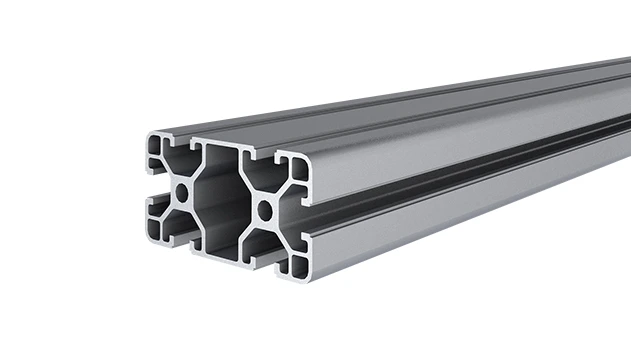
4080A is a 4.00x8.00 CM fractional 40 series square extrusion T-slot profile with two side open T-slots, each side with 4.00cm face, two side with 8.00cm face. The profile has align-a-grooves to assist in aligning connecting profiles.
Walk into any modern robotics facility, and you'll notice something fundamental: the workcells—the spaces where robots, tools, and operators collaborate—are rarely static. One day, a cell might be assembling small electronic components; the next, it could be reconfigured to test larger automotive parts. This constant shift isn't chaos; it's the future of manufacturing. And at the heart of this adaptability? The unsung hero of modular design: aluminum extrusion profiles. Specifically, the 4080A EU Standard Aluminum Profile has emerged as a cornerstone for building robotics workcells that don't just keep up with change—they embrace it.
Why Flexibility Matters in Robotics Workcells
Let's start with the obvious: robotics isn't a one-size-fits-all industry. A warehouse robot handling pallets has different needs than a collaborative robot (cobot) assembling medical devices. Even within a single facility, production goals shift—demand spikes, new product lines launch, or quality standards evolve. Rigid, fixed workcells made from welded steel or custom-built frames can't keep pace. They're expensive to modify, time-consuming to reconfigure, and often end up as scrap when needs change.
Flexibility here isn't just a buzzword; it's a cost-saving, innovation-driving necessity. Manufacturers need workcells that can:
- Scale quickly : Add or remove stations as production volume changes.
- Customize on the fly : Adjust heights, add tool mounts, or integrate new sensors without rebuilding from scratch.
- Support collaboration : Create safe, ergonomic spaces where humans and robots work side by side.
- Reduce downtime : Minimize production halts during reconfiguration.
This is where aluminum extrusion profiles shine. Lightweight, strong, and infinitely modular, they're the building blocks of workcells that grow and change with your needs. And among the countless profiles available, the 4080A EU Standard stands out for a simple reason: it strikes the perfect balance between strength, versatility, and ease of use.
What is 4080A EU Standard Aluminum Profile?
First, let's break down the name. "4080A" refers to its dimensions: 40mm in width and 80mm in height. The "EU Standard" means it adheres to European design specifications, ensuring compatibility with a vast ecosystem of accessories and components. Unlike generic aluminum tubes, extrusion profiles have precision-engineered T-slots running along their length—those grooves you see on the sides. These slots are where the magic happens: they let you attach brackets, panels, sensors, and tools without drilling or welding. Just slide in a bolt, tighten a nut, and you're done.
But the 4080A isn't just about dimensions. It's made from high-grade aluminum alloy (typically 6063-T5), which offers an impressive strength-to-weight ratio. That means it can support heavy loads—think robot arms, workbenches, or material racks—without weighing down the workcell. And because it's extruded, each profile is consistent in shape and strength, so you know exactly what you're getting, every time.
A Quick Comparison: 4080A vs. Other Common Profiles
To understand why the 4080A is a favorite for robotics, let's see how it stacks up against other popular profiles. The table below compares it to the 4040A (a smaller 40x40mm profile) and the 3030A (a compact 30x30mm option):
| Profile Type | Dimensions (WxH) | Typical Load Capacity (Horizontal) | Best For | Limitations |
|---|---|---|---|---|
| 4080A EU Standard | 40mm x 80mm | Up to 500kg/m (depending on support spacing) | Heavy-duty workbenches, robot bases, material racks, roller tracks | Bulkier than smaller profiles; overkill for light tasks |
| 4040A EU Standard | 40mm x 40mm | Up to 300kg/m | Light robot mounts, shelving, small conveyors | Limited vertical space for T-slot accessories |
| 3030A EU Standard | 30mm x 30mm | Up to 150kg/m | Prototyping, lightweight tool holders, cobot safety barriers | Not ideal for heavy loads or large work surfaces |
The 4080A's sweet spot? It's robust enough for heavy-duty tasks but not so large that it wastes space. Its 80mm height provides extra T-slot real estate, meaning you can attach more accessories—like dual brackets or multi-layer panels—without sacrificing stability. For robotics workcells, where you might need to mount a robot arm, a workbench, and a roller track all in one frame, this versatility is gold.

The 4080A Advantage: Modularity with Aluminum Profile Accessories
If the 4080A profile is the backbone of a workcell, then aluminum profile accessories are the joints, muscles, and nerves that bring it to life. The EU Standard ensures compatibility with thousands of off-the-shelf components, so you're never stuck waiting for custom parts. Let's dive into the accessories that make the 4080A so adaptable:
Connectors: The Glue That Holds It All Together
No modular system works without reliable connectors, and the 4080A has no shortage of options. From simple 90° brackets to multi-axis joints, these (accessories) let you build frames in any shape. Take the "internal straight aluminum joint," for example. Slide it into the T-slot of two 4080A profiles, tighten the grub screws, and you've got a seamless, rigid connection—no welding required. Need to angle a section? Use a 45° or 135° connector. For more complex setups, "three-way" or "four-way" connectors let you branch profiles in multiple directions, perfect for building L-shaped workbenches or multi-level material racks.
What's game-changing here is that these connectors are reusable. Disassemble a workcell, swap out a connector, and rebuild it into something entirely new. Compare that to welding: once steel is welded, modifying it means cutting, grinding, and re-welding—costing time and labor. With 4080A and its connectors, reconfiguration is as easy as loosening a few screws.
Workbenches: Customizable from Top to Bottom
A robotics workcell isn't complete without a workbench—where operators prep parts, monitor controls, or perform quality checks. The 4080A excels here because it lets you build workbenches that fit your exact needs. Start with the frame: 4080A profiles form the legs and rails, adjusted to any height (standard or ergonomic) using height-adjustable feet. Then, choose the top: aluminum honeycomb panels for lightweight durability, ESD (electrostatic discharge) tops for electronics assembly, or even wooden tops for a warmer feel.
Need mobility? Add caster wheels (and caster accessories like brakes) to make the bench portable. Want storage? Mount shelves or drawers using T-slot brackets. Even the little things matter: tool hooks, monitor arms, or bin holders can all be attached directly to the 4080A frame via T-slot nuts. One facility we worked with built a cobot workbench using 4080A that could be adjusted from 750mm to 900mm in height, with a fold-down side shelf for extra workspace—all without modifying the frame itself.
Roller Tracks: Keeping Materials Moving
In robotics, efficient material flow is everything. Parts need to move from storage to the robot, and finished products need to move out—without bottlenecks. Roller tracks, built with 4080A profiles, solve this problem. These tracks use gravity or motorized rollers to slide parts along a path, and they integrate seamlessly with the workcell frame.
Here's how it works: Mount aluminum guide rails (like the "aluminum guide rail A" or "plastic roller track guide rail") to the 4080A frame using brackets. Add roller track placon mounts (those handy connectors that bridge the rail to the profile) and insert roller balls or wheels. Suddenly, you've got a smooth, adjustable conveyor system. Need to change the angle? Loosen the brackets, tilt the track, and retighten. Moving the track to a new location? Disassemble it, carry the 4080A sections, and rebuild in minutes.
One automotive parts manufacturer we partnered with used 4080A roller tracks to feed components to their welding robots. When they introduced a new part size, they simply extended the track with additional 4080A sections and adjusted the guide rails—no need for a custom conveyor system. That's adaptability in action.
Supporting Lean Systems: Less Waste, More Productivity
Lean manufacturing isn't just about cutting costs—it's about creating value by eliminating waste. And 4080A profiles are lean by design. Here's how they support lean principles in robotics workcells:
- Reduced waste : Unlike custom-built frames, which often end up in landfills when obsolete, 4080A profiles and accessories are reusable. A workcell frame can be repurposed a dozen times over, cutting down on material waste.
- Minimized downtime : Reconfiguring a 4080A workcell takes hours, not days. That means less idle time for robots and operators, keeping production on track.
- Ergonomic efficiency : Adjustable heights and customizable layouts reduce operator fatigue, which is a hidden source of waste in manufacturing. A workbench built with 4080A can be tailored to each operator's height, reducing strain and improving focus.
- Just-in-time (JIT) readiness : With modular components, you can build workcells as needed, avoiding over-investment in unused space or equipment. Need a temporary testing station for a new robot? Assemble it with 4080A, use it, then disassemble and store the parts for later.
Take the example of a medical device manufacturer that adopted 4080A for their cobot workcells. Previously, they'd build custom steel frames for each product line, which sat unused between runs. Now, they reconfigure the same 4080A profiles to test catheters one week and pacemakers the next. The result? A 30% reduction in setup time and a 25% drop in material costs—all while supporting their lean goals.
Real-World Applications: 4080A in Action
Let's get concrete. How are manufacturers actually using 4080A EU Standard Aluminum Profiles in robotics workcells? Here are two case studies that highlight its flexibility and adaptability:
Case Study 1: E-Commerce Fulfillment Cobot Workcell
A major e-commerce company needed to automate their small-package sorting process. Their challenge? Packages range from tiny jewelry boxes to shoe boxes, and order volumes spike during holidays. They needed a workcell where cobots could pick items from a conveyor, scan them, and place them into bins—with room to add more cobots during peak times.
Solution: They built a modular frame using 4080A profiles. The base frame supported two cobots, a roller track for incoming packages, and a bank of sorting bins. When holiday demand hit, they added two more 4080A sections to the frame, mounted two additional cobots, and extended the roller track. The entire expansion took a single day, with no disruption to existing operations. After the holidays, they removed the extra sections and stored them—ready for next year.
Case Study 2: Automotive Component Testing Workcell
An automotive supplier tests sensors for self-driving cars. Each sensor model requires different testing equipment—cameras, lasers, and calibration tools—mounted at precise angles. Their old workcells, built with welded steel, required custom tooling for each sensor, leading to long lead times.
Solution: They switched to 4080A profiles. Now, each testing station is a 4080A frame with adjustable brackets. When a new sensor model arrives, they swap out the brackets, reposition the cameras using T-slot nuts, and tighten everything down. What used to take 2 weeks (building a new steel frame) now takes 2 hours. Plus, they can reuse the brackets and tools across stations, cutting tooling costs by 40%.
Sustainability: Aluminum's Green Edge
Modern manufacturers don't just care about flexibility—they care about sustainability. Aluminum extrusion profiles, including the 4080A, check this box too. Aluminum is 100% recyclable, and recycling it uses just 5% of the energy required to produce new aluminum. When a workcell reaches the end of its life, the 4080A profiles can be melted down and turned into new profiles, reducing reliance on raw materials.
Compare that to steel: while steel is also recyclable, its weight makes transportation and recycling more energy-intensive. The 4080A's lightweight design means lower shipping costs (less fuel used) and easier handling during recycling. For companies aiming for net-zero goals, this is a small change with a big impact.
Choosing the Right Supplier: More Than Just Parts
Of course, none of this matters if you can't get the 4080A profiles and accessories you need, when you need them. That's why partnering with a reliable supplier is key. Look for suppliers who offer:
- Stock availability : No one wants to wait weeks for a 4080A profile. A good supplier keeps common lengths (like 2m, 3m, or 6m) in stock, along with popular accessories like connectors and brackets.
- Custom cutting : Need a 4080A profile cut to 1.23m? A supplier with in-house cutting services can deliver precise lengths, saving you time on-site.
- Technical support : Building a complex workcell? Look for suppliers who provide design guidance, CAD files, or even sample assemblies to help you get it right the first time.
Remember, the best supplier isn't just selling parts—they're partnering with you to solve problems. Whether you're building your first robotics workcell or reconfiguring a dozen, their expertise can make the difference between a smooth project and a frustrating one.
Conclusion: Building Workcells That Grow With You
The 4080A EU Standard Aluminum Profile isn't just a piece of metal. It's a promise of flexibility—a commitment that your robotics workcells won't hold you back when the next big idea hits. In an industry where change is the only constant, modular design isn't a luxury; it's survival. And with 4080A, survival looks a lot like success: lower costs, faster innovation, and workcells that adapt as quickly as your team does.
So the next time you walk into a robotics facility, take a closer look at those silver frames holding everything together. Chances are, they're 4080A profiles—quietly powering the future of manufacturing, one T-slot at a time.