
- Company Articles
- Products and Technology
- Product knowledge
- 4080B EU Standard Aluminum Profile in Renewable Energy Equipment: Solar Panel Mounts
The world is at a pivotal moment in the fight against climate change, and renewable energy has emerged as our most powerful ally. Among the stars of this movement, solar power shines brightest—its potential seemingly limitless as technology advances and adoption soars. But behind every field of glistening solar panels, there's a critical, often overlooked component that makes it all possible: the mounting system. Without a reliable, adaptable foundation, even the most efficient solar cells would fail to capture sunlight effectively. Today, we're exploring how one specific innovation is redefining solar mount design: the 4080B EU Standard Aluminum Profile. This unassuming extrusion isn't just a piece of metal; it's the backbone of sustainable, efficient, and scalable solar energy systems worldwide.
The Unsung Hero: Why Solar Panel Mounts Matter
Solar panels are marvels of engineering, but they're only as good as the structures that hold them. A solar mount does more than just "hold up" panels—it dictates their angle, orientation, and stability, directly impacting energy output. Imagine a panel tilted too far from the sun: it loses efficiency. A mount that rusts in coastal humidity: it becomes a safety hazard. One that can't adapt to a rooftop's slope: it limits installation possibilities. In short, the mount is the bridge between raw sunlight and usable electricity, and choosing the right material for it is non-negotiable.
As solar projects scale—from residential rooftops to sprawling utility-scale farms—the demands on mounts grow. They need to be lightweight to avoid structural strain, durable to withstand decades of weather, and flexible to fit diverse environments. Enter aluminum extrusion profiles, a material that's quietly revolutionizing the industry. And among these, the 4080B EU Standard Aluminum Profile stands out as a game-changer.
Aluminum Extrusion Profiles: The Material of Choice for Solar Innovation
Why aluminum? Let's start with the basics. Aluminum is lightweight—about one-third the density of steel—making it ideal for installations where weight matters, like rooftops or mobile solar units. But don't let its lightness fool you: when extruded into precise shapes, aluminum becomes remarkably strong. Its natural oxide layer acts as a built-in shield against corrosion, even in harsh climates (think salty coastal air or desert dust). And perhaps most importantly for renewable energy, aluminum is 100% recyclable. Unlike plastics or composites, it can be melted down and reused indefinitely without losing quality, aligning perfectly with solar's eco-friendly mission.
But aluminum's true magic lies in its manufacturing process: extrusion. Picture a Play-Doh press, but for metal. Heated aluminum billets are forced through a die, creating complex, consistent cross-sections in one seamless piece. This process allows for aluminum extrusion profiles with intricate designs—like the T-slots that define the 4080B—without sacrificing strength. Extrusion also ensures uniformity, so every meter of 4080B profile performs exactly like the last, a critical factor for large-scale projects.

Deep Dive: The 4080B EU Standard Aluminum Profile
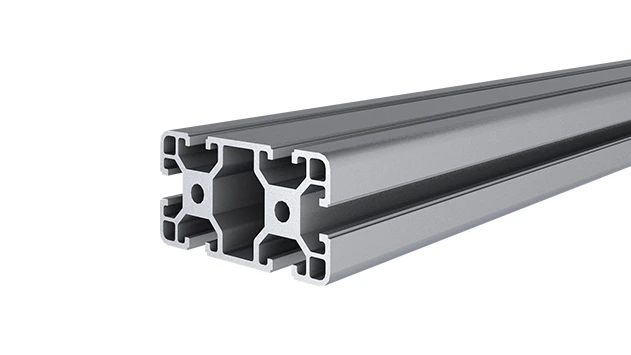
Now, let's zoom in on the star of the show: the 4080B EU Standard Aluminum Profile. At first glance, it's a simple rectangle—40mm wide, 80mm tall—but its design is anything but basic. This profile is engineered to balance strength, versatility, and ease of use, making it a favorite among engineers and installers alike.
Dimensions and Structural Integrity
The 40x80mm cross-section is no accident. It's wide enough to provide lateral stability (preventing panels from swaying in wind) and tall enough to support vertical loads (like snow accumulation or heavy panels). The internal structure, reinforced with ribs, distributes weight evenly, ensuring the profile can handle up to 500kg per meter in some configurations—more than enough for even the heaviest commercial solar panels.
The T-Slot Advantage
Look closely at the 4080B, and you'll notice grooves running along its length: T-slots. These slots are the profile's secret weapon. They allow aluminum profile accessories —like brackets, connectors, and fasteners—to slide into place and lock securely, no welding required. Need to adjust a panel's angle? Loosen a T-slot nut, reposition the bracket, and tighten. It's that simple. This flexibility turns rigid structures into adaptable systems, a must for projects where "one size fits all" never works.
EU Standards: Built for Reliability
The "EU Standard" label isn't just a marketing term. The 4080B adheres to strict European norms for material quality, dimensional accuracy, and safety. This means every batch is tested for tensile strength, corrosion resistance, and thermal stability—critical for solar mounts that must perform in -40°C winters and 50°C summers. For installers and project managers, this compliance isn't just reassuring; it's often a legal requirement, especially in regulated markets.
Aluminum Profile Accessories: Turning Profiles into Systems
A 4080B profile alone is powerful, but it's the aluminum profile accessories that unlock its full potential. Think of the profile as a canvas; accessories are the paint that brings it to life. Let's explore the key players:
- Connectors and Brackets: These are the "joints" of the solar mount. From 90-degree angles for framing to adjustable brackets for tilting panels, they slide into T-slots and lock in place with bolts. Some, like the "internal straight aluminum joint," create seamless connections, while others, like "swivel roller balls," add mobility for adjustable systems.
- End Caps and Covers: Small but mighty, these accessories protect the profile's ends from debris and moisture, preventing internal corrosion. They also give mounts a clean, professional look—important for residential or commercial projects where aesthetics matter.
- Fasteners and T-Slot Nuts: These tiny components are the glue that holds everything together. Designed to fit perfectly into T-slots, they allow for tool-free adjustments, saving installers hours of work. No more drilling holes or welding—just slide, tighten, and done.
- Foot Plates and Casters: For ground-mounted or mobile systems, foot plates distribute weight to prevent sinking in soft soil, while casters (yes, even caster accessories like "swivel stem caster wheels") turn fixed mounts into portable units—ideal for temporary setups or disaster relief efforts.
Together, these accessories transform the 4080B from a static extrusion into a modular, customizable system. Need a mount for a sloped rooftop? Use angle brackets to adjust the tilt. Building a solar farm that will expand over time? Add extension profiles with compatible connectors. The possibilities are endless, and that's by design.
Lean System Principles: Efficiency from Factory to Field
The solar industry thrives on efficiency—both in energy production and project execution. This is where the 4080B aligns perfectly with lean system principles, a methodology focused on minimizing waste and maximizing value. Lean thinking isn't just for manufacturing floors; it's reshaping how solar mounts are designed, built, and installed.
Consider traditional solar mounts: often custom-welded steel structures that require on-site cutting, drilling, and painting. They're slow to produce, hard to adjust, and generate mountains of waste (scrap metal, excess paint). The 4080B system flips this script. Its modular design means components are prefabricated in factories, cut to precise lengths, and shipped ready to assemble. On-site, installers use simple hand tools to connect profiles and accessories—no welding, no messy adhesives, no wasted materials.
Waste reduction doesn't stop there. If a project's needs change (say, a client wants to add more panels), the 4080B system adapts. Old components can be reused or repurposed, avoiding the need for entirely new mounts. Even end-of-life mounts are recycled, closing the loop on sustainability. It's lean, it's green, and it's saving project managers time and money at every step.
Material Showdown: Why 4080B Beats the Competition
To truly appreciate the 4080B, let's pit it against common alternatives. The table below compares key factors for solar mount materials:
| Material | Weight (kg/m) | Corrosion Resistance | Recyclability | Installation Time (per 10m mount) | Lifespan (years) |
|---|---|---|---|---|---|
| 4080B Aluminum | 2.7 | Excellent (natural oxide layer) | 100% recyclable | 1-2 hours | 25-30+ |
| Galvanized Steel | 7.8 | Good (coating required) | Recyclable (high energy use) | 4-6 hours (welding/painting) | 15-20 (with maintenance) |
| Wood | 0.7 | Poor (needs chemical treatment) | Biodegradable (limited reuse) | 3+ hours (cutting, sealing) | 5-10 |
| Composite | 2.0 | Good | Limited (mixed materials) | 2-3 hours | 15-20 |
The data speaks for itself. Aluminum's lightweight nature cuts shipping costs and eases installation. Its corrosion resistance eliminates costly maintenance (no repainting every few years). And its recyclability aligns with solar's "green" mission. For large projects, the 4080B's speed of assembly alone can shave weeks off timelines—critical in an industry where delays mean lost revenue from unused sunlight.
Case Study: A Solar Farm's Journey with 4080B
In southern Spain, a 50MW solar farm faced a unique challenge: how to scale quickly while keeping costs low and environmental impact minimal. The project's engineers initially considered galvanized steel mounts, but concerns about weight (the soil was soft in parts) and corrosion (proximity to the Mediterranean Sea) led them to explore alternatives. They chose the 4080B EU Standard Aluminum Profile, and the results were transformative.
Thanks to the T-slot design, installers assembled mounts 60% faster than with steel, using only hand tools. The lightweight profiles reduced the need for heavy machinery, cutting carbon emissions during construction. Five years later, the farm has expanded to 120MW—without replacing a single mount. Instead, they simply extended existing rows using compatible aluminum connectors. "The 4080B wasn't just a material choice," says the project manager. "It was a scalability choice. We're still finding new ways to adapt it as our needs grow."
Sustainability: Closing the Loop on Green Energy
Solar power is all about sustainability, so it's only fitting that its supporting infrastructure should be too. Aluminum's recyclability is a game-changer here. When a 4080B mount reaches the end of its lifespan (after 30+ years of service), it can be melted down and extruded into new profiles—using just 5% of the energy required to produce primary aluminum. This creates a closed-loop system: solar panels generate clean energy, and their mounts are recycled into new mounts, with minimal waste.
But sustainability isn't just about end-of-life. The 4080B's production process is also greener than alternatives. Aluminum extrusion uses less energy than steel forging, and EU standards ensure manufacturers minimize emissions and waste. Even the accessories play a role: many are made from recycled plastics or aluminum, further reducing the carbon footprint.
In a world where "greenwashing" is common, the 4080B stands out as the real deal. It's a material that doesn't just support renewable energy—it embodies it.
The Future: Where 4080B and Solar Innovation Meet
The solar industry isn't standing still, and neither is the 4080B. As panels become thinner and more efficient, mounts will need to support new designs—like flexible solar films or double-sided panels. The 4080B's adaptability makes it ready for these changes. Engineers are already experimenting with integrating smart technology: sensors that monitor wind stress, actuators that adjust panel angles in real time, and even built-in wiring channels (thanks to the T-slots) for seamless connectivity.
Another trend? Urban solar. As cities embrace rooftop and vertical solar (on buildings, bus stops, even streetlights), the need for compact, lightweight mounts grows. The 4080B's slim profile and modularity make it perfect for these tight spaces. Imagine a city skyline where every rooftop is a solar farm, held up by unobtrusive aluminum frames—that future is closer than we think, and the 4080B is leading the way.
Final Thoughts: More Than a Profile—A Partner in Progress
The 4080B EU Standard Aluminum Profile may not have the glamour of solar panels or batteries, but it's every bit as essential. It's the quiet force that turns sunlight into electricity, that makes solar accessible in deserts and cities alike, that ensures projects are scalable, sustainable, and efficient. As we build a future powered by renewable energy, we need reliable, adaptable, and green foundations. The 4080B isn't just a foundation—it's a partner in progress.
So the next time you drive past a solar farm, take a moment to look beyond the panels. You'll see the 4080B profiles, standing strong, silent, and ready to help power the world—one ray of sunlight at a time.