- Company Articles
- Products and Technology
- Product knowledge
- 4080B EU Standard Aluminum Profile Load Capacity: How Much Weight Can It Support?

4080B EU Standard Aluminum Profile Load Capacity: How Much Weight Can It Support?
Related Product
4080B EU Standard Aluminum Profile
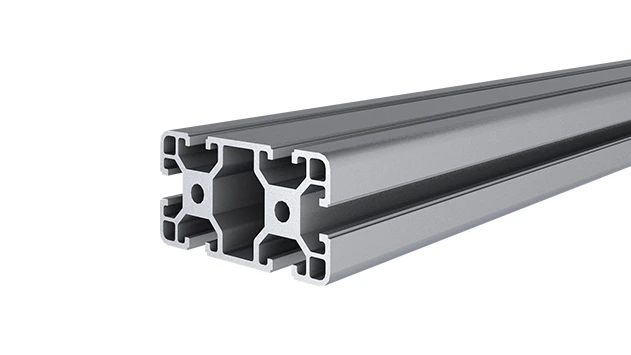
4080B is a 4.00x8.00 CM fractional 40 series square extrusion T-slot profile with two side open T-slots, each side with 4.00cm face, two side with 8.00cm face. The profile has align-a-grooves to assist in aligning connecting profiles.
When you're running a manufacturing facility, warehouse, or assembly line, the last thing you need is equipment that can't keep up. A wobbly workbench that sags under the weight of tools, a material rack that bends when stacked with parts, or a conveyor system that stalls under heavy loads—these aren't just minor inconveniences. They slow down production, compromise safety, and eat into your bottom line. That's where the right aluminum profile comes in. And if you're in the market for something robust, reliable, and built to handle real-world demands, the 4080B EU Standard Aluminum Profile is likely on your radar. But here's the question every operations manager, workshop foreman, and lean system supplier asks: How much weight can it actually support?
In this article, we're diving deep into the load capacity of the 4080B EU Standard Aluminum Profile. We'll break down what makes this profile a staple in industrial settings, the factors that influence how much weight it can hold, real-world testing data, and how accessories like aluminum guide rail A or aluminum profile accessories can boost its performance. Whether you're building a heavy-duty workbench, a high-capacity material rack, or a seamless conveyor system, by the end, you'll know exactly what this profile is capable of—and how to make the most of it.
What Is the 4080B EU Standard Aluminum Profile, Anyway?
Before we get into load capacity, let's make sure we're all on the same page about what the 4080B EU Standard Aluminum Profile is. If you're familiar with aluminum extrusion profile (the process of shaping aluminum by pushing it through a die), you know that profiles come in all shapes and sizes, each designed for specific tasks. The "4080B" in its name gives away its dimensions: 40 millimeters in width and 80 millimeters in height. It's a rectangular profile, and the "EU Standard" label means it meets strict European union guidelines for material quality, dimensional accuracy, and safety—no cutting corners here.
But why does that matter? EU standards ensure consistency. When you order a 4080B profile from a reputable supplier, you know it's made from high-grade aluminum alloy (typically 6063-T5 or similar), which balances strength, corrosion resistance, and lightweight properties. This isn't just any aluminum extrusion profile; it's engineered for structural integrity, making it a go-to choice for everything from workbenches and machine guards to automated conveyor systems and production line frames.
Think of it as the workhorse of the aluminum profile world. Its size—wider than a 4040 profile but more compact than a 60120—strikes a sweet spot between load-bearing capability and versatility. And because it's part of the EU standard range, it's compatible with a vast array of aluminum profile accessories, from connectors and brackets to end caps and gusset plates, letting you customize it for almost any application.
The Big Question: Factors That Determine Load Capacity
Load capacity isn't a one-size-fits-all number. Even for a standardized profile like the 4080B, how much weight it can support depends on several key factors. Let's break them down so you can estimate what your specific setup can handle.
1. Material Grade and Temper
Not all aluminum is created equal. The 4080B is typically made from 6063 aluminum alloy, a common choice for extrusions because it's easy to shape and has good mechanical properties. But within 6063, there are different "tempers"—heat treatment processes that alter the metal's strength. Most 4080B profiles use T5 temper, which involves cooling the extrusion quickly (quenching) and then aging it at room temperature. This gives it a tensile strength of around 180 MPa (megapascals) and a yield strength of about 145 MPa—numbers that translate to solid load-bearing ability.
If you opt for a higher-grade alloy or a T6 temper (which involves artificial aging for extra strength), you might see slightly higher load capacities, but for most industrial applications, T5 is more than sufficient. The key takeaway? Always check the material specs from your supplier—reputable lean system suppliers will provide detailed alloy and temper information upfront.
2. Profile Design: Wall Thickness and Cross-Section
The 4080B's cross-section is a rectangle with internal ribs (called "webs") that add rigidity. But the critical factor here is wall thickness. A thicker wall means more material to resist bending and compression. Most standard 4080B profiles have a wall thickness of 2.0mm to 3.0mm, though some heavy-duty variants go up to 4.0mm. Unsurprisingly, a 3.0mm wall will support more weight than a 2.0mm wall, especially over longer spans.
The cross-sectional design also plays a role. The 4080B's 40mm x 80mm shape, with its wider flange (the 80mm side), provides more surface area for distributing weight. When used horizontally (e.g., as a workbench top support), the wider flange resists bending better than a narrower profile would. Vertical use (e.g., as a leg on a material rack) leverages the profile's height for compressive strength.
3. Length of the Profile
This is a big one: the longer the profile, the less weight it can support without bending. It's basic physics—think of a ruler. A 30cm ruler can hold a stack of books without sagging, but a 1m ruler will bend under the same load. The same principle applies to the 4080B.
For example, a 1-meter length of 4080B (2.5mm wall, T5 temper) supported at both ends can typically handle around 150-200 kg when loaded evenly. But if you extend that to 2 meters, the load capacity drops—maybe to 50-80 kg—because the longer span increases deflection (bending). Add a center support, though, and you can boost that 2-meter span back up to 120-150 kg. We'll dive into specific numbers later, but remember: shorter spans = higher load capacity.
4. Support Configuration
How you mount the profile matters just as much as its length. There are three common support setups:
- Simple span (supported at both ends): The most common setup, like a beam across two workbench legs. Load capacity here is limited by bending in the middle.
- Continuous span (supported at multiple points): Adding intermediate supports (e.g., a third leg in the middle of a 2m beam) reduces the effective span length, increasing load capacity significantly.
- Cantilever (supported at one end only): The weakest setup, like a shelf sticking out from a wall. Load capacity here is much lower—often less than half of a simple span of the same length.
For maximum strength, always use as many supports as possible. Even adding a single center support to a long span can double its load capacity.
5. Aluminum Profile Accessories and Connections
You could have the strongest profile in the world, but if your connections are weak, the whole structure will fail. Aluminum profile accessories like brackets, connectors, and gusset plates play a critical role in distributing weight and reinforcing joints.
For example, using a gusset plate (a triangular bracket) at a 90-degree joint between two 4080B profiles adds rigidity and prevents the joint from flexing under load. Similarly, heavy-duty connectors with bolts (instead of just friction-fit fasteners) create a tighter, more secure bond. Even small accessories like end caps can help—they reinforce the open ends of the profile, preventing crushing when weight is applied.
One accessory worth highlighting is the aluminum guide rail A, a slotted rail that attaches to the 4080B's T-slots. When used in conveyor systems or material racks, guide rails help distribute the weight of sliding or rolling items evenly across the profile, reducing stress on any single point. Pair that with roller track placon mounts (another common accessory), and you've got a setup that can handle continuous, dynamic loads without strain.

Real-World Load Capacity Data: What the Numbers Say
Enough theory—let's get to the numbers. Below is a table showing typical load capacities for the 4080B EU Standard Aluminum Profile (2.5mm wall thickness, 6063-T5 alloy) under different support configurations. These values are based on static load testing (i.e., stationary weight, not moving or vibrating loads) and assume even weight distribution. Your actual results may vary slightly based on material quality, installation, and accessories, but this gives you a solid baseline.
| Profile Length | Support Configuration | Maximum Static Load (Evenly Distributed) | Deflection at Maximum Load* |
|---|---|---|---|
| 1000mm (1m) | Supported at both ends | 180 – 220 kg | 2 – 3mm |
| 1000mm (1m) | Supported at both ends + center support | 350 – 400 kg | 1 – 2mm |
| 2000mm (2m) | Supported at both ends | 60 – 80 kg | 8 – 10mm |
| 2000mm (2m) | Supported at both ends + 1 center support | 120 – 150 kg | 3 – 4mm |
| 2000mm (2m) | Supported at both ends + 2 intermediate supports (total 4 supports) | 250 – 300 kg | 1 – 2mm |
| 3000mm (3m) | Supported at both ends | 25 – 35 kg | 15 – 18mm |
| 3000mm (3m) | Supported at both ends + 2 intermediate supports (total 4 supports) | 90 – 110 kg | 4 – 5mm |
*Deflection is the amount the profile bends under load. For most structural applications, a deflection of less than 5mm is considered acceptable to avoid sagging or instability.
Pro Tip: If you're dealing with dynamic loads (e.g., parts sliding down a roller track, or a workbench where tools are constantly being placed and removed), reduce the maximum static load by 20-30%. Dynamic loads create additional stress from movement, so it's better to err on the side of caution.
Let's put these numbers in context. A 1m-long 4080B profile supported at both ends can easily hold a workbench top with tools, a laptop, and a few hundred kilograms of parts—no problem. A 2m span with two intermediate supports (so three supports total) could handle a material rack with multiple layers of heavy components, like automotive parts or metal castings. And if you're building a conveyor system using aluminum guide rail A and roller tracks, the 4080B's rigidity ensures smooth, consistent movement even with continuous product flow.
Boosting Load Capacity with Aluminum Profile Accessories
One of the best things about the 4080B is how customizable it is with aluminum profile accessories. These add-ons don't just make installation easier—they can significantly increase load capacity by reinforcing weak points and distributing weight more effectively. Here are some key accessories to consider:
Gusset Plates
Gusset plates are triangular or rectangular brackets that attach to the inside or outside of a joint (e.g., where a vertical leg meets a horizontal beam). They act like "struts" to prevent the joint from flexing under load. For a 4080B workbench, adding gusset plates at each corner can increase the overall load capacity by 30-40%. Look for aluminum or steel gusset plates with pre-drilled holes that align with the profile's T-slots for easy installation.
Heavy-Duty Connectors
Standard friction-fit connectors are fine for light loads, but for heavy-duty applications, upgrade to bolt-on connectors. These use high-tensile bolts to clamp the profiles together, creating a rigid, almost seamless joint. Brands like Bosch Rexroth or Item offer EU-standard connectors designed specifically for 4080B profiles, but even generic options from reputable lean system suppliers will work well. Just make sure the bolts are tightened to the recommended torque—over-tightening can strip the T-slots, while under-tightening leaves the joint loose.
Aluminum Guide Rail A
Aluminum guide rail A is a slotted rail that mounts along the length of the 4080B profile, providing a smooth surface for roller tracks, sliding bins, or conveyor belts. But it also adds structural rigidity. By attaching the guide rail to the profile's T-slots, you're essentially creating a "double wall" along one side, which resists bending and twisting. This is especially useful for conveyor systems or material racks where the profile is subject to lateral (sideways) forces.
End Caps and Internal Supports
Open-ended profiles can crush or deform under heavy vertical loads. Adding plastic or metal end caps reinforces the ends, preventing the walls from buckling. For extra-long spans, consider internal support rods or tubes that fit inside the 4080B's hollow core. These act like a backbone, reducing deflection and increasing load capacity by up to 25% in some cases.
Casters with Brake Systems
If you're building a mobile workbench or trolley with 4080B profiles, invest in heavy-duty casters with locking brakes. Casters distribute the load across four points (instead of just the profile's ends), and brakes prevent movement that could create dynamic stress. Look for casters rated for at least 150kg each—four of these will give you a total mobile load capacity of 600kg or more, depending on the profile setup.
Common Applications and Real-World Examples
To truly understand the 4080B's load capacity, let's look at how it's used in real industrial settings. These examples show how the right configuration and accessories make it a versatile solution for heavy-duty needs.
Workbenches for Automotive Assembly
Automotive manufacturing plants use 4080B profiles to build workbenches where mechanics assemble engine components, which can weigh 50-100 kg each. A typical setup uses 1.5m-long 4080B beams supported by four vertical legs (one at each corner) with gusset plates at the joints. The workbench top is a plywood or steel panel attached to the beams, and with this configuration, the bench easily supports the engine parts, tools, and a mechanic's weight (another 70-100 kg) without sagging.
Material Racks for Warehouse Storage
Warehouses often use 4080B to build multi-tiered material racks for storing heavy boxes or pallets. A 2m-tall rack with three shelves (each 1.8m long) might use 4080B uprights and horizontal beams. By adding intermediate supports every 60cm along the horizontal beams and using heavy-duty connectors, each shelf can hold 200-250 kg—enough for 4-5 large boxes of industrial parts. The aluminum extrusion profile's corrosion resistance also makes it ideal for humid warehouses, where steel racks might rust.
Conveyor Systems for Electronics Production
Electronics factories need conveyor systems that can handle circuit boards, components, and even small appliances. A 4080B-based conveyor uses aluminum guide rail A to support roller tracks, with the profile spanning 2m between support legs. The rollers distribute the weight of the products evenly, and with center supports, the conveyor can handle a continuous load of 50-70 kg (about 20-30 circuit board assemblies) without slowing down.
FAQs: Your Load Capacity Questions Answered
Still have questions? Here are answers to the most common ones we hear from customers and lean system suppliers.
Q: Can a 4080B profile support 500 kg if it's only 1m long?
A: It depends on the support configuration. A 1m span supported at both ends and the center (three supports total) with gusset plates and heavy-duty connectors can handle around 350-400 kg. To reach 500 kg, you'd need additional supports (e.g., every 30cm) or a thicker-walled profile (3.0mm or more).
Q: Do I need to worry about corrosion affecting load capacity?
A: 6063 aluminum has natural corrosion resistance, but in harsh environments (e.g., chemical plants, coastal areas), consider anodized or powder-coated 4080B profiles. Corrosion weakens the material over time, so proper finishing can extend both lifespan and load capacity.
Q: Can I mix 4080B with other profile sizes (e.g., 4040) in the same structure?
A: Yes, but be mindful of load distribution. The 4040 is smaller and has lower load capacity, so use it for lighter components (e.g., side rails) and 4080B for the main structural beams. Always consult a structural engineer if mixing sizes for heavy loads.
Q: How do I know if my supplier's 4080B meets EU standards?
A: Reputable lean system suppliers will provide certification documents, such as CE marking or ISO 9001 compliance. Ask for test reports on load capacity and material composition—if they can't provide these, look for another supplier.
Conclusion: Why the 4080B Is a Reliable Choice for Heavy Loads
At the end of the day, the 4080B EU Standard Aluminum Profile is more than just a piece of metal—it's a foundation for efficient, safe, and productive operations. Its load capacity, when paired with the right supports and aluminum profile accessories, makes it suitable for everything from workbenches and material racks to conveyor systems and machine frames. Whether you're a small workshop owner or a large-scale manufacturer, understanding its capabilities helps you build structures that last, reduce downtime, and keep your team safe.
Remember, the numbers we've discussed are guidelines. Every application is unique, so always factor in your specific load type (static vs. dynamic), span length, and environmental conditions. And when in doubt, consult a trusted lean system supplier or structural engineer—they can help you design a setup that maximizes the 4080B's potential while staying within safety limits.
So, how much weight can the 4080B support? With the right configuration, it can handle more than enough for most industrial needs—proving that when it comes to aluminum extrusion profiles, sometimes the best things really do come in 40mm x 80mm packages.