- Company Articles
- Products and Technology
- Product knowledge
- 5 Advantages of Using Swivel Stem Caster Wheels with Brake in 3C Assembly Lines

5 Advantages of Using Swivel Stem Caster Wheels with Brake in 3C Assembly Lines
Related Product
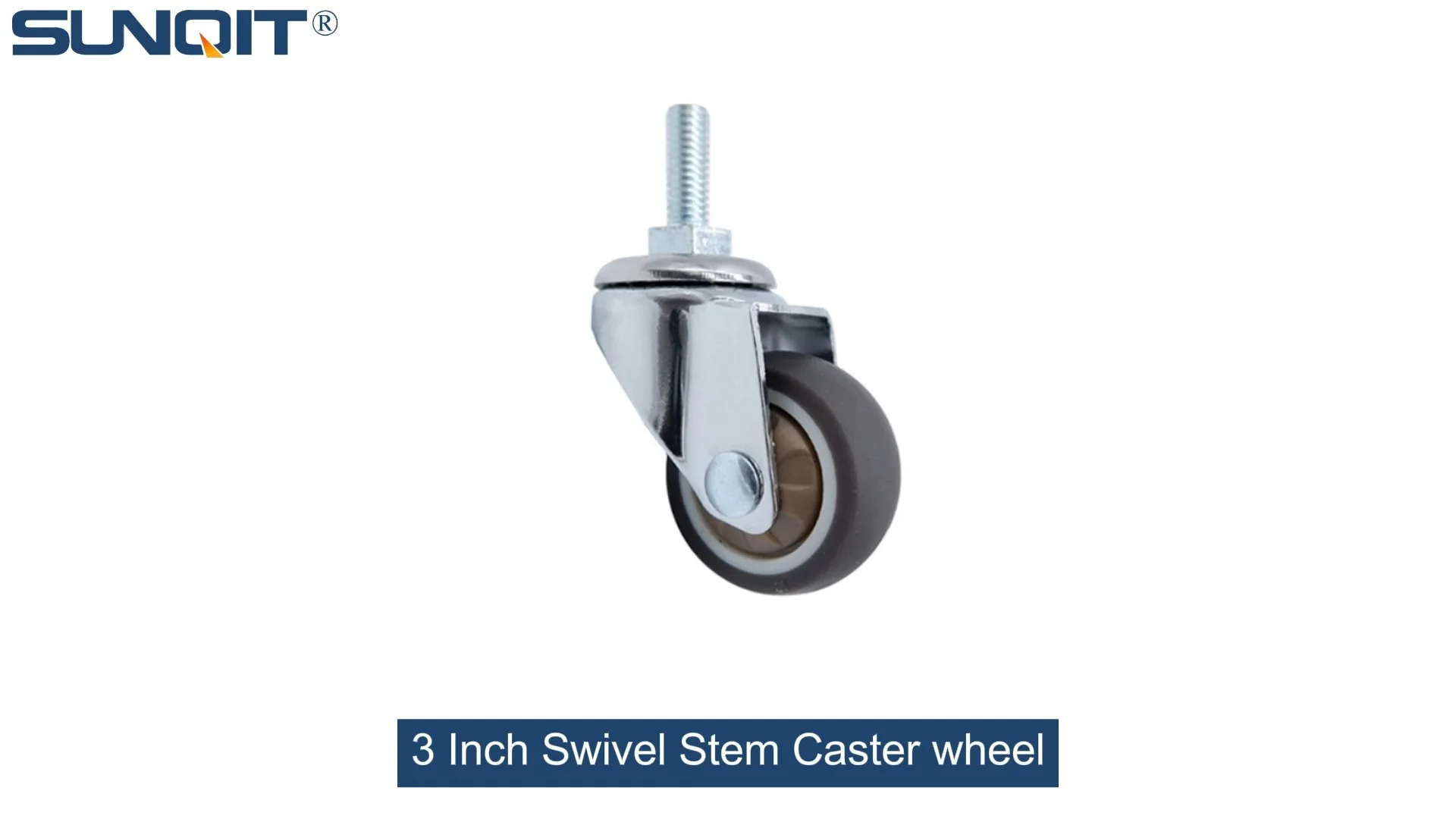
Swivel Stem Caster wheel
360 Degree Swivel Stem Caster. Threaded-post mount design, castors diameter 3 inch.Each swivel caster wheels loading 70KGS. Heavy enough and widely suit for carts, chairs, cabinet, flow rack, workbench, turnover rolley.
Walk into any modern 3C (computers, communications, consumer electronics) assembly plant, and you'll be met with a symphony of precision: robotic arms placing microchips, workers handling delicate circuit boards, and conveyors gliding components from station to station. In this high-stakes environment—where a single misaligned part can derail an entire production run—the tools and equipment that keep things moving are just as critical as the tech being built. Among these unsung heroes? Swivel stem caster wheels with brake. These small but mighty components are the backbone of mobile workstations, material trolleys, and even lightweight conveyors, quietly ensuring that every step of the assembly process is efficient, safe, and adaptable. Let's dive into why these caster wheels have become indispensable in 3C manufacturing, and how they deliver tangible benefits that ripple through productivity, quality, and worker satisfaction.
1. Enhanced Mobility with Controlled Stability: Moving Freely Without Compromising Safety
In 3C assembly lines, flexibility is everything. Production schedules shift, new product models are introduced, and workcells are reconfigured to meet demand—often overnight. This constant change demands equipment that can keep up, and swivel stem caster wheels with brake excel here. Unlike fixed casters, which lock movement to a single direction, the swivel design allows 360-degree rotation, making it effortless to maneuver workbenches, component trolleys, or tool carts around tight corners, between conveyor belts, and into cramped spaces. Imagine a technician needing to move a heavy ESD workstation from one end of the line to another to assist with a rush order: with swivel casters, they can pivot smoothly around a row of testing machines without having to lift or disassemble the workstation.
But mobility without control is chaos. That's where the brake feature shines. Once the workstation or trolley is in position, a simple foot pedal press engages the brake, locking the wheels in place with near-instant precision. This is critical in 3C assembly, where even a slight drift of a workbench could misalign a component during soldering or connector fitting—costing time, materials, and potentially damaging sensitive parts like OLED screens or microprocessors. Maria, a production supervisor at a smartphone assembly plant in Shenzhen, puts it this way: "Before we switched to braked swivel casters, we had workers propping up wooden blocks under trolley wheels to keep them steady. Now, one tap of the brake, and everything stays put. It's cut down on accidental shifts by 90%."
The stability of these casters also extends to worker safety. 3C plants are busy, with teams moving between stations, and heavy loads (like bins of lithium-ion batteries or metal chassis) being transported daily. Unbraked or poorly designed casters can lead to runaway trolleys, collisions, or strained muscles from wrestling with uncooperative equipment. Swivel stem casters with brake eliminate these risks by putting control directly in the hands (or feet) of the operator. Whether a trolley is loaded with 50kg of circuit boards or a lightweight tool cart holding precision screwdrivers, the brake ensures it stays exactly where it's needed until intentionally moved.
2. Precision Positioning: The Secret to Consistent, High-Quality Assembly
3C products are defined by their precision. A smartphone's camera module must align within 0.1mm of the housing; a laptop's keyboard keys need to sit flush to avoid jamming. Achieving this level of accuracy requires not just skilled workers and advanced machinery, but also work surfaces that stay perfectly positioned during every step of assembly. Swivel stem caster wheels with brake play a starring role here by enabling micro-adjustments that fixed or low-quality casters simply can't match.
Let's take a typical scenario: assembling a smartwatch. The process involves attaching a tiny OLED display to a metal frame, a task that requires the workbench to be at eye level, angled slightly toward the worker, and completely stationary. With swivel casters, the worker can first wheel the workbench into the general area, then use the 360-degree rotation to tweak its position—shifting it left by an inch, tilting it forward slightly—until it's ergonomically ideal. Once set, the brake locks the wheels, ensuring no movement even when the worker leans into the bench to apply pressure during adhesive bonding.
Contrast this with traditional rigid casters or even unbraked swivel casters: workers might waste 5-10 minutes per shift just readjusting workstations that creep out of place. Over a full production line of 50 workers, that's 250-500 minutes of lost time daily—time that could be spent assembling 200+ additional units. "We used to have a 'positioning checklist' for each station," says Li Wei, a line engineer at a tablet manufacturer. "Workers would mark the floor with tape to line up trolleys, but the tape wore off, or casters slipped. Now, with braked swivels, they set it once and forget it. Our first-pass yield on display alignment has gone up by 3%—that's thousands of fewer defective units per month."
The precision of these casters also benefits automated systems. Many 3C plants use collaborative robots ("cobots") to assist with repetitive tasks like screw driving or component sorting. These cobots rely on fixed reference points; if the mobile workstation they're paired with shifts, the robot's programming is thrown off, leading to errors. Swivel stem casters with brake ensure the workstation remains within the cobot's "sweet spot," maintaining alignment shift after shift. It's a small detail, but in an industry where margins are tight and quality standards are unforgiving, small details add up to big wins.

3. Seamless Integration with Lean Systems: Minimizing Waste, Maximizing Flow
Lean manufacturing principles—focused on eliminating waste, optimizing workflow, and continuous improvement—are the lifeblood of 3C production. Swivel stem caster wheels with brake align perfectly with this philosophy, acting as a bridge between static infrastructure and dynamic, demand-driven assembly. Let's break down how:
First, they reduce "motion waste"—one of the seven core wastes in lean. In traditional setups, workers might walk back and forth to retrieve tools or components stored in fixed racks. With mobile workstations on braked swivel casters, everything a worker needs—tools, parts bins, ESD mats—can be brought directly to the assembly point. A study by the Lean Enterprise Institute found that plants using mobile workstations with swivel casters reduced worker walking time by up to 40%, freeing up hours each week for value-adding tasks.
Second, they enable "pull production," where components are delivered to stations only when needed, reducing inventory buildup. For example, a smartphone assembly line might use "kanban" cards to signal when a station is low on charging ports. A material handler can quickly wheel a trolley loaded with ports to the station, brake it in place, and restock—no need to pre-stack parts at each station, cluttering the workspace. "Before, we'd have bins of extra components sitting on the floor next to workstations, just in case," recalls Zhang Hong, a lean coordinator at a manufacturing plant. "Now, with mobile trolleys on swivel casters, we deliver exactly what's needed, when it's needed. Floor space has opened up, and we've cut inventory costs by 15%."
Third, they support "quick changeovers," a key lean practice for adapting to small-batch production. 3C manufacturers often produce multiple product variants (e.g., 128GB vs. 256GB smartphones, or different color options) on the same line. With swivel casters, entire workcells can be reconfigured in minutes: a workstation for assembling camera modules can be moved to the front of the line for a high-demand model, then shifted back when production switches to a basic model without cameras. The brake ensures the new layout stays locked in, avoiding delays from misaligned stations. Without this flexibility, changeovers could take hours, eating into production time and increasing lead times for customers.
In short, swivel stem caster wheels with brake don't just "work with" lean systems—they actively enhance them. By making mobility controlled, predictable, and efficient, they turn lean's abstract goals into tangible, everyday practices that drive bottom-line results.

4. ESD Compatibility: Protecting Sensitive Electronics from Static Damage
3C components—think microchips, memory modules, and touchscreen controllers—are extremely sensitive to electrostatic discharge (ESD). A single static shock, often imperceptible to humans, can fry a circuit board or corrupt data in a flash drive, rendering the product useless. That's why ESD protection is non-negotiable in assembly lines, and swivel stem caster wheels with brake play a critical role here, too.
Many manufacturers offer ESD-safe versions of these casters, designed with conductive materials (like carbon-infused rubber wheels or metal stems) that channel static electricity away from the workstation and into the ground. This creates a continuous "ground path" from the worker (wearing ESD wristbands) to the workstation surface (an ESD mat) to the casters, ensuring no static buildup can jump to components. For example, a worker handling a drone's flight controller board on an ESD workstation with conductive swivel casters can rest easy knowing that even if they shuffle their feet (a common static generator), the charge will dissipate harmlessly—instead of zapping the $500 controller.
Non-ESD casters, by contrast, can act as insulators, trapping static and turning mobile workstations into ticking time bombs. A 2023 report by the Electrostatic Discharge Association (ESDA) found that 15% of field failures in 3C products trace back to undetected ESD damage during assembly—often caused by inadequate grounding in mobile equipment. "We used to have random 'ghost failures'—phones that worked in testing but died days later," says Raj, a quality assurance manager at a consumer electronics plant in Malaysia. "After switching to ESD swivel casters on all mobile workstations, those failures dropped by 80%. It was a game-changer for our warranty costs."
ESD-safe swivel casters also meet strict industry standards, such as ANSI/ESD S20.20, which is required for suppliers to major brands like Apple, Samsung, and Huawei. This compliance isn't just a box to check—it's a competitive advantage. Manufacturers that can prove their entire assembly process, down to the casters, is ESD-protected are more likely to win contracts and build trust with clients who demand zero-defect products.

5. Durability and Cost-Efficiency: Built to Last in High-Volume Environments
3C assembly lines run hard—often 24/7, with equipment enduring constant use, exposure to oils, coolants, and cleaning agents, and the wear and tear of heavy loads. A caster wheel that fails prematurely isn't just an inconvenience; it's a production stopper. Swivel stem caster wheels with brake are engineered to thrive in this harsh environment, delivering long-term durability that translates to lower total cost of ownership (TCO).
Let's start with materials. High-quality swivel casters for 3C lines typically use reinforced nylon or polyurethane wheels, which resist abrasion, chemicals, and impact. The swivel joints are sealed with precision bearings and lubricated for life, preventing dust and debris from jamming the mechanism—critical in plants where metal shavings or plastic particles are common. The brake mechanism itself is built to withstand thousands of actuations, with rust-resistant springs and pedals that won't bend or break under repeated foot pressure.
Compare this to cheap, generic casters, which might last 6-12 months before the wheels crack, the swivel joint seizes, or the brake fails. Replacing these casters requires shutting down the workstation, sourcing replacements, and paying for maintenance labor—costs that add up fast. A mid-sized 3C plant with 100 mobile workstations could spend $10,000+ annually on caster replacements alone. Investing in durable swivel stem casters with brake—even at a higher upfront cost—pays off by extending service life to 3-5 years, slashing replacement and downtime costs.
There's also the "hidden cost" of poor casters: damage to floors. 3C plants often use smooth epoxy or vinyl floors to maintain cleanliness and ESD control. Cheap casters with rough or uneven wheels can scratch or gouge these surfaces, requiring expensive repairs. Swivel stem casters with soft, non-marking wheels (like polyurethane) glide smoothly, protecting floors and reducing maintenance costs. "We used to resurface our plant floors every two years because of caster damage," says Chen, a facilities manager at a tablet factory. "With the new swivel casters, we're going on four years, and the floors still look brand new. That's saved us $30,000 in floor repairs alone."
| Feature | Swivel Stem Caster Wheels with Brake | Traditional Fixed Casters |
|---|---|---|
| Mobility | 360° swivel for easy maneuvering in tight spaces | Limited to forward/backward movement; hard to pivot |
| Stability | Brake locks wheels in place; no drift during assembly | No brake; risk of movement from vibration or bumps |
| ESD Protection | Available with conductive materials for static dissipation | Rarely ESD-safe; may trap static |
| Durability | Reinforced wheels, sealed bearings; 3-5 year lifespan | Basic materials; 6-12 month lifespan |
| Lean Compatibility | Reduces motion waste; supports pull production and quick changeovers | Static design increases walking time and limits flexibility |
Conclusion: Small Wheels, Big Impact in 3C Assembly
In the fast-paced, precision-driven world of 3C manufacturing, success hinges on the details. Swivel stem caster wheels with brake may seem like humble components, but their impact is anything but small. They empower workers with mobility and control, protect delicate electronics from damage, align with lean principles to eliminate waste, and stand up to the rigors of 24/7 production—all while keeping costs in check.
As 3C products continue to shrink in size and grow in complexity—think foldable smartphones, AR glasses, and IoT devices—the demand for flexible, reliable assembly tools will only increase. Swivel stem caster wheels with brake are more than just a "nice-to-have"; they're a strategic investment in productivity, quality, and worker well-being. So the next time you pick up your smartphone or tablet, take a moment to appreciate the unseen heroes that helped build it—including the small, swiveling, braked wheels that kept everything moving, safely and precisely, down the line.