- Company Articles
- Products and Technology
- Procurement Guidelines
- 85 Staggered Roller Track Cost Analysis: Investment vs Return

85 Staggered Roller Track Cost Analysis: Investment vs Return
Related Product
85 Staggered Roller Track
Triple staggered roller track is designed to enhance carton flow in various applications, such as flow racks and carton flow systems. This triple-staggered roller track is ideal for bins, boxes, or products that require smoother, more efficient rolling.
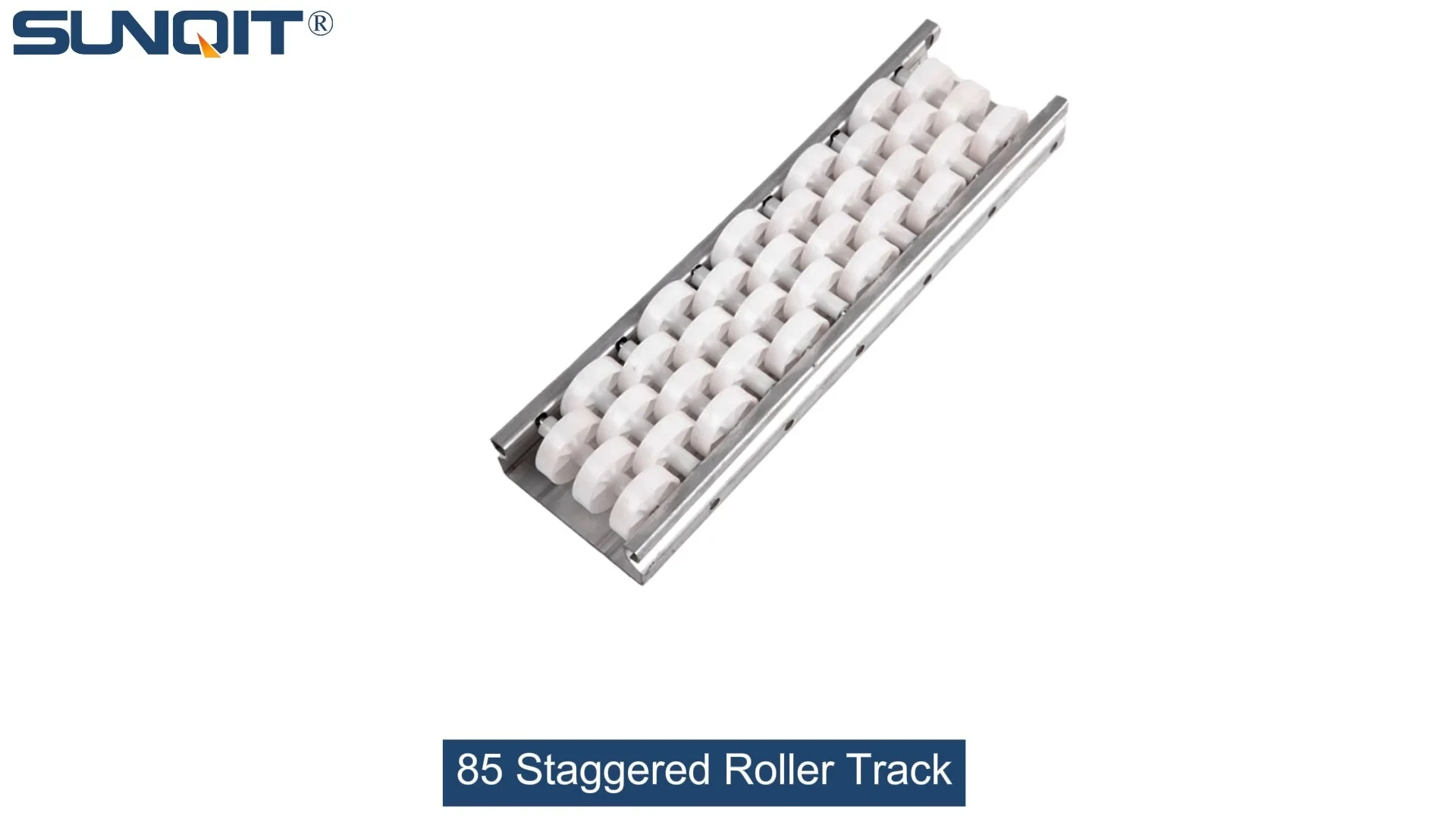
Let's talk about the backbone of manufacturing efficiency—those unsung heroes that keep production lines moving, workers from straining, and deadlines from slipping. If you're in charge of a factory floor, a warehouse, or any manufacturing setup, you know the drill: every second counts, every dollar spent needs to pull its weight, and "good enough" today might mean falling behind tomorrow. That's where tools like the 85 Staggered Roller Track come into play. It's not just a piece of equipment; it's a silent partner in making your operations smoother, faster, and smarter. But before you hit "buy," let's break down the real deal: what does it cost to bring this into your space, and more importantly, what kind of return can you actually expect? Let's dive in.
First Things First: The Investment Side of the Equation
When we talk about "cost," it's easy to fixate on the price tag of the roller track itself. But any smart manufacturer knows the initial purchase is just one piece of the puzzle. Let's break down what you're really investing in when you choose an 85 Staggered Roller Track system.
1. The Core Hardware: Roller Track & Accessories
The 85 Staggered Roller Track isn't a one-size-fits-all product—and that's a good thing. Its design, with staggered rollers (meaning they're offset, not perfectly aligned), is built to handle loads smoothly, even with unevenly distributed weight. But to make it work for your specific needs, you'll need the track itself plus the right accessories. Let's break down the numbers here:
| Component | Estimated Cost Range | Why It Matters |
|---|---|---|
| 85 Staggered Roller Track Units (per meter) | $45 - $75 | Depends on material (steel vs. aluminum), load capacity (light vs. heavy-duty), and finish (standard vs. ESD-safe for sensitive electronics). |
| Aluminum Profile & Supports | $20 - $40 per linear meter | Aluminum profiles provide the sturdy frame that holds the roller track. They're lightweight but strong, and compatible with a range of aluminum profile accessories for easy customization. |
| Connectors & Joints | $5 - $15 per piece | Think of these as the "glue" that holds your system together. From 90° aluminum joints to end supports with stops, they ensure your track stays stable and aligned, even under constant use. |
| Customization Parts (e.g., guides, brakes) | $30 - $100+ per feature | Need a brake to slow down fast-moving loads? A side guide to keep items from slipping off? These add-ons tailor the track to your workflow. |
Pro tip: If you're buying in bulk (say, for a full production line), roller track wholesale options can bring these costs down by 10-15%. Suppliers often offer discounts for larger orders, so don't hesitate to ask about volume pricing.
2. Design & Customization: Making It Yours
Here's where the "lean solution" part kicks in. The best roller track systems aren't just bought—they're designed. If you're working in 3C assembly, for example, you might need the track to integrate with an ESD workstation to protect sensitive circuit boards. In automotive manufacturing, you might need it to handle heavier parts like engine components. This customization isn't free, but it's where the real value starts.
A basic, off-the-shelf setup might skip this step, but we've seen too many factories waste money on "cheap" systems that don't fit their space or workflow—only to replace them a year later. A good supplier will offer design services (often included in the overall cost or at a nominal fee) to map out the track layout, ensuring it connects seamlessly with your existing lean pipe workbench or conveyor systems. Expect to budget $150 - $500 for professional design, depending on the complexity of your setup.
3. Installation & Training: Getting It Right the First Time
You could save a few bucks by having your in-house team install the track, but is that worth the risk of misalignment, loose joints, or uneven loading? Probably not. Improper installation can lead to jams, damaged products, or even worker injuries—all of which cost way more than professional installation. Most suppliers offer installation services, typically charging $80 - $120 per hour per technician, with a small team (2-3 people) finishing a standard setup in 1-2 days. For a 10-meter track with accessories, that's roughly $1,200 - $2,000.
Then there's training. Your workers need to know how to use the track safely, adjust it if needed, and spot minor issues before they become big problems. A quick 2-hour training session for your team (included in many supplier packages) ensures everyone's on the same page—and avoids costly mistakes down the line.
Total Initial Investment Estimate
Putting it all together, a mid-sized 85 Staggered Roller Track system (say, 10 meters long, with aluminum profiles, basic customization, and professional installation) will likely set you back between $3,500 - $6,000 . That might sound steep at first, but let's flip the script: what do you get in return?
The Return: When Efficiency Turns Into Real Savings
Here's the thing about manufacturing investments: the best ones don't just "pay for themselves"—they keep paying. The 85 Staggered Roller Track is all about long-term gains, from faster production to less waste. Let's quantify that return, so you can see exactly how this investment works for you.
1. Labor Savings: Let the Track Do the Heavy Lifting
Imagine a worker on your assembly line manually moving a bin of parts from Station A to Station B—maybe 10 meters away, 50 times a day. At minimum wage ($15/hour), that's 50 trips x 2 minutes per trip = 100 minutes per day, or over 8 hours per week, just on moving parts. Now, replace that with an 85 Staggered Roller Track: the bin glides smoothly with a gentle push, cutting that time to 30 seconds per trip. Suddenly, that worker is saving 75 minutes per day—over 6 hours per week—time they can spend on more valuable tasks, like quality checks or assembly.
| Scenario | Manual Handling (per week) | With Roller Track (per week) | Weekly Savings |
|---|---|---|---|
| Time Spent Moving Parts | 8 hours | 2 hours | 6 hours |
| Cost (at $15/hour) | $120 | $30 | $90 |
| Annual Savings (50 weeks) | - | - | $4,500 |
And that's just one worker on one line. Scale that to a full factory with multiple tracks, and the savings add up fast. We've seen clients report labor savings of $10,000 - $20,000 per year with just a few roller track installations.
2. Reduced Product Damage: No More "Oops, Dropped It" Moments
Ever had a worker drop a bin of delicate parts—say, medical device components or 3C assembly parts? The cost of replacing those parts, plus the time to clean up and restart, can be brutal. The 85 Staggered Roller Track's smooth, controlled movement drastically cuts down on spills and drops. Even a 5% reduction in damaged goods can mean big savings: if your line produces 1,000 units per week with a 2% damage rate (20 units lost, at $50 per unit), that's $1,000 per week in waste. Cut that damage rate to 0.5% (5 units lost), and you're saving $750 per week— $39,000 per year .
3. Flexibility: Adapt Without Starting Over
Manufacturing isn't static. A new product line, a shift in demand, or a layout redesign can throw a wrench into fixed systems. But here's where the lean system philosophy shines: the 85 Staggered Roller Track is built to be reconfigured. Its aluminum profiles and modular joints mean you can disassemble, move, and rebuild the track in a fraction of the time it would take to install a new fixed conveyor. Let's say your company launches a new product line that requires a 5-meter extension to the track. With modular components, that's a few hours of work and $500 in new parts—not $5,000 for a whole new system.
Over time, this adaptability adds up. Factories that use rigid, non-modular systems often spend 2-3x more on rework every 2-3 years. With a lean, modular setup, you're future-proofing your space—and your budget.
4. Sustainability: Reuse, Reduce, Repeat
Sustainability isn't just a buzzword—it's a cost-saver. The 85 Staggered Roller Track, made with durable aluminum and steel, is built to last. Unlike cheap plastic alternatives that crack or warp after a year, this track can handle years of heavy use. And when you do need to reconfigure, those aluminum profiles and joints? They're reusable. No need to throw away old parts—just repurpose them. Over a 5-year lifespan, that's a 70% reduction in waste compared to disposable systems, cutting your long-term material costs by thousands.

Real-World Impact: When Theory Meets the Factory Floor
Let's ground this in reality with a quick example. A mid-sized 3C assembly plant we worked with recently was struggling with bottlenecks in their smartphone production line. Workers were manually moving component trays between soldering and testing stations, leading to delays and frequent spills (costing them ~$2,000/month in damaged parts). They invested in a 15-meter 85 Staggered Roller Track system with aluminum profiles and ESD-safe rollers (to protect sensitive electronics), totaling $5,200.
Three months later, here's what changed: part-moving time dropped by 75%, damaged parts decreased by 90% (saving $1,800/month), and workers reclaimed 10 hours per week for higher-value tasks. By month 4, the system had already paid for itself. Now, a year later, they're expanding the track to two more lines—because the ROI was too clear to ignore.

So, Is the 85 Staggered Roller Track Worth It? The Verdict
Let's boil it down: the initial investment for an 85 Staggered Roller Track system is real—$3,500 to $6,000 for a mid-sized setup. But the return? It's even more real. From labor savings that add up to $5,000+ per year, to reduced damage, flexibility, and sustainability, this isn't just a purchase. It's an investment in making your factory smarter, faster, and more resilient.
If you're in manufacturing, you know the difference between spending money and investing it. The 85 Staggered Roller Track? That's investing. It's about turning every dollar spent today into more efficiency, more productivity, and more profit tomorrow. And in a world where every second and every cent counts, that's the kind of partner your production line needs.