- Company Articles
- Products and Technology
- Product knowledge
- One Way Rotatory Straight Lean Pipe Joints for Custom Material Handling Solutions

One Way Rotatory Straight Lean Pipe Joints for Custom Material Handling Solutions
Related Product
One Way Rotatory Straight Lean Pipe Joint
Two way lean pipe joint for 2 pcs 28MM lean pipe connection in straight angle with rotatory fucntion, which used widely in workbench, flow rack, hand trolley frame connection.
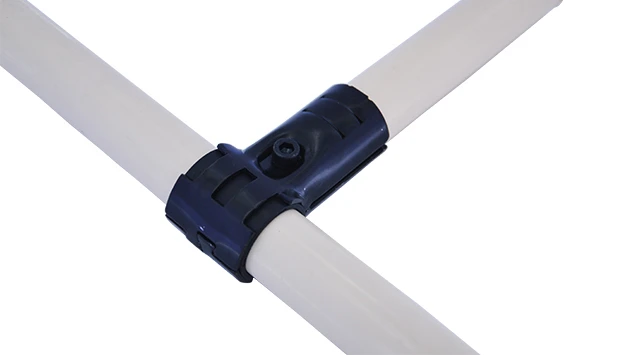
In the fast-paced world of manufacturing and logistics, material handling isn't just a background process—it's the heartbeat of operational efficiency. Every second wasted on retrieving parts, every inch of space misused, and every rigid system that can't adapt to shifting production needs chips away at a company's bottom line. Today's facilities don't just need tools to move materials; they need solutions that grow with them . Enter lean pipe systems: modular, flexible, and designed to eliminate waste—one joint, one pipe, one custom configuration at a time. At the core of this adaptability lies a small but mighty component: the One Way Rotatory Straight Lean Pipe Joint . Far more than a simple connector, this joint is the unsung hero of custom material handling, enabling teams to build, adjust, and reimagine workflows without starting from scratch. Let's dive into how this unassuming part is transforming how businesses handle materials, one rotation at a time.
The Rise of Lean Pipe Systems: Flexibility in a Rigid World
Before we zoom in on the one-way rotatory joint, let's set the stage: What makes lean pipe systems so indispensable in modern manufacturing? Traditional material handling setups—think fixed steel racks, welded conveyors, and one-size-fits-all workbenches—are like concrete shoes in a marathon. They work… until they don't. A new product line, a shift in production volume, or a layout redesign can render them obsolete, requiring costly replacements or time-consuming modifications. Lean pipe systems, by contrast, are built on the principle of modularity . They use lightweight, durable pipes (often steel with a plastic coating, aluminum, or stainless steel) and a variety of joints to create structures that can be assembled, disassembled, and reconfigured in hours, not weeks.
At their simplest, these systems start with lean pipe —a hollow tube that's strong enough to support tools, parts, and even heavy machinery, yet light enough for a single worker to maneuver. But the real magic? The joints. These small connectors link pipes at angles, allowing for the creation of workbenches, flow racks, conveyors, turnover trolleys, and more. Without reliable, versatile joints, lean pipe systems would be little more than a pile of tubes. And among the many joint types available—fixed, swivel, multi-angle—the one-way rotatory straight lean pipe joint stands out for its unique blend of flexibility and stability.
Meet the Star: What Is a One Way Rotatory Straight Lean Pipe Joint?
Imagine building a workbench where you need a shelf to tilt slightly for easier access to tools—but once tilted, it stays put. Or a flow rack where each level's angle must be fine-tuned to match the weight of the materials sliding down it (heavier parts need a steeper incline; lighter ones, gentler). That's where the one-way rotatory straight lean pipe joint shines. Unlike fixed joints (which lock pipes at a set angle) or fully swivel joints (which rotate freely), this joint offers controlled rotation : it allows pipes to rotate in one direction (usually 0° to 180°) but locks securely when turned the other way, preventing unintended movement. This "one-way" action gives operators precision without sacrificing stability—a game-changer for custom setups.
Design Breakdown: How It Works
Let's get technical (but not too technical). A typical one-way rotatory straight lean pipe joint consists of a few key parts: a cylindrical body (usually made of high-strength steel or aluminum), an internal locking mechanism (often a spring-loaded pin or ratchet), and threaded holes for securing pipes. Here's the play-by-play:
- Assembly : The joint slides over the end of a lean pipe, and a setscrew (or hex bolt) tightens to grip the pipe securely. No welding, no drilling—just a wrench and a few minutes.
- Rotation : When force is applied in the "allowed" direction (e.g., clockwise), the internal mechanism releases, letting the joint rotate smoothly around the pipe. This adjusts the angle of the connected structure (say, a shelf or roller track).
- Locking : When rotated in the opposite direction (e.g., counterclockwise), the locking mechanism engages, "clicking" into place to hold the joint at the desired angle. This prevents accidental shifts, even under load.
The result? A joint that's both adjustable and reliable . It's like having a hinge that lets you set the perfect angle and then locks it there—no tools needed for adjustments, just a firm twist.
Materials Matter: Durability by Design
Not all joints are created equal, and the one-way rotatory straight lean pipe joint is built to last. Most are made from chrome-plated steel (for corrosion resistance and strength) or aluminum (for lighter-weight applications). The internal locking components are often heat-treated to withstand repeated use—critical in high-traffic areas like assembly lines, where joints might be adjusted daily. Even the setscrews are designed to bite into the pipe without damaging it, ensuring a tight grip that won't loosen over time. For environments where cleanliness is key (think food processing or electronics manufacturing), stainless steel versions are available, resisting rust and harboring fewer germs than traditional steel.

Building Custom Solutions: Where the Joint Shines
The true power of the one-way rotatory straight lean pipe joint lies in its ability to turn generic lean pipe components into custom-tailored material handling systems. Let's walk through three real-world applications where this joint transforms "good enough" into "perfect for us."
1. Adjustable Workbenches: Ergonomics at Your Fingertips
A workbench isn't just a table—it's where operators spend 8+ hours a day assembling products, testing components, or packing orders. Poor ergonomics here leads to fatigue, errors, and even injuries. With the one-way rotatory joint, workbenches become adaptable to every operator's needs. Imagine a bench with a tool shelf that can be tilted upward for easy access to frequently used tools, then locked in place. Or a parts bin holder that angles downward to reduce bending, adjusted on the fly for left- or right-handed workers. In electronics manufacturing, where precision is critical, a workbench with a rotating component tray (held by one-way joints) lets operators swing parts closer without straining, cutting down on reach time and errors.
Case in point: A medical device manufacturer recently upgraded their assembly workbenches with one-way rotatory joints. Previously, workers had to stretch across fixed shelves to grab small screws and wires, leading to repetitive strain injuries. By adding rotating shelves adjusted via the joints, they reduced reach distances by 40% and reported a 25% drop in operator fatigue complaints. All without replacing the entire bench—just swapping out a few fixed joints for one-way rotatory ones.
2. Flow Racks: Fine-Tuning the "Flow" in Flow Racks
Flow racks are the backbone of just-in-time (JIT) production, using gravity to feed materials from the back (replenishment side) to the front (picking side). But not all materials flow the same: a box of heavy circuit boards needs a steeper incline than a lightweight plastic housing. Fixed-angle flow racks force teams to compromise—either some items slide too fast (risking damage) or others get stuck (causing delays). Enter the one-way rotatory joint.
By attaching roller tracks to the rack's uprights using one-way rotatory joints, teams can adjust each shelf's angle individually. Heavier items? Tilt the track to 15° for smooth sliding. Lighter items? drop it to 5° to prevent spills. Even within the same rack, different sections can have different angles, accommodating mixed materials. And when production shifts to a new product line, adjusting the angles takes minutes, not days. A automotive parts supplier we worked with recently used this setup to handle both metal brackets (heavy) and rubber gaskets (light) on the same flow rack, cutting picking errors by 30% and reducing restocking time by half.
3. Conveyor Systems: Adapting to Product Sizes
Conveyors move materials from Point A to Point B, but what if Point B shifts? Or if you need to merge two lines into one, or create a "buffer" zone where products slow down before packaging? Fixed conveyors require expensive modifications, but with lean pipe conveyors and one-way rotatory joints, reconfiguration is a breeze. For example, roller conveyors built with these joints can have their tracks angled to create gentle curves, guide products into sorting lanes, or even adjust the height of the conveyor to match an adjacent machine. In a warehouse, this means a single conveyor line can handle small boxes in the morning and larger pallets in the afternoon—no tools, no downtime, just a few twists of the joint.
One e-commerce fulfillment center we partnered with used this approach to seasonal spikes. During the holidays, they needed to merge three picking lines into one packaging line. Using one-way rotatory joints, they angled sections of roller track to funnel products into a single stream, doubling throughput without installing new conveyors. After the season, they reconfigured the tracks back to their original layout—all in a day's work.

Why Choose One-Way Rotatory? A Joint Comparison
With so many lean pipe joints on the market, how does the one-way rotatory straight joint stack up? Let's compare it to three common alternatives to see where it fits best.
| Joint Type | Rotation Range | Stability Under Load | Best For | Adjustment Ease |
|---|---|---|---|---|
| Fixed Joint | 0° (no rotation) | Excellent (permanent lock) | Static structures (e.g., fixed-height racks) | Poor (requires disassembly to adjust) |
| Full Swivel Joint | 360° (unrestricted) | Fair (may shift under heavy load) | Temporary setups (e.g., event displays) | Good (rotates freely, but no locking) |
| Multi-Angle Joint | Pre-set angles (e.g., 30°, 45°, 90°) | Very Good (locks at set angles) | Structures with standard angles (e.g., L-shaped workbenches) | Good (clicks into preset positions) |
| One-Way Rotatory Straight Joint | 0°–180° (one direction) | Excellent (locks at any angle in range) | Custom angles, ergonomic setups (e.g., adjustable flow racks, workbenches) | Excellent (tool-free, infinite angle options) |
The takeaway? If you need infinite adjustability combined with rock-solid stability , the one-way rotatory joint is your best bet. It bridges the gap between fixed joints (too rigid) and full swivel joints (too loose), making it ideal for environments where "close enough" isn't enough.
Beyond Flexibility: The Hidden Benefits of the One-Way Rotatory Joint
We've covered flexibility and adaptability, but the one-way rotatory straight lean pipe joint offers more than just adjustability. Here are three hidden benefits that make it a smart investment for any facility:
1. Reduced Downtime, Increased Productivity
Traditional systems require teams to shut down production to reconfigure workbenches or racks—welding, drilling, or hiring contractors. With the one-way rotatory joint, adjustments take minutes, not hours. An operator can tweak a flow rack's angle between shifts, or a supervisor can reposition a conveyor track during a lunch break. Less downtime means more time spent producing, packing, and shipping—directly boosting the bottom line.
2. Lower Costs Over Time
Modular systems already save money by eliminating the need for custom-built, one-off structures. The one-way rotatory joint takes this further by extending the life of those systems. When production needs change, you don't need to buy new parts—just adjust the joints. A workbench built today can become a parts cart tomorrow, then a mobile testing station next month. Over time, this reusability cuts down on waste and reduces capital expenses.
3. Empowering Teams to Innovate
The best material handling solutions often come from the people using them daily—operators, supervisors, and line leads who know exactly what works (and what doesn't). The one-way rotatory joint puts the power to innovate in their hands. No need to wait for engineering approval or external contractors; teams can experiment with angles, layouts, and configurations on the fly, testing new ideas and refining processes in real time. This "maker mindset" fosters a culture of continuous improvement—core to lean manufacturing principles.
The Future of Material Handling: Small Joints, Big Impact
In a world where manufacturing is faster, more complex, and more customer-driven than ever, adaptability isn't a luxury—it's a necessity. Lean pipe systems have long been a cornerstone of flexible operations, but it's the details—the joints, the connectors, the small parts—that turn these systems into competitive advantages. The one-way rotatory straight lean pipe joint is a prime example: a simple, affordable component that unlocks endless possibilities for custom material handling. Whether you're building an ergonomic workbench, a dynamic flow rack, or a reconfigurable conveyor, this joint ensures your system doesn't just meet today's needs—it grows with tomorrow's challenges.
So, the next time you walk through your facility, take a closer look at the structures around you. Are they holding your team back, or empowering them to do their best work? With the right joints, the answer can be the latter. After all, in lean manufacturing, it's often the smallest parts that make the biggest difference.