- Company Articles
- Products and Technology
- Product knowledge
- Parallel Fixation Aluminum Pipe Joints in Aerospace Component Assembly

Parallel Fixation Aluminum Pipe Joints in Aerospace Component Assembly
Related Product
Parallel Fixation Aluminum Pipe Joint
Aluminum parallel joint for two pcs 28mm aluminum pipe connected by parallel direction.
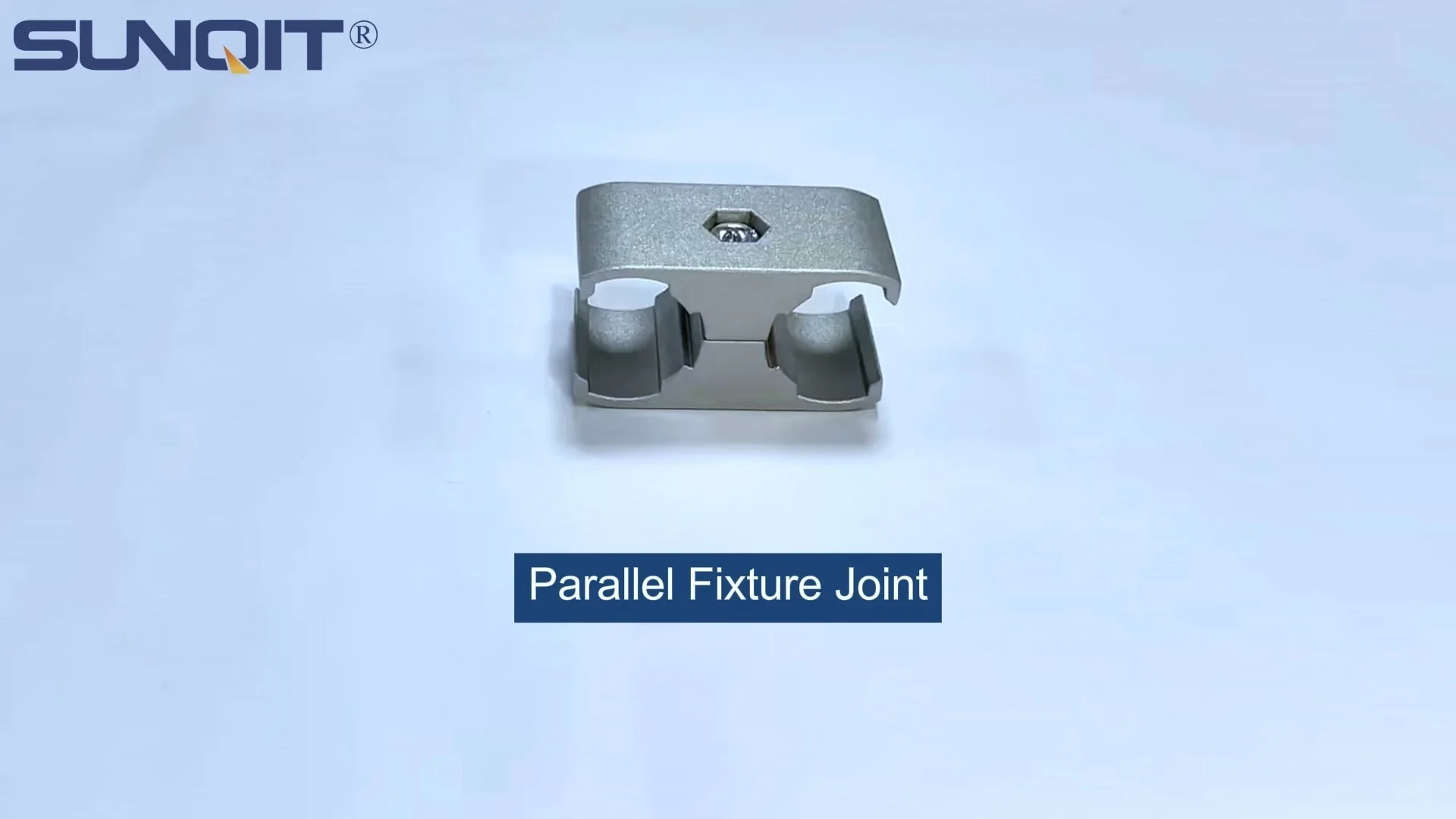
Parallel Fixation Aluminum Pipe Joints in Aerospace Component Assembly: Engineering Precision, Flexibility, and Lean Efficiency
Aerospace manufacturing is a realm where the margin for error is measured in microns, and the demand for adaptability grows by the day. From assembling intricate avionics systems to constructing large-scale wing components, every step requires a delicate balance of rigidity and flexibility. Traditional assembly setups—often built with welded steel frames or rigid bolted structures—struggle to keep pace with this demand. They're heavy, time-consuming to reconfigure, and prone to corrosion in factory environments. Enter parallel fixation aluminum pipe joints: a modular, lightweight, and highly adaptable solution that's quietly revolutionizing how aerospace manufacturers build, retool, and optimize their production lines. In this article, we'll explore how these unassuming components are becoming the backbone of modern aerospace assembly, blending material science, lean principles, and engineering ingenuity to meet the industry's most pressing challenges.
The Aerospace Assembly Challenge: Why Rigidity and Flexibility Can't Be Compromised
To understand the value of parallel fixation aluminum pipe joints, let's first unpack the unique hurdles aerospace manufacturers face. Precision is non-negotiable: a misalignment in a turbine blade mount or a loose connection in a flight control system could have catastrophic consequences. At the same time, production lines must be flexible. Aerospace programs often involve low-volume, high-variety manufacturing—think custom components for military aircraft, commercial airliners, and even space exploration vehicles. A single factory might switch between assembling 50-seat regional jet parts one month and satellite brackets the next. Traditional rigid setups simply can't pivot quickly enough. Welded steel workbenches, for example, take days to disassemble and rebuild, leading to costly downtime. Bolted frames fare slightly better but require specialized tools and often result in stripped threads or damaged components when reconfigured.
Durability is another concern. Aerospace factories are harsh environments: constant vibration from machinery, exposure to coolants and lubricants, and the need to support heavy loads (think 50kg tool cabinets or 200kg aircraft subassemblies) all take a toll. Materials must resist corrosion, maintain structural integrity under stress, and keep long-term maintenance costs in check. Finally, there's the push for leaner operations. In an industry where profit margins are tight and competition is fierce, eliminating waste—whether in time, materials, or space—is critical. Every minute spent retooling a line, every square meter of floor space wasted on fixed infrastructure, and every kilogram of excess weight in workstations adds up. For aerospace manufacturers, the ideal solution would address all these needs: precision alignment, rapid reconfigurability, durability, and lean efficiency. That's where parallel fixation aluminum pipe joints come into play.
What Are Parallel Fixation Aluminum Pipe Joints? Breaking Down the Design
At their core, parallel fixation aluminum pipe joints are mechanical connectors designed to join two or more aluminum pipes (or profiles) in parallel, ensuring they remain perfectly aligned while allowing for quick adjustments and disassembly. Unlike traditional welded joints, which fuse materials permanently, or basic bolted joints, which rely on friction alone, these joints use a combination of clamping mechanisms, internal locking tabs, and precision-machined surfaces to create a secure yet reversible connection. Let's break down their key design features:
Modular Clamping Systems: Most parallel fixation joints use a two-part clamping design: a base that attaches to one aluminum profile and a sliding or rotating clamp that secures the parallel profile. This allows for micro-adjustments in spacing—often down to 0.1mm—critical for aligning work surfaces or guide rails in aerospace assembly. For example, when building a workbench for assembling circuit boards, operators might need to adjust the distance between two parallel rails to accommodate different board sizes. The joint's clamping mechanism lets them do this without disassembling the entire structure.
Load-Bearing Geometry: Aerospace assembly often involves heavy loads, from tooling equipment to partially assembled components. Parallel fixation joints are engineered with load-bearing surfaces that distribute weight evenly across the aluminum profile, reducing stress concentrations. Many feature reinforced ribs or gusseted designs, which strength without adding excess weight. A typical joint can support loads of 500kg or more when paired with high-grade aluminum extrusion profiles—more than enough for most aerospace workstation needs.
Corrosion-Resistant Materials: Most parallel fixation joints are made from anodized aluminum or stainless steel, both of which resist rust and chemical damage. Anodization, in particular, creates a hard, protective oxide layer on the aluminum surface, making the joints suitable for use in environments where coolants, lubricants, or cleaning agents are present. This longevity reduces replacement costs and ensures the joints maintain their precision over years of use.
Tool-Free or Quick-Release Options: To support lean manufacturing principles, many parallel fixation joints are designed for tool-free adjustment. Some use cam levers or thumb screws, allowing operators to reposition profiles in minutes rather than hours. Even those requiring tools often use standard hex keys or torque wrenches, eliminating the need for specialized equipment. This speed is a game-changer for retooling: a line that once took a team of engineers a full day to reconfigure can now be adjusted by a single technician in under an hour.
Aluminum Extrusion Profile: The Perfect Partner for Parallel Fixation Joints
Parallel fixation joints don't work in isolation—their performance hinges on the quality of the aluminum extrusion profiles they connect. Aluminum extrusion is a manufacturing process where heated aluminum billets are forced through a die to create custom cross-sectional shapes. For aerospace assembly, this process offers three key advantages that make it ideal for pairing with parallel fixation joints: lightweight strength, design versatility, and corrosion resistance.
Lightweight Strength: Aluminum has a strength-to-weight ratio that outperforms steel in many applications. A 6061-T6 aluminum extrusion profile, for example, has a tensile strength of around 310 MPa (megapascals) while weighing just 2.7 g/cm³—about one-third the density of steel. This means workbenches, material racks, and assembly line structures built with aluminum profiles are significantly lighter than their steel counterparts, making them easier to move, reconfigure, and install. For aerospace manufacturers, this reduces floor loading requirements and lowers the risk of workplace injuries from heavy lifting.
Design Versatility: Extrusion dies can be customized to create profiles with complex cross-sections, including T-slots, grooves, and channels that integrate seamlessly with parallel fixation joints. A T-slot profile, for instance, has a long, narrow slot running along its length, allowing joints to be attached at any point along the profile—no pre-drilled holes required. This flexibility lets manufacturers design assembly systems tailored to their exact needs. Need a workbench with adjustable shelving? Use T-slot profiles and parallel fixation joints to mount shelves at variable heights. Building a material flow rack for small components? Add roller tracks to the extrusion's integrated channels. The possibilities are nearly endless, and because the profiles are standardized, components can be mixed and matched across different projects.
Corrosion Resistance: Unlike steel, aluminum naturally forms a protective oxide layer when exposed to air, preventing rust. For aerospace factories, where humidity, coolants, and cleaning agents are common, this is a critical advantage. Even in harsh environments, aluminum extrusion profiles require minimal maintenance—often just occasional wiping—to stay in top condition. Some manufacturers take this a step further by anodizing the profiles, which thickens the oxide layer and adds color (common options include clear, black, or silver), enhancing both durability and aesthetics.
When paired with parallel fixation joints, aluminum extrusion profiles create a system that's greater than the sum of its parts. The joints provide the precision and adjustability, while the profiles deliver the strength and versatility. Together, they form a modular building block that can be used to construct everything from simple workbenches to complex automated assembly cells.
Lean Systems Integration: How Parallel Fixation Joints Reduce Waste and Boost Efficiency
Lean manufacturing, born from the Toyota Production System, is all about eliminating waste—or "muda," as it's known in Japanese. In aerospace, the seven classic types of waste include overproduction, waiting, transportation, defects, inventory, motion, and overprocessing. Parallel fixation aluminum pipe joints and aluminum extrusion profiles directly target several of these, making them a cornerstone of lean aerospace assembly lines.
Eliminating Waiting Waste: Waiting waste occurs when production stops due to retooling, maintenance, or setup delays. Traditional welded or bolted assembly lines can take days to reconfigure for a new part model. With parallel fixation joints, retooling time is slashed. For example, a leading aerospace supplier in Europe recently reported reducing line changeover time from 48 hours to just 4 hours after switching to aluminum extrusion profiles and parallel fixation joints. By allowing operators to quickly disassemble, adjust, and reassemble workstations, these joints minimize downtime, keeping production flowing and reducing idle time for both workers and machinery.
Reducing Motion Waste: Motion waste refers to unnecessary movement by workers—walking to retrieve tools, bending to reach components, or adjusting awkwardly positioned work surfaces. Parallel fixation joints enable the creation of ergonomic workstations tailored to human factors. For instance, a workbench for assembling cockpit controls can be adjusted in height (using telescoping aluminum profiles and parallel joints) to suit operators of different statures, reducing strain on the back and shoulders. Tool racks built with the same system can be mounted at eye level, eliminating the need for workers to bend or stretch. Over time, this reduces fatigue and injury rates, while boosting productivity.
Minimizing Inventory Waste: Inventory waste occurs when excess materials, tools, or components are stockpiled "just in case." With modular aluminum systems, manufacturers can build flexible material racks that hold only what's needed for the current production run. Parallel fixation joints allow these racks to be expanded or contracted as inventory levels change, preventing overstocking. Additionally, because aluminum profiles and joints are standardized, manufacturers can keep a small inventory of generic components that can be repurposed across multiple projects, rather than stocking custom parts for each assembly line.
Eliminating Overprocessing Waste: Overprocessing happens when more work is done than necessary—for example, using a heavy steel frame where a lightweight aluminum one would suffice. Parallel fixation joints and aluminum profiles are inherently efficient here. Their lightweight design reduces the need for heavy-duty lifting equipment, and their modularity means manufacturers don't have to over-engineer structures "just to be safe." A workstation that needs to support 100kg doesn't require a steel frame rated for 500kg; aluminum profiles with parallel joints can be sized precisely for the load, saving material and reducing costs.
From Workbenches to Material Racks: Real-World Applications in Aerospace
Parallel fixation aluminum pipe joints aren't just theoretical—they're transforming aerospace assembly lines in tangible ways. Let's look at three key applications where they're making the biggest impact: custom workbenches, material flow systems, and automated assembly cells.
Custom Workbenches: Tailored to the Task
Aerospace assembly tasks vary wildly, from soldering tiny electronics to fitting large composite panels. A one-size-fits-all workbench simply won't cut it. Parallel fixation joints and aluminum extrusion profiles enable the creation of workbenches that are custom-built for each task, yet easy to reconfigure when needs change. For example, a workbench used for assembling avionics circuit boards might include:
- Adjustable height (via telescoping aluminum profiles and parallel fixation joints) to accommodate seated or standing operators.
- Integrated ESD (electrostatic discharge) protection, using conductive aluminum profiles and ESD-safe joint components to prevent static damage to sensitive electronics.
- Tool rails mounted parallel to the work surface, using parallel fixation joints to hold screwdrivers, tweezers, and meters within easy reach.
- Under-shelf storage racks, attached with quick-release parallel joints, for organizing components and documentation.
When the factory switches to assembling sensor modules instead of circuit boards, operators can reposition the tool rails, adjust the height, and swap out the storage racks in under an hour—no welding or drilling required.
Material Flow Systems: Smooth, Efficient, and Adaptable
Getting components to the assembly line quickly and without damage is critical in aerospace. Material flow systems—such as roller racks, conveyor lines, and turnover trolleys—must handle delicate parts (like carbon fiber composites) with care while maintaining a steady flow to prevent bottlenecks. Parallel fixation joints shine here, as they allow manufacturers to build modular flow systems that adapt to part size, weight, and throughput.
Consider a roller rack for transporting wing spars—long, lightweight composite structures that require precise alignment. Using aluminum extrusion profiles as the rack frame and parallel fixation joints to mount roller tracks, manufacturers can adjust the spacing between rollers to match the spar's length, ensuring even weight distribution and preventing bending. If a new spar design with a different length is introduced, the rollers can be repositioned in minutes by loosening the parallel joints, sliding them along the aluminum profiles, and retightening. Compare this to a welded steel rack, which would need to be completely rebuilt—at a cost of time and materials.
Automated Assembly Cells: Rigidity for Robotic Precision
Automation is becoming increasingly common in aerospace, with robots handling tasks like drilling, fastening, and inspection. These robots require extremely rigid bases to maintain precision—even a small vibration or shift can throw off a drill hole by tenths of a millimeter. Parallel fixation joints, when paired with high-strength aluminum extrusion profiles, provide the rigidity needed for these applications. For example, a robotic drilling cell might use a frame built from 40x80mm aluminum profiles joined with parallel fixation joints. The joints lock the profiles together with minimal play, ensuring the frame doesn't flex under the robot's movement. And if the robot's position needs to be adjusted (to accommodate a new part model), the joints allow for micro-adjustments to the frame, ensuring the drill path remains accurate.
How Parallel Fixation Joints Compare to Traditional Alternatives: A Technical Breakdown
To truly appreciate the value of parallel fixation aluminum pipe joints, it's helpful to compare them to the alternatives: welded steel joints, basic bolted joints, and plastic modular systems. The table below highlights key performance metrics for each, based on real-world testing and industry data.
| Performance Metric | Parallel Fixation Aluminum Pipe Joints | Welded Steel Joints | Basic Bolted Steel Joints | Plastic Modular Joints |
|---|---|---|---|---|
| Installation Time (per joint) | 5–10 minutes (tool-free or basic tools) | 30–60 minutes (requires welding equipment and skilled labor) | 15–20 minutes (requires drilling, bolts, and wrenches) | 3–5 minutes (snap-fit design) |
| Adjustability | High: Micro-adjustments (0.1mm increments); reconfigurable without damage | None: Permanent; requires cutting and rewelding to adjust | Low: Limited to pre-drilled holes; risk of stripped threads on reconfiguration | Medium: Snap-fit allows repositioning, but limited load capacity |
| Load Capacity (per joint) | Up to 500kg (with high-grade aluminum profiles) | Up to 1000kg (depending on steel thickness) | Up to 800kg (with high-tensile bolts) | Up to 50kg (limited by plastic strength) |
| Corrosion Resistance | High: Anodized aluminum or stainless steel components resist rust and chemicals | Low: Requires painting or coating; prone to rust if damaged | Low: Steel bolts and frames rust without protective coating | High: Plastic resists corrosion, but degrades in UV light |
| Cost (Initial + Long-Term) | Medium initial cost; low long-term cost (reusable, minimal maintenance) | Low initial cost; high long-term cost (not reusable, maintenance-intensive) | Low initial cost; medium long-term cost (some reusability, but prone to wear) | Low initial cost; high long-term cost (low durability, frequent replacement) |
As the table shows, parallel fixation aluminum pipe joints strike a unique balance: they offer nearly the load capacity of steel joints with the adjustability and corrosion resistance that plastic or basic bolted systems can't match. For aerospace manufacturers, this balance translates to lower downtime, higher flexibility, and reduced long-term costs—making them the clear choice for modern assembly lines.
Case Study: A Tier-1 Aerospace Supplier Cuts Retooling Time by 90% with Parallel Fixation Joints
To put these benefits into context, let's look at a real-world example. A tier-1 aerospace supplier based in the U.S. specializes in manufacturing landing gear components for commercial airliners. The company was struggling with frequent retooling of its assembly lines to accommodate different gear models—each with unique dimensions and fastening requirements. Prior to adopting parallel fixation joints, the company used welded steel workbenches and roller racks. Retooling a single line took two full shifts (16 hours) and required a team of three technicians, including a certified welder. This led to frequent production delays and high labor costs.
In 2023, the company decided to overhaul its assembly lines using aluminum extrusion profiles and parallel fixation joints. The results were striking:
- Retooling Time Reduced by 90%: What once took 16 hours now takes just 1.5 hours, with a single technician using basic hand tools. The parallel fixation joints allow for quick disassembly and reconfiguration, eliminating the need for welding or drilling.
- Error Rates Dropped by 15%: The precision alignment of parallel fixation joints reduced part misalignment during assembly, leading to fewer defects and less rework. This was especially critical for landing gear components, where tight tolerances are essential for safety.
- Floor Space Savings of 20%: Modular aluminum workbenches and racks, built with parallel joints, are more compact than the old steel systems. The company reclaimed 20% of its factory floor space, which was repurposed for new production lines.
- Maintenance Costs Cut in Half: The anodized aluminum profiles and corrosion-resistant joints required minimal maintenance compared to the old steel systems, which needed regular painting and rust removal.
"We used to dread line changeovers—they were always a source of stress and delays," said the company's production manager. "Now, with the aluminum extrusion and parallel joint system, we can retool a line during a lunch break and be back to production by the afternoon. It's been a game-changer for our flexibility and bottom line."
Future Trends: Where Parallel Fixation Joints and Aluminum Profiles Are Headed
As aerospace manufacturing continues to evolve, so too will the technology behind parallel fixation aluminum pipe joints and aluminum extrusion profiles. Here are three trends to watch in the coming years:
Advanced Materials: Higher Strength, Lower Weight
Aluminum alloy development is ongoing, with new formulations offering even better strength-to-weight ratios. For example, aluminum-lithium alloys, already used in aircraft airframes, could find their way into extrusion profiles, offering 10–15% higher strength than traditional 6061-T6 alloys at a similar weight. When paired with parallel fixation joints, these advanced alloys could enable even lighter, more durable assembly systems—ideal for aerospace's push toward fuel efficiency and reduced emissions.
Smart Joints: Integrated Sensors for Predictive Maintenance
The rise of Industry 4.0 is bringing connectivity to factory floors, and parallel fixation joints are no exception. Future joints could include embedded sensors that monitor torque, vibration, or temperature, sending real-time data to a central system. If a joint begins to loosen or a profile shows signs of fatigue, operators would be alerted before a failure occurs. This predictive maintenance could further reduce downtime and improve safety in aerospace assembly.
3D-Printed Joint Components: On-Demand Customization
3D printing, or additive manufacturing, is already used in aerospace for prototyping and low-volume parts. In the future, 3D-printed parallel fixation joint components could allow for even greater customization. For example, a manufacturer could 3D-print a joint with a custom clamping mechanism for an unusual profile shape, or with integrated cable management channels for wiring. This would reduce lead times for specialized components and enable even more tailored assembly solutions.
Conclusion: The Unseen Hero of Aerospace Assembly
Parallel fixation aluminum pipe joints may not be the most glamorous components in aerospace manufacturing, but their impact is undeniable. By combining precision engineering, lightweight materials, and lean principles, they're helping manufacturers meet the dual demands of rigidity and flexibility. From custom workbenches that adapt to changing tasks to material flow systems that protect delicate components, these joints are quietly transforming how aerospace products are built—one connection at a time.
As the industry continues to push for greater efficiency, sustainability, and innovation, parallel fixation aluminum pipe joints and aluminum extrusion profiles will only grow in importance. They're not just tools for building assembly lines—they're tools for building the future of aerospace. And in a world where every micron and every minute counts, that's a difference worth celebrating.