- Company Articles
- Products and Technology
- Product knowledge
- Parallel Fixation Aluminum Pipe Joints: Reducing Downtime in Line Reconfigurations

Parallel Fixation Aluminum Pipe Joints: Reducing Downtime in Line Reconfigurations
Related Product
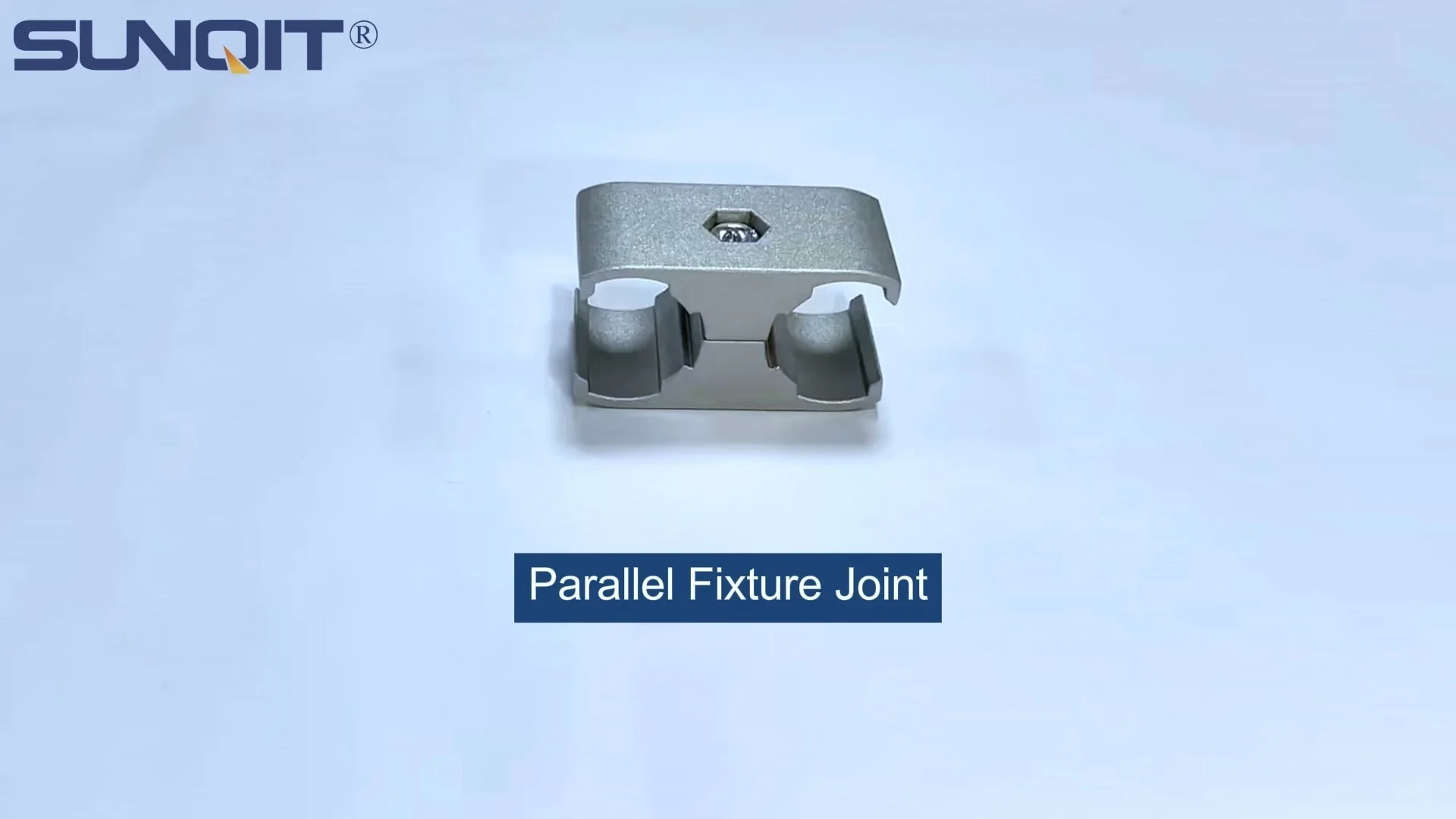
Parallel Fixation Aluminum Pipe Joint
Aluminum parallel joint for two pcs 28mm aluminum pipe connected by parallel direction.
It's 7:30 AM on a Wednesday, and the air in the electronics assembly plant hums with the quiet tension of a team racing the clock. The night shift left a half-finished batch of circuit boards on the line, and the morning crew's first task is to reconfigure the workstation for the new model rolling in at 9 AM. Last month, this same changeover took four hours—two hours over schedule—because the old steel pipe workbench, bolted and welded into place, needed a maintenance crew with power tools to disassemble. Today, though, there's a different energy. Carlos, the lead technician, kneels beside the workstation, his hands moving quickly as he twists a sleek silver joint, releasing an aluminum pipe with a soft *click*. "We've got this," he says to his teammate, Elena, who's already fitting a new crossbar into place. "I bet we're done by 8:15."
This shift—from frustration to confidence, from delay to efficiency—didn't happen by accident. It started with a simple question: What if reconfiguring a production line didn't have to mean downtime? For Carlos's team, the answer came in the form of parallel fixation aluminum pipe joints: unassuming but revolutionary components that are quietly transforming how factories, warehouses, and workshops adapt to change. These joints aren't just metal parts; they're tools that respect the rhythm of work, the pressure of deadlines, and the skill of the people on the floor. Let's dive into how they work, why they matter, and the ripple effects they're creating across lean manufacturing.
The Hidden Cost of Downtime: More Than Just Lost Minutes
Before we talk about solutions, let's get real about the problem: downtime during line reconfigurations isn't just a blip on a spreadsheet. It's the overtime hours Elena had to work last month to make up for lost production. It's the stress in Maria's voice, the plant manager, when she calls the sales team to explain why an order will be delayed. It's the quiet frustration of a team that prides itself on quality, forced to rush through setup because there's no time left to double-check measurements. "You don't realize how much mental energy goes into dreading a changeover until you don't dread it anymore," Carlos told me later. "Before, we'd start planning the reconfig the night before—who brings the wrench set, who's on bolt duty, how many coffee runs we'd need to get through it. Now? We just… do it."
Traditional production setups—whether built with welded steel pipes, heavy stainless steel frames, or even basic wooden workbenches—are designed for permanence. They're sturdy, sure, but that sturdiness comes at a cost: rigidity. When your line needs to shift from assembling 500 small sensors to 200 large control panels, or when seasonal demand spikes require adding a third row to a material rack, those fixed structures become obstacles. Disassembling them means time with wrenches, grinders, or even cutting tools. Reassembling them means measuring twice, drilling new holes, and hoping the bolts line up. And if you make a mistake? You start over. For many teams, a single reconfiguration can eat up half a day—time that could be spent training, maintaining equipment, or, you know, actually making products.
The Numbers Tell the Story: A 2023 survey by the Manufacturing Performance Institute found that 62% of factories report losing 4+ hours per week to unplanned downtime, with reconfigurations and changeovers accounting for 31% of that loss. For a mid-sized plant running two 8-hour shifts, that's over 600 hours of lost production annually—enough to fill 75 full workdays. And that's not counting the indirect costs: rushed setups leading to quality errors, employee burnout, and missed opportunities to pivot quickly to new orders.
Parallel Fixation Aluminum Pipe Joints: The "Click-and-Go" Revolution
So, what makes parallel fixation aluminum pipe joints different? Let's start with the basics. These joints are the connective tissue of modern lean systems, designed to link aluminum lean pipe—lightweight, durable, and infinitely adaptable—into structures that can be built, adjusted, and rebuilt in minutes, not hours. Unlike traditional welded or bolted joints, which lock pipes into fixed angles, parallel fixation joints use a clever internal mechanism: a rotating cam or clamping system that grips the aluminum pipe tightly when twisted, but releases just as easily when you need to adjust. Think of it like a high-tech Lego brick for adults—strong enough to hold a 200-pound load, but simple enough for one person to assemble with just their hands.
The "parallel fixation" part is key here. These joints are engineered to secure pipes along parallel axes, meaning you can create stable frames, shelves, and workbenches without the need for diagonal bracing (though bracing is easy to add if you need extra strength). Picture a workbench: with parallel fixation joints, you can set the height by sliding pipes up or down in the joints, lock them in place with a 90-degree twist, and attach a shelf or a roller track—all without a single tool. "I used to need a socket wrench and a level just to adjust the height of our old steel workbench," Elena recalls. "Now, I can tweak it while I'm standing up, one hand on the joint and the other holding the pipe. It's like the joint was designed by someone who's actually had to do this work."
But the real magic isn't just in the joints themselves—it's in how they work with aluminum lean pipe. Aluminum is lighter than steel (about 1/3 the weight), which makes handling pipes easier for teams. It's resistant to corrosion, so even in humid warehouses or plants with frequent cleaning, the pipes won't rust or degrade. And unlike stainless steel, which can be slippery and hard to grip, aluminum has a slight texture that makes assembling structures safer—no more fumbling with greasy pipes. When you pair that with parallel fixation joints, you get a system that's not just flexible, but *human-centric*. It's designed to work with the natural movement of hands, not against it.

From Workbench to Warehouse: Real-World Applications That Save Time
Let's get specific. Where do these joints shine brightest? The answer is anywhere a team needs to adapt quickly. Here are three scenarios where Carlos's plant has seen the biggest impact:
1. Workbench Reconfigurations: From "Bolted Down" to "Built for Change"
The assembly line workbench is the heart of many production processes. It's where parts are sorted, tools are stored, and final assemblies are checked. In Carlos's plant, each workbench used to be a Frankenstein's monster of steel pipes, wooden shelves, and zip-tied cable management. Changing the height? You'd need to unbolt the legs, drill new holes, and hope the shelf brackets still lined up. Adding a roller track for sliding parts? That meant welding a steel rail to the edge, which was permanent—if you later needed the space for a larger tool, you'd have to grind off the welds. "We had one workbench that had so many extra holes from past changes, it looked like Swiss cheese," Elena laughs. "We called it 'The Relic.'"
Now, their workbenches are built with aluminum lean pipe and parallel fixation joints. The legs adjust in 2-inch increments: twist the joint, slide the pipe, twist again to lock. The shelves? They're mounted on adjustable brackets that clip into the joints, so adding a second tier takes 5 minutes. Most importantly, they've added roller track—specifically, 38 aluminum roller track with yellow wheel flanges—to the front edge. "The roller track used to be a separate piece we'd bolt on," Carlos explains. "Now, we just snap the track's placon mount into the parallel fixation joints on the workbench frame. If we need to remove it for a larger assembly, we pop it off in 30 seconds. No bolts, no tools, no holes left behind."
The result? A workbench that can shift from handling small circuit boards (with a lower shelf for tools) to large control panels (with the shelf raised for legroom) in under an hour. "Last week, we had a rush order for 100 custom sensors," Carlos says. "We needed to add a third bin to the parts sorter on the bench. Two of us did it during our morning break. That would've taken half the morning before."
2. Material Racks: Seasonal Shifts Without the Slog
Warehouses and distribution centers face a different kind of reconfiguration challenge: seasonal demand. Think about a toy manufacturer ramping up for the holidays, or a clothing retailer shifting from summer to winter inventory. Material racks that work for small, lightweight items in April may need to handle bulkier, heavier boxes in November. Traditional steel racks are fixed in height and width—if you need more space, you either buy new racks (expensive) or spend a day disassembling and rebuilding existing ones (time-consuming).
At a nearby distribution center I visited, manager Raj Patel showed me their solution: aluminum profile material racks built with parallel fixation joints. "We used to have steel racks that were 4 feet deep, with fixed shelves every 18 inches," he said. "In Q4, when we get pallets of winter coats, we need shelves 24 inches apart. Before, we'd have to unload the rack, take it apart with a wrench, cut new support beams, and put it back together. That was a full-day job for two people. Now? We loosen the parallel fixation joints, slide the shelf supports up, and lock them in. The whole process takes 45 minutes—for an entire rack. And if we need to go back to 18 inches in January? Same thing."
Raj's team also uses aluminum lean pipe for the rack frames, which are lighter than steel, making them easier to move with caster wheels (another accessory that clips into parallel fixation joints). "Last year, we needed to shift three racks from the west warehouse to the east to make room for a new conveyor. With steel racks, we would've had to empty them, disassemble, move the parts, and rebuild. With aluminum and parallel joints? We just locked the casters, pushed them, and locked again. The racks were loaded with boxes the whole time. It was like moving furniture, not industrial equipment."
3. Roller Tracks and Conveyors: Smoothing the Flow of Parts
In lean manufacturing, "flow" is everything—the steady movement of parts from one station to the next, without bottlenecks or delays. Roller tracks and conveyors are critical to this flow, but they often need adjustments: raising the track to match a new workstation height, adding a curve to avoid a new machine, or extending the length to reach a new assembly line. Traditional roller tracks, often made of steel with welded brackets, are hard to modify. "We had a steel roller track that ran 20 feet along the production line," Maria, the plant manager, told me. "When we added a new testing station, we needed to bend the track 90 degrees. The maintenance team had to cut the steel, weld a new section, and repaint it. That took two days, and the track never rolled as smoothly after."
Now, the plant uses aluminum roller track with parallel fixation joints. The track sections connect via placon mount connectors that snap into the joints, allowing for quick adjustments. "Last month, we needed to raise the track by 6 inches to align with a new lifting table," Maria says. "We loosened the joints holding the track to the support frame, slid the aluminum pipes up, and locked them. Total time: 20 minutes. And because the joints are precision-machined, the track stayed perfectly level—no wobbles, no stuck parts."
Even better, the aluminum roller track is compatible with other accessories, like swivel roller balls (1 inch, in Carlos's case) for turning corners. "We used to need a separate turntable for parts to change direction," Elena explains. "Now, we just attach a section of swivel roller balls to the roller track using parallel fixation joints. The balls let parts glide smoothly around the corner, and if we don't need it anymore, we remove it in seconds. It's like building with blocks, but for grown-ups who make things."

Why Aluminum? The Material That Makes It All Possible
You might be wondering: Why aluminum? Why not stick with steel, which is stronger? Or stainless steel, which is corrosion-resistant? The answer lies in balance. Aluminum lean pipe hits the sweet spot between strength, weight, and versatility—qualities that make parallel fixation joints work so well.
Let's break it down: Steel is strong, but it's heavy. A 10-foot steel pipe can weigh 20 pounds, making it hard for one person to handle during assembly. Aluminum, by contrast, weighs about 6 pounds for the same length—light enough that Elena can carry two pipes at once without straining her back. That light weight makes reconfigurations faster: fewer people needed, less fatigue, and fewer dropped pipes (which, let's be honest, used to happen with steel). "We used to need three people to move a steel workbench frame," Carlos says. "Now, Elena and I can carry an aluminum frame by ourselves. That alone cuts setup time in half."
Then there's corrosion resistance. In plants where cleaning with water or chemicals is common, steel rusts—especially at welded joints, where the protective coating is broken. Aluminum forms a natural oxide layer that resists rust, even in humid environments. "Our old steel racks would start rusting around the bolts within a year," Raj, the warehouse manager, notes. "The aluminum racks? They still look brand-new after three years, even in our damp storage area."
Stainless steel, while rust-resistant, is expensive—often double the cost of aluminum. It's also harder to machine, which makes joints bulkier and more expensive to produce. For most lean manufacturing setups, aluminum offers the best combination of performance and cost. "We looked at stainless steel first," Maria says. "But the price tag was too high, and the joints were heavier. Aluminum let us outfit the entire line for the same budget, and the team actually prefers working with it."

Beyond the Joint: Accessories That Multiply Flexibility
Parallel fixation aluminum pipe joints are powerful on their own, but they're even better when paired with the right accessories. These small parts turn basic pipes into full-fledged systems that adapt to almost any need. Here are a few that Carlos's team swears by:
- Caster Accessories: Adding casters to a workbench or material rack turns it into a mobile unit. "We have a turnover trolley built with aluminum pipe and parallel fixation joints," Elena says. "The caster mounting plates clip right into the joints, and we can lock the wheels when we need stability. If we need to move the trolley to a different line, we just unlock the casters and roll it—no heavy lifting."
- Aluminum Profile Rubber Strips: These strips fit into the T-slots of aluminum profile (another material the plant uses for larger structures) to protect parts from scratches. "We added them to the edges of our workbench shelves," Carlos explains. "They're soft enough to keep circuit boards safe, but tough enough to handle daily use. And because they're held in place by the profile's T-slot, we can replace them easily if they wear out."
- Swivel Roller Balls: As mentioned earlier, these 1-inch balls (stainless steel, in their case) let parts glide in any direction, perfect for corners or loading areas. "We mounted a section on top of our material rack," Raj says. "Now, when we unload pallets, we can slide boxes onto the rack without lifting them—saves our backs and speeds things up."
The beauty of these accessories is that they're designed to work with parallel fixation joints, so adding them doesn't require modifying the pipes or drilling new holes. It's plug-and-play flexibility, which is exactly what lean manufacturing is all about.
The Human Impact: When Tools Respect the Team
At the end of the day, the most important benefit of parallel fixation aluminum pipe joints isn't the time saved or the money cut from the budget. It's the impact on the people using them. "I've been in manufacturing for 15 years, and I've never seen a tool that changes the team's attitude like this," Maria says. "Before, changeovers were something to dread. Now, they're something to tackle—like solving a puzzle, not fighting a battle."
Elena put it more simply: "It makes us feel valued. When the company invests in tools that make our jobs easier, it tells us they care about how we work, not just what we produce. I don't leave work exhausted anymore because I spent half the day wrestling with a workbench. I leave feeling like I accomplished something."
Carlos nods in agreement. "Last week, we had a new hire, Lila, join the team. On her second day, we did a workbench reconfiguration. She walked up, watched me adjust a joint, and said, 'Is that it?' Then she tried it herself and smiled. That's the difference—these tools don't require years of experience to use. They empower everyone on the team to contribute."
The Future of Lean: Building for Change, Not Just Efficiency
Lean manufacturing has always been about eliminating waste—waste of time, waste of materials, waste of effort. But parallel fixation aluminum pipe joints remind us that lean is also about respect for people. A system that's flexible isn't just efficient; it's humane. It acknowledges that change is constant, and that the people adapting to that change deserve tools that work with them, not against them.
As Carlos and Elena finished their 8:15 AM reconfiguration that Wednesday, I asked Carlos what he thought the old steel workbench would say if it could talk. He laughed. "Probably, 'Why didn't we do this sooner?'" Then he got serious. "But really, it's not about replacing old tools. It's about upgrading how we think about work. We don't just build products here—we build systems that let people do their best work. These joints are a part of that."
So, the next time you walk through a factory or warehouse, take a closer look at the workbenches, the material racks, the roller tracks. If they're built with aluminum pipe and sleek silver joints, chances are there's a team behind them that's no longer dreading the next changeover. They're ready for it. And that readiness? It's the quiet revolution that's making lean manufacturing not just more efficient, but more human.