- Company Articles
- Products and Technology
- Product knowledge
- Parallel Lean Pipe Joints in Aerospace Manufacturing: Precision Requirements

Parallel Lean Pipe Joints in Aerospace Manufacturing: Precision Requirements
Related Product
Parallel Lean Pipe Joint
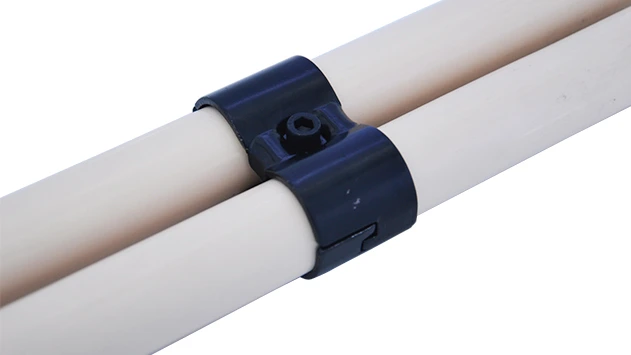
Parallel lean pipe joint used for 2 pcs 28MM lean pipe connection in parallel direction to enhance frame structure, usually for heavy payload requirement for workbench. flow rack, hand trolley.
In the high-stakes world of aerospace manufacturing, where a single misalignment can compromise safety or delay production timelines, precision isn't just a goal—it's the foundation of every operation. From assembling intricate avionics systems to constructing airframe components, every step demands tools and infrastructure that can keep pace with unforgiving tolerances. Among the unsung heroes of this precision-driven environment are lean systems, the backbone of efficient, adaptable workflows. And at the heart of these systems lie components like parallel lean pipe joints, yet critical elements that ensure stability, flexibility, and reliability in the manufacturing process. In this article, we'll explore how parallel lean pipe joints meet the rigorous precision requirements of aerospace manufacturing, their role in optimizing workflows, and why materials like aluminum lean pipe have become indispensable in this sector.
Lean Systems: The Backbone of Modern Aerospace Manufacturing
Aerospace manufacturing is a complex dance of speed, accuracy, and adaptability. With product lifecycles shrinking and customer demands evolving, manufacturers can't afford rigid, one-size-fits-all production lines. This is where lean systems shine. Rooted in the principles of waste reduction, continuous improvement, and employee empowerment, lean systems prioritize flexibility—allowing teams to reconfigure workspaces, adjust material flow, and scale operations with minimal disruption. But flexibility doesn't mean sacrificing precision; in fact, the two go hand in hand. A well-designed lean system must be both agile and rock-solid, ensuring that even as workflows change, the physical infrastructure supporting them remains stable and consistent.
At the core of these lean systems are modular components: pipes, joints, workbenches, and material racks that can be assembled, disassembled, and reconfigured like building blocks. This modularity is what makes lean systems so valuable in aerospace, where production runs may shift from small-batch specialty parts to high-volume components. But for this modularity to work, the connections between these components—specifically, the joints—must be engineered to exacting standards. A loose joint or misaligned pipe can throw off an entire workflow, leading to inefficiencies, quality issues, or even safety risks. This is where parallel lean pipe joints come into play: they're the linchpin that holds lean systems together, ensuring that flexibility doesn't come at the cost of precision.
Parallel Lean Pipe Joints: Design and Function
Parallel lean pipe joints are specialized connectors designed to link two or more lean pipes in a parallel configuration, creating stable, load-bearing structures. Unlike angled joints (which connect pipes at 45° or 90°), parallel joints are engineered to align pipes along the same plane, distributing weight evenly and preventing lateral movement. This design is critical for applications where flat, level surfaces are non-negotiable—think workbenches for assembling delicate circuit boards or material racks for storing sensitive composite materials.
The mechanics of a parallel lean pipe joint are deceptively simple, but their precision is anything but. Most parallel joints consist of a central hub with two or more collars that grip the outer surface of the lean pipes. Tightening a setscrew or lever secures the pipes in place, creating a rigid connection that can withstand vertical and horizontal loads. What sets high-quality parallel joints apart is their tolerance for misalignment: even if the pipes aren't perfectly straight (a common challenge in modular systems), the joint should compensate, ensuring a snug, consistent fit. This is especially important in aerospace, where a wobbly workbench or uneven material rack can compromise the accuracy of assembly tasks or damage expensive materials.
Materials Matter: Why Aluminum Lean Pipe Takes Center Stage
While lean pipe systems can be constructed from materials like steel or stainless steel, aluminum lean pipe has emerged as the material of choice in aerospace manufacturing—and for good reason. Aluminum offers a unique blend of strength, lightweight design, and corrosion resistance that aligns perfectly with aerospace requirements. Let's break it down:
- Strength-to-weight ratio: Aluminum is significantly lighter than steel, making lean systems easier to reconfigure. In a sector where production lines are often adjusted to accommodate new projects, this reduces the physical strain on workers and minimizes downtime during reconfigurations. Yet, despite its lightness, aluminum lean pipe is strong enough to support aerospace-grade loads—think engine components, avionics modules, or large composite panels.
- Corrosion resistance: Aerospace manufacturing environments are often tightly controlled, with cleanrooms, humidity regulation, and strict contamination protocols. Aluminum's natural resistance to rust and corrosion ensures that lean systems remain durable even in these environments, eliminating the risk of flaking rust or degradation that could contaminate sensitive parts.
- Precision manufacturing: Aluminum is highly malleable, allowing for tight tolerances in pipe diameter and wall thickness. This consistency is critical when paired with parallel lean pipe joints, as even a 0.1mm variation in pipe diameter can affect how securely the joint grips the pipe. Aluminum lean pipe, when manufactured to aerospace standards, ensures that every pipe fits into its joint with the same level of precision, batch after batch.
When combined with parallel lean pipe joints, aluminum lean pipe creates a system that's both flexible and unyielding—capable of adapting to changing workflows while maintaining the precision aerospace demands.

Precision Requirements in Aerospace: What's at Stake?
In aerospace manufacturing, precision is measured in thousandths of an inch. A turbine blade that's off by 0.001 inches can cause engine vibrations; a misaligned circuit board can lead to electrical failures. These tiny discrepancies can have catastrophic consequences, which is why every aspect of the manufacturing process—including the infrastructure—must meet stringent precision standards. For parallel lean pipe joints, this translates to three key requirements:
1. Load-Bearing Stability
Aerospace components are heavy. A single aircraft engine, for example, can weigh over 10,000 pounds, and while lean systems don't typically support entire engines, they do handle subcomponents, tools, and materials that can weigh hundreds of pounds. Parallel lean pipe joints must distribute these loads evenly across the system, preventing sagging, warping, or shifting over time. This requires joints with high clamping force—enough to grip aluminum lean pipes without deforming them—and a design that minimizes stress concentration at the connection point.
Consider a workbench used for assembling landing gear components. The workbench's frame, constructed from aluminum lean pipe and parallel joints, must remain perfectly level even when a 500-pound gear assembly is placed on it. If the parallel joints loosen or the pipes flex, the workbench could tilt, leading to misalignment during assembly. Over time, this could result in landing gear that doesn't fit properly, compromising flight safety. To prevent this, parallel lean pipe joints are tested to withstand not just static loads but also dynamic loads—vibrations from nearby machinery, accidental impacts, or the repeated placement and removal of heavy parts.
2. Dimensional Consistency
In modular systems, consistency is key. If one parallel joint is slightly thicker than another, or if the collar that grips the pipe is misaligned, the entire structure can become uneven. This is why aerospace-grade parallel lean pipe joints are manufactured with tight dimensional tolerances. The collar diameter, setscrew position, and hub thickness are all controlled to within ±0.05mm, ensuring that every joint behaves the same way. This consistency extends to the joint's interaction with aluminum lean pipe: the inner diameter of the joint's collar must match the outer diameter of the pipe exactly, creating a friction fit that, when combined with the setscrew, eliminates play.
This level of consistency is especially important for material racks—another critical component in aerospace workflows. Material racks use roller tracks to move parts from storage to assembly stations, and these tracks must be perfectly aligned to prevent jamming or damage to parts. If the parallel joints holding the rack's frame are inconsistent, the tracks could slope or warp, causing parts to slide unevenly or get stuck. In aerospace, where parts like turbine blades or composite skins are often delicate and expensive, this isn't just an inconvenience—it's a risk to quality and cost.
3. Long-Term Durability
Aerospace manufacturing systems are built to last. Unlike consumer goods, which may have lifecycles of a few years, lean systems in aerospace facilities are expected to remain operational for decades, withstanding thousands of reconfigurations, load cycles, and environmental changes. Parallel lean pipe joints must therefore maintain their precision over time. This means resisting wear from repeated assembly and disassembly, maintaining clamping force even after hundreds of setscrew adjustments, and withstanding the stress of constant load-bearing.
Manufacturers achieve this through rigorous testing: joints are subjected to salt spray tests for corrosion resistance, torque tests to ensure setscrews retain their grip, and fatigue tests to simulate years of load cycles. Only joints that pass these tests make it into aerospace facilities, where their long-term durability directly impacts production reliability.

A Closer Look: Comparing Lean Pipe Joints in Aerospace Applications
To better understand why parallel lean pipe joints are critical in aerospace, let's compare them to other common joint types, focusing on their precision, load capacity, and typical applications. The table below highlights key differences:
| Joint Type | Primary Function | Precision Tolerance | Max Load Capacity (Static) | Common Aerospace Applications | Material Compatibility |
|---|---|---|---|---|---|
| Parallel Lean Pipe Joint | Connects pipes in parallel planes; distributes load evenly | ±0.05mm (pipe diameter fit) | 500-800 lbs (per joint) | Workbenches, material racks, assembly line frames | Aluminum lean pipe, stainless steel pipe |
| 90° Fixed Lean Pipe Joint | Connects pipes at right angles; creates vertical/horizontal corners | ±0.1mm (angle alignment) | 600-900 lbs (per joint) | Machine enclosures, vertical storage racks, partition walls | Steel, aluminum, stainless steel |
| Swivel Lean Pipe Joint | Allows 360° rotation; enables adjustable angles | ±0.2mm (rotation smoothness) | 300-400 lbs (per joint) | Adjustable workstations, ergonomic tool holders | Aluminum lean pipe, plastic-coated pipe |
| Three-Way Lean Pipe Joint | Connects three pipes at a single hub; creates branching structures | ±0.15mm (hub alignment) | 400-600 lbs (per joint) | Multi-level material racks, complex assembly jigs | Steel, aluminum |
As the table shows, parallel lean pipe joints excel in precision tolerance and load capacity for parallel-plane applications—exactly what's needed for workbenches and material racks in aerospace. Their ability to maintain a ±0.05mm fit with aluminum lean pipe ensures that the structures they support remain stable and level, even under heavy loads. While other joints have their place (swivel joints for adjustability, three-way joints for branching), parallel joints are the workhorses of precision in aerospace lean systems.
Real-World Applications: How Parallel Lean Pipe Joints Impact Aerospace Workflows
To ground these concepts in reality, let's explore two specific applications where parallel lean pipe joints and aluminum lean pipe are making a difference in aerospace manufacturing:
1. Avionics Assembly Workbenches
Avionics systems—the electronic brains of an aircraft—require assembly in environments with minimal vibration, dust, and electromagnetic interference. The workbenches used for this task must be absolutely stable: even a tiny tremor can misalign circuit boards or solder joints, leading to system failures. Enter parallel lean pipe joints. By forming the frame of the workbench, these joints ensure that the bench's surface remains level and rigid, even when technicians lean on it or place heavy tools (like oscilloscopes or soldering stations) on it.
Aluminum lean pipe, paired with parallel joints, creates a workbench that's both lightweight (easy to move if needed) and stable. The joints' tight tolerances prevent the frame from "walking" or shifting during use, and their corrosion resistance ensures the bench remains clean and free of contaminants. Additionally, the modularity of the system allows for custom add-ons—tool holders, cable management trays, or ESD (electrostatic discharge) mats—all secured with parallel joints to maintain the bench's precision.
2. Composite Material Racks
Modern aircraft rely heavily on composite materials—lightweight, high-strength materials like carbon fiber reinforced polymer (CFRP). These materials are expensive and prone to damage if mishandled, making proper storage critical. Material racks for composites must have evenly spaced shelves, smooth roller tracks, and stable frames to prevent bending or cracking of the materials. Parallel lean pipe joints are essential here: they align the rack's vertical supports and horizontal shelves, ensuring that each shelf is level and can bear the weight of composite sheets without sagging.
The roller tracks, which allow composites to be slid onto and off the shelves with minimal friction, are also mounted using parallel joints. This ensures the tracks are perfectly aligned, preventing the composites from catching or warping as they're moved. In this scenario, the precision of the parallel joints directly impacts the quality of the final aircraft part—if the rack is uneven, the composite material could develop internal stresses, leading to structural weaknesses in the airframe.
Challenges and Innovations in Parallel Lean Pipe Joint Design
Meeting aerospace's precision requirements isn't without challenges. One of the biggest hurdles is balancing flexibility with rigidity: lean systems need to be reconfigurable, but parallel joints must remain tight and stable even after repeated disassembly. To address this, manufacturers have developed innovations like self-locking setscrews, which maintain tension even after multiple adjustments, and quick-release levers that allow for tool-free reconfiguration without sacrificing grip strength.
Another challenge is thermal expansion. Aluminum lean pipe and its joints expand and contract with temperature changes, which can affect precision in environments with fluctuating temperatures (e.g., facilities with seasonal climate variations). To mitigate this, some manufacturers use materials with matched thermal expansion coefficients for pipes and joints, ensuring that both components expand at the same rate and maintain their fit.
Looking to the future, we're seeing the integration of smart technology into lean systems. Imagine parallel lean pipe joints equipped with sensors that monitor clamping force, temperature, or vibration in real time. These sensors could alert maintenance teams if a joint is loosening or if a pipe is under excessive stress, preventing failures before they occur. While still in the early stages, this "smart lean" approach has the potential to revolutionize precision in aerospace manufacturing, making systems more proactive and resilient.
Conclusion: The Unsung Precision of Parallel Lean Pipe Joints
In the grand scheme of aerospace manufacturing, parallel lean pipe joints may seem. They don't fly, they don't power engines, and they rarely make headlines. But without them, the precision, flexibility, and efficiency that define modern aerospace production would be impossible. These small, unassuming connectors—paired with aluminum lean pipe—form the backbone of lean systems, ensuring that workbenches stay level, material racks remain stable, and workflows adapt without missing a beat.
As aerospace manufacturing continues to evolve—with new materials, tighter tolerances, and smarter production methods—the demand for high-precision lean components will only grow. Parallel lean pipe joints, with their focus on consistency, durability, and adaptability, are poised to remain at the forefront of this evolution. They are a testament to the idea that in aerospace, precision isn't just about the parts that take flight—it's about every part that helps build them.