- Company Articles
- Products and Technology
- Product knowledge
- Parallel Lean Pipe Joints in Communication Equipment Production

Parallel Lean Pipe Joints in Communication Equipment Production
Related Product
Parallel Lean Pipe Joint
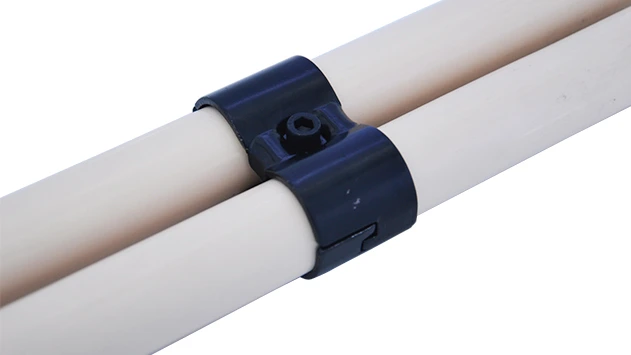
Parallel lean pipe joint used for 2 pcs 28MM lean pipe connection in parallel direction to enhance frame structure, usually for heavy payload requirement for workbench. flow rack, hand trolley.
In the humming halls of communication equipment factories, where circuit boards zip through assembly lines and precision is non-negotiable, the difference between a smooth shift and a chaotic one often comes down to the tools that hold everything together. Production teams don't just need equipment—they need systems that bend, adapt, and grow with the demands of ever-evolving tech. That's where parallel lean pipe joints step in: unassuming yet transformative, these components are the unsung heroes behind the agility of modern communication device manufacturing.
The Problem with Rigidity: Why Traditional Setups Fall Short
Mike, a production supervisor at a mid-sized telecom hardware plant, remembers the days before parallel lean pipe joints all too well. "We'd spend weeks reconfiguring a workbench for a new router model," he says, shaking his head. "Bolts, welding, custom brackets—by the time we were done, the design specs would change, and we'd have to start over. It felt like fighting a losing battle."
Traditional production setups, often built with fixed metal frames or welded structures, are built for stability but not speed. In communication equipment manufacturing, where product lifecycles shrink by the month and customization is key, this rigidity becomes a bottleneck. A single design tweak can render an entire workbench obsolete, and retooling costs eat into already tight margins. worse, the downtime disrupts workflows, leaving teams scrambling to meet deadlines.
Parallel Lean Pipe Joints: The Flexibility Revolution
Enter parallel lean pipe joints: modular connectors designed to link aluminum lean pipes (or stainless steel, for heavier loads) into customizable structures. Unlike fixed joints, these components allow for quick adjustments—twist a bolt, reposition a pipe, and suddenly a workbench for smartphones becomes one for fiber optic modems. "It's like building with advanced Tinkertoys," laughs Sarah, an industrial engineer who helped Mike's plant transition. "But instead of plastic, it's industrial-grade aluminum that can handle the wear of daily production."
What makes these joints special? Their dual functionality. Parallel joints, as the name suggests, keep pipes aligned in parallel, ensuring stability while retaining the ability to pivot or extend. Whether you're building a lean pipe workbench with adjustable height, a flow rack for component storage, or a lightweight conveyor for moving circuit boards, these joints form the backbone. They're compatible with a range of accessories—casters for mobility, roller tracks for smooth material flow, and even ESD (electrostatic discharge) components to protect sensitive electronics from static damage.

From Blueprint to Assembly Line: How Parallel Joints Transform Workflows
Let's walk through a typical scenario. Imagine Mike's team needs to assemble a new line for 5G base station components—smaller, more delicate, and with tighter tolerances than previous models. With traditional setups, this would involve ordering custom workbenches, waiting for delivery, and hoping they fit the floor plan. With parallel lean pipe joints, the process looks very different:
- Design in Hours, Not Weeks: Using CAD software (or even hand sketches), Sarah and her team map out a lean pipe workbench with adjustable shelves, ESD mats, and a built-in flow rack for component bins. The parallel joints ensure the frame stays level, even when shelves are added or removed.
- Assemble in a Shift: The team unboxes aluminum lean pipes, parallel joints, and accessories. No welding, no heavy tools—just hex keys and a rubber mallet. "We had the entire line up in 6 hours," Mike recalls. "Two guys, a few boxes, and zero frustration."
- Adapt on the Fly: During testing, the team realizes the component bins are too deep. With a few twists of the parallel joints, they adjust the flow rack angles, adding roller tracks to guide parts more smoothly. "No waiting for a fabricator—we did it during lunch," Sarah says.
"The best part? When the next model comes in, we won't scrap the whole setup. We'll just reconfigure the joints, swap out a few pipes, and we're ready. It's saved us at least 30% on retooling costs this year alone." — Mike, Production Supervisor

Material Matters: Why Aluminum and Stainless Steel Lead the Way
Parallel lean pipe joints are only as strong as the pipes they connect. That's why most manufacturers opt for aluminum lean pipes or stainless steel series. Aluminum, in particular, is a favorite in communication equipment plants for its winning combo of lightness and durability. "Aluminum lean pipes are easy to handle—even a single operator can reposition a section of a workbench," explains Raj, a supplier rep who works with Mike's plant. "And they're resistant to corrosion, which is crucial in cleanrooms where humidity is controlled."
Stainless steel, on the other hand, shines in high-wear environments, like conveyor systems moving heavy metal enclosures. "We use stainless steel pipe series for our conveyor frames," Mike notes. "They hold up to the constant rolling of parts without bending, and the parallel joints keep the roller tracks perfectly aligned—no jams, no downtime."
Beyond Joints: The Ecosystem of Lean Manufacturing
Parallel lean pipe joints don't work in isolation. They're part of a broader ecosystem of lean solutions designed to streamline production. At Mike's plant, for example, the lean pipe workbench connects to a flow rack via roller tracks (fitted with parallel joint adapters), which feeds into a conveyor system. Components move seamlessly from storage to assembly to testing, with each step optimized for the task at hand.
Accessories play a big role, too. Swivel roller balls (1 inch or 0.5 inch) on workbench surfaces let operators slide heavy circuit boards with minimal effort. ESD workbench mats, paired with grounded aluminum pipes, prevent static from frying sensitive microchips. Even casters—lockable, heavy-duty, and easy to attach via joint adapters—turn fixed workstations into mobile units that can be repositioned for team collaboration.
Traditional vs. Parallel Lean Pipe: The Numbers Speak
| Feature | Traditional Fixed Setups | Parallel Lean Pipe Joint Systems |
|---|---|---|
| Assembly Time | Weeks (welding, custom fabrication) | Hours (tool-free or minimal tools) |
| Cost to Reconfigure | High (scrap old parts, new materials) | Low (reuse pipes/joints, add accessories) |
| Weight | Heavy (steel frames, welded parts) | Light (aluminum pipes, modular joints) |
| Adaptability to Design Changes | Low (requires full redesign) | High (adjust joints/pipes in minutes) |
| Durability | High (but rigid; prone to cracking if stressed) | High (flexible yet strong; aluminum resists corrosion) |
Choosing the Right Supplier: More Than Just Parts
Not all parallel lean pipe joints are created equal. For communication equipment manufacturers, where precision is critical, partnering with a reliable lean pipe supplier is key. "We learned the hard way," Mike admits. "Early on, we bought cheap joints online, and they stripped after a few adjustments. Now we work with a supplier who provides aluminum lean pipes with reinforced threads and joints tested to 10,000+ adjustments. It's worth the extra dollar per joint to avoid downtime."
Look for suppliers who offer more than just parts: technical support for custom designs, fast wholesale shipping (since communication production lines can't wait for backorders), and a range of materials (aluminum, stainless steel, ESD-safe options). A good supplier will also stock accessories—from roller track connectors to caster wheels—so you're not piecing together components from multiple vendors.
The Future of Communication Production: Lean, Modular, Human-Centered
As communication technology races forward—5G, IoT, satellite communication—production lines must keep pace. Parallel lean pipe joints aren't just tools; they're enablers of human-centric manufacturing. They let teams focus on innovation, not retooling. They turn frustration into efficiency. And they transform factories from rigid spaces into dynamic ecosystems that adapt as quickly as the ideas powering them.
Mike sums it up best: "Last month, we had a rush order for 500 emergency routers for a storm-hit region. With our old setup, we would've missed the deadline. With parallel joints? We reconfigured three workbenches in a day, trained the team, and shipped on time. The look on the team's faces—pride, not panic—that's the real impact."
In the end, parallel lean pipe joints are more than connectors. They're the bridge between the complexity of communication technology and the simplicity of human ingenuity. And in a world where change is the only constant, that's a connection worth building.