- Company Articles
- Products and Technology
- Application Cases
- Parallel Lean Pipe Joints in Educational Workshops: Teaching Lean Principles

Parallel Lean Pipe Joints in Educational Workshops: Teaching Lean Principles
Related Product
Parallel Lean Pipe Joint
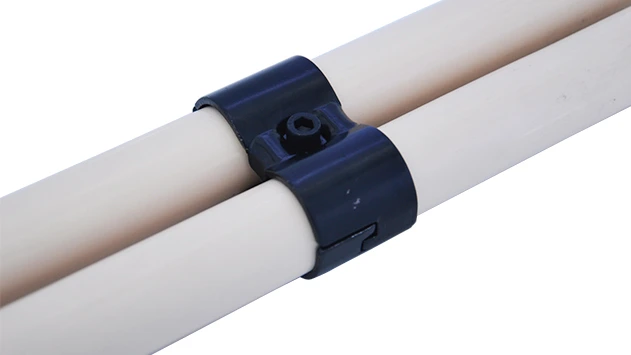
Parallel lean pipe joint used for 2 pcs 28MM lean pipe connection in parallel direction to enhance frame structure, usually for heavy payload requirement for workbench. flow rack, hand trolley.
Walk into any modern manufacturing facility, and you'll likely spot a common theme: efficiency. Assembly lines hum with synchronized precision, tools hang within arm's reach of workers, and materials flow seamlessly from one station to the next. Behind this harmony lies a set of principles known as "lean manufacturing"—a philosophy centered on eliminating waste, optimizing flow, and fostering continuous improvement. But how do we teach these abstract concepts to the next generation of engineers, operations managers, and technicians? For educators, the answer increasingly lies in hands-on learning—specifically, through the use of modular tools like parallel lean pipe joints, lean systems, and workbenches that turn theory into tangible experience.
In traditional classrooms, lean principles are often taught through textbooks, lectures, and case studies. While these methods lay a foundation, they lack the tactile engagement needed to truly internalize concepts like "flow" or " muda" (the Japanese term for waste). Students might memorize definitions, but without seeing how a poorly designed workbench creates unnecessary motion waste or how a flexible joint can adapt to changing needs, the lessons remain abstract. This is where educational workshops equipped with lean pipe and accessories step in. By building, modifying, and optimizing structures using tools like parallel lean pipe joints, students don't just learn about lean—they live it.
Parallel Lean Pipe Joints: The Unsung Heroes of Lean Systems
At first glance, a parallel lean pipe joint might seem unremarkable. It's a small, often metallic component designed to connect two lean pipes in a parallel configuration, allowing for the creation of stable, yet adjustable structures. But to dismiss it as "just a joint" is to miss its revolutionary role in lean education. Unlike fixed joints or welded connections, parallel lean pipe joints offer a unique combination of rigidity and flexibility. They lock pipes securely in place when needed but can be loosened, repositioned, and reused when requirements change—mirroring the lean principle of "just-in-time" adaptability.
Consider this: In a typical workshop, students are tasked with designing a workbench for a simulated assembly line. Using traditional materials like wood or welded steel, the process would be time-consuming and unforgiving. A miscalculation in height or shelf placement would mean starting over, wasting both materials and time—the very "waste" lean seeks to eliminate. But with parallel lean pipe joints, the process transforms. Students can quickly assemble a basic frame, test its functionality, and then tweak the design on the spot. Too low? Loosen the joints, raise the pipes, and retighten. Need an extra shelf? Add a crossbar using a parallel joint and secure it in minutes. This iterative process isn't just efficient; it's a masterclass in "kaizen," or continuous improvement—one of the core pillars of lean thinking.
Educators often highlight the "aha moments" that come from this hands-on experimentation. Sarah Chen, a vocational instructor at a technical college in Michigan, recalls a student who struggled with the concept of "overprocessing" (a type of waste where more work is done than necessary). The student had designed a workbench with multiple layers of shelves, assuming more storage meant better efficiency. But when tasked with simulating an assembly process using the bench, they quickly realized the extra shelves forced workers to reach, bend, and search for tools—creating motion waste. "By adjusting the parallel joints to remove the unnecessary layers and reposition the remaining shelves at eye level, the student didn't just fix the bench," Chen says. "They felt the impact of overprocessing. That lesson stuck far better than any lecture I could have given."
Building Blocks: Lean Pipe and Accessories in Educational Workshops
Parallel lean pipe joints don't work in isolation. They're part of a larger ecosystem of lean pipe and accessories—components that include metal or aluminum pipes, casters, end caps, and connectors. Together, these parts form the "Lego set" of lean education, allowing students to build everything from simple workbenches to complex flow racks and turnover trolleys. This modularity is key: it lets workshops adapt to different lessons, student skill levels, and industry trends without requiring a complete overhaul of equipment.
Take the humble workbench, for example. In a lean workshop, a workbench isn't just a table—it's a microcosm of lean principles. Students start with the basics: a frame built from lean pipes connected by parallel joints, a flat surface (often made of aluminum or wood), and maybe a few shelves. But the real learning begins when they're asked to optimize it. Is the workbench at the right height to prevent back strain? Are tools stored within the "golden zone" (the area between shoulder and knee height) to minimize motion? Can the bench be moved easily with casters to reconfigure the assembly line? Each question pushes students to apply lean concepts like ergonomics, 5S (sort, set in order, shine, standardize, sustain), and visual management.
One community college in Ohio takes this a step further by hosting "lean challenges" where teams of students compete to design the most efficient workbench for a simulated task—say, assembling a small electronic device. The rules are simple: use only lean pipe and accessories, stay within a budget, and minimize waste (time, motion, materials). The winning team isn't just the one with the sturdiest bench; it's the one that can demonstrate how their design reduces cycle time, improves worker comfort, and adapts to changes (like adding a new tool or increasing production volume). "The first year we ran the challenge, one team spent hours perfecting a fixed, welded workbench," says Mark Torres, the college's manufacturing program coordinator. "It was beautiful, but when we asked them to reconfigure it for a taller worker, they couldn't. The next year, every team used parallel lean pipe joints. They'd learned that in lean, rigidity is the enemy of improvement."
| Feature | Traditional Fixed Workbench | Lean Workbench with Parallel Lean Pipe Joints |
|---|---|---|
| Flexibility | Fixed design; cannot be adjusted without tools/welding | Modular; joints can be loosened/repositioned in minutes |
| Waste Reduction | Prone to overdesign (e.g., unnecessary shelves) due to inability to adapt | Encourages minimalism; only add components as needed |
| Student Engagement | Passive use (students work on the bench, not with it) | Active participation (building, modifying, and optimizing the bench) |
| Cost Over Time | High; requires replacement when needs change | Low; components can be reused for new projects |
| Alignment with Lean Principles | Limited; demonstrates static efficiency only | Strong; embodies adaptability, continuous improvement, and flow |

Beyond the Workbench: Applying Lean Principles in Real Time
While workbenches are a great starting point, the true power of parallel lean pipe joints and lean systems emerges when students move beyond individual structures to simulate entire production lines. In advanced workshops, educators set up "mini-factories" where students build interconnected systems: a flow rack to hold raw materials, a conveyor (simplified using roller tracks and parallel joints) to move parts between stations, and a final assembly workbench. This setup allows them to tackle more complex lean concepts like bottleneck analysis, pull systems, and value stream mapping.
At a university in California, engineering students recently completed a project that illustrates this perfectly. Tasked with simulating a smartphone assembly line, they used lean pipe and accessories to build a modular system. The initial design had a problem: the flow rack feeding components to the assembly station was too far away, causing workers to walk back and forth—creating transportation waste. Using parallel lean pipe joints, the students repositioned the flow rack closer to the workbench, but they didn't stop there. They added swivel roller balls to the rack's surface, allowing parts to glide smoothly to the edge, and installed a small conveyor (made with roller tracks and aluminum guide rails) to move completed subassemblies to the next station. The result? Cycle time dropped by 30%, and the students could clearly see how each adjustment added value to the process.
"The beauty of using parallel joints here is that students can test hypotheses quickly," explains Dr. Elena Rodriguez, who leads the university's lean lab. "If they think moving the flow rack will help, they don't need to disassemble the entire system—just loosen the joints, shift the pipes, and retighten. It turns problem-solving into a rapid, iterative process, which is exactly how lean works in the real world. No company sticks with the first design; they experiment, learn, and improve. We're teaching that mindset, not just the tools."

Benefits for Students: Skills Gained Beyond the Workshop
The lessons learned in these workshops extend far beyond manufacturing. While many students go on to careers in operations or production, the skills they develop—critical thinking, adaptability, and a focus on continuous improvement—are transferable to nearly any field. Healthcare administrators use lean to reduce patient wait times; logistics managers apply it to optimize supply chains; even office teams use 5S principles to organize workspaces and boost productivity. By working with parallel lean pipe joints and lean systems, students develop a "lean mindset" that makes them valuable in any industry.
Employers have taken notice. A recent survey of manufacturing firms found that 82% prioritize candidates with hands-on lean experience, citing their ability to "hit the ground running" and drive process improvements from day one. For students, this translates to better job prospects and higher starting salaries. "I interviewed at three companies, and every one asked about my experience with lean workshops," says Jason Liu, a recent graduate who now works as a production supervisor at an automotive plant. "When I described building a flow rack with parallel joints and optimizing it for waste reduction, they didn't just see a skill—they saw someone who understands how to make things better. That's what sets you apart."
Educators' Perspective: Why Parallel Lean Pipe Joints Transform Learning
For educators, the shift to workshop-based lean learning hasn't been without challenges. Initial costs for lean pipe and accessories can be a barrier, and training instructors to lead hands-on sessions requires time and resources. But those who have made the investment say the benefits far outweigh the drawbacks. "Traditional lectures can feel like trying to teach someone to ride a bike by reading a book," says Torres. "You can explain balance and pedaling, but until they get on the bike and wobble a few times, they won't truly understand. Parallel lean pipe joints are the 'training wheels' of lean education—they let students experiment safely, make mistakes, and learn from them without the high stakes of a real production line."
Another advantage is inclusivity. Not all students learn the same way: some are visual learners, others kinesthetic. Workshops with modular tools cater to diverse learning styles, ensuring that everyone—whether they excel at math, art, or problem-solving—can contribute. A student who struggles with textbook definitions might shine at designing a workbench that minimizes motion waste, while a detail-oriented student might excel at standardizing the assembly process. "We've seen students who were previously disengaged become the most enthusiastic participants," Chen notes. "When they realize they can build something tangible that solves a real problem, their confidence skyrockets. That's the power of these tools."
The Future of Lean Education: Scaling with Modular Tools
As industries evolve—driven by automation, sustainability, and global supply chain complexities—the need for lean-savvy professionals will only grow. Educational institutions are responding by expanding their workshop offerings, partnering with manufacturers to stay updated on the latest tools, and even integrating digital technologies (like sensors or simulation software) with physical lean systems. Imagine a student building a workbench with parallel lean pipe joints, then using a tablet to track how changes to the design affect worker efficiency in a virtual simulation. This blend of physical and digital learning—often called "phygital" education—promises to make lean principles even more accessible and impactful.
Sustainability is another area where parallel lean pipe joints and lean systems shine. Unlike disposable or single-use teaching materials, lean pipe components are durable and reusable. A set of pipes and joints bought today can be used to build workbenches this semester, flow racks next year, and turnover trolleys the year after. This aligns with the lean principle of "eliminating waste" and teaches students the importance of sustainability—a critical value in modern manufacturing. "We talk a lot about reducing waste in production," Rodriguez says, "but we should also practice what we preach in education. Reusing these tools sends a powerful message: lean isn't just about efficiency—it's about responsibility."
Conclusion: Empowering the Next Generation of Lean Thinkers
Parallel lean pipe joints may be small, but their impact on lean education is enormous. By turning abstract principles into hands-on experiences, they bridge the gap between theory and practice, helping students develop the skills and mindset needed to thrive in a lean world. Whether building a workbench, optimizing a flow rack, or simulating a production line, students in these workshops aren't just assembling structures—they're assembling a future where waste is minimized, efficiency is maximized, and continuous improvement is second nature.
As educators, manufacturers, and students continue to embrace this approach, one thing is clear: the future of lean education isn't in textbooks. It's in the clink of pipes being connected, the hum of a well-designed workbench, and the pride on a student's face when they realize they've built something that works— and makes work better. Parallel lean pipe joints are more than tools; they're the foundation of a new way of learning—one that empowers the next generation to not just understand lean, but to lead it.