- Company Articles
- Products and Technology
- Product knowledge
- Parallel Lean Pipe Joints vs. Welded Connections: Pros & Cons

Parallel Lean Pipe Joints vs. Welded Connections: Pros & Cons
Related Product
Parallel Lean Pipe Joint
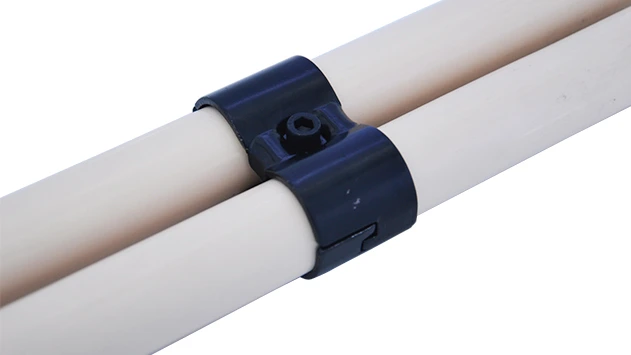
Parallel lean pipe joint used for 2 pcs 28MM lean pipe connection in parallel direction to enhance frame structure, usually for heavy payload requirement for workbench. flow rack, hand trolley.
Walk into any modern manufacturing facility, and you'll notice a silent hero at work: the humble lean pipe structure. From assembly line workbenches to material flow racks, these modular systems are the backbone of efficient, lean operations. But here's the thing—behind every sturdy workbench or smooth-flowing conveyor lies a critical decision: how to connect those pipes. For decades, welded connections were the default, seen as the "tough" choice for durability. But in recent years, parallel lean pipe joint systems have emerged as a agile alternative, promising flexibility without sacrificing strength. Today, we're diving deep into this debate: Which connection method truly serves the needs of today's fast-paced, ever-changing factories? Let's unpack the pros, cons, and real-world impact of both.
The Backbone of Lean Manufacturing: Why Connections Matter
Before we compare parallel joints and welds, let's ground ourselves in why lean system connections are so vital. Lean manufacturing isn't just a buzzword—it's about eliminating waste, optimizing flow, and adapting to change. A lean pipe system (often made of steel, aluminum, or aluminum lean pipe ) is designed to support this philosophy by creating customizable structures: think workstations that adjust to new product lines, flow racks that speed up material delivery, or trolleys that navigate tight factory floors. But none of this works if the connections between pipes fail—either by breaking under load or locking the system into a rigid, unchangeable design.
In short, the connection method isn't just a technical detail; it's the difference between a system that grows with your business and one that becomes obsolete the moment your workflow changes. Now, let's meet the two contenders.
Contender 1: Parallel Lean Pipe Joints – The Modular Mavericks
If welded connections are the old-school craftsmen of the manufacturing world, parallel lean pipe joint systems are the tech-savvy innovators. These joints—often made of durable plastic, metal, or aluminum—are designed to clamp, twist, or lock onto lean pipes without the need for heat, sparks, or specialized tools. Picture a simple, yet clever, connector that slides over two parallel pipes and tightens with a hex key, creating a secure bond that can be loosened and repositioned in minutes. That's the essence of a parallel joint.
How Parallel Lean Pipe Joints Work
Most parallel joints feature a split design with internal grooves that grip the pipe's surface when tightened. Some use friction, others have teeth that dig slightly into the pipe (without damaging it), and a few even combine both for extra hold. The "parallel" in their name refers to their ability to connect pipes running side by side—common in structures like workbench frames or flow rack sides—though many designs also handle perpendicular or angled connections with adapters.
What truly sets them apart is their modularity. A single joint can be reused across multiple projects, and an entire structure can be disassembled, reconfigured, and reassembled with minimal effort. For example, a factory that needs to shrink a workbench from 6 feet to 4 feet to make space for a new machine? With parallel joints, that's a 20-minute job. With welds? You're cutting pipes and starting over.

Contender 2: Welded Connections – The Traditional Titans
Welded connections have been around since the dawn of metalworking, and for good reason: when done right, they create a bond that's as strong as the pipe itself. In the context of lean systems, welding involves heating the ends (or intersection) of two pipes to melting point and fusing them together with a filler metal. The result is a permanent, rigid joint that feels "unbreakable"—a quality that has made welds the go-to for manufacturers who prioritize raw strength and longevity.
The Appeal of Welded Connections
For decades, welds were seen as the gold standard for "serious" structures. Why? Because they eliminate movement. In high-vibration environments (like near heavy machinery), a welded joint won't loosen over time the way a bolted connection might. They also have a reputation for handling heavier loads—though, as we'll see later, modern parallel joints often match or exceed that capacity. Welds also have a certain aesthetic appeal for some: a smooth, seamless look with no visible hardware, which can make structures feel more "finished."
But there's a catch: welding is a skilled trade. It requires trained professionals, specialized equipment (welders, masks, ventilation), and strict safety protocols. It's also time-consuming—each joint takes minutes to prep, weld, and cool—and once the weld is done, that's it. No second chances. If you make a mistake, you're grinding it off and starting over.

Head-to-Head: Parallel Joints vs. Welded Connections
Now, let's pit these two against each other in the categories that matter most to manufacturers: flexibility, cost, time, durability, and more. We'll use a real-world lens—no theoretical "what-ifs," just practical realities.
1. Flexibility & Adaptability – The "Change or Die" Test
In today's manufacturing landscape, change is constant. Product lines shift, order volumes spike, and new technologies (like collaborative robots) demand reconfigured workspaces. Here's where parallel joints shine brightest.
Parallel Lean Pipe Joints: These are built for change. Need to add a shelf to a flow rack? Loosen a few joints, slide in a new crossbar, and retighten. Want to repurpose a turnover trolley into a parts bin holder? Disassemble it and rebuild with the same joints. Even better, if a structure is no longer needed, the pipes and joints can be stripped down and used to build something entirely new—no waste, no extra cost.
Welded Connections: Welds are permanent by design. Once two pipes are fused, altering the structure means cutting the welds (which weakens the pipe), grinding down the metal, and re-welding new pieces. This isn't just time-consuming; it often renders the original pipes unusable for future projects. For example, a welded workbench that's too tall for a new operator can't be shortened—you'd have to cut the legs, which may leave them unstable, or build a new bench from scratch.
Winner: Parallel joints, by a mile. In a world where agility equals competitiveness, their adaptability is a game-changer.
2. Installation Time & Labor – The "Downtime is Money" Showdown
Every minute a production line is idle because a workbench isn't built or a flow rack isn't set up is money lost. Let's compare how long each method takes to get a structure up and running.
Parallel Lean Pipe Joints: No special skills required. A factory worker with basic hand tools (a hex key, maybe a rubber mallet) can assemble a simple workbench in under an hour. Even complex structures, like a 20-foot conveyor frame, take a fraction of the time of welding. There's no waiting for metal to cool, no need for a certified welder on-site, and no cleanup of welding slag or fumes.
Welded Connections: Welding demands expertise. A certified welder might take 3-4 hours to build that same simple workbench, factoring in setup (ventilation, protective gear), measuring, tack-welding, full welding, and cooling time. For larger projects, this can stretch into days. Plus, welding creates fumes and sparks, so the area often needs to be cleared of flammables, further delaying production.
Winner: Parallel joints. They cut installation time by 50-70%, letting teams get back to what matters—making products.
3. Cost: Short-Term vs. Long-Term
At first glance, welded connections might seem cheaper. After all, you're not buying specialized joints—just pipes and welding supplies. But the true cost story unfolds over time.
Parallel Lean Pipe Joints: The upfront cost is higher. A single parallel joint can cost $5-$15, depending on material and design, whereas welding rods and gas are relatively inexpensive. But consider this: a set of 20 joints can build 10 different structures over 5 years. Welded pipes, once cut or modified, are often discarded. Over time, the reusability of joints drives down the total cost of ownership.
Labor costs also tip the scales. Welders earn an average of $25-$40 per hour, while a general factory worker assembling with joints might earn $15-$20. For a large project, the labor savings alone can offset the joint cost in the first build.
Welded Connections: Lower upfront material costs, but higher labor and long-term waste. A welded structure that becomes obsolete in a year is a sunk cost, whereas a jointed structure can be repurposed. Plus, welding equipment (a MIG welder, helmet, gloves) is a significant investment for small to mid-sized factories.
Winner: Parallel joints, in the long run. Their reusability and lower labor costs make them more economical over time.
4. Durability & Strength – The "Can It Handle the Heat?" Myth
Here's the biggest myth: "Welded connections are always stronger." Let's separate fact from fiction.
Parallel Lean Pipe Joints: Modern parallel joints are engineered to handle impressive loads. High-quality metal joints (like those made from die-cast aluminum) can support 500+ pounds per connection—more than enough for most lean system applications (workbenches, flow racks, trolleys). They're also designed to flex slightly under stress, which can absorb shocks (like a heavy box being dropped on a shelf) better than rigid welds, which may crack under sudden impact.
That said, they do have limits. In extreme conditions—like continuous vibration from a stamping press or outdoor use in harsh weather—joints may loosen over time (though regular checks with a hex key fix this). And while they're strong, they can't match the raw tensile strength of a perfect weld in ultra-heavy applications (like supporting 2-ton machinery).
Welded Connections: When done by a skilled welder, a weld creates a bond that's theoretically as strong as the pipe itself. This makes them ideal for static, ultra-heavy structures—think a fixed assembly platform for automotive engines. However, poor welding (porosity, undercutting, or cold joints) can create weak points that fail unexpectedly. Welds also concentrate stress at the joint, making them prone to cracking under repeated bending or vibration.
Winner: It depends on the application. For 90% of lean manufacturing needs (workstations, flow racks, light-to-medium conveyors), parallel joints are strong enough. For ultra-heavy, static loads, welds still have an edge—but those cases are rare in modern, agile factories.
5. Maintenance & Repairs – The "Oops, It Broke" Test
No structure lasts forever. Parts wear out, accidents happen, and daily use takes a toll. How easy is it to fix each system?
Parallel Lean Pipe Joints: Repairs are a breeze. If a joint cracks (uncommon with quality parts), you unscrew it and replace it in 5 minutes. If a pipe bends, swap it out with a new one—no cutting or welding. Even better, loose joints are a simple fix: just tighten the bolt. No need for a maintenance crew or specialized tools.
Welded Connections: Repairs mean re-welding, which requires removing the damaged section, cleaning the metal, and re-fusing. This is time-consuming and often requires taking the entire structure offline. For example, a cracked weld on a flow rack beam can't be fixed while the rack is in use—you'd have to unload all the materials, remove the beam, weld it, and reload. And if the pipe itself is damaged near the weld, the entire section may need replacement.
Winner: Parallel joints. They turn maintenance from a major headache into a minor chore.
The Verdict: Parallel Lean Pipe Joints for the Modern Factory
After weighing flexibility, cost, time, and durability, it's clear that parallel lean pipe joint systems are the better choice for most manufacturers. They align with the core principles of lean manufacturing—eliminating waste, adapting to change, and optimizing flow—while saving time, labor, and money in the long run. Welded connections still have a place, but it's shrinking: reserved for ultra-heavy, static structures where permanence is more important than adaptability.
For the rest of us—factories churning out custom parts, warehouses handling seasonal spikes, and workshops iterating on new products—parallel joints aren't just a tool; they're a strategic advantage. They let you build today for what you need now, and rebuild tomorrow for what you'll need next. In the end, that's the true power of lean manufacturing: not just efficiency, but the freedom to evolve.
Comparison Table: Parallel Lean Pipe Joints vs. Welded Connections
| Factor | Parallel Lean Pipe Joints | Welded Connections |
|---|---|---|
| Flexibility | Highly adaptable; reconfigurable in minutes | Permanent; requires cutting/welding to modify |
| Installation Time | 1-2 hours for most structures (no special skills) | 3-8 hours (requires certified welders) |
| Cost (5-Year View) | Lower; joints and pipes reusable across projects | Higher; labor and waste from one-time use |
| Strength | Sufficient for 90% of lean applications (500+ lbs/connection) | Stronger for ultra-heavy, static loads |
| Maintenance | Easy; tighten or replace joints with basic tools | Complex; requires re-welding and downtime |
| Sustainability | Eco-friendly; minimal waste, high reusability | Wasteful; pipes often discarded after modification |
So, if you're building or upgrading your lean system , ask yourself: Do I need a structure that stays the same forever, or one that grows with my business? For most of us, the answer is clear. Parallel lean pipe joints aren't just a connection method—they're a step toward a more agile, efficient, and future-ready factory.