- Company Articles
- Products and Technology
- Product knowledge
- Price Comparison: Four Way Straight Lean Pipe Joint Options for Small vs. Large Manufacturers

Price Comparison: Four Way Straight Lean Pipe Joint Options for Small vs. Large Manufacturers
Related Product
Four Way Straight Lean Pipe Joint
Four way lean pipe joint for 4 pcs 28MM lean pipe connection in straight angle, which used widely in workbench, flow rack, hand trolley frame connection.
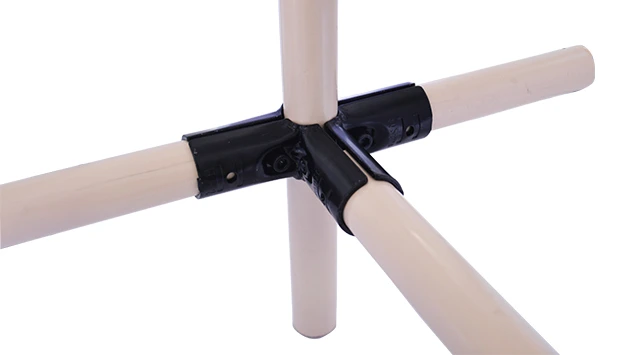
Why the Four Way Straight Lean Pipe Joint Deserves Your Attention
Let's start by talking about lean manufacturing—you've probably heard the term thrown around in factory floors, production meetings, or even industry blogs. It's all about cutting waste, streamlining processes, and making every step count. But here's the thing: behind every smooth, efficient lean system is a unsung hero that doesn't get nearly enough credit: the four way straight lean pipe joint . These little connectors are the backbone of modular workbenches, flow racks, material trolleys, and just about any custom structure a manufacturer might need. They're the reason you can reconfigure a production line in a day instead of a week, or add a new shelf to a workbench without calling in a carpenter.
Now, if you're a small manufacturer—maybe a startup with a handful of employees, or a family-run shop with a focus on niche products—your priorities are probably tight budgets and flexibility. You need tools that can grow with you, not break the bank. On the flip side, if you're part of a large manufacturing operation—think automotive plants, electronics giants, or big-box retailers' in-house production—you're dealing with scale. Thousands of units, consistent quality, and long-term supply chains are your bread and butter.
But here's the common ground: both small and large manufacturers need to get the best value for their money when it comes to these four way joints. The problem? The price tag can vary wildly depending on who you buy from, how many you need, and what extras (like lean pipe and accessories ) come with the deal. So today, we're diving into the world of four way straight lean pipe joints—specifically the chrome-plated ones—and breaking down how small and large manufacturers can navigate pricing to get exactly what they need without overspending.
First Things First: What Even Is a Four Way Straight Lean Pipe Joint?
Before we get into prices, let's make sure we're all on the same page. A four way straight lean pipe joint is a metal connector designed to join four lean pipes (those cylindrical tubes you see in workshops) at 90-degree angles, creating a sturdy, modular frame. Picture this: you're building a workbench. You need vertical legs, horizontal supports, and maybe a crossbar for stability. A four way joint lets you connect all those pipes in one spot, no welding or drilling required. It's like the LEGO brick of manufacturing—simple, versatile, and infinitely reusable.
Most of these joints are made from steel with a chrome plating (hence the term four way straight lean pipe joint chrome ), which gives them a smooth finish and resistance to rust. But there are alternatives, too—like aluminum joints, which are lighter and often used with aluminum profile systems for industries where weight matters, like aerospace or medical device manufacturing. For now, though, we're focusing on chrome because it's the most common, especially for general manufacturing.
And let's not forget the extras. You rarely buy just the joint—you need the pipes themselves, maybe some end caps, clamps, or brackets. That's where lean pipe and accessories come into play. A good supplier will bundle these, but pricing can get tricky if you're not careful. Small manufacturers, take note: those "little" accessory costs can add up fast.

Small Manufacturers: Balancing Budget and Functionality
Let's put ourselves in the shoes of a small manufacturer. Say you run a custom electronics repair shop with 15 employees. You need to build 3 workbenches, a small flow rack for parts, and a turnover trolley. After crunching the numbers, you realize you'll need about 30 four way joints, plus 20 meters of lean pipe, some casters, and a few clamps. Total joints: 30. That's not a huge order, but it's enough to make you think twice about every dollar.
Here's the challenge for small manufacturers: most suppliers prioritize large orders. A lean pipe supplier might have a minimum order quantity (MOQ) of 100 joints, which is way more than you need. So you're stuck buying from smaller, local suppliers who can sell you 30 units, but at a higher per-unit price. Let's say a large-scale supplier sells chrome joints for $5 each when you buy 1000, but a local shop charges $8 for 30. That's a 60% markup—ouch.
Another issue? Accessories. A small supplier might not stock lean pipe and accessories in small quantities, so you end up ordering pipes from one place, joints from another, and clamps from a third. Shipping costs alone can eat into your budget. And forget about negotiating—with small orders, you have little leverage. You take the price they give you, or you go without.
But it's not all doom and gloom. Small manufacturers can play to their strengths: flexibility and agility. Maybe you don't need top-of-the-line chrome joints—standard ones will do. Or you can buy slightly used joints from other small shops (many manufacturers sell their old lean systems when they upgrade). You can also partner with other small businesses to combine orders and hit that MOQ, splitting the cost. For example, if three small shops each need 40 joints, they can order 120 together and get the bulk price of $6 per unit instead of $8.

Large Manufacturers: Scaling for Savings
Now, let's switch gears to large manufacturers. Imagine you're part of a company that produces consumer appliances—think refrigerators, washing machines, etc. You have multiple production lines, each requiring hundreds of workbenches, flow racks, and material handlers. Every year, you need thousands of four way joints. For you, price per unit is less important than total cost over time—and consistency.
Large manufacturers have a secret weapon: volume. A lean system supplier (the kind that handles big accounts) will drool over an order for 5000 four way joints. Why? Because producing in bulk lowers their costs—they can negotiate better prices for raw materials, streamline production runs, and reduce shipping per unit. In return, they'll offer you a bulk discount. For example, while a small supplier charges $8 for 30 joints, a large-scale supplier might charge $4.50 for 5000. Over 5000 units, that's a savings of $17,500—enough to buy new equipment or hire an extra worker.
But it's not just about price. Large manufacturers need reliability. They can't afford a shipment of faulty joints derailing a production line. So they partner with suppliers who offer quality guarantees, consistent lead times, and even custom solutions. Maybe they need joints with a specific thread size to fit their existing aluminum profile system, or joints that can handle heavier loads. A large lean system supplier will invest in tooling to meet those needs, something a small supplier can't do.
And let's talk about bundling. A big supplier will throw in lean pipe and accessories at no extra cost, or heavily discounted. Order 5000 joints, and they might include 100 free meters of pipe, or a pallet of end caps. They'll also assign you a dedicated account manager to handle reorders, so you never run out of stock. For a large manufacturer, that peace of mind is worth paying a little extra per unit (though they rarely have to).
The Price Breakdown: A Side-by-Side Comparison
Enough talk—let's look at real numbers. Below is a comparison table showing how pricing differs for small vs. large manufacturers, using data from actual lean pipe supplier and lean system supplier quotes. We'll include unit prices, total costs for different quantities, and whether lean pipe and accessories are included.
| Supplier Type | Product | Quantity Range | Unit Price (USD) | Total for 50 Units | Total for 1000 Units | Lean Pipe & Accessories Included? |
|---|---|---|---|---|---|---|
| Small-Scale Lean Pipe Supplier | Four Way Straight Lean Pipe Joint Chrome | 1–100 units | $7.50 | $375 | N/A (MOQ not met) | No (accessories sold separately at $25/kit) |
| Small-Scale Lean Pipe Supplier | Four Way Straight Lean Pipe Joint Chrome (Bundled) | 100–500 units | $6.00 | N/A (MOQ: 100 units) | N/A (MOQ not met) | Yes (includes 10m pipe + 10 end caps per 100 joints) |
| Large-Scale Lean System Supplier | Four Way Straight Lean Pipe Joint Chrome | 500–5000 units | $4.50 | N/A (MOQ: 500 units) | $4,500 | Yes (includes 100m pipe + 50 clamps + free shipping) |
| Large-Scale Lean System Supplier | Four Way Straight Lean Pipe Joint (Aluminum Alternative) | 1000+ units | $6.00 | N/A (MOQ: 1000 units) | $6,000 | Yes (includes 100m aluminum profile + 50 brackets) |
Let's unpack this. For a small manufacturer needing 50 joints, the only option is the small-scale supplier at $7.50 per unit, totaling $375. They'll also have to buy accessories separately—say $25 for a kit of pipe and end caps—so total cost is $400. For a large manufacturer needing 1000 chrome joints, the large-scale supplier charges $4.50 each, totaling $4,500, and includes $200 worth of pipe and clamps for free. That's a savings of $3,000+ compared to buying from a small supplier (which would cost $7,500 for 1000 units, plus $250 in accessories).
Notice the aluminum alternative? It's pricier per unit, but for manufacturers using aluminum profile systems, it's worth it for the weight savings. A large manufacturer might mix chrome and aluminum joints, depending on the application—chrome for heavy-duty racks, aluminum for mobile trolleys.
Beyond the Price Tag: Other Factors to Consider
Price is important, but it's not the only thing. Here are a few other factors that can make or break a deal, whether you're small or large:
Lead Time: Small manufacturers often need parts fast. A local lean pipe supplier might deliver in 2–3 days, while a large-scale supplier could take 2–3 weeks for a bulk order. If you're in a pinch, that extra cost for speed is worth it.
Quality Control: A $4 joint might seem like a steal, but if it cracks after a month of use, you're worse off. Large suppliers usually have stricter QC processes, but small suppliers might let you inspect products before buying. Always ask for samples!
Customization: Large manufacturers might need joints with custom threading or colors. A lean system supplier can do this, but it'll cost extra. Small manufacturers? Stick to standard—custom parts are rarely worth the markup for small orders.
Location: Overseas suppliers (common for large orders) have lower labor costs, but shipping and import taxes can add 10–20% to the total. Local suppliers are pricier per unit but avoid those hidden fees.
Final Tips: Getting the Best Deal for Your Size
For small manufacturers: Join a buying group! Many industry associations (like the National Association of Manufacturers) have group purchasing programs that let small businesses access bulk pricing. You can also ask your lean pipe supplier about "open stock"—leftover inventory from large orders that they'll sell at a discount. And don't sleep on used equipment—websites like eBay or Facebook Marketplace often have like-new lean systems for 50% off.
For large manufacturers: Negotiate! Ask for volume discounts, free accessories, or extended payment terms. You can also sign a long-term contract (say, 2 years) in exchange for a lower per-unit price. And consider dual sourcing—work with two suppliers to avoid supply chain disruptions. If one has a delay, the other can pick up the slack.
And for everyone: Always compare total cost, not just unit price. A joint that costs $5 but requires $2 in accessories is more expensive than a $6 joint that includes accessories. And don't forget to factor in durability—spending $1 more per joint now might save you $10 later in replacements.
Wrapping Up: The Right Joint for the Right Manufacturer
At the end of the day, whether you're a small shop or a large factory, the goal is the same: build efficient, reliable workspaces without overspending. For small manufacturers, that means prioritizing flexibility and finding creative ways to lower costs (group buys, used equipment). For large manufacturers, it's about leveraging scale and building long-term supplier relationships.
The four way straight lean pipe joint chrome might seem like a tiny part of the manufacturing puzzle, but it's a critical one. Choose wisely, and it'll keep your operations running smoothly for years. Choose poorly, and you'll be stuck with wobbly workbenches and a budget that's gone off the rails.
So go forth—crunch the numbers, ask suppliers tough questions, and don't be afraid to walk away if the deal doesn't fit. Your bottom line (and your production line) will thank you.