- Company Articles
- Products and Technology
- Product knowledge
- Rapid Assembly Features of 3060 National Standard Profile A Structures

Rapid Assembly Features of 3060 National Standard Profile A Structures
Related Product
3060 National Standard Profile A
Workbench, production line, logistic rack, warehouse rack Industry: Manufacturer workshop, Automobile, Electronic, Assembling, logistic
In the fast-paced world of modern manufacturing and industrial operations, every minute saved in setup and assembly can translate to significant gains in productivity, cost efficiency, and overall competitiveness. Whether it's building a production workbench, a material handling rack, or an entire assembly line, the speed at which these structures can be put together directly impacts a company's bottom line. This is where the 3060 National Standard Profile A comes into play—a game-changing aluminum extrusion profile designed to redefine how industrial structures are assembled. Combining lightweight durability with innovative design, this profile, paired with the right aluminum profile accessories , makes rapid assembly not just a possibility, but a standard practice.
Understanding 3060 National Standard Profile A: The Basics
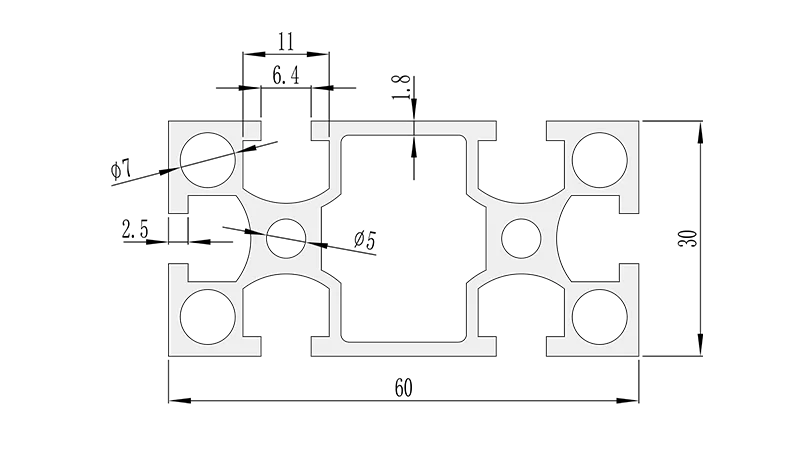
Before diving into its assembly features, let's first clarify what the 3060 National Standard Profile A is. As the name suggests, this is an aluminum extrusion profile that adheres to national manufacturing standards, ensuring consistency in dimensions, material quality, and performance across suppliers. The "3060" refers to its cross-sectional dimensions: 30 millimeters in width and 60 millimeters in height—a versatile size that strikes a balance between load-bearing capacity and flexibility.
Made from high-grade aluminum alloy (typically 6063-T5, known for its excellent strength-to-weight ratio and corrosion resistance), the profile is extruded through precision dies to create a uniform, hollow structure with internal reinforcing ribs. This design not only reduces weight (aluminum is roughly one-third the weight of steel) but also enhances rigidity, making it suitable for a wide range of applications, from light-duty workbenches to medium-weight material racks.
What truly sets the 3060 National Standard Profile A apart, however, is its focus on assembly efficiency. Unlike traditional steel profiles, which often require welding, drilling, or complex machining, this aluminum profile is engineered from the ground up to simplify every step of the building process. Let's explore the key features that make rapid assembly possible.
The T-Slot Design: The Foundation of Rapid Assembly
At the heart of the 3060 Profile A's assembly speed lies its iconic T-slot design. If you've ever looked closely at an aluminum extrusion profile, you've likely noticed the long, narrow grooves running along its length—these are T-slots. On the 3060 Profile A, these slots are precision-machined into the profile's outer surfaces, creating channels that act as built-in "tracks" for attaching accessories.
Unlike traditional steel structures, where you'd need to drill holes, weld brackets, or use adhesives to add components, T-slots allow for tool-free or minimal-tool attachment. Simply insert a T-slot nut (a specialized nut with a T-shaped base) into the slot, slide it to the desired position, and tighten a bolt through the accessory you're attaching (e.g., a bracket, a connector, or a panel). The T-slot nut locks securely in place as the bolt is tightened, creating a strong, stable connection without any permanent modification to the profile itself.
This design eliminates two major time drains in traditional assembly: measuring and marking for holes, and welding. With T-slots, adjustments are easy—if you need to reposition a bracket or add a new component later, just loosen the bolt, slide the nut to the new location, and retighten. No drilling, no grinding, no repainting. For manufacturers or workshops that frequently reconfigure their layouts (a common practice in agile production environments), this flexibility is invaluable.
Aluminum Profile Accessories: The "Building Blocks" of Speed
A profile is only as good as the accessories that complement it, and the 3060 Profile A shines here thanks to a robust ecosystem of aluminum profile accessories designed specifically for rapid assembly. Let's take a closer look at two key accessories that make a big difference: the 90° aluminum profile connector and the aluminum profile end cap .
1. 90° Aluminum Profile Connectors: Joining Profiles in Seconds
One of the most common assembly tasks is joining two profiles at a right angle—for example, attaching a vertical leg to a horizontal beam on a workbench. In traditional steel setups, this might involve welding the two pieces together (a time-consuming process requiring skilled labor) or using bulky angle brackets with multiple bolts (which demand precise alignment and tools).
The 90° aluminum profile connector simplifies this to a two-step process. These connectors are compact, lightweight brackets (often made of die-cast aluminum or reinforced plastic) that fit snugly into the T-slots of two perpendicular 3060 Profile A pieces. To use one: align the connector with the T-slots of both profiles, insert T-slot nuts into the slots, and tighten the included bolts with a hex key. That's it—no welding, no drilling, no measuring beyond a quick visual check.
What's more, these connectors are designed to distribute weight evenly across the joint, ensuring stability even under load. Some models even feature built-in reinforcement ribs or rubber gaskets to reduce vibration, making them suitable for use in machinery or high-traffic areas.
2. Aluminum Profile End Caps: Finishing Touches, Fast
While end caps might seem like a minor detail, they play an important role in both safety and aesthetics—and with the 3060 Profile A, installing them is a breeze. Aluminum profile end caps are small, lightweight covers that snap or screw into the open ends of the profile, hiding sharp edges (a critical safety feature in workplaces) and preventing dust, debris, or moisture from entering the hollow interior (which can cause corrosion over time).
Most end caps for the 3060 Profile A are "snap-fit" designs: simply align the cap with the end of the profile and press firmly—it locks into place with a satisfying "click." For applications where a more secure fit is needed (e.g., in high-vibration environments), there are also screw-on end caps that attach via a small bolt through the T-slot. Either way, installation takes seconds per cap, compared to the time it would take to grind down sharp steel edges or apply protective coatings to traditional metal profiles.
From Unboxing to Use: A Step-by-Step Example of Rapid Assembly
To put this into perspective, let's walk through a real-world example: assembling a simple workbench using 3060 National Standard Profile A, 90° connectors, end caps, and a few other basic accessories. For context, a traditional steel workbench of similar size might take 2–3 hours to assemble (including cutting steel, welding joints, grinding rough edges, and painting). Here's how it works with the 3060 Profile A:
- Prepare the materials : You'll need four 3060 Profile A legs (120cm long), two 3060 Profile A side rails (180cm long), two 3060 Profile A cross rails (60cm long), eight 90° aluminum profile connectors, eight aluminum profile end caps, a sheet of plywood or aluminum panel for the worktop, and a hex key set.
- Assemble the frame : Attach the 90° connectors to the ends of the side rails. Slide T-slot nuts into the side rails' T-slots, position the connectors, and tighten the bolts with the hex key (30 seconds per connector). Repeat for the cross rails.
- Attach the legs : Connect the legs to the corners of the side/cross rail frame using the 90° connectors. Again, slide T-slot nuts into the legs' T-slots, align with the frame connectors, and tighten—another 30 seconds per leg.
- Add end caps : Snap the end caps onto the top of each leg and the ends of the rails (10 seconds per cap).
- Install the worktop : Place the plywood/aluminum panel on top of the frame. Use T-slot bolts through the panel into the frame's T-slots to secure it (no drilling needed—just tighten the bolts through pre-drilled holes in the panel).
Total assembly time? About 20–30 minutes. That's less than a fraction of the time required for a steel workbench, and the result is a sturdy, lightweight workbench that can be easily disassembled, modified, or repurposed later. And because there's no welding or painting, the work area stays clean, and there's no need for specialized tools or skills—even someone with minimal DIY experience can do it.
3060 Profile A vs. Traditional Steel: A Comparison
To highlight just how much time and effort the 3060 Profile A saves, let's compare its assembly metrics to those of a traditional steel structure. The table below summarizes key differences:
| Metric | 3060 National Standard Profile A | Traditional Steel Structure |
|---|---|---|
| Assembly Time (per 10ft structure) | 20–30 minutes | 2–3 hours |
| Tools Required | Hex key, rubber mallet (optional) | Welder, grinder, drill, saw, paintbrush |
| Skill Level Needed | Basic (no specialized training) | Skilled (welding certification, machining experience) |
| Reusability/Reconfigurability | High (easily disassembled and modified) | Low (welded joints are permanent; modifications require cutting/welding) |
| Post-Assembly Cleanup | Minimal (no debris, no paint fumes) | Extensive (metal shavings, welding slag, paint cleanup) |
Beyond Speed: Other Benefits of 3060 Profile A Assembly
While rapid assembly is the star feature, the 3060 Profile A offers additional advantages that make it a smart choice for modern industrial settings:
- Lightweight yet strong : Aluminum's low density means structures are easy to move (even by hand, in some cases), reducing the need for heavy lifting equipment. Despite this, the 3060 Profile A can support up to 200kg per linear meter, making it suitable for most workshop and production applications.
- Corrosion resistance : Unlike steel, aluminum naturally forms a protective oxide layer, so it won't rust—ideal for humid environments or facilities that use water-based cleaning solutions.
- Sustainability : Aluminum is 100% recyclable, and the modular design of the 3060 Profile A means components can be reused or repurposed, reducing waste.
- Cost efficiency : While the upfront cost of aluminum profiles may be slightly higher than steel, the savings in labor, tools, and reconfiguration costs quickly offset this difference.
Who Benefits Most from 3060 Profile A's Rapid Assembly?
The 3060 National Standard Profile A isn't just for large manufacturers—it's a versatile solution for any operation that values speed, flexibility, and efficiency. This includes:
- Small to medium-sized workshops : Where teams are lean and time is limited, the ability to assemble structures quickly without specialized labor is a game-changer.
- Automotive and electronics manufacturers : These industries often require frequent line reconfigurations to adapt to new product models—modular aluminum profiles make this fast and easy.
- Logistics and warehousing : Material racks, picking stations, and conveyor systems built with 3060 Profile A can be assembled and modified as inventory needs change.
- Educational institutions and makerspaces : Where students or hobbyists need to build and rebuild projects without access to welding equipment.
Conclusion: Rapid Assembly as a Competitive Advantage
In a world where manufacturing cycles are shorter, and customer demands are more dynamic than ever, the ability to assemble industrial structures quickly and flexibly isn't just a convenience—it's a competitive advantage. The 3060 National Standard Profile A , with its T-slot design, intuitive aluminum profile accessories like the 90° aluminum profile connector and aluminum profile end cap , and lightweight durability, delivers exactly that. By eliminating the need for welding, drilling, and complex tools, it cuts assembly time from hours to minutes, reduces labor costs, and allows for easy reconfiguration.
Whether you're building a simple workbench or a complex production line, the message is clear: with the right materials and design, assembly doesn't have to be a bottleneck. The 3060 Profile A isn't just a profile—it's a tool for innovation, enabling businesses to adapt faster, produce more, and stay ahead in today's fast-paced industrial landscape.