- Company Articles
- Products and Technology
- Technology Sharing
- Reusability of T Slot Aluminum Pipe with Board Holder: Reducing Waste in Manufacturing

Reusability of T Slot Aluminum Pipe with Board Holder: Reducing Waste in Manufacturing
Related Product
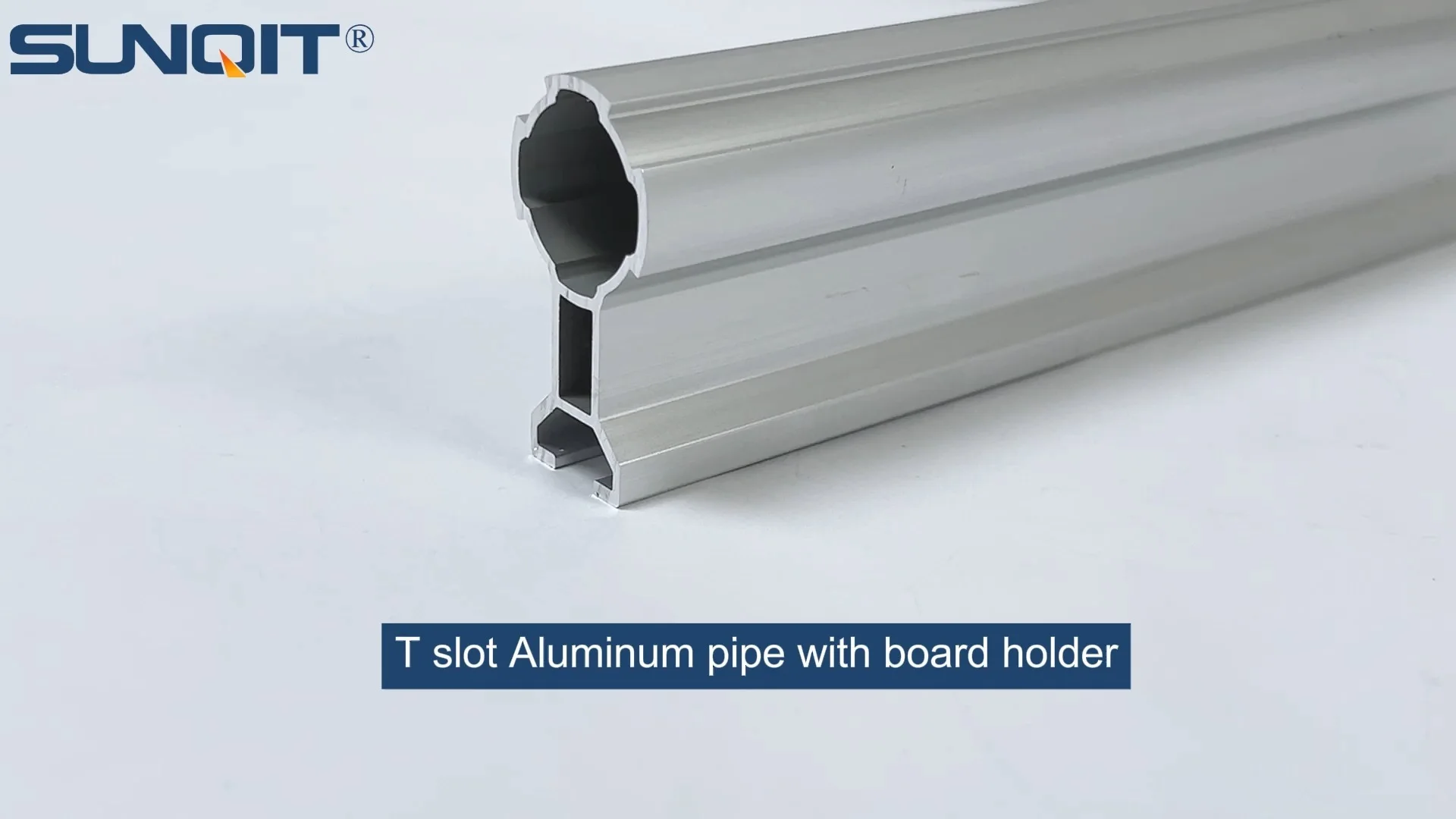
T Slot Aluminum Pipe with Board Holder
T slot Aluminum pipe with board holder,the pipe one side connected by a joint, the other side with a slot which can hold a tray or a aluminum pannel
In the fast-paced world of manufacturing, where efficiency and cost-effectiveness are the cornerstones of success, waste has long been the silent enemy. From excess materials gathering dust in storage to rigid production setups that become obsolete overnight, waste creeps into every corner—eating into profits, slowing down operations, and hindering adaptability. For decades, manufacturers have sought solutions to trim this waste, turning to principles like lean manufacturing to streamline processes. Yet, even with the best lean strategies, one area often remains overlooked: the very structures that form the backbone of the workshop—racks, workbenches, and material handling systems. Enter the T Slot Aluminum Pipe with Board Holder, a deceptively simple innovation that's quietly revolutionizing how factories approach sustainability, flexibility, and waste reduction. At its core, this system isn't just about building better workbenches or sturdier flow racks; it's about rethinking how we design, use, and reuse the tools that keep production lines moving. In this article, we'll explore how the reusability of T Slot Aluminum Pipe with Board Holder is not just a feature, but a game-changer—one that aligns perfectly with lean system principles and helps manufacturers cut waste at its source.
What Is T Slot Aluminum Pipe with Board Holder, Anyway?
Before diving into its impact, let's demystify the star of the show: T Slot Aluminum Pipe with Board Holder. At first glance, it might look like any other industrial aluminum setup, but its design holds the key to its versatility. The system starts with aluminum extrusion profile —hollow, lightweight tubes with a T-shaped groove running along their length. These grooves aren't just for show; they're the secret to the system's adaptability, allowing accessories like connectors, brackets, and (you guessed it) board holders to slide in and lock into place without welding or drilling. The board holder itself is a simple but clever addition: a bracket that attaches to the T Slot Aluminum Pipe, providing a stable platform for mounting everything from wooden work surfaces to tool panels, bins, or even digital displays.
But what truly sets this system apart is its ecosystem of aluminum profile accessories . Think of it as a modular building set for adults: with the right connectors, joints, and casters, a single set of aluminum pipes can be transformed into a workbench one month, a flow rack the next, and a turnover trolley after that. No need for specialized tools or a team of engineers—just a few hand tools and a bit of creativity. This modularity isn't just convenient; it's the foundation of its reusability, which we'll explore in depth later. For now, suffice it to say: T Slot Aluminum Pipe with Board Holder isn't a single product. It's a toolkit for building exactly what you need, when you need it—and reusing it when you don't.
The Hidden Cost of "One-and-Done" Manufacturing Setups
To appreciate the value of reusability, let's first look at the alternative: traditional manufacturing setups. For decades, factories relied on fixed structures—steel racks welded into place, wooden workbenches nailed together, or plastic flow racks molded into a single shape. These systems were built to last, but "last" often meant "until the next production line change." And in today's manufacturing landscape, where product lifecycles shrink and customization demands grow, those changes happen more often than ever.
Consider a scenario: A electronics manufacturer invests in a set of welded steel flow racks to hold circuit board components. Six months later, they launch a new, larger product line, and suddenly those racks are too short, too narrow, or spaced incorrectly. What happens next? The old racks are either abandoned in a corner (wasting space and materials) or hauled away as scrap (adding to landfill waste and disposal costs). The manufacturer then orders new, custom-built racks, repeating the cycle. It's a process that's not just expensive—it's wasteful. According to lean system principles, this is "muda" (waste) in its purest form: overproduction of fixed assets, excess inventory of unused equipment, and unnecessary transportation of discarded materials. And the costs add up: a 2023 study by the Manufacturing Extension Partnership found that U.S. manufacturers lose an estimated $10 billion annually to "structural waste"—the cost of replacing or modifying fixed production setups.
Worse, traditional setups often lock manufacturers into inefficiency. A wooden workbench might be perfect for assembling small parts, but if a new product requires a higher surface or additional tool storage, you're stuck. You could try retrofitting it with screws or brackets, but that weakens the structure, makes it harder to clean, and still doesn't guarantee a perfect fit. In the end, most manufacturers opt for the "safe" choice: buying a new workbench. And so the cycle continues—each new product, each process improvement, requiring a new set of fixed structures. It's a system built for a world where production lines never changed. But that world no longer exists.

Reusability: The Superpower of T Slot Aluminum Systems
Now, let's circle back to reusability—the feature that makes T Slot Aluminum Pipe with Board Holder a waste-busting hero. Unlike traditional fixed structures, which are designed to be built once and replaced later, T Slot Aluminum systems are engineered to be taken apart, reconfigured, and reused repeatedly. It's a mindset shift from "build it and forget it" to "build it, use it, rebuild it." Let's break down how this works in practice.
1. Disassembly Without Destruction
Traditional setups often require brute force to modify. Welded steel racks need a grinder to take apart; nailed wooden workbenches splinter when you try to remove a shelf. T Slot Aluminum systems? They come apart as easily as they go together. The T-slot grooves allow accessories to be loosened, removed, and repositioned in minutes. A workbench that's no longer needed? Unscrew the board holder, detach the aluminum pipes from their connectors, and you've got a pile of reusable components ready for their next job. No damage, no waste—just a clean slate.
2. From Workbench to Flow Rack (and Back Again)
Imagine a small manufacturer that produces seasonal products: Halloween decorations in Q4, gardening tools in Q2. With traditional setups, they'd need separate workbenches and storage racks for each season, taking up valuable floor space year-round. With T Slot Aluminum Pipe with Board Holder? In October, they assemble workbenches with board holders for decoration assembly. Come March, they disassemble those workbenches, add roller tracks to the aluminum pipes, and suddenly they've got flow racks for gardening tool parts. In June, they might take some of those pipes, add casters, and build turnover trolleys to move finished goods to shipping. The same set of aluminum pipes, connectors, and board holders is reused three times in a year—no new materials, no storage clutter, just pure efficiency.
3. Scaling Up (or Down) Without Starting Over
Growth is great, but it often means expanding production lines—and buying new equipment. Not with T Slot Aluminum systems. Let's say a bakery using T Slot flow racks for cooling trays suddenly lands a big order and needs to double capacity. Instead of buying an entirely new flow rack, they can simply add more aluminum pipes and connectors to their existing setup, extending it to fit more trays. If the order is temporary, they can scale back down later, reusing the extra pipes elsewhere. It's growth without the waste of over-investing in fixed structures that may not be needed long-term.

T Slot Aluminum and Lean System: A Match Made in Manufacturing Heaven
If reusability is the "what" of T Slot Aluminum Pipe with Board Holder, then lean system principles are the "why." Lean manufacturing, pioneered by Toyota, is all about maximizing value while minimizing waste—and T Slot Aluminum systems embody this philosophy from the ground up. Let's explore how:
Eliminating "Waste of Overproduction" (Muda #1)
Lean system teaches us to avoid making more than what's needed. With traditional fixed structures, manufacturers often overbuild "just in case"—buying extra racks or workbenches to anticipate future needs, leading to excess inventory. T Slot Aluminum systems eliminate this: since components can be reused, there's no need to overbuy. Need an extra workbench for a rush order? Reconfigure existing parts. Done with it? Take it apart and store the pipes until next time. No more gathering dust in the corner.
Reducing "Waste of Waiting" (Muda #3)
In manufacturing, time is money—and waiting for new equipment is a costly waste. Traditional setups can take weeks to design, build, and install. T Slot Aluminum systems? A team can assemble a basic workbench with a board holder in under an hour. Need to adjust a flow rack to fit a new product size? 30 minutes. This speed means production lines spend less time idle and more time making products—a direct win for lean efficiency.
Supporting "Continuous Improvement" (Kaizen)
Lean isn't a one-time fix; it's a culture of continuous improvement (kaizen). T Slot Aluminum systems thrive in this environment. If a team suggests rearranging a workbench to reduce motion waste, they can test the new layout the same day. If a flow rack isn't working as well as hoped, they can tweak the roller track position or add a board holder for tools—no need to wait for a new rack to be ordered. This flexibility turns every employee into a problem-solver, empowering teams to make changes that drive real, immediate improvements.
By the Numbers: How Reusability Translates to Savings
At this point, you might be thinking, "This all sounds great, but isn't T Slot Aluminum more expensive upfront than welded steel or wood?" It's a fair question. Aluminum extrusion profile and accessories do have a higher initial cost than, say, a basic wooden workbench. But reusability turns that upfront investment into long-term savings. Let's crunch the numbers with a real-world comparison:
| Feature | Traditional Wooden Workbench | T Slot Aluminum Workbench with Board Holder |
|---|---|---|
| Initial Cost | $200 (pre-built, fixed size) | $400 (aluminum pipes, board holder, connectors) |
| Reconfigurability | None (fixed size, cannot be modified) | High (can be resized, converted to flow rack/trolley) |
| Lifespan | 2–3 years (wood warps, screws loosen) | 10+ years (aluminum resists corrosion, no wear from disassembly) |
| Waste Generated Over 5 Years | 2–3 discarded workbenches (wood, screws, paint waste) | 0 discarded components (reused for other setups) |
| Total Cost Over 5 Years* | $600–$1,000 (3–5 replacements) | $400 (initial purchase + occasional new accessories) |
*Assumes annual production line changes requiring workbench modifications/replacement.
The table tells a clear story: while the T Slot Aluminum system costs twice as much upfront, it costs half as much over five years. And that's just for a single workbench. Scale that up to a factory with 50 workbenches, flow racks, and material racks, and the savings balloon into the tens of thousands. Add in the intangible benefits—less storage space for unused equipment, faster changeover times, reduced landfill waste—and the ROI becomes even more compelling. As one manufacturing manager put it: "We used to see our racks and workbenches as 'expenses.' Now, with T Slot Aluminum, we see them as 'investments'—ones that keep paying dividends every time we reconfigure them."
Beyond the Factory Floor: Sustainability and the Environment
In an era where consumers and regulators alike demand greener business practices, reusability isn't just good for the bottom line—it's good for the planet. Traditional manufacturing setups contribute to waste in two major ways: material waste (discarded racks, workbenches) and embodied carbon (the energy used to produce new steel, wood, or plastic). T Slot Aluminum Pipe with Board Holder attacks both.
First, aluminum is infinitely recyclable. Unlike plastic, which degrades when recycled, or wood, which can't be reused indefinitely, aluminum retains its strength and quality through multiple recycling cycles. Even if a T Slot Aluminum component eventually wears out (after decades of use), it can be melted down and turned into new aluminum extrusion profile—closing the loop on material waste. Second, reusability reduces the need for new production. Every time a manufacturer reuses an aluminum pipe instead of buying a new steel one, they save the energy required to mine, process, and shape that steel. According to the Aluminum Association, recycling aluminum uses 95% less energy than producing it from raw bauxite ore. That's a staggering reduction—and one that adds up quickly when multiplied across thousands of factories.
For forward-thinking manufacturers, this sustainability isn't just a bonus; it's a competitive advantage. Companies like Patagonia and IKEA have already set the bar by prioritizing circular economy principles, and manufacturing is following suit. A 2024 survey by Deloitte found that 63% of industrial buyers prefer suppliers with strong sustainability credentials—meaning T Slot Aluminum systems could soon be a requirement, not just an option, for winning business.
Choosing the Right T Slot Aluminum System: Tips for Manufacturers
Ready to make the switch? Here are a few key considerations to ensure you get the most out of your T Slot Aluminum Pipe with Board Holder system:
1. Partner with a Reputable Aluminum Profile Supplier
Not all aluminum extrusion profile is created equal. Look for a supplier that offers high-quality, anodized aluminum (to resist corrosion) and a wide range of accessories. A good aluminum profile supplier will also provide technical support—helping you choose the right pipe thickness, connectors, and board holders for your specific needs. Avoid generic, low-quality aluminum; thin walls or poorly designed T slots can lead to instability and reduced reusability.
2. Start Small, Think Big
If you're new to T Slot Aluminum, don't overhaul your entire factory at once. Start with a single workbench or flow rack, experiment with reconfigurations, and train your team on assembly. Once you see the benefits firsthand, scaling up will feel natural. Many manufacturers start with a "test cell"—a small section of their production line where they can iterate and learn before rolling out the system company-wide.
3. Invest in Quality Accessories
The board holder, connectors, and casters are just as important as the aluminum pipes. Skimping on cheap plastic connectors might save a few dollars upfront, but they'll wear out quickly, limiting reusability. Opt for metal or high-grade plastic accessories designed to withstand repeated assembly and disassembly. Remember: the goal is to reuse these components for years, so durability matters.
Real Stories: Manufacturers Winning with Reusability
Still not convinced? Let's look at two real-world examples of manufacturers that transformed their operations with T Slot Aluminum Pipe with Board Holder:
Case Study 1: Automotive Parts Supplier Cuts Waste by 40%
A mid-sized automotive parts manufacturer in Michigan was struggling with frequent production line changes. Their welded steel workbenches and flow racks couldn't keep up with new part designs, leading to $50,000 annually in replacement costs and 10 tons of scrap metal waste. After switching to T Slot Aluminum systems, they reconfigured existing components to fit new parts, eliminating the need for new racks. Within a year, they reduced structural waste by 40% and cut changeover time from 2 weeks to 2 days. "We used to dread product launches because of the setup headaches," said their production manager. "Now, we look forward to them—our T Slot Aluminum systems make it easy to adapt."
Case Study 2: Electronics Factory Slashes Storage Costs
A consumer electronics factory in Vietnam had a problem: seasonal demand spikes meant they needed extra storage racks for 3 months of the year, but those racks sat empty the rest. Storing them took up 2,000 square feet of valuable floor space. With T Slot Aluminum Pipe with Board Holder, they built modular racks that could be disassembled and stored flat during off-seasons. The result? They reclaimed 1,500 square feet of floor space, rented out the extra area, and generated $30,000 annually in additional income—all while reducing their carbon footprint.
Overcoming the Final Hurdle: The "But We've Always Done It This Way" Mentality
Change is hard, especially in manufacturing, where "if it ain't broke, don't fix it" is a common mantra. Some teams might resist switching to T Slot Aluminum, arguing that their current setup "works fine." To overcome this, focus on education and empowerment. Invite skeptics to help design the first T Slot Aluminum workbench—let them see how easy it is to assemble and modify. Share the cost savings and sustainability wins from other manufacturers. And most importantly, celebrate small wins: when a team reconfigures a rack in an hour instead of waiting a week for a new one, make sure that success is visible. Over time, the "we've always done it this way" mindset will shift to "why didn't we do this sooner?"
The Future of Manufacturing: Reusable, Flexible, and Lean
As manufacturing continues to evolve—with trends like mass customization, shorter product lifecycles, and a focus on sustainability—the need for reusable, flexible tools will only grow. T Slot Aluminum Pipe with Board Holder isn't just a solution for today's waste problems; it's a foundation for tomorrow's factories. Imagine a future where production lines are reconfigured daily to meet customer demand, where waste is measured in grams instead of tons, and where every workbench, rack, and trolley is seen as a reusable resource, not a disposable tool. That future is already here for manufacturers using T Slot Aluminum systems.
At the end of the day, reusability isn't just about saving money or reducing waste (though those are huge perks). It's about giving manufacturers the freedom to adapt, innovate, and thrive in an unpredictable world. So the next time you walk through a factory, take a look at the racks, workbenches, and flow racks. Are they holding your team back, or empowering them to build a better, leaner future? With T Slot Aluminum Pipe with Board Holder, the answer is clear: it's time to build to reuse.