- Company Articles
- Products and Technology
- Product knowledge
- Reusable Lean Pipe Clamps: Reducing Production Costs Long-Term

Reusable Lean Pipe Clamps: Reducing Production Costs Long-Term
Related Product
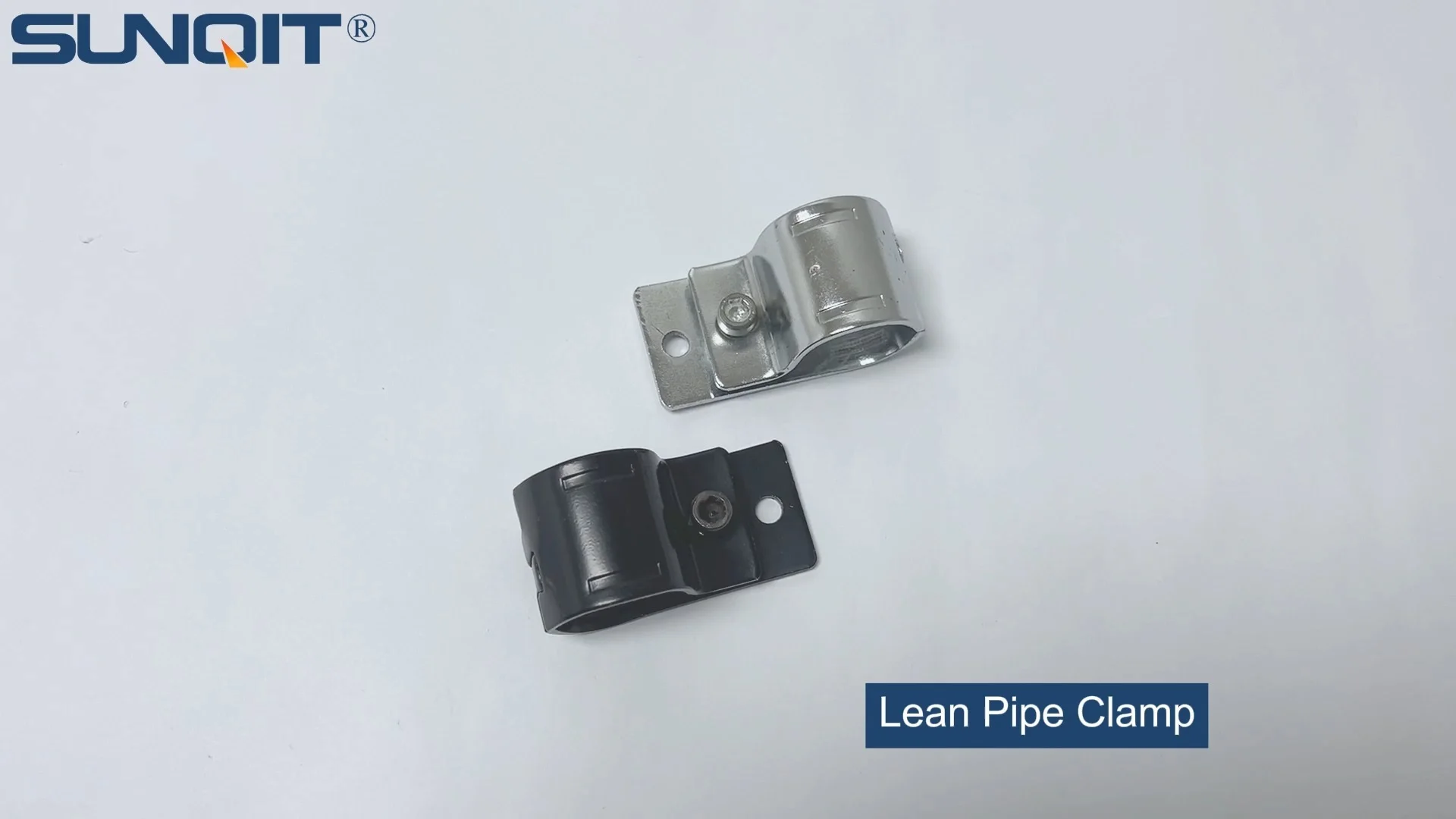
Lean Pipe Clamp
Lean pipe clamp is used for rack system hang monitor or other panel for workbenck, flowrack in production daily use.
It's 8:15 AM on a Tuesday, and Maria, the production manager at a mid-sized automotive parts factory in Ohio, is staring at her third budget overrun report this quarter. The new sensor assembly line her team launched last month required entirely new workbenches—welded steel, custom-built, and now sitting idle because the client changed the design. "We just spent $12,000 on those racks," she mutters, pinching the bridge of her nose. "And now we need to tear them down and start over." Across the floor, her lead technician, Jake, is trying to rig a temporary solution with zip ties and plywood. It's not safe, it's not efficient, and Maria knows it's only a matter of time before this Band-Aid approach backfires.
If Maria's story sounds familiar, you're not alone. In manufacturing, the pressure to stay agile, cut costs, and adapt to shifting production needs is relentless. Yet so many facilities are still stuck in the "build once, replace often" cycle—sinking money into rigid, one-and-done workbenches, flow racks, and conveyor systems that become obsolete the second a product design changes. The hidden costs here aren't just financial; they're emotional. The stress of missed deadlines, the frustration of watching your team waste hours on workarounds, the guilt of explaining yet another budget overrun to leadership. What if there was a better way?
The Problem with "Permanent" Solutions
Let's talk about the elephant in the factory: traditional fixed production setups. For decades, manufacturers relied on welded steel frames, bolted-down workbenches, and custom-machined flow racks. They were sturdy, sure—but that sturdiness came with a fatal flaw: inflexibility . When your line produces the same widget for 10 years, that's fine. But in today's world, where product lifecycles shrink from years to months, rigidity is a death sentence.
Consider a typical scenario: Your team spends 6 weeks designing a custom workbench for a new product. It's welded on-site, takes 3 days to install, and costs $3,500. Six months later, the product is updated—slightly larger, with a new component. Suddenly, the workbench is too short, the shelves are the wrong height, and the tool hooks are in the wrong place. Now you have two options: either spend $2,000 to modify the existing bench (which still might not fit perfectly) or scrap it entirely and build a new one for $4,000. Either way, you're bleeding cash and losing valuable production time.
And it's not just the big-ticket items. Think about the smaller stuff: the conveyor tracks that can't be adjusted for a new box size, the material racks that can't expand when demand spikes, the ESD workstations that become useless when you switch to a different circuit board. Each of these "permanent" solutions adds up to a mountain of waste—waste that hits your bottom line and your team's morale.
Reusable Lean Pipe Clamps: The Flexible Alternative
Enter reusable lean pipe clamps. If traditional setups are like concrete—strong but unyielding—these clamps are like Lego blocks: sturdy enough to support heavy loads, but designed to be taken apart, reconfigured, and reused again and again. They're the backbone of a lean manufacturing system that prioritizes adaptability, and they're quietly revolutionizing how small and medium-sized factories operate.
So, what exactly are these clamps? At their core, they're simple: durable, often made from zinc-plated steel or aluminum, with a design that lets you connect lean pipe (hollow metal tubes, usually aluminum or steel) quickly and securely—no welding, no drilling, no specialized tools required. Imagine a clamp that screws tight around two pipes, holding them at 90 degrees, 45 degrees, or straight—whatever angle you need. Need to adjust the height of a shelf? Loosen the clamp, slide the pipe up, retighten. Done. Want to add a new arm to your workbench for a tool holder? Snap on a new clamp, add a pipe, and you're ready to go in 5 minutes.
The magic here is in the reusability . Unlike welded joints or glued connections, these clamps don't damage the pipes. That means when your production needs change, you don't have to throw anything away. You just disassemble the old setup, sort the pipes and clamps, and rebuild something new. Maria, from our earlier story, could have taken those $12,000 worth of "obsolete" racks, broken them down into pipes and clamps, and reassembled them into the new sensor line's workbench in a day—saving $8,000 and avoiding a week of downtime.
Why Aluminum Lean Pipe? The Material That Makes It Work
While lean pipe clamps are the "brains" of the system, the "brawn" comes from the pipes themselves—and more and more manufacturers are choosing aluminum lean pipe for good reason. Aluminum is lightweight (about 1/3 the weight of steel), which makes a breeze—even a single technician can move a full workbench without a forklift. It's also corrosion-resistant, so it holds up in humid or dusty environments, and it's compatible with ESD (electrostatic discharge) coatings, critical for electronics manufacturing where static can fry sensitive components.
But the best part? Aluminum lean pipe is incredibly durable . A well-maintained aluminum pipe can last 10+ years, even with constant disassembly and reassembly. Compare that to plywood shelving (which warps or splinters after 2-3 years) or painted steel (which chips and rusts). When you pair aluminum pipes with high-quality lean pipe clamps, you're not just buying a workstation—you're investing in a system that grows with your business.

From Workbench to Flow Rack: Real-World Savings in Action
Let's get concrete (pun intended) about the savings. To truly understand the impact of reusable lean pipe clamps, let's walk through two common applications: workbenches and flow racks. These are the workhorses of any production floor, and they're where the cost differences between fixed and flexible setups become starkly clear.
Workbenches: The Heart of the Line
A standard fixed workbench, built with welded steel, might cost $3,000 and take 2 days to install. If you need to reconfigure it (e.g., add a shelf, adjust the height), you're looking at $500 in labor and materials—and that's if the modification is even possible. If not, you're replacing it entirely for $3,500 (since prices always go up). Over 5 years, assuming you need to reconfigure or replace it twice, that's a total cost of $3,000 + $500 + $3,500 = $7,000.
Now, a reusable lean pipe workbench. The initial cost is slightly higher—around $3,500 (pipes, clamps, a wooden or aluminum top). But here's the kicker: reconfiguring it takes 1 hour (no labor costs, since your team can do it), and you don't need new materials—just rearrange the existing pipes and clamps. Over 5 years, even if you reconfigure it 5 times (for new products, new tools, or new team needs), your total cost is still $3,500. That's a 50% savings —and that's not counting the downtime avoided (which, for a busy line, could be worth $1,000+ per day).
Flow Racks: Keeping Materials Moving
Flow racks—those sloped racks that let materials glide down to the assembly line—are another area where reusable clamps shine. A fixed steel flow rack with 5 levels might cost $4,000. If your materials change size (e.g., from small boxes to larger bins), you need to replace the rollers, adjust the slope, or buy a new rack. A reusable lean pipe flow rack, built with aluminum pipe and plastic roller tracks, costs $4,500 upfront but lets you swap out rollers, adjust the slope, or add levels in minutes using—you guessed it—lean pipe clamps. Over 5 years, the fixed rack might cost $4,000 + $2,000 (modifications) + $5,000 (replacement) = $11,000. The reusable version? $4,500 total. Savings: $6,500.
| Setup Type | Initial Cost | 5-Year Reconfiguration/Replacement Costs | Total 5-Year Cost | Downtime for Changes |
|---|---|---|---|---|
| Fixed Steel Workbench | $3,000 | $4,000 (2 reconfigurations/replacements) | $7,000 | 2-3 days per change |
| Reusable Lean Pipe Workbench | $3,500 | $0 (5 reconfigurations, no new parts) | $3,500 | 1-2 hours per change |
| Fixed Steel Flow Rack | $4,000 | $7,000 (1 modification, 1 replacement) | $11,000 | 1-2 days per change |
| Reusable Lean Pipe Flow Rack | $4,500 | $0 (3 reconfigurations, no new parts) | $4,500 | 30 minutes per change |

The Emotional Payoff: Beyond the Spreadsheet
Numbers tell part of the story, but the real impact of reusable lean pipe clamps is emotional. Let's go back to Maria. Six months after switching to a lean pipe system, she's a different person. "Last week, we got a rush order for a new sensor variant," she says, grinning. "Jake and the team took apart the old workbench at 3 PM, reconfigured it with the clamps, and had the new line up and running by 5:30 PM. No overtime, no panic, no budget request. The client was thrilled, and my boss even mentioned it in the all-hands meeting."
Her team is happier, too. "Before, we'd grumble every time a product changed," Jake admits. "Now, it's like a puzzle—we get to redesign the setup, make it work better than before. It feels like we're actually contributing, not just following orders." Morale isn't just a nice-to-have; happy teams are 12% more productive, according to Gallup research. That productivity boost alone can offset the initial cost of switching to lean pipe clamps.
There's also the peace of mind. Maria no longer lies awake at night worrying about the next product change. She knows her setup can adapt. She's stopped dreading budget meetings because she can show tangible savings: "Last quarter, we cut production setup costs by 35%," she tells her CFO. "And we're on track to hit 40% this quarter." That kind of confidence? Priceless.

Choosing the Right Partner: Not All Clamps Are Created Equal
So, you're sold on reusable lean pipe clamps—now what? The next step is finding a reliable supplier. Not all clamps are made the same, and cutting corners here will cost you in the long run. A cheap clamp might save you $5 upfront, but if it slips under load or cracks after a few reconfigurations, you'll end up replacing it (and possibly the pipes it was holding)—undoing all those savings.
Look for suppliers who specialize in lean manufacturing solutions, not just generic hardware. They should offer a range of clamp types (90-degree, 45-degree, parallel, swivel) to fit different configurations, and they should stock compatible aluminum lean pipe and accessories (like caster wheels for mobile workbenches or roller tracks for flow racks). Ask about material quality: steel clamps should be zinc-plated to resist rust; aluminum clamps should be anodized for durability. And don't be afraid to ask for samples—test the clamps yourself. Do they tighten securely? Are they easy to adjust without stripping the threads? A good supplier will happily send you a few to try.
Also, consider customer support. Even with the most user-friendly system, you'll have questions. Does the supplier offer assembly guides, video tutorials, or phone support? Maria's supplier, for example, sent a technician to train her team for free when they first switched. "That 2-hour training saved us weeks of trial and error," she says. "It showed they cared about our success, not just making a sale."
The Future of Manufacturing: Lean, Flexible, and Human-Centered
Manufacturing isn't just about machines and materials—it's about people. People who want to do their jobs well, who hate waste, who take pride in building something that matters. Reusable lean pipe clamps aren't just tools; they're enablers. They empower your team to adapt, innovate, and take ownership of their workspace. They turn frustration into creativity, and budget stress into confidence.
As product cycles get shorter and customer demands get more specific, the factories that thrive will be the ones that can pivot quickly—without breaking the bank or burning out their teams. Reusable lean pipe clamps aren't a silver bullet, but they're a powerful step in the right direction. They're proof that sometimes, the best way to cut costs long-term is to stop thinking in terms of "permanent" and start thinking in terms of "possible."
So, to all the Marias and Jakes out there—tired of tearing down and rebuilding, of watching your hard-earned budget go up in smoke—take a look at your production floor. What if that rigid workbench could be something else tomorrow? What if that flow rack could grow with your business instead of holding it back? The future of manufacturing isn't about being stuck. It's about being ready—for whatever comes next.