- Company Articles
- Products and Technology
- Product knowledge
- Reusable Lean Pipe Clamps: Supporting Sustainable Manufacturing Practices

Reusable Lean Pipe Clamps: Supporting Sustainable Manufacturing Practices
Related Product
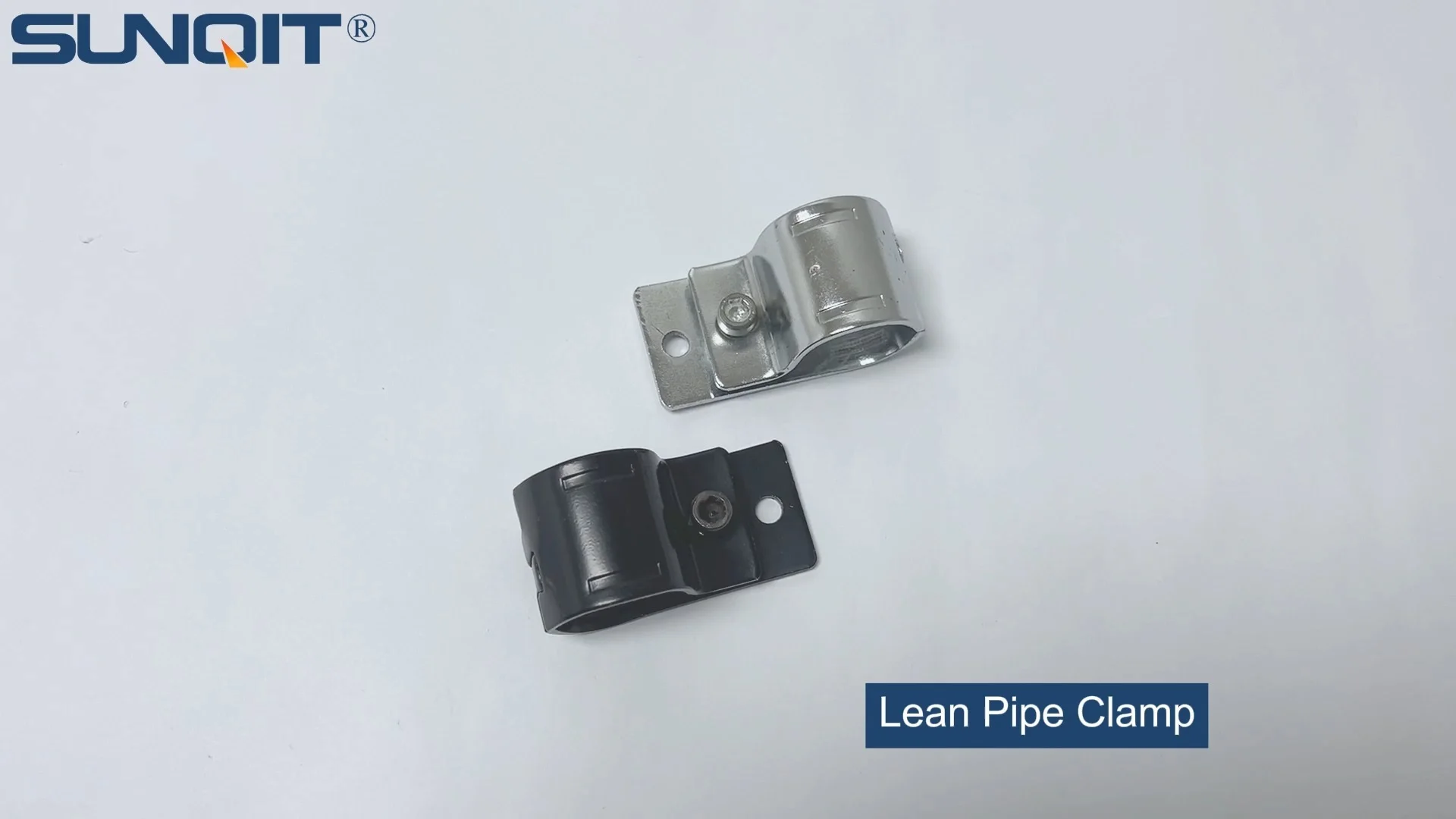
Lean Pipe Clamp
Lean pipe clamp is used for rack system hang monitor or other panel for workbenck, flowrack in production daily use.
In today's fast-paced manufacturing world, the pressure to do more with less has never been greater. But "less" isn't just about cutting costs—it's about reducing waste, minimizing environmental impact, and building systems that stand the test of time (and change). Enter reusable lean pipe clamps: small components that pack a big punch when it comes to sustainability. These unassuming connectors are quietly revolutionizing how factories, assembly lines, and warehouses operate, proving that even the smallest parts can drive meaningful change in sustainable manufacturing. Let's dive into why these clamps matter, how they work, and the real-world impact they're having on businesses and the planet.
The Rise of Sustainable Manufacturing: Why It's No Longer Optional
Manufacturing has long been the backbone of global economies, but it's also a major contributor to resource depletion and waste. According to the United Nations Industrial Development Organization, the manufacturing sector accounts for nearly 28% of global carbon emissions and generates over 70% of industrial waste. In response, consumers, regulators, and businesses themselves are demanding change. Companies like IKEA, Toyota, and Siemens have made bold commitments to carbon neutrality, while regulations like the EU's Circular Economy Action Plan are pushing industries to rethink "take-make-dispose" models.
Sustainable manufacturing isn't just a trend—it's a survival strategy. Businesses that ignore it risk higher costs from waste disposal, regulatory fines, and lost customers who prioritize eco-friendly brands. But sustainability doesn't have to mean sacrificing efficiency or productivity. In fact, the most successful sustainable practices often improve operations while reducing environmental harm. That's where lean manufacturing principles come in, and at the heart of lean systems lies the humble lean pipe.
Sustainable manufacturing isn't just a trend—it's a survival strategy. Businesses that ignore it risk higher costs from waste disposal, regulatory fines, and lost customers who prioritize eco-friendly brands. But sustainability doesn't have to mean sacrificing efficiency or productivity. In fact, the most successful sustainable practices often improve operations while reducing environmental harm. That's where lean manufacturing principles come in, and at the heart of lean systems lies the humble lean pipe.
What Are Reusable Lean Pipe Clamps, Anyway?
To understand reusable lean pipe clamps, let's start with the basics: lean pipe systems. These systems use modular components—typically aluminum lean pipe or steel pipes with plastic coatings—and connectors to build flexible structures like workbenches, material racks, and assembly lines. Unlike traditional fixed structures built with welded metal or glued parts, lean pipe systems are designed to be reconfigured, adapted, and reused. And the star of this modularity? The lean pipe clamp.
A lean pipe clamp is a connector that joins lean pipe sections together, allowing users to build and modify structures without welding, drilling, or specialized tools. Traditional clamps might be glued, welded, or made of brittle plastic that breaks when disassembled, making them one-and-done. Reusable clamps, however, are engineered for durability and repeated use. They're often made of high-grade aluminum or steel, with precision-engineered joints that lock securely but can be easily loosened with a wrench or even by hand.
Think of them as the Lego bricks of manufacturing: snap them together to build a workbench today, take them apart next month to build a flow rack, and reuse them again next year for a conveyor system. This flexibility is game-changing, especially in industries where production lines evolve rapidly—like electronics, automotive, and consumer goods.
A lean pipe clamp is a connector that joins lean pipe sections together, allowing users to build and modify structures without welding, drilling, or specialized tools. Traditional clamps might be glued, welded, or made of brittle plastic that breaks when disassembled, making them one-and-done. Reusable clamps, however, are engineered for durability and repeated use. They're often made of high-grade aluminum or steel, with precision-engineered joints that lock securely but can be easily loosened with a wrench or even by hand.
Think of them as the Lego bricks of manufacturing: snap them together to build a workbench today, take them apart next month to build a flow rack, and reuse them again next year for a conveyor system. This flexibility is game-changing, especially in industries where production lines evolve rapidly—like electronics, automotive, and consumer goods.

The Environmental Impact: Less Waste, More Resources Saved
The most obvious environmental benefit of reusable lean pipe clamps is waste reduction. Let's do the math: a traditional fixed workbench might use welded steel clamps. When the workbench is no longer needed (because the product line changes, or the company moves), the clamps are cut or broken off, ending up in landfills. The steel is recycled, but recycling still requires energy—melting down steel uses 74% less energy than producing new steel, but it's not zero. Plus, the labor and time spent on welding and cutting are wasted.
Reusable clamps, by contrast, stay in circulation. A single set of high-quality lean pipe clamps can be reused 10+ times over a decade. That means fewer raw materials extracted from the earth, less energy spent on manufacturing new clamps, and less waste sent to landfills. Consider a mid-sized factory that replaces 50 fixed workbenches with modular lean pipe workbenches using reusable clamps. Over five years, if those workbenches are reconfigured three times, the factory could avoid sending over 2,000 pounds of metal waste to landfills—equivalent to taking 1.5 cars off the road in carbon emissions, according to EPA estimates.
But the impact goes beyond waste. Reusable clamps also reduce the need for new production. Every clamp reused is one less clamp that needs to be mined, processed, and shipped. Aluminum, for example, requires significant energy to extract and refine—reusing aluminum lean pipe clamps cuts down on that energy demand. And since lean pipe systems are lightweight, they also reduce transportation emissions when structures are moved or reconfigured.
Reusable clamps, by contrast, stay in circulation. A single set of high-quality lean pipe clamps can be reused 10+ times over a decade. That means fewer raw materials extracted from the earth, less energy spent on manufacturing new clamps, and less waste sent to landfills. Consider a mid-sized factory that replaces 50 fixed workbenches with modular lean pipe workbenches using reusable clamps. Over five years, if those workbenches are reconfigured three times, the factory could avoid sending over 2,000 pounds of metal waste to landfills—equivalent to taking 1.5 cars off the road in carbon emissions, according to EPA estimates.
But the impact goes beyond waste. Reusable clamps also reduce the need for new production. Every clamp reused is one less clamp that needs to be mined, processed, and shipped. Aluminum, for example, requires significant energy to extract and refine—reusing aluminum lean pipe clamps cuts down on that energy demand. And since lean pipe systems are lightweight, they also reduce transportation emissions when structures are moved or reconfigured.

Economic Benefits: Sustainability That Boosts the Bottom Line
Sustainability and profitability don't have to be at odds—and reusable lean pipe clamps prove it. While the upfront cost of high-quality reusable clamps might be slightly higher than cheap, disposable ones, the long-term savings are undeniable. Let's break it down:
Lower Replacement Costs: Disposable clamps need to be replaced every time a structure is modified. A $5 plastic clamp that breaks after one use might seem cheap, but if you need 100 clamps for a workbench and reconfigure twice a year, that's $1,000 over five years. A $15 reusable clamp that lasts 10 uses? That's $150 over the same period—an 85% savings.
Reduced Labor Time: Welding or drilling fixed structures takes skilled labor and time. Reusable clamps can be assembled and disassembled by any worker with a basic wrench, cutting setup time by 50-70%. For a factory reconfiguring a production line, that means less downtime and more time making products.
Flexibility = Future-Proofing: Markets change, products evolve, and customer demands shift. A factory with fixed structures is stuck—if a new product requires a taller workbench or a wider material rack, they have to build it from scratch. With reusable clamps, they can adapt existing structures, avoiding the cost of new materials and labor. A study by the Lean Enterprise Institute found that manufacturers using modular lean systems report 30% faster response times to market changes and 25% lower capital expenditure on new equipment.
Lower Replacement Costs: Disposable clamps need to be replaced every time a structure is modified. A $5 plastic clamp that breaks after one use might seem cheap, but if you need 100 clamps for a workbench and reconfigure twice a year, that's $1,000 over five years. A $15 reusable clamp that lasts 10 uses? That's $150 over the same period—an 85% savings.
Reduced Labor Time: Welding or drilling fixed structures takes skilled labor and time. Reusable clamps can be assembled and disassembled by any worker with a basic wrench, cutting setup time by 50-70%. For a factory reconfiguring a production line, that means less downtime and more time making products.
Flexibility = Future-Proofing: Markets change, products evolve, and customer demands shift. A factory with fixed structures is stuck—if a new product requires a taller workbench or a wider material rack, they have to build it from scratch. With reusable clamps, they can adapt existing structures, avoiding the cost of new materials and labor. A study by the Lean Enterprise Institute found that manufacturers using modular lean systems report 30% faster response times to market changes and 25% lower capital expenditure on new equipment.
Case Study: How a Electronics Manufacturer Cut Costs and Waste with Reusable Clamps
ABC Electronics, a mid-sized producer of smartphone components, used to rely on custom-built workbenches with welded steel frames. When they launched a new product line in 2022, they needed to lower workbench heights by 12 inches. Their solution? Cut the old frames and weld new ones, generating 300 pounds of metal scrap and paying $12,000 in labor costs.
In 2023, they switched to lean pipe systems with reusable clamps from a trusted lean pipe supplier. When they needed to reconfigure lines for a new model six months later, they disassembled the existing workbenches, adjusted the lean pipe lengths, and reused 95% of the clamps. The process took two days instead of a week, generated 10 pounds of waste (mostly packaging from new pipe sections), and cost $1,800 in labor and materials. Over two years, ABC estimates they've saved $45,000 and reduced waste by 90% compared to their old system.

Traditional vs. Reusable Clamps: A Head-to-Head Comparison
| Feature | Traditional Disposable Clamps | Reusable Lean Pipe Clamps |
|---|---|---|
| Material Composition | Low-grade plastic, brittle metal, or glued components | High-grade aluminum, steel, or stainless steel with durable coatings |
| Average Lifespan | 1-2 uses (often breaks during disassembly) | 10+ uses (some last 10+ years with proper care) |
| Waste per Use Cycle | High: 100% of clamp ends up in landfill after use | Low: <5% waste (minimal wear and tear over time) |
| 5-Year Cost (100 clamps, 2 reconfigurations/year) | $1,000 (disposable $5 clamps replaced every use) | $150 (reusable $15 clamps reused 10 times) |
| Setup Time for a 10-Foot Workbench | 4-6 hours (welding/drilling required) | 1-2 hours (no special tools needed) |
| Sustainability Rating (1-5, 5=Best) | 1 (high waste, high energy for replacement production) | 5 (low waste, energy savings from reuse) |
Practical Applications: Where Reusable Clamps Shine
Reusable lean pipe clamps aren't just for workbenches—they're versatile enough to build almost any structure in a manufacturing or warehouse setting. Here are some common applications where they make the biggest difference:
Lean Pipe Workbenches: From assembly stations to packing areas, workbenches are the backbone of factories. Reusable clamps let workers adjust height, add shelves, or attach tools as needed. For example, an ESD workbench (used in electronics manufacturing to prevent static damage) can be modified with new shelves or anti-static mats without replacing the entire frame.
Flow Racks and Material Handling: Flow racks use gravity to move materials from loading to picking stations, improving efficiency. Reusable clamps make it easy to adjust rack height, add dividers, or change the angle of the roller track as product sizes change. A food packaging plant, for instance, can switch from handling small cereal boxes to larger pasta packages by reconfiguring the flow rack with the same clamps.
Assembly Lines and Conveyors: Conveyor systems often need to be extended, shortened, or rerouted. With reusable clamps, a factory can adjust conveyor height or add curves without welding new supports. Automotive plants, which frequently retool for new models, rely heavily on this flexibility.
Turnover Trolleys and Carts: Trolleys for moving materials around the factory can be built with lean pipe and reusable clamps, then disassembled and rebuilt if the trolley needs a larger base or more shelves. This is especially useful in warehouses with seasonal demand spikes.
Lean Pipe Workbenches: From assembly stations to packing areas, workbenches are the backbone of factories. Reusable clamps let workers adjust height, add shelves, or attach tools as needed. For example, an ESD workbench (used in electronics manufacturing to prevent static damage) can be modified with new shelves or anti-static mats without replacing the entire frame.
Flow Racks and Material Handling: Flow racks use gravity to move materials from loading to picking stations, improving efficiency. Reusable clamps make it easy to adjust rack height, add dividers, or change the angle of the roller track as product sizes change. A food packaging plant, for instance, can switch from handling small cereal boxes to larger pasta packages by reconfiguring the flow rack with the same clamps.
Assembly Lines and Conveyors: Conveyor systems often need to be extended, shortened, or rerouted. With reusable clamps, a factory can adjust conveyor height or add curves without welding new supports. Automotive plants, which frequently retool for new models, rely heavily on this flexibility.
Turnover Trolleys and Carts: Trolleys for moving materials around the factory can be built with lean pipe and reusable clamps, then disassembled and rebuilt if the trolley needs a larger base or more shelves. This is especially useful in warehouses with seasonal demand spikes.
Choosing the Right Reusable Clamps: What to Look For
Not all reusable lean pipe clamps are created equal. To maximize sustainability and savings, keep these factors in mind when choosing clamps for your operation:
Material Matters: Aluminum lean pipe clamps are lightweight and corrosion-resistant, making them ideal for clean environments like food processing or pharmaceuticals. Steel clamps are stronger for heavy loads but may rust if not coated. For ESD-sensitive areas, look for clamps with anti-static coatings compatible with esd workstations.
Load Capacity: Clamps are rated for maximum weight—don't skimp here. A clamp rated for 50 pounds won't hold a 100-pound tool, leading to accidents or clamp failure. Check the manufacturer's specs and test with your heaviest loads.
Ease of Use: The best clamps are easy to tighten and loosen. Look for designs with ergonomic handles or quick-release mechanisms that don't require special tools. This saves time and reduces worker frustration.
Compatibility: Ensure the clamps work with your existing lean pipe and accessories. Most clamps are designed for standard pipe diameters (1.5 inches is common), but double-check if you're using aluminum profile or specialized pipes.
Supplier Reliability: A cheap clamp from an unknown supplier might fail after a few uses. Choose a reputable lean pipe supplier with a track record of quality. Look for certifications like ISO 9001, which indicates strict quality control.
Material Matters: Aluminum lean pipe clamps are lightweight and corrosion-resistant, making them ideal for clean environments like food processing or pharmaceuticals. Steel clamps are stronger for heavy loads but may rust if not coated. For ESD-sensitive areas, look for clamps with anti-static coatings compatible with esd workstations.
Load Capacity: Clamps are rated for maximum weight—don't skimp here. A clamp rated for 50 pounds won't hold a 100-pound tool, leading to accidents or clamp failure. Check the manufacturer's specs and test with your heaviest loads.
Ease of Use: The best clamps are easy to tighten and loosen. Look for designs with ergonomic handles or quick-release mechanisms that don't require special tools. This saves time and reduces worker frustration.
Compatibility: Ensure the clamps work with your existing lean pipe and accessories. Most clamps are designed for standard pipe diameters (1.5 inches is common), but double-check if you're using aluminum profile or specialized pipes.
Supplier Reliability: A cheap clamp from an unknown supplier might fail after a few uses. Choose a reputable lean pipe supplier with a track record of quality. Look for certifications like ISO 9001, which indicates strict quality control.
Future Trends: Innovations in Lean Pipe and Accessories
The future of reusable lean pipe clamps is bright, with innovations making them even more sustainable and efficient. Here are a few trends to watch:
Lightweight, High-Strength Materials: New aluminum alloys and composite materials are making clamps lighter (reducing transportation emissions) while maintaining strength. For example, aluminum lean pipe clamps with carbon fiber reinforcements are 30% lighter than steel but just as strong.
Smart Clamps with IoT Integration: Some manufacturers are adding RFID tags or sensors to clamps, allowing factories to track usage, monitor wear and tear, and predict when clamps need maintenance. This "smart" maintenance prevents unexpected failures and extends clamp lifespans.
Modular Joints for Infinite Configurations: Next-gen lean pipe joints are designed to connect pipes at any angle—30°, 45°, 135°—without special adapters. This reduces the need for multiple clamp types, simplifying inventory and increasing flexibility.
Recyclable and Biodegradable Coatings: While the clamps themselves are reusable, their coatings (like plastic or rubber) can wear off. New plant-based, biodegradable coatings are being tested to reduce microplastic waste when clamps finally reach the end of their lifespan.
Lightweight, High-Strength Materials: New aluminum alloys and composite materials are making clamps lighter (reducing transportation emissions) while maintaining strength. For example, aluminum lean pipe clamps with carbon fiber reinforcements are 30% lighter than steel but just as strong.
Smart Clamps with IoT Integration: Some manufacturers are adding RFID tags or sensors to clamps, allowing factories to track usage, monitor wear and tear, and predict when clamps need maintenance. This "smart" maintenance prevents unexpected failures and extends clamp lifespans.
Modular Joints for Infinite Configurations: Next-gen lean pipe joints are designed to connect pipes at any angle—30°, 45°, 135°—without special adapters. This reduces the need for multiple clamp types, simplifying inventory and increasing flexibility.
Recyclable and Biodegradable Coatings: While the clamps themselves are reusable, their coatings (like plastic or rubber) can wear off. New plant-based, biodegradable coatings are being tested to reduce microplastic waste when clamps finally reach the end of their lifespan.
Conclusion: Small Components, Big Impact
Reusable lean pipe clamps might not grab headlines, but they're a quiet revolution in sustainable manufacturing. By prioritizing reusability, flexibility, and durability, these small components help factories reduce waste, cut costs, and adapt to a changing world. They embody the circular economy principle of "make, use, reuse" and prove that sustainability doesn't have to be a sacrifice—it can be a competitive advantage.
As more businesses embrace lean manufacturing and circularity, the demand for high-quality, reusable lean pipe and accessories will only grow. Whether you're building a single workbench or retooling an entire factory, choosing reusable clamps is a simple step with far-reaching benefits: for your bottom line, your workers, and the planet. After all, in the fight against waste, every clamp counts.
As more businesses embrace lean manufacturing and circularity, the demand for high-quality, reusable lean pipe and accessories will only grow. Whether you're building a single workbench or retooling an entire factory, choosing reusable clamps is a simple step with far-reaching benefits: for your bottom line, your workers, and the planet. After all, in the fight against waste, every clamp counts.