- Company Articles
- Products and Technology
- Solution
- Reusable Workbench Solutions: Aluminum Workbench A's Contribution to Circular Manufacturing

Reusable Workbench Solutions: Aluminum Workbench A's Contribution to Circular Manufacturing
Related Product
Aluminum Workbench A
Aluminum tube workbench is more flexible and durable, compared with traditional PE/ABS coated steel tube. It is easy to assemble, anti corrosion, rust protection, and recycle use after disassemble.
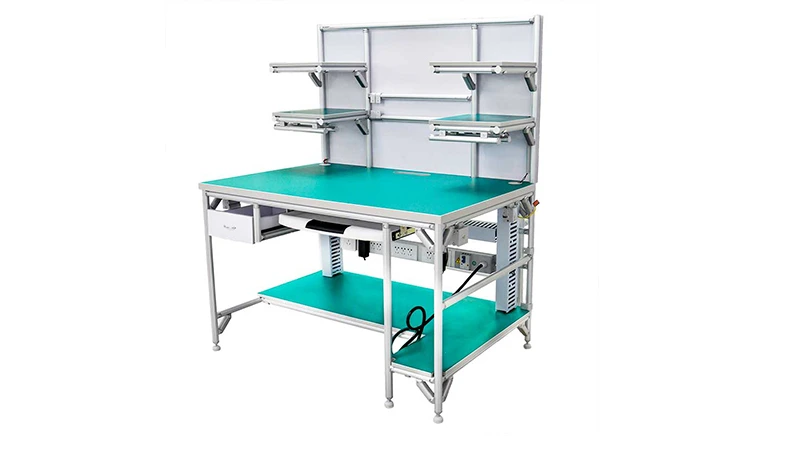
In today's fast-paced manufacturing world, the pressure to stay competitive while reducing environmental impact has never been higher. Circular manufacturing—an approach that prioritizes reusing, recycling, and reducing waste—has emerged as a guiding principle for forward-thinking factories. Yet, one often-overlooked area where circularity can make a significant difference is the humble workbench. For decades, manufacturers have relied on rigid, single-use workbenches that end up in landfills when production lines change or facilities upgrade. Enter aluminum workbench A : a modular, durable solution designed to align with circular ideals, support lean system principles, and redefine how we think about factory furniture.
The Hidden Cost of "Disposable" Workbenches
Walk into many traditional manufacturing plants, and you'll find workbenches that tell a story of inefficiency. Made from plywood, particleboard, or even heavy steel, these workbenches are built to last—until they don't. When a new product line is introduced, a workstation needs to be reconfigured, or a facility expands, these fixed structures become liabilities. They're too heavy to move, too rigid to modify, and too often, their materials are not recyclable. The result? Thousands of pounds of waste each year, not to mention the financial drain of replacing them with new workbenches.
Consider a mid-sized electronics manufacturer that updates its production line every 18 months. Each update requires new workbench dimensions to accommodate larger circuit boards. With traditional steel workbenches, the old ones are either scrapped (adding to landfill waste) or stored (taking up valuable floor space). Over five years, that's three sets of workbenches—each costing tens of thousands of dollars—plus the environmental cost of raw materials and manufacturing energy. This isn't just bad for the planet; it's bad for the bottom line.
Aluminum Workbench A: Modularity Meets Durability
Aluminum Workbench A was designed to flip the script on disposable workbenches. At its core is a simple yet powerful idea: build a workbench that can adapt, evolve, and outlive multiple production cycles. How? By leveraging aluminum profile and high-quality aluminum pipe accessories to create a modular system that's as flexible as it is strong.
Let's break down the components. The frame is constructed from lightweight yet robust aluminum profile—extruded aluminum beams with precision-engineered T-slots that allow for quick attachment of accessories. Unlike steel, aluminum is corrosion-resistant, so it holds up in harsh factory environments without rusting. The work surface, typically a durable aluminum composite or ESD-safe panel, is secured to the frame using quick-release clamps, making it easy to swap out if damaged or if a different surface type is needed (e.g., heat-resistant for soldering tasks).
But the real magic is in the aluminum pipe accessories . From adjustable feet and swivel casters to tool holders and shelf brackets, these accessories snap into the T-slots of the aluminum profile with minimal effort. Need to add a second shelf for storage? Slide in a bracket and secure it with a hand screw. Want to move the workbench to a new location? Attach casters in minutes. When production needs change, the workbench can be disassembled, and its components repurposed to build a completely new workstation. No waste, no new materials—just adaptability.

Supporting Lean Systems: More Than Just a Workbench
At its heart, lean system thinking is about eliminating waste—whether that's time, materials, or space. Aluminum Workbench A doesn't just fit into lean principles; it amplifies them. Here's how:
- Reduced Setup Time: Traditional workbench assembly can take hours (or even days) with bolts, welding, or custom cutting. Aluminum Workbench A, by contrast, can be fully assembled in under an hour using nothing more than a hex key. When a production line needs to pivot, teams can reconfigure workstations in minutes, not days, minimizing downtime.
- Elimination of "Dead Space": The modular design means every inch of the workbench is intentional. Add a tool rail above the surface to keep screwdrivers and pliers within arm's reach, or attach a bin rack below for parts storage. No more cluttered, inefficient workspaces—just a setup tailored to the task at hand.
- Continuous Improvement: Lean manufacturing thrives on feedback. If a team finds that a workbench is too low for ergonomic comfort, simply adjust the height using extendable aluminum pipe legs. If a process change requires a longer surface, add an extension using compatible aluminum profile sections. The workbench evolves with the team, not against it.
In short, Aluminum Workbench A isn't just a piece of furniture—it's a lean solution that empowers teams to work smarter, faster, and more sustainably.

Circular by Design: From Cradle to Cradle
Circular manufacturing isn't just about recycling at the end of a product's life—it's about designing products to avoid becoming waste in the first place. Aluminum Workbench A excels here on multiple levels:
100% Recyclable Materials: Aluminum is one of the most recyclable materials on the planet, with a recycling rate of over 90% in many industries. When an Aluminum Workbench A finally reaches the end of its long service life (which, with proper care, can be 15+ years), its aluminum profile and accessories can be melted down and repurposed into new products—with 95% less energy than producing new aluminum from raw bauxite ore.
Reusable Components: Most workbench "end-of-life" scenarios aren't truly the end. A factory that downsizes might disassemble its Aluminum Workbench A and sell the components to another manufacturer. A team that needs a smaller workstation can take apart a larger one and reuse the aluminum profile to build a new, compact version. Even individual accessories—like casters or tool holders—can be swapped between workbenches, extending their useful life indefinitely.
Minimal Waste in Production: The aluminum extrusion process used to create the workbench's profile is highly efficient, generating little scrap. Any waste from cutting or shaping the profile is recycled on-site by manufacturers, ensuring that even the production phase aligns with circular principles.
Traditional vs. Aluminum Workbench A: A Side-by-Side Comparison
| Feature | Traditional Steel/Plywood Workbench | Aluminum Workbench A |
|---|---|---|
| Material | Heavy steel or non-recyclable wood composites | Lightweight, recyclable aluminum profile |
| Modularity | Fixed design; cannot be reconfigured without tools/welding | Tool-free reconfiguration using aluminum pipe accessories |
| Reusability | Typically scrapped when no longer needed | Components can be disassembled and reused indefinitely |
| Expected Lifespan | 3–5 years (before becoming obsolete) | 15+ years (with component replacement as needed) |
| Environmental Impact | High: Raw material extraction, manufacturing energy, landfill waste | Low: Recyclable materials, minimal waste, energy-efficient production |
| Total Cost Over 10 Years* | $45,000 (3 replacements + disposal fees) | $18,000 (1 initial purchase + minor accessory upgrades) |
*Estimate based on a mid-sized manufacturing facility with 10 workbenches, assuming a $15,000 initial investment per set of traditional workbenches and $12,000 for Aluminum Workbench A (including accessories).
Real-World Impact: How One Factory Cut Waste by 60%
To understand the tangible benefits of Aluminum Workbench A, let's look at a hypothetical (but representative) case study. A automotive parts manufacturer in the Midwest was struggling with frequent workstation reconfigurations. Their production line for brake components required workbenches of varying heights and widths, depending on the part size. With traditional steel workbenches, they were replacing 20 workstations every two years, at a cost of $30,000 per replacement. Waste was piling up, and the production team was frustrated by the downtime during transitions.
In 2023, they switched to Aluminum Workbench A. The initial investment was $24,000 for 20 workbenches (slightly less than a single set of traditional workbenches). Within six months, they needed to reconfigure 10 workstations for a new brake caliper design. Instead of ordering new workbenches, they disassembled the existing ones, added 12-inch aluminum profile extensions to the frames, and swapped out the work surfaces for larger ESD-safe panels. The entire process took two days—down from two weeks with traditional workbenches.
Two years later, the manufacturer has not purchased a single new workbench. They've reused components from old configurations to build three new inspection stations, and when they expanded their facility, they simply disassembled workbenches from the old location and reassembled them in the new space. Waste from workbench disposal has dropped by 60%, and they've saved over $60,000 in replacement costs. As the plant manager put it: "We're not just saving money—we're finally building a factory that grows with us, not against us."
Beyond the Workbench: Building a Lean, Circular Ecosystem
Aluminum Workbench A is more than a standalone product; it's part of a larger ecosystem of circular manufacturing solutions. Pair it with flow racks made from the same aluminum profile, and you create a seamless material handling system that can be reconfigured as workflows change. Add ESD-safe accessories, and it becomes a critical tool in electronics manufacturing, where static control is non-negotiable. The key is that every component—from the aluminum profile to the smallest caster—is designed to work together, ensuring that the entire system remains adaptable.
This ecosystem approach aligns perfectly with lean system goals. By standardizing on aluminum components, manufacturers reduce complexity in their supply chains. They work with fewer suppliers, order fewer custom parts, and spend less time training teams on how to use new tools. It's a ripple effect of efficiency: a more adaptable workstation leads to a more flexible production line, which leads to faster response to customer demands, which leads to a stronger competitive edge.
Choosing Quality: Why Accessories Matter
To fully unlock the potential of Aluminum Workbench A, manufacturers need to prioritize quality aluminum pipe accessories . Cheap, poorly made joints or brackets can compromise the workbench's stability and reusability. Look for accessories that are precision-cast, with smooth finishes and secure locking mechanisms. A well-made aluminum joint should hold firm under heavy loads but release easily when it's time to reconfigure—no stripped threads, no bent metal, no frustration.
Reputable suppliers understand this balance between durability and flexibility. They test their accessories to ensure they can withstand thousands of assembly/disassembly cycles, and they offer a range of options to meet specific needs—from heavy-duty casters for mobile workstations to anti-fatigue mat brackets for ergonomic comfort. Investing in quality accessories isn't an extra cost; it's an insurance policy that ensures your workbench will deliver value for decades.
The Future of Workstations: Circular, Lean, and Human-Centered
As manufacturers look to the future, the focus is shifting from "how much can we produce?" to "how sustainably can we produce it?" Aluminum Workbench A represents a small but critical step in that direction. It's a reminder that sustainability and efficiency don't have to be trade-offs—in fact, they're often two sides of the same coin. By designing workstations that adapt to human needs, rather than forcing humans to adapt to rigid workstations, we create factories that are not only greener but also more people-centric.
Imagine a world where a workbench isn't just a place to assemble parts, but a tool that grows with the team using it. A workbench that's passed from one production line to the next, its components repurposed and reinvented, decade after decade. That's the promise of circular manufacturing—and Aluminum Workbench A is leading the way.
Conclusion: Your Workbench, Reimagined
The days of disposable workbenches are numbered. In their place is a new generation of tools designed for adaptability, reusability, and sustainability. Aluminum Workbench A, with its aluminum profile, high-quality aluminum pipe accessories, and alignment with lean system principles, isn't just a workbench—it's a statement. It says that your factory values efficiency, respects the planet, and invests in the future.
So, the next time you walk through your production floor, take a closer look at those workbenches. Are they holding you back, or propelling you forward? With Aluminum Workbench A, the answer is clear: it's time to build a workstation that works as hard as your team does—today, tomorrow, and for years to come.