- Company Articles
- Products and Technology
- Solution
- ROI of Aluminum Workbench B: How It Lowers Operational Costs in Manufacturing

ROI of Aluminum Workbench B: How It Lowers Operational Costs in Manufacturing
Related Product
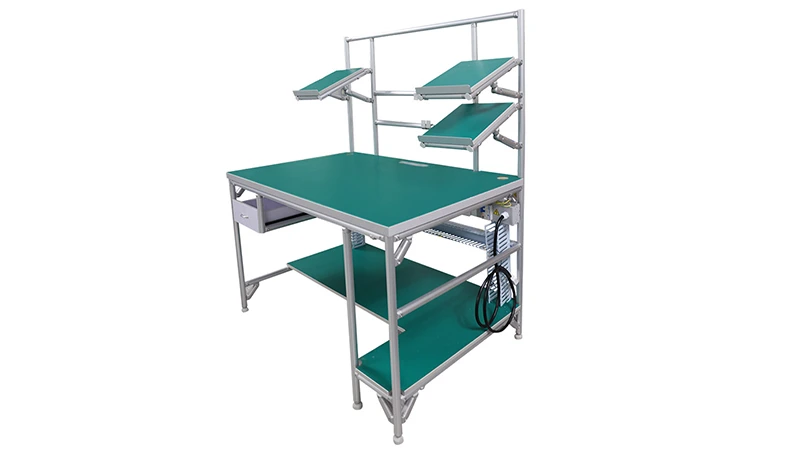
Aluminum Workbench B
Aluminum tube workbench is more flexible and durable, compared with traditional PE/ABS coated steel tube. It is easy to assemble, anti corrosion, rust protection, and recycle use after disassemble.
In the fast-paced world of manufacturing, where every second and every dollar counts, the difference between profit and loss often lies in the details of your operations. From the layout of your factory floor to the tools your team uses daily, each element plays a role in driving efficiency—or draining it. One tool that's quietly revolutionizing how manufacturers approach operational costs is the Aluminum Workbench B. It's not just a workstation; it's a strategic investment in lean manufacturing principles, designed to cut waste, boost productivity, and deliver tangible returns over time. Let's dive into how this unassuming piece of equipment can transform your bottom line.
What Is Aluminum Workbench B, Anyway?
Before we get into the ROI, let's clarify what makes Aluminum Workbench B stand out. Unlike generic workbenches cobbled together from wood or heavy steel, this is a purpose-built solution engineered for the demands of modern manufacturing. At its core is high-quality aluminum profile—lightweight yet surprisingly strong, resistant to corrosion, and infinitely customizable. It's designed as a single-deck unit without casters (though casters can be added as an accessory), making it a stable, fixed workstation that forms the hub of your production line.
But what really sets it apart is its modularity. Thanks to compatible aluminum profile accessories—think shelves, tool hooks, bin holders, and even integrated roller tracks—Aluminum Workbench B adapts to your specific needs. Whether you're assembling small electronics, packing finished goods, or testing components, you can configure it to keep tools, parts, and materials exactly where your team needs them. No more one-size-fits-all frustration; this workbench grows with your operations.
The Hidden Costs of Outdated Workstations
To understand the value of Aluminum Workbench B, let's first look at the problem it solves: the hidden costs of using outdated or ill-suited workstations. Many manufacturers stick with old steel benches, rickety wooden tables, or even repurposed furniture, not realizing how much these choices cost them in the long run.
Consider this: A typical steel workbench is heavy and hard to modify. If your production needs change—say, you start manufacturing a new product line—you can't easily add shelves or adjust the height. You're stuck buying a whole new bench, or worse, forcing your team to work around a workstation that doesn't fit. Then there's maintenance: steel rusts, especially in humid or dusty factory environments, leading to frequent repairs or replacements. Wooden workbenches fare even worse, warping with moisture or splintering under heavy use, creating safety hazards and requiring constant upkeep.
Beyond durability, there's the issue of efficiency. A disorganized workstation forces workers to waste time searching for tools, reaching across cluttered surfaces, or walking to retrieve parts from distant storage. In lean system terms, this is "motion waste"—one of the seven deadly wastes that erode productivity. Studies estimate that workers in poorly organized workspaces spend up to 20% of their shift on non-value-adding activities like these. Multiply that by your hourly labor cost, and the numbers add up fast.

How Aluminum Workbench B Cuts Costs (and Boosts ROI)
Aluminum Workbench B addresses these pain points head-on, delivering savings in five key areas. Let's break down each, with real-world examples of how they translate to lower operational costs.
1. Labor Cost Reduction: Less Motion, More Production
Labor is often the single largest expense in manufacturing, so any tool that reduces wasted time directly impacts your bottom line. Aluminum Workbench B is designed with ergonomics and efficiency in mind, minimizing the movement your team needs to perform their tasks.
Imagine a worker assembling circuit boards. With an outdated workstation, their tools might be scattered across a messy surface, and parts stored in bins under the bench. Each time they need a screwdriver or a resistor, they lean, bend, or reach—small movements that add up over an 8-hour shift. Now, picture the same worker at an Aluminum Workbench B: tools hang from a pegboard above the bench (secured with aluminum profile accessories), parts are sorted in labeled bins on a shelf at eye level, and frequently used components rest on a roller track attached to the bench edge, sliding easily into reach. Suddenly, every motion has purpose. No more searching, no more stretching—just focused, uninterrupted work.
The numbers bear this out. A study by the Lean Enterprise Institute found that optimizing workstation layout can reduce motion waste by 30–50%, translating to 1–2 extra hours of productive work per employee per day. For a team of 10 workers earning $25/hour, that's $500–$1,000 in daily labor savings—over $125,000–$250,000 annually. Aluminum Workbench B isn't just a table; it's a productivity multiplier for your most valuable asset: your people.
2. Material Handling: Smoother Flow, Fewer Errors
In manufacturing, time spent moving parts from point A to point B is time not spent building products. Aluminum Workbench B integrates seamlessly with other lean tools like flow racks and conveyors, creating a streamlined material flow that reduces manual handling and speeds up production.
Take a typical assembly line: Parts arrive in bulk and are stored in a distant warehouse. Workers fetch them in batches, cart them to the line, and unload them onto workbenches. With Aluminum Workbench B, you can position flow racks directly adjacent to the bench, stocked with just-in-time parts. Thanks to the workbench's compatibility with roller track accessories, parts slide smoothly from the flow rack onto the workstation—no lifting, no carrying, no delays. Finished components can then feed directly onto a conveyor system, moving to the next station without human intervention.
This integration isn't just about speed; it also cuts down on errors. When parts are handled manually, there's a higher risk of damage, loss, or misplacement. By automating the flow with roller tracks and conveyors, you reduce human touchpoints, lowering defect rates and the need for rework. For a manufacturer producing 10,000 units monthly, a 1% reduction in defects (common with improved material flow) saves hours of rework time and materials—easily $10,000–$20,000 annually.
3. Space Optimization: Do More with Less Floor Area
Factory space is expensive, whether you're renting or own your facility. Wasting square footage on bulky, inefficient workstations eats into your bottom line. Aluminum Workbench B, built with lightweight aluminum profile, maximizes space efficiency in two ways: by being compact yet durable, and by leveraging vertical storage.
Traditional steel workbenches are often overbuilt, taking up more space than necessary. Aluminum Workbench B, with its strong yet slim aluminum profile, has a smaller footprint while still supporting heavy loads (up to 500 lbs per deck, depending on configuration). This frees up floor space for additional workstations, storage, or equipment. But the real space saver is its vertical adaptability. Using aluminum profile accessories like overhead shelves, hanging bins, or side-mounted tool racks, you can store tools and parts above or beside the bench, keeping the work surface clear and utilizing airspace that would otherwise go unused.
Consider a factory with 10 workstations. If each outdated bench takes up 6 sq ft more space than Aluminum Workbench B, switching frees up 60 sq ft—enough for an additional workstation or a small flow rack. At an average industrial rent of $8–$12 per sq ft annually, that's $480–$720 saved on rent, plus the revenue from the extra production capacity. Over five years, that's $2,400–$3,600 in pure space-related savings.
4. Durability: Lower Maintenance, Longer Lifespan
A workstation is only a good investment if it lasts. Aluminum Workbench B's aluminum profile construction makes it far more durable than traditional options, slashing maintenance and replacement costs over time.
Steel workbenches rust, especially in factories with high humidity or exposure to chemicals. Wooden benches warp, crack, or harbor bacteria (a problem in food or pharmaceutical manufacturing). Aluminum, however, is naturally corrosion-resistant—no painting, no rust-proofing, no annual touch-ups. Even in harsh environments, it holds up, requiring only occasional wiping to stay clean. And because aluminum profile is rigid yet flexible, the bench resists dents and scratches, maintaining its structural integrity for years.
Let's crunch the numbers: A typical steel workbench costs $500 and lasts 3–5 years, requiring $100/year in maintenance (painting, rust removal). An Aluminum Workbench B costs more upfront—say, $800—but lasts 10–15 years with $20/year in maintenance (basic cleaning). Over 10 years, the steel bench would cost $500 + (10 years x $100) = $1,500, and you'd need to replace it once. Aluminum Workbench B? $800 + (10 years x $20) = $1,000, with no replacement needed. That's a $500 savings over a decade, not counting the downtime avoided from replacing workstations.
5. Adaptability: Grow Without Replacing Equipment
Manufacturing needs change—new products, higher volumes, updated processes. A workstation that can't adapt forces you to buy new equipment, driving up capital costs. Aluminum Workbench B, with its modular aluminum profile and accessories, evolves with your operations, eliminating the need for frequent replacements.
Suppose you start by using the workbench for small-part assembly, but six months later, you switch to larger components. With aluminum profile accessories, you can add a second deck, extend the work surface, or attach side rails to hold bigger parts—all without buying a new bench. If you adopt a new lean system initiative and need to rearrange your production line, the workbench can be disassembled and reassembled in minutes, thanks to its easy-to-use joints and connectors. No more paying for custom fabrication or new furniture every time your needs shift.
This adaptability is a game-changer for growing businesses. A manufacturer expanding into a new product line might otherwise spend $5,000–$10,000 on new workstations. With Aluminum Workbench B, they can reconfigure existing units for a fraction of the cost—say, $500 in new accessories—saving $4,500–$9,500 per line. Over time, these savings compound, making the workbench a long-term partner in your growth.

Calculating Your ROI: The Numbers Don't Lie
Let's put it all together with a concrete example. Suppose you're a mid-sized manufacturer with 20 workstations, currently using outdated steel benches. You decide to switch to Aluminum Workbench B, with an average cost of $800 per unit (including basic accessories). Here's how the ROI might shake out over five years:
| Cost/Saving Category | Annual Impact per Workstation | Total for 20 Workstations (5 Years) |
|---|---|---|
| Initial Investment | -$800 (one-time) | -$16,000 |
| Labor Savings (motion waste reduction) | +$6,250 ($25/hour x 250 workdays x 1 hour saved/day) | +$625,000 |
| Material Handling/Error Reduction | +$1,000 (rework/defect savings) | +$100,000 |
| Space Savings (rent/extra capacity) | +$60 (based on 6 sq ft saved at $10/sq ft/year) | +$6,000 |
| Maintenance/Replacement Savings | +$80 (vs. $100/year for steel benches) | +$8,000 |
| Adaptability (avoiding new workstation costs) | +$500 (average annual savings from reconfiguration) | +$50,000 |
| Total 5-Year ROI | +$7,090 per workstation | +$743,000 |
These numbers are conservative—many manufacturers report even higher savings, especially as they scale. For example, a company with 50 workstations could see over $1.8 million in 5-year ROI. The key takeaway? Aluminum Workbench B isn't an expense; it's a high-return investment that pays for itself in months, not years.
Real-World Success: How One Manufacturer Boosted ROI by 300%
Case Study: Precision Electronics Inc.
Precision Electronics Inc., a mid-sized manufacturer of medical devices, was struggling with high labor costs and frequent errors on their assembly line. Their 15 steel workstations were disorganized, with tools scattered and parts stored in distant warehouses. Workers spent 15–20 minutes per hour walking to retrieve materials, and defect rates hovered at 3% due to manual handling.
In 2023, they switched to Aluminum Workbench B, integrating flow racks and conveyors to create a continuous production flow. Within six months, the results were staggering: Motion waste dropped by 40%, cutting labor hours by 120 per week. Defect rates fell to 1%, saving $15,000 annually in rework. And by reconfiguring existing workbenches (instead of buying new ones) when launching a new product line, they avoided $25,000 in equipment costs.
Today, Precision Electronics estimates their Aluminum Workbench B investment delivered a 300% ROI in the first year alone. "It's not just about the workbench," says their Operations Manager. "It's about building a lean system around it. The bench is the hub that makes everything else work better."
Why Aluminum Workbench B Beats the Alternatives
You might be wondering: Why not just buy a cheaper workbench? Let's compare Aluminum Workbench B to common alternatives to see why it's worth the investment:
- Steel Workbenches: Heavier, harder to customize, and prone to rust. They cost less upfront but require frequent maintenance and replacement, leading to higher long-term costs.
- Wooden Workbenches: Inexpensive but short-lived. They warp, splinter, and can't support heavy loads, making them unsuitable for industrial use.
- Plastic Workbenches: Lightweight but flimsy. They flex under heavy tools, creating safety risks, and aren't compatible with accessories like roller tracks or shelves.
- Generic Aluminum Benches: Not all aluminum workbenches are created equal. Many lack the modular aluminum profile system that makes Aluminum Workbench B adaptable. They're static, one-size-fits-all solutions that quickly become obsolete as your needs change.
Aluminum Workbench B strikes the perfect balance: durability, flexibility, and efficiency. It's built to last, designed to adapt, and engineered to save you money from day one.
Final Thoughts: Invest in Your Team, Invest in Your Future
At the end of the day, manufacturing is about people. The tools you provide your team shape their ability to work efficiently, safely, and proudly. Aluminum Workbench B isn't just a piece of equipment—it's a statement that you value their time, their skills, and their impact on your business. By reducing motion waste, streamlining material flow, and adapting to your evolving needs, it transforms operational costs from a drain into a source of profit.
If you're ready to stop throwing money away on outdated workstations and start investing in tools that deliver real ROI, Aluminum Workbench B is the answer. It's not just about lowering costs today—it's about building a leaner, more resilient manufacturing operation that thrives for years to come. Your team deserves it, and your bottom line will thank you.