- Company Articles
- Products and Technology
- Product knowledge
- Rubber Swivel Stem Caster Wheels: Best for Floor Protection in Electronics Factories

Rubber Swivel Stem Caster Wheels: Best for Floor Protection in Electronics Factories
Related Product
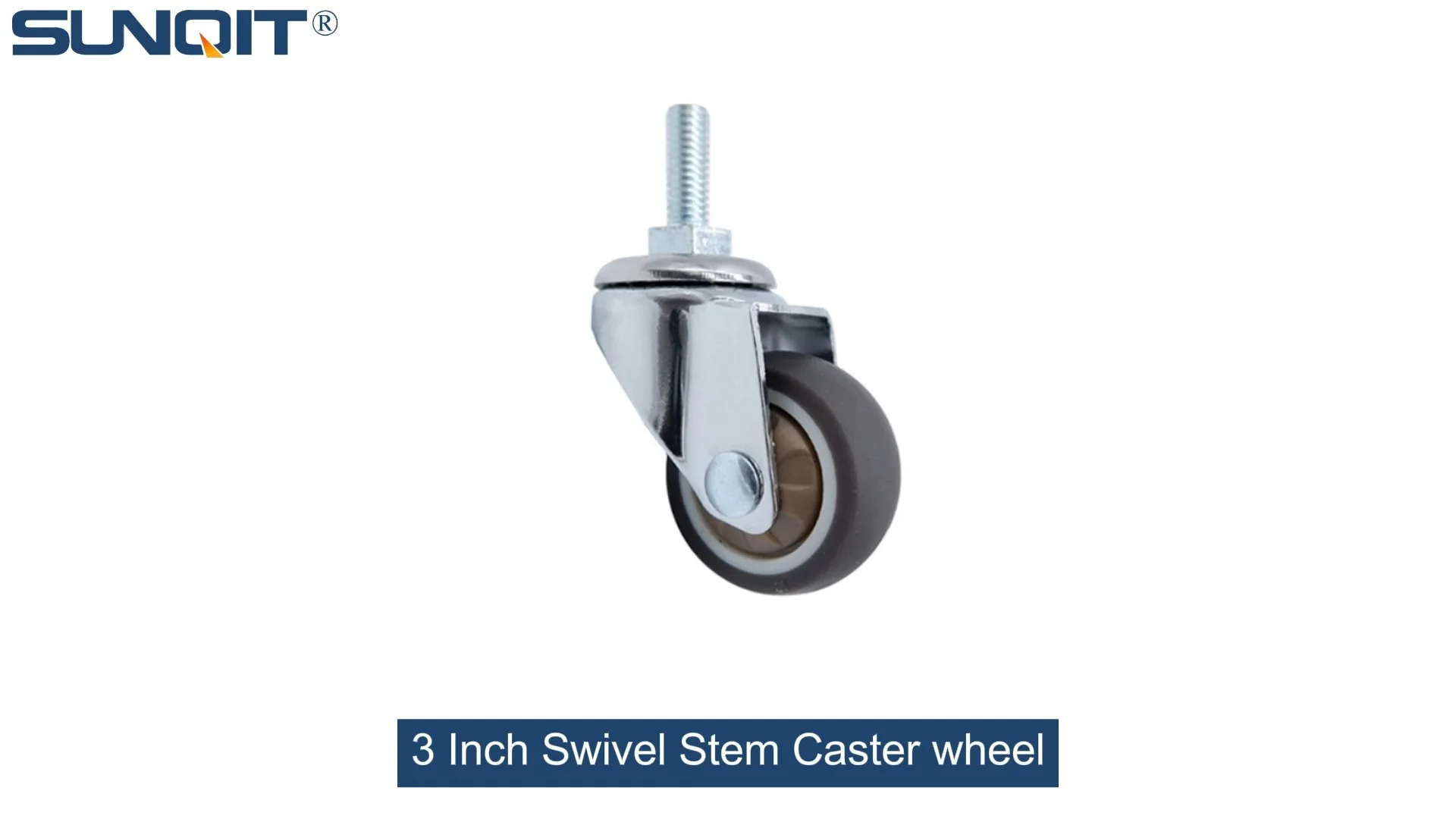
Swivel Stem Caster wheel
360 Degree Swivel Stem Caster. Threaded-post mount design, castors diameter 3 inch.Each swivel caster wheels loading 70KGS. Heavy enough and widely suit for carts, chairs, cabinet, flow rack, workbench, turnover rolley.
Walk into any electronics factory, and you'll immediately notice the precision in every corner. From the hum of automated assembly lines to the careful handling of microchips no larger than a grain of rice, these spaces thrive on control—control over static electricity, control over contamination, and control over the tools and equipment that keep production moving. But there's one unsung hero of this controlled environment that often goes overlooked: the floors. Smooth, clean, and damage-free floors aren't just about aesthetics here; they're critical for maintaining a sterile workspace, preventing debris buildup, and ensuring the longevity of expensive flooring materials like epoxy or vinyl. And when it comes to protecting these floors while keeping equipment mobile, one solution stands out: rubber swivel stem caster wheels.
In this article, we'll dive into why rubber swivel stem caster wheels have become the go-to choice for electronics factories, how they safeguard floors from scratches and dents, and why they're an essential component of both lean systems and ESD workstations. Whether you're managing a small-scale assembly line or a large manufacturing plant, understanding the value of these casters could save you thousands in floor repairs and downtime—all while keeping your production line running smoothly.
The Unique Challenges of Electronics Factory Floors
Electronics manufacturing is a world of extremes. On one hand, you have delicate components that can be ruined by a single static discharge; on the other, you have heavy equipment, workbenches, and material carts that need to move freely to keep production on track. Floors bear the brunt of this duality, and their condition directly impacts both safety and efficiency.
First, consider the flooring materials themselves. Most electronics factories use epoxy, vinyl, or polished concrete floors. These materials are chosen for their smoothness (which prevents dust traps), chemical resistance (to handle cleaning agents), and often, their anti-static properties. But they're not indestructible. Metal casters, for example, can leave deep scratches as carts are pushed across the floor, creating grooves that trap dust and debris—major enemies in a cleanroom environment. Over time, these scratches can grow, requiring costly repairs or even full floor replacements.
Then there's the issue of static electricity. ESD (Electrostatic Discharge) workstations are standard in electronics factories because static charges can fry sensitive microchips. But if the casters on these workstations or the carts moving between them aren't designed to dissipate static, they can become carriers of electrostatic buildup. A metal caster wheel, for instance, might not conduct static away from the workstation, turning a mobile tool into a silent threat to your products.
Finally, there's maneuverability. In lean manufacturing systems, efficiency is king. Workstations need to be reconfigured quickly, material carts need to navigate tight aisles, and tools need to be within arm's reach of operators. Casters that don't swivel smoothly or lock securely can slow down workflows, create bottlenecks, and even lead to operator fatigue—all of which chip away at your bottom line.
Put simply, the casters you choose for your factory's equipment aren't just "wheels on a cart." They're a critical link in maintaining floor integrity, ESD safety, and operational efficiency. And when it comes to balancing all three, rubber swivel stem caster wheels are in a league of their own.
Why Rubber Swivel Stem Caster Wheels Stand Out
At first glance, a caster wheel might seem like a simple component, but the difference between a generic wheel and a high-quality rubber swivel stem caster is night and day—especially in an electronics factory. Let's break down what makes these casters so effective.
1. Non-Marking Rubber: Gentle on Floors, Tough on Performance
The star of the show here is the rubber wheel itself. Unlike metal or hard plastic wheels, which can scrape and scratch even the toughest epoxy floors, rubber wheels act like a buffer. The soft, pliable material conforms slightly to the floor surface, distributing weight evenly and reducing friction. This means no more unsightly scratch marks, no more grooves collecting dust, and no more expensive floor repairs. Even better, high-quality rubber casters are "non-marking," so they won't leave black streaks or residue behind—perfect for maintaining that pristine factory floor appearance.
But don't let the "soft" material fool you. Industrial-grade rubber used in these casters is designed to handle heavy loads. Whether you're moving a fully loaded ESD workstation or a cart stacked with circuit boards, rubber wheels can support weights ranging from 100 to 500 pounds per caster (depending on the model), all while protecting the floor below.
2. Swivel Design: Maneuverability in Tight Spaces
Electronics factories are often a maze of workstations, assembly lines, and storage racks. Narrow aisles and tight corners are the norm, which is why a fixed caster (one that only rolls forward and backward) just won't cut it. Rubber swivel stem casters, on the other hand, can rotate 360 degrees, allowing carts and workbenches to pivot, turn, and glide around obstacles with minimal effort. This isn't just about convenience—it's about speed. Operators can move materials from point A to point B faster, reconfigure workstations in minutes instead of hours, and keep production flowing without unnecessary delays.
Many models also come with a swivel lock, which lets you lock the caster in place to prevent unwanted movement. This is crucial for ESD workstations, where stability is key during precision tasks. Flip the lock, and the workstation stays put; release it, and you're ready to relocate.
3. Stem Mount: Easy Installation on Workbenches and Trolleys
Stem mount casters are designed to be inserted into a pre-drilled hole or socket, making installation a breeze. Unlike plate-mount casters, which require bolts and a flat surface, stem casters can be attached to the legs of workbenches, the bottom of ESD workstations, or the frame of material carts with just a few turns of a wrench. This simplicity saves time during setup and makes it easy to replace casters when they eventually wear out. Plus, stem mounts are often more compact, leaving more ground clearance for the equipment they're attached to—handy for navigating uneven floors or small debris.
4. ESD Compatibility: Static Dissipation Built In
For electronics factories, static control is non-negotiable. Many rubber swivel stem casters are available with conductive rubber wheels, which are designed to dissipate static electricity safely to the ground. This means when you roll an ESD workstation or cart across the floor, the caster wheels act as a path for static charges to escape, preventing buildup that could damage sensitive components. Look for casters with a surface resistance of 10^6 to 10^9 ohms—this range is ideal for ESD protection, as it's conductive enough to bleed off static but not so conductive that it creates a shock hazard for operators.

Caster Materials Compared: Why Rubber Beats the Rest
To truly understand the value of rubber swivel stem casters, it helps to see how they stack up against other common caster materials. Below is a comparison table highlighting key factors for electronics factories:
| Caster Material | Floor Protection | ESD Compatibility | Load Capacity (Per Caster) | Best For |
|---|---|---|---|---|
| Rubber (Swivel Stem) | Excellent – Non-marking, scratch-resistant | Yes (with conductive rubber) | 100 – 500 lbs | ESD workstations, material carts, lean system setups |
| Plastic | Fair – May mark floors under heavy loads | Limited (rarely conductive) | 50 – 300 lbs | Light-duty carts, non-critical areas |
| Metal | Poor – Scratches and damages floors | Yes (conductive, but high shock risk) | 500+ lbs | Heavy machinery (not recommended for electronics floors) |
| Polyurethane | Good – Moderate protection, high durability | Yes (with conductive additives) | 300 – 800 lbs | Medium to heavy-duty carts, outdoor use |
As the table shows, rubber swivel stem casters excel in the areas that matter most for electronics factories: floor protection, ESD compatibility, and versatility. While polyurethane comes close, rubber's softer texture offers superior scratch resistance, making it the safer choice for delicate factory floors.

Fitting into Lean Systems and ESD Workstations
Modern electronics manufacturing isn't just about building products—it's about building them efficiently, safely, and sustainably. Two frameworks that guide this approach are lean manufacturing and ESD control. Rubber swivel stem casters play a surprisingly vital role in both.
Lean Systems: Flexibility and Waste Reduction
Lean manufacturing is all about eliminating waste—whether that's wasted time, wasted space, or wasted resources. Rubber swivel stem casters support this by making equipment highly flexible. In a lean factory, workstations aren't fixed in place; they're modular, able to shift with production needs. A soldering station might need to move next to an assembly line one day and a testing area the next. With swivel stem casters, this reconfiguration takes minutes, not hours. No more calling in a maintenance crew to disassemble and reassemble workbenches—operators can do it themselves, keeping production on track.
Material flow is another cornerstone of lean systems. Carts equipped with rubber swivel stem casters glide smoothly along designated paths, delivering components exactly where they're needed, when they're needed. This reduces "motion waste" (operators walking long distances to fetch parts) and "inventory waste" (stockpiling parts because they're hard to move). Over time, these small efficiencies add up to significant cost savings.
ESD Workstations: Safety First
An ESD workstation is more than just a table with a grounding mat. It's a complete system designed to protect sensitive electronics from static damage. Every component, from the work surface to the tools to the casters, must work together to dissipate static. Rubber swivel stem casters with conductive wheels are a critical part of this system. When the workstation is grounded (via a cord or the casters themselves), the wheels ensure that any static charge generated by moving the workstation is safely drained away. This is especially important in high-mix, low-volume production environments, where workstations are frequently repositioned.
Imagine an operator needs to move an ESD workstation to accommodate a rush order. If the casters aren't conductive, the act of rolling the workstation could generate static buildup, which might discharge when the operator touches a circuit board. With conductive rubber casters, that static is neutralized before it can cause harm. It's a small detail, but it can mean the difference between a functional product and a costly failure.

Installation Tips for Maximum Performance
Even the best caster wheels won't perform well if they're installed incorrectly. Here's a step-by-step guide to installing rubber swivel stem casters on your ESD workstations, carts, or other equipment:
- Check the stem size: Most stem casters come in standard sizes (e.g., 1/2-inch diameter, 1-inch length). Make sure the stem matches the pre-drilled holes or sockets on your equipment. If the hole is too large, use a bushing (a common caster accessory) to secure the stem.
- Clean the mounting area: Remove any dirt, debris, or old adhesive from the socket or hole. This ensures a tight, secure fit.
- insert the caster: Push the stem into the socket firmly. For threaded stems, screw them in until they're tight (use a wrench if needed, but don't over-tighten—you could strip the threads).
- Test swivel and brakes: Spin the wheel to ensure it swivels smoothly. Engage the brake (if equipped) to make sure it locks the wheel in place. If the caster wobbles or sticks, check for debris in the swivel mechanism or a misaligned stem.
- Balance the load: When installing casters on a workstation or cart, use at least four casters (one at each corner) to distribute weight evenly. Uneven loading can cause casters to wear out faster or damage floors.
Pro tip: If you're retrofitting existing equipment with new casters, consider replacing all four casters at once. Mixing old and new casters can lead to uneven wear and reduced maneuverability.
Maintenance: Keeping Your Casters Rolling Smoothly
Like any piece of equipment, rubber swivel stem casters need regular maintenance to perform at their best. Fortunately, caring for them is simple and takes just a few minutes each month.
1. Clean the Wheels
Dust, dirt, and small debris can get trapped in the wheel bearings or between the wheel and the fork, causing the caster to stick or roll unevenly. Use a brush or compressed air to remove debris from the wheels and swivel mechanism. For sticky residue (like oil or grease), wipe the wheels with a damp cloth and mild soap.
2. Lubricate Moving Parts
The swivel joint and wheel bearings need lubrication to stay smooth. Every 3–6 months, apply a few drops of light machine oil (e.g., 3-in-1 oil) to the swivel bearing (where the caster rotates) and the wheel axle. Wipe away excess oil to prevent attracting dust.
3. Inspect for Wear
Check the wheels for signs of damage: cracks, flat spots, or worn tread. If the rubber is hardening or cracking, it's time to replace the caster—old wheels won't protect floors or dissipate static effectively. Also, inspect the stem and swivel joint for looseness. A wobbly stem can cause the equipment to tip or damage the mounting socket.
4. replace When Necessary
Even with proper maintenance, casters will eventually wear out. As a general rule, replace rubber casters every 1–2 years in high-traffic areas, or sooner if you notice signs of damage. Keeping a few spare casters on hand ensures you can make replacements quickly, minimizing downtime.
Case Study: How One Factory Transformed with Rubber Swivel Stem Casters
To put this all in perspective, let's look at a real-world example (names changed for privacy). PrecisionTech Electronics, a mid-sized manufacturer of circuit boards, was struggling with two major issues: frequent floor repairs and recurring ESD-related product failures.
Their factory floor, a 5-year-old epoxy surface, was covered in scratches from metal-castered carts and workstations. The maintenance team was spending $2,000 monthly on patching and resurfacing. Meanwhile, ESD events were causing an average of 10% of their circuit boards to fail testing—costing the company over $50,000 annually in wasted materials and rework.
After consulting with an industrial supply expert, PrecisionTech decided to replace all metal casters with conductive rubber swivel stem casters on their ESD workstations and material carts. They also added swivel stem casters to their mobile testing stations, which had previously been fixed in place.
The results were dramatic: Within six months, floor repair costs dropped by 70% (to just $600 monthly). ESD failures decreased by 50%, saving the company $25,000 in the first year alone. Perhaps most surprisingly, production efficiency improved—operators reported spending 20% less time moving equipment and materials, thanks to the casters' smooth swivel action.
"We didn't realize how much time we were wasting wrestling with stiff, scratchy carts," said Maria Gonzalez, PrecisionTech's production manager. "The new casters made everything easier—moving workstations, fetching parts, even cleaning the floors. It's like night and day."
Conclusion: Invest in Protection, Reap the Rewards
In the fast-paced world of electronics manufacturing, it's easy to overlook small components like caster wheels. But as we've seen, rubber swivel stem casters are far more than just "wheels"—they're a strategic investment in floor protection, ESD safety, and operational efficiency. By choosing casters that are gentle on floors, easy to maneuver, and compatible with lean and ESD systems, you're not just avoiding costly repairs and product failures—you're creating a factory that can adapt, grow, and compete in today's market.
So, the next time you're evaluating equipment for your electronics factory, don't forget to look down. The right casters might just be the unsung hero that takes your production to the next level.