- Company Articles
- Products and Technology
- Product knowledge
- Small Iron Corner Code Working Principle: Securing Connections in Material Rack B

Small Iron Corner Code Working Principle: Securing Connections in Material Rack B
Related Product
Small Iron Corner Code
Used for 30 series aluminum profile 90° plane connection
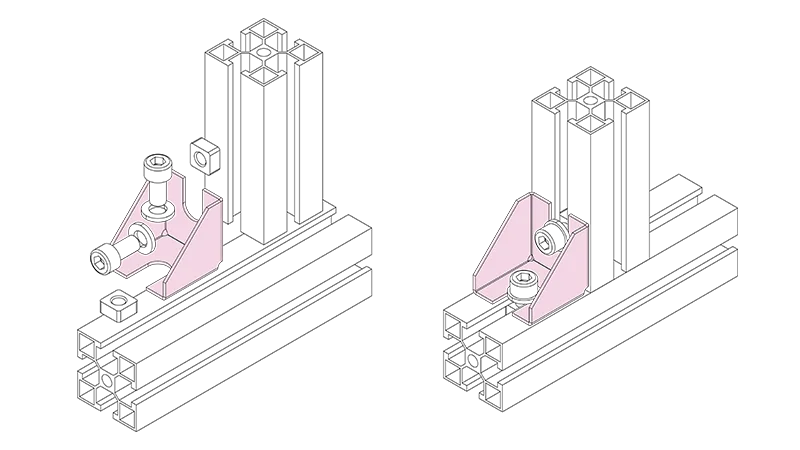
In the hum of a busy manufacturing facility, where the rhythm of production never skips a beat, there's a quiet hero working behind the scenes: the small iron corner code . You might not notice it at first glance, hidden where metal meets metal, but without it, the sturdy Material Rack B (3 row and 3 floor) —a workhorse of warehouses and assembly lines—wouldn't stand a chance against the daily grind of heavy loads, constant movement, and the relentless push for efficiency that defines modern lean systems . Let's pull back the curtain on this unassuming component, exploring how it works, why it matters, and how it keeps operations running smoothly, safely, and lean.
Material Rack B: The Backbone of Organized Storage
Before diving into the small iron corner code, let's get to know its most common partner: Material Rack B. Designed with three rows and three floors, this rack is a staple in environments where space and organization are critical—think automotive plants, electronics workshops, and distribution centers. Its multi-tiered structure maximizes vertical storage, keeping materials within arm's reach while minimizing clutter on the factory floor. But here's the thing: a rack is only as strong as its weakest connection. With each shelf holding boxes of components, tools, or finished products—sometimes weighing 50 pounds or more—every joint, every bracket, and every fastener must stand up to constant stress.
Imagine a typical Tuesday morning in a electronics warehouse. Workers are loading circuit boards onto the top floor of Material Rack B, while others unload plastic casings from the middle row. A forklift glides by, dropping off a pallet of wiring harnesses at the bottom shelf. Each movement jostles the rack slightly; each load tests its structural integrity. If even one connection loosens, the whole system could wobble, risking damage to materials—or worse, endangering the people around it. This is where the small iron corner code steps in: it's the silent guarantor that keeps those shelves level, the uprights steady, and the entire rack anchored to its purpose.
What Is a Small Iron Corner Code, Anyway?
At its core, a small iron corner code is a compact, L-shaped piece of metal—usually stamped or bent from low-carbon steel—designed to reinforce right-angle connections between two structural components, like the vertical uprights and horizontal beams of Material Rack B. Think of it as a "hidden handshake" between metal parts: it wraps around the corner where two pieces meet, distributing weight evenly and preventing the joint from twisting or pulling apart under pressure. Unlike flashy bolts or bulky brackets, it's unobtrusive, often bolted or welded into place where it's least likely to interfere with loading or unloading.
But don't let its size fool you. These corner codes are engineered for strength. Most are between 20mm and 50mm in length (about the size of a matchbox), with pre-drilled holes for screws or bolts. Their iron construction gives them a high tensile strength—meaning they resist stretching or breaking—while their L-shape ensures they can withstand both vertical loads (the weight of materials on the shelf) and lateral forces (the side-to-side movement from loading/unloading or nearby machinery).

The Working Principle: How It Secures Material Rack B
The magic of the small iron corner code lies in its simplicity. Let's break down how it works, step by step, using Material Rack B's structure as our example.
Step 1: Fitting the Corner Code into the Rack's Anatomy
Material Rack B's frame consists of four vertical uprights (the tall, vertical poles) and horizontal beams that connect them to form each shelf. At each intersection—where an upright meets a beam—there's a potential weak spot. Without reinforcement, the beam might start to pull away from the upright over time, especially as heavy items are placed on the shelf. The small iron corner code is installed at these intersections, with one arm of the "L" bolted to the upright and the other arm bolted to the beam. It's like adding a third "hand" to hold the two pieces together, creating a triangular support system (triangles, as any engineer will tell you, are nature's most stable shape).
Step 2: Distributing Weight, Not Just Holding It
When you place a heavy box on a shelf of Material Rack B, the weight doesn't just push down on the beam—it also tries to pull the beam away from the upright. The small iron corner code counteracts this by distributing the force across a wider area. Instead of the beam's connection relying solely on the screws that attach it to the upright, the corner code adds extra points of contact. This means the weight is spread out over more metal, reducing stress on any single fastener. It's similar to how a backpack with wide, padded straps is more comfortable than one with thin strings: by distributing the load, you prevent strain.
Step 3: Resisting Lateral Forces
In a busy warehouse, lateral forces are everywhere. A worker might bump the rack with a hand trolley, or a nearby conveyor might vibrate as it moves materials. These forces try to twist the rack's joints, turning right angles into obtuse or acute angles. The small iron corner code acts as a rigid barrier against this twisting. Because it's made of solid iron, it doesn't bend easily, so when the beam tries to shift sideways, the corner code "pushes back," keeping the joint locked at 90 degrees. It's like a doorstop for the rack's joints—simple, but incredibly effective.
Step 4: Long-Term Durability
Steel and iron are prone to rust, but most small iron corner codes are coated with zinc or painted to resist corrosion. This is crucial in environments where humidity or spills are common (like food processing or automotive plants). Over time, even with regular use, the corner code maintains its strength, ensuring the rack stays stable for years—reducing the need for frequent repairs or replacements, which aligns perfectly with the lean system goal of minimizing waste (in this case, waste of time and resources on maintenance).
Why Small Iron Corner Codes Beat Other Fasteners
You might be wondering: why use a small iron corner code instead of other fasteners, like aluminum angle yards or plastic brackets? The answer lies in their unique blend of strength, cost-effectiveness, and ease of installation. Let's compare:
| Feature | Small Iron Corner Code | Aluminum Angle Yards | Plastic Brackets |
|---|---|---|---|
| Strength | High tensile strength; ideal for heavy loads (up to 200+ lbs per joint) | Moderate strength; better for light to medium loads | Low strength; only suitable for very light materials |
| Cost | Affordable; steel is widely available and inexpensive to manufacture | More expensive; aluminum is pricier than steel | Cheapest upfront, but needs frequent replacement |
| Durability | Resists corrosion (with coating); lasts 5–10+ years | Lightweight but prone to bending under heavy stress | Prone to cracking, warping, or breaking; lasts 1–2 years |
| Installation | Easy to drill and bolt; compatible with standard tools | Requires specialized cutting tools for custom fits | Simple to snap into place, but less secure |
| Best For | Heavy-duty racks like Material Rack B, industrial workbenches | Light shelving, decorative or temporary structures | Home storage, lightweight retail displays |
For Material Rack B, which often holds heavy industrial materials, the small iron corner code is the clear winner. Its combination of strength and affordability ensures the rack can handle daily use without breaking the bank—a key consideration for businesses aiming to stay competitive in tight markets.
Installation Tips: Getting the Most Out of Your Corner Codes
Even the best corner code won't work if it's installed poorly. Here are a few pro tips to ensure your Material Rack B stays secure:
- Align first, then fasten: Before drilling, use a level to ensure the upright and beam form a perfect 90-degree angle. A misaligned joint will stress the corner code, weakening its effectiveness.
- Use the right bolts: Pair corner codes with high-quality, corrosion-resistant bolts (like stainless steel). Avoid over-tightening, which can strip the holes, but don't leave them loose—snug is best.
- Inspect regularly: As part of your lean system's preventive maintenance routine, check corner codes for signs of rust, bending, or loose bolts. Tighten or replace them as needed to avoid bigger issues later.
- Don't skimp on quantity: Every corner of every shelf should have a corner code. Skipping even one can create a weak link that compromises the entire rack.
Beyond Material Rack B: Where Else Do Small Iron Corner Codes Shine?
While Material Rack B is a common application, small iron corner codes are versatile. You'll find them reinforcing workbenches (keeping tabletops steady during assembly work), supporting roller track systems (ensuring the tracks stay aligned as materials slide along them), and even strengthening turnover trolleys—those wheeled carts that ferry materials between workstations. In each case, their job is the same: to turn weak joints into strong ones, ensuring that the tools and structures workers rely on every day are safe, stable, and ready to perform.
The Bottom Line: Small Parts, Big Impact
In the world of lean systems, where every second counts and every component must earn its place, the small iron corner code is a quiet overachiever. It doesn't demand attention, but it never fails to deliver—securing Material Rack B, supporting workbenches, and keeping roller tracks on track. It's a reminder that in manufacturing and warehousing, success often hinges on the smallest details: the fasteners you can't see, the connections you take for granted, and the unassuming parts that hold everything together.
So the next time you walk past a Material Rack B, take a moment to appreciate the small iron corner code. It might be tiny, but it's the reason that rack stands tall, load after load, day after day—keeping your operations lean, your workers safe, and your materials exactly where they need to be.