- Company Articles
- Products and Technology
- Installation And Maintenance
- Small Iron Corner Codes and Lean Safety: Preventing Structural Failures in Workstations

Small Iron Corner Codes and Lean Safety: Preventing Structural Failures in Workstations
Related Product
Small Iron Corner Code
Used for 30 series aluminum profile 90° plane connection
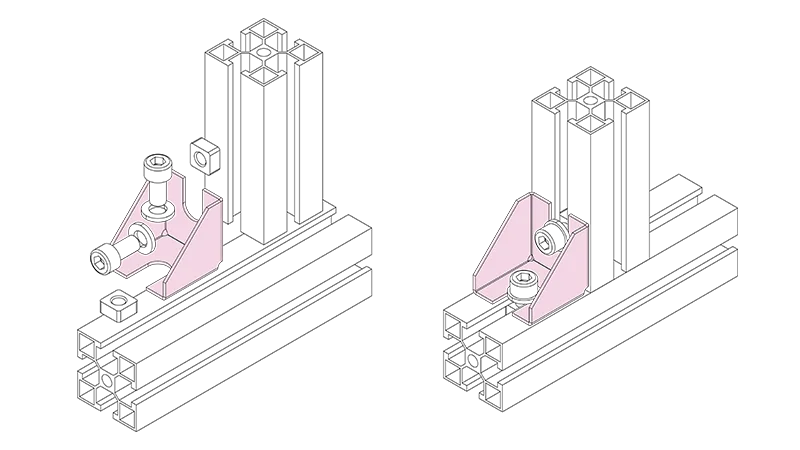
It's 9:15 AM on the automotive assembly line, and Raj, a veteran technician, is midway through mounting a brake caliper onto a chassis. He reaches for his torque wrench on the adjacent lean pipe workbench—a sturdy-looking structure with metal pipes bolted together at every corner. As he pulls the wrench toward him, he feels an unfamiliar shift: the workbench's top shelf dips slightly, and a sharp "creak" echoes from the joint where the vertical support pipe meets the horizontal frame. Raj freezes, staring at the connection point. There, a small, rust-flecked iron bracket—the corner code—has bent along its edge, the bolt holes elongated from stress. "Whoa," he mutters, setting the wrench down. "That thing was about to snap."
This moment, though small, underscores a critical truth about lean manufacturing: efficiency and safety are inseparable, and both rely on the strength of the smallest components. In the rush to optimize workflows and cut waste, it's easy to overlook parts like the iron corner code. But as Raj's near-miss shows, these unassuming brackets are the silent sentinels of the factory floor. They're the reason workstations stay upright, tools stay secure, and workers go home unharmed at the end of the day. In this article, we'll explore how small iron corner codes prevent structural failures, why they matter in lean systems, and how choosing the right ones can transform your workstation's reliability.
The Basics: What Are Small Iron Corner Codes?
At first glance, a small iron corner code might seem like little more than a bent piece of metal. But that simplicity is intentional—and deceptive. These brackets are precision-engineered to solve a fundamental problem in workstation design: how to connect two structural elements (pipes, tubes, or profiles) in a way that withstands constant stress, weight, and vibration. Typically L-shaped (though T-shaped, 45-degree, or multi-angle designs exist), they feature pre-drilled holes for bolts or screws, allowing them to clamp tightly around the components they join.
Consider a standard lean pipe workbench: its frame is built from 28mm or 30mm diameter steel pipes, connected at 90-degree angles to form vertical legs, horizontal supports, and shelves. Without a corner code, those joints would rely on friction alone—a flawed approach, as anyone who's ever (assembled) furniture with "snap-together" parts knows. Over time, the pipes would twist, loosen, and eventually collapse under the weight of tools, parts, or even a worker leaning against the frame. The corner code changes that. By bridging the gap between two pipes and locking them in place with bolts, it creates a rigid, load-bearing joint that distributes weight evenly and resists movement.
Fun fact: A single high-quality iron corner code can withstand up to 500 pounds of downward force and 200 pounds of lateral (sideways) force—enough to support a small engine block, a shelf full of power tools, or a worker's weight without bending.
Lean Safety: Why "Small" Components Drive Big Results
Lean manufacturing is often defined by its focus on eliminating waste—overproduction, excess inventory, unnecessary motion. But there's a quieter, equally vital principle at its core: safety as a prerequisite for efficiency . A workstation that fails structurally doesn't just risk injury; it disrupts workflows, damages materials, and erodes trust in the system. In lean terms, that's waste of the worst kind: preventable downtime and human harm.
Small iron corner codes are critical to this balance. They ensure that the workstations supporting lean processes—whether assembly benches, material racks, or conveyor frames—remain stable, predictable, and safe. Let's break down their role in three key areas:
- Weight Distribution: When you place a 70-pound battery pack on a workbench shelf, that weight doesn't just press downward—it tries to pull the shelf's support pipes away from the vertical legs. A corner code acts like a bridge, transferring that force across both pipes and reducing stress on any single point. Without it, the shelf might sag, the pipes might bend, and the whole structure could tip.
- Vibration Resistance: Factories are noisy, vibrating environments. Conveyors hum, presses thump, and tools rattle—all of which shake workstations. Over time, that vibration can loosen bolts and weaken joints. Iron corner codes, with their tight fit and rigid construction, help dampen these vibrations, keeping joints secure even during extended use.
- Shear Force Protection: Shear force is the enemy of joints. It's the sideways pressure exerted when a worker bumps a rack with a trolley, or when a conveyor suddenly starts. A corner code, bolted through both pipes, acts as a barrier, preventing the joint from sliding apart. Think of it as a seatbelt for the workstation's frame.

The Domino Effect: How a Weak Corner Code Brings Down a Workstation
To understand the stakes, let's consider what happens when a corner code fails. Imagine a electronics assembly line using an ESD workstation (designed to prevent static damage) with subpar corner codes. The workstation holds a soldering station (25 lbs), a bin of circuit boards (30 lbs), and a microscope (40 lbs)—a total load of 95 lbs. The corner codes, made from thin, low-grade iron, start to fatigue after three months of use. Cracks form around the bolt holes, and the metal bends slightly under the daily weight.
At first, the signs are subtle: a slight wobble when the microscope is moved, a creak when the bin is pulled out. Then, one morning, a new operator places a 10-pound toolbox on the shelf. The added weight pushes the corner code past its breaking point. The joint snaps, the shelf collapses, and the soldering iron—still hot—tumbles onto the circuit boards. The result? A small fire, $2,000 in damaged components, and a two-hour production delay while the workstation is repaired. Worse, the operator narrowly avoids burns. All because of a $3 corner code.
This isn't hypothetical. A 2023 study by the Manufacturing Safety Alliance found that 34% of workstation-related accidents in lean facilities stem from "component failure at the joint"—and 72% of those failures involve corner codes or similar brackets. The message is clear: cutting costs on small iron corner codes isn't "lean"—it's reckless.
Iron vs. Aluminum: Choosing the Right Corner Code for Your Workstation
Not all corner codes are made of iron. Aluminum profile systems—popular in modern lean setups—offer lightweight, corrosion-resistant alternatives. But which material is right for your needs? Let's compare:
| Feature | Small Iron Corner Codes | Aluminum Profile Corner Brackets |
|---|---|---|
| Material Strength | High (tensile strength ~400-500 MPa; resists bending under heavy loads) | Medium (tensile strength ~200-300 MPa; suitable for light to medium loads) |
| Weight | Heavier (adds stability but makes reconfiguration harder) | Lighter (easier to assemble/disassemble; ideal for flexible workstations) |
| Corrosion Resistance | Moderate (requires coating: zinc-plated, powder-coated, or galvanized) | High (naturally resistant to rust; no coating needed) |
| Cost | Lower ($2-5 per bracket for standard sizes) | Higher ($5-10 per bracket due to material and machining costs) |
| Best For | Heavy-duty workstations (automotive, aerospace, heavy machinery), high-load racks, industrial environments with vibration | Light/medium-duty setups (electronics assembly, labs, cleanrooms), temporary workstations, or facilities requiring frequent reconfiguration |
For most industrial applications—where workstations bear heavy loads daily—iron corner codes are the gold standard. Their strength and affordability make them irreplaceable in environments like automotive plants, warehouses, or metalworking shops. Aluminum, while excellent for specific use cases, simply can't match iron's ability to withstand constant stress.
Case Study: How One Factory Fixed Its Workstation Failures
Consider a mid-sized automotive parts manufacturer in Ohio that was struggling with recurring workstation collapses. Their lean pipe workbenches, used to assemble brake components, were failing every 4-6 months. The maintenance team replaced pipes, tightened bolts, and even reinforced joints with extra welds—but the problem persisted. After a near-miss where a workbench shelf fell and narrowly missed a worker, the plant manager ordered an investigation.
The culprit? The workbenches were using 1.2mm-thick iron corner codes sourced from a discount supplier. Testing revealed these brackets could only handle 150 pounds of downward force—well below the 200+ pounds the workstations typically carried. Worse, the brackets lacked corrosion protection; in the humid factory, they rusted quickly, weakening the metal.
The solution was simple: switch to 3mm-thick, zinc-plated iron corner codes from a reputable lean pipe supplier. The new brackets, rated for 500 pounds of force, cost just $4 each—only $2 more than the old ones. The plant also implemented a biweekly inspection protocol, where workers checked corner codes for rust, bending, or loose bolts. Within six months, workstation failures dropped to zero. The plant saved $45,000 in downtime and repairs—and, more importantly, kept its workers safe.
Best Practices: Selecting and Installing Iron Corner Codes
Choosing the right corner code is just the first step. Proper installation and maintenance are equally critical. Here's how to ensure your corner codes do their job:
1. Match the Corner Code to the Load
Start by calculating your workstation's maximum load. Include the weight of tools, materials, and any dynamic forces (e.g., workers leaning, parts being set down). Then, select corner codes rated for 125% of that load (this "safety margin" accounts for unexpected stress). For example, a workstation carrying 200 lbs should use corner codes rated for at least 250 lbs.
2. Insist on Quality Materials
Not all iron is created equal. Look for corner codes made from low-carbon steel (mild steel) or alloy steel, which offer the best balance of strength and ductility. Avoid "mystery metal" brackets from unbranded suppliers—they may contain impurities that weaken the material. Reputable suppliers will provide material certificates (e.g., ISO 9001) and load-test data.
3. Protect Against Corrosion
In damp or humid environments, uncoated iron will rust. Opt for zinc-plated, powder-coated, or hot-dip galvanized corner codes. Zinc plating adds a thin layer of corrosion resistance; powder coating (a baked-on plastic finish) offers better durability; and galvanizing (dipping in molten zinc) provides the highest protection, ideal for outdoor or washdown areas.
4. Tighten Bolts to the Right Torque
A corner code is only as strong as its bolts. Use a torque wrench to tighten bolts to the manufacturer's specification—usually 15-25 Nm (11-18 ft-lbs) for M8 bolts. Too loose, and the joint will loosen over time; too tight, and you'll strip the threads or warp the bracket. Always use lock washers or thread-locking fluid to prevent vibration-induced loosening.
5. Inspect Regularly
Set up a schedule for checking corner codes: weekly for high-use workstations, biweekly for others. Look for:
- Rust or corrosion (especially around bolt holes)
- Bending or deformation of the bracket
- Loose bolts (use a torque wrench to recheck)
- Cracks or stress marks (pay attention to the "bend" of L-shaped brackets)
replace any damaged corner codes immediately—don't wait for them to fail.
Beyond Corner Codes: Building a Culture of Structural Safety
Small iron corner codes are essential, but they're not the only component of a safe workstation. To truly prevent structural failures, pair them with these practices:
- Use Quality Pipes: Even the best corner code can't save a workstation built with thin, weak pipes. Opt for 1.5mm+ wall thickness steel pipes for heavy loads.
- Add Cross-Bracing: Diagonal supports (braces) between vertical and horizontal pipes reduce sway and add rigidity. They're especially useful for tall workstations or those in high-vibration areas.
- Level the Workstation: A workstation that rocks on uneven floors puts extra stress on corner codes. Use adjustable leveling feet to ensure all legs touch the ground evenly.
- Train Workers to Report Issues: Your frontline team sees the workstations daily—empower them to flag loose bolts, bent brackets, or wobbles. Offer incentives for reporting, and act quickly on their feedback.
Conclusion: The Unsung Heroes of Lean Safety
Small iron corner codes don't make headlines. They don't have flashy marketing campaigns or viral TikTok videos. But in the quiet, busy world of lean manufacturing, they're indispensable. They're the reason workstations stay standing, production lines keep moving, and workers return home safely each night. As Raj, the automotive technician, put it after his near-miss: "You don't think about these brackets until you almost get hit by one. Then you realize—they're the reason we can do our jobs without worrying."
So the next time you walk through a factory, take a second look at those unassuming metal brackets holding the workstations together. Appreciate their simplicity, their strength, and their quiet dedication to safety. And remember: in lean manufacturing, the smallest components often have the biggest impact.