- Company Articles
- Products and Technology
- Application Cases
- Small-Scale Manufacturing: How Aluminum Workbench B Supports Agile Production Runs

Small-Scale Manufacturing: How Aluminum Workbench B Supports Agile Production Runs
Related Product
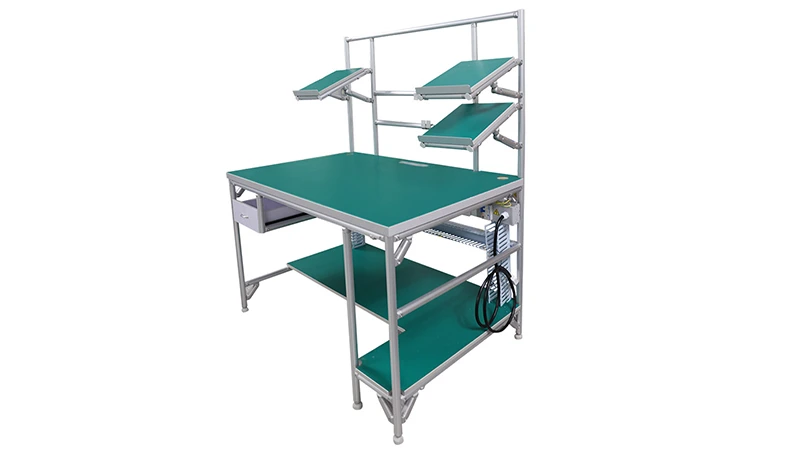
Aluminum Workbench B
Aluminum tube workbench is more flexible and durable, compared with traditional PE/ABS coated steel tube. It is easy to assemble, anti corrosion, rust protection, and recycle use after disassemble.
Small-scale manufacturing isn't just about producing goods—it's about navigating a minefield of constraints: tight budgets, limited floor space, and the constant pressure to pivot when customer demands shift. You've probably experienced it: one month, you're cranking out a steady line of products; the next, a client requests a custom order, and suddenly your workspace feels like a jigsaw puzzle with missing pieces. Traditional workbenches? They're part of the problem. Heavy, bolted to the floor, and about as adaptable as a brick wall. But what if your workbench could keep up? Enter Aluminum Workbench B—a modular, lightweight, and surprisingly tough solution designed to turn chaos into control. In this article, we'll dive into how this unassuming piece of equipment is quietly revolutionizing small-scale production, why its aluminum profile design matters, and how it integrates with lean systems to keep your workflow smooth, even when the unexpected hits.
The Small-Scale Manufacturing Paradox: Why Flexibility Isn't a Luxury—It's Survival
Let's start with the obvious: small manufacturers don't have the luxury of sprawling warehouses or unlimited capital. You're operating in a space where every square foot counts, and every dollar spent on equipment needs to deliver measurable returns. But here's the paradox: the market doesn't care about your constraints. Customers want customization, faster turnaround times, and lower costs—all while expecting the same quality as industry giants. In a recent survey by the National Small Manufacturers Association, 63% of respondents cited "inability to quickly reconfigure production lines" as a top barrier to meeting client demands. That's not just a workflow issue; it's a threat to your bottom line.
Consider the alternative: You land a rush order for a new product variant. Your current workbench is fixed, so you cobble together a temporary setup with sawhorses and plywood. It works—for a week. Then a team member trips over the extension cord snaking across the floor, or the makeshift surface warps under the weight of tools. Downtime follows, and suddenly that "profitable" rush order becomes a headache. Sound familiar? This isn't just inefficiency—it's a symptom of a workspace that's working against you, not with you.
The solution? A workspace that adapts as fast as you do. Aluminum Workbench B isn't just another table; it's a system built on the idea that your tools should bend to your needs, not the other way around. Let's break down why that matters.
Aluminum Workbench B: More Than Metal—A Masterclass in Modularity
At first glance, Aluminum Workbench B might look like any other workbench. But take a closer look, and you'll notice the difference: its frame is built from lightweight aluminum profiles—sleek, silver rails with precision-engineered slots that make customization a breeze. Unlike steel, aluminum is corrosion-resistant, so it holds up in dusty workshops or even humid environments. Unlike wood, it won't warp, splinter, or harbor mold. But the real magic? How easy it is to change.
Built to Assemble (and Reassemble) in Minutes, Not Hours
Traditional workbenches often require a crew to move or modify. Steel models? They're so heavy you'll need a forklift just to shift them six inches. Wooden ones? Screw holes strip, and adding a shelf means drilling into the frame—permanently. Aluminum Workbench B? It's designed for one-person setup. The aluminum profiles connect using internal rotary aluminum joints—twist, lock, and you're done. No welding, no power tools, no headaches. Need to add a second shelf? Slide a bracket into the T-slot, tighten a knob, and you're ready. Want to lower the height for a shorter team member? Loosen four joints, adjust, and retighten. Total time? Less than 15 minutes. For small teams where every minute of labor counts, that's a game-changer.
Take it from Raj, who runs a small electronics assembly shop in Texas. "Last year, we got a contract to build circuit boards for a robotics startup," he recalls. "Their design changed three times in two months. With our old steel bench, reconfiguring took half a day—two guys, wrenches, and a lot of swearing. Now, with Aluminum Workbench B, I can adjust the layout myself during lunch. Add a bin rail here, a tool holder there, and we're back to production by 1 PM. No downtime, no overtime. Just… done."
Lightweight, but Don't Let That Fool You—It's Tough as Nails
You might be thinking: Aluminum? Isn't that flimsy? Let's set the record straight. The aluminum profiles used in Workbench B are engineered for strength. Each rail is extruded—pressed through a die to create a uniform shape that distributes weight evenly. The result? A bench that can handle up to 500 pounds of tools, materials, and equipment without so much as a creak. Compare that to a typical wooden workbench, which starts to bow under 300 pounds, or a plastic folding table that feels wobbly with a laptop on it. Aluminum Workbench B isn't just flexible; it's reliable. And in manufacturing, reliability means fewer mistakes, fewer delays, and fewer trips to the hardware store for repairs.
| Feature | Aluminum Workbench B | Traditional Steel Workbench | Wooden Workbench |
|---|---|---|---|
| Weight (empty) | 45 lbs (easy to move by one person) | 200+ lbs (requires forklift/team to reposition) | 120 lbs (heavy, but prone to warping over time) |
| Assembly Time | 20 minutes (no tools needed) | 2+ hours (requires welding or heavy bolts) | 1 hour (needs screws, drills, and alignment) |
| Reconfiguration Time | 10–15 minutes (adjust heights, add shelves on the fly) | 4+ hours (requires disassembling and rewelding) | Not feasible (permanent modifications only) |
| Weight Capacity | 500 lbs (evenly distributed) | 1,000+ lbs (but overkill for small-scale needs) | 300 lbs (max before warping/weakening) |
| Durability | 10+ years (corrosion-resistant, no splintering) | 15+ years (but prone to rust if not maintained) | 5–7 years (susceptible to moisture, dents, and wear) |

From Workbench to Workflow: How Aluminum Workbench B Plays Well with Others
A workbench isn't an island. To truly boost agility, it needs to integrate with the rest of your setup—material racks, conveyors, and storage systems. Aluminum Workbench B shines here, thanks to its T-slot aluminum profiles, which are compatible with a wide range of accessories. Let's break down two key partnerships that turn this bench into a full-fledged production hub: its integration with lean systems and its ability to pair with flow racks for seamless material handling.
Lean Systems 101: Why Aluminum Workbench B is a Natural Fit
Lean manufacturing isn't just a buzzword—it's a philosophy built on eliminating waste, streamlining workflows, and focusing on continuous improvement. For small manufacturers, lean isn't optional; it's the only way to compete with larger players. But here's the catch: lean systems require flexibility. If your workspace is fixed, your processes will always be one step behind. Aluminum Workbench B solves this by aligning with two core lean principles: visual management and pull production .
Visual management is all about making problems visible at a glance. With Aluminum Workbench B, you can attach tool holders, bin rails, and label clips directly to the aluminum profiles. No more hunting for a missing screwdriver or misplacing small parts—everything has a designated spot, and if something's out of place, you'll notice immediately. This cuts down on "hidden waste" like time spent searching for tools (which, according to lean experts, can eat up 15–20% of a worker's day).
Pull production, on the other hand, means producing only what's needed, when it's needed. That requires materials to flow to the workbench exactly when the operator is ready for them—not before, not after. Here's where Aluminum Workbench B pairs perfectly with flow racks. A flow rack (think: a tilted shelf with roller tracks) uses gravity to feed materials forward, so the next part is always within arm's reach. Attach a flow rack to the side of your Aluminum Workbench B, and suddenly you've got a self-serve material station. No more walking to the stockroom, no more overstocking parts—just a steady, efficient pull of materials that matches your production pace.
Real-World Lean: How a Bakery Used Aluminum Workbench B to Cut Waste by 30%
Let's take a detour from electronics and metalwork to something more relatable: a small artisanal bakery in Portland, Oregon. Specializing in custom wedding cakes, the bakery's production line was a mess of mismatched tables, flour sacks piled in corners, and decor tools scattered across surfaces. Their biggest issue? "We were always over-ordering fondant because we couldn't track how much we used," says owner Mia. "And when a client wanted a last-minute design change, we'd have to clear an entire table to make space—wasting 20 minutes of prep time."
After switching to Aluminum Workbench B, Mia's team mounted small flow racks to the bench's side, each holding pre-cut fondant sheets labeled by color. Tool holders clipped to the aluminum profiles kept piping bags and stencils organized. "Now, when a client changes their mind, we just adjust the bench's height to fit the cake stand, slide a new bin of decorations into the flow rack, and keep going," Mia explains. "We've cut material waste by 30% and prep time by 25%. And the best part? The bench wipes clean in seconds—no more flour crumbs hiding in wooden cracks."
Beyond the Bench: Accessories That Turn Good into Great
Aluminum Workbench B is only as powerful as the accessories you pair with it. Luckily, its aluminum profile design is compatible with a universe of add-ons, from caster wheels for mobility to roller tracks for moving parts across the bench. Let's highlight a few that small manufacturers swear by:
- Material Rack B (3 Row and 3 Floor): This stackable rack fits perfectly alongside Aluminum Workbench B, holding raw materials or finished products without taking up valuable floor space. Its open design makes inventory checks a breeze—no more digging through closed cabinets.
- Swivel Roller Balls (1 Inch): These small, unassuming balls attach to the bench's surface, letting you slide heavy parts (like metal panels or circuit boards) across the workspace with minimal effort. They're a lifesaver for assembly tasks that require moving items back and forth.
- Plastic Roller Track Guide Rail (Yellow/Grey): Mount these to the edge of the bench, and suddenly you've got a mini-conveyor for moving small parts from one end to the other. Perfect for assembly lines where multiple team members are working on the same product.
The best part? These accessories are as modular as the bench itself. Need to remove the roller track for a custom project? Twist a few knobs, and it's off. Want to add casters to roll the bench to a new location? Screw them into the aluminum foot bases, and you're mobile. This level of adaptability means your setup can evolve with your needs—no need to buy a whole new workbench when your product line changes.

The Cost Factor: Why Aluminum Workbench B Saves You Money (Even If It Costs More Upfront)
Let's talk numbers. A basic Aluminum Workbench B costs more than a budget wooden workbench—there's no denying that. But small manufacturers who've made the switch will tell you: it's not about the upfront cost; it's about the total cost of ownership . Let's break it down:
Downtime Savings: Traditional workbenches take hours (or days) to reconfigure. Aluminum Workbench B takes minutes. If your team makes $25/hour and reconfigures twice a month, that's 2 hours x $25 x 24 months = $1,200 saved over two years.
Durability: A wooden workbench might last 5 years before warping or splintering. Aluminum Workbench B? 10+ years. That means you're buying one bench instead of two—saving the cost of a replacement.
Space Efficiency: Aluminum Workbench B's compact design and stackable accessories mean you can fit more production in less space. For a small manufacturer paying $15/sq ft in rent, saving 10 sq ft translates to $1,800/year.
Sarah, who runs a custom jewelry manufacturing studio in Colorado, puts it bluntly: "I hesitated at the price tag—$450 for a workbench felt steep. But my old wooden bench started warping after a year, and I spent $200 replacing it. Then I had to pay someone to move the new bench into place. With Aluminum Workbench B, I've had it three years, reconfigured it a dozen times, and it still looks brand new. The math? It paid for itself in under two years."
Is Aluminum Workbench B Right for You? 3 Questions to Ask
Aluminum Workbench B isn't a one-size-fits-all solution—but for many small manufacturers, it's a game-changer. To decide if it's right for your shop, ask yourself these three questions:
- Do you reconfigure your production line more than once a quarter? If you're constantly shifting between products or adapting to custom orders, the time saved on reconfiguration alone makes this bench worth it.
- Is floor space at a premium? If you're working in a garage, basement, or small warehouse, Aluminum Workbench B's compact design and stackable accessories will free up valuable square footage.
- Do you struggle with "hidden waste" (e.g., lost tools, material delays)? If your team spends too much time searching for supplies or moving materials, the bench's visual management features and flow rack compatibility will streamline your workflow.
If you answered "yes" to any of these, Aluminum Workbench B is worth a closer look. It's not just a workbench—it's an investment in your ability to adapt, grow, and compete in a market that won't slow down for anyone.
Final Thoughts: The Workbench That Grows With You
Small-scale manufacturing is a rollercoaster. One day, you're celebrating a big order; the next, you're scrambling to fix a production bottleneck. Through it all, your workspace should be your greatest ally, not your biggest headache. Aluminum Workbench B isn't flashy, and it won't solve all your problems—but it will make the daily grind a little smoother. Its aluminum profile design, modular accessories, and lean system compatibility turn a static workspace into a dynamic tool that adapts as fast as you do.
So, if you're tired of fighting with workbenches that can't keep up, if you're ready to turn "I can't" into "I can, and quickly," give Aluminum Workbench B a chance. It might just be the quiet revolution your shop has been waiting for. After all, in manufacturing, the best tools aren't the ones that do one job perfectly—they're the ones that grow with you, no matter where the journey takes you.