- Company Articles
- Products and Technology
- Product knowledge
- Space Footprint: Aluminum Workbench C vs Bulkier Traditional Workbenches

Space Footprint: Aluminum Workbench C vs Bulkier Traditional Workbenches
Related Product
Aluminum Workbench C
aluminum-tube-workbench-is-more-flexible-and-durable,-compared-with-traditional-pe/abs-coated-steel-tube.-it-is-easy-to-assemble,-anti-corrosion,-rust-protection,-and-recycle-use-after-disassemble.
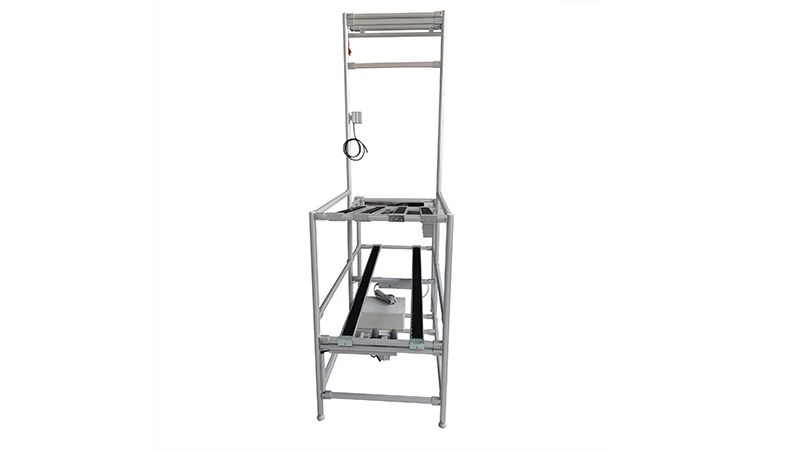
In the world of manufacturing, laboratories, and even home workshops, there's one resource that's always in short supply: space. Whether you're running a small electronics assembly line, managing a busy auto repair shop, or tinkering with DIY projects in your garage, the way you use your workspace directly impacts efficiency, mood, and bottom-line results. For decades, traditional workbenches have been the default—sturdy, reliable, and… surprisingly bulky. But in an era where flexibility and lean operations reign supreme, their bulk is starting to look less like a feature and more like a flaw. Today, we're diving into a head-to-head comparison: the sleek, modular Aluminum Workbench C versus the old-school, space-hogging traditional workbench. Spoiler alert: The way we think about workspaces is about to get a whole lot lighter.
Traditional Workbenches: The Hidden Cost of "Sturdy"
Let's start with the familiar. Traditional workbenches are often made from thick hardwood, solid steel, or a mix of both. They're built to last, and at first glance, that durability seems like a win. But "built to last" has historically meant "built to stay put"—and that's where the trouble begins. Walk into any workshop still using these relics, and you'll notice the same patterns: benches bolted to the floor, fixed shelves that can't be adjusted, and a footprint that feels more like a permanent installation than a tool.
Take Maria, for example. She runs a small-scale woodworking shop in Portland, where she and her team craft custom furniture. Five years ago, she invested in three heavy oak workbenches, each 6 feet long and 3 feet deep, weighing over 300 pounds. At the time, they seemed perfect: solid enough to clamp large slabs of wood, and "built to last a lifetime," as the salesman put it. But as her business grew, Maria needed to add a new CNC machine. Suddenly, those "lifetime" benches became a problem. They couldn't be moved without hiring a crew of movers, and their fixed position blocked the optimal layout for the new equipment. The result? The CNC ended up in a corner, requiring her team to carry heavy materials an extra 20 feet across the shop—wasting time, energy, and valuable floor space.
Maria's story isn't unique. Traditional workbenches often come with hidden costs: wasted square footage from fixed dimensions, lost productivity from poor workflow, and the frustration of being stuck with a layout that no longer fits your needs. They're also surprisingly inefficient when it comes to vertical space. A typical wooden bench might have a single shelf 18 inches below the work surface, leaving feet of unused airspace above and around it—space that could be used for storage, tool hooks, or even additional work areas if the design were more flexible.
Meet Aluminum Workbench C: A Lean Solution for the Space-Conscious
Enter Aluminum Workbench C—a modular, lightweight alternative designed with modern workspace challenges in mind. If traditional workbenches are like brick walls, Aluminum Workbench C is more like a set of building blocks: adaptable, lightweight, and ready to evolve with your needs. At its core is aluminum profile —a material that's strong yet surprisingly light, resistant to rust, and infinitely customizable. Pair that with aluminum profile accessories like adjustable shelves, tool hooks, and clamp-on bins, and you've got a workbench that doesn't just take up space—it optimizes it.
But what exactly makes Aluminum Workbench C different? Let's break it down. First, the frame: instead of solid wood or steel, it uses hollow aluminum profiles with a T-slot design. These slots let you attach accessories anywhere along the frame—no drilling, no welding, no permanent modifications. Need a shelf at 24 inches instead of 18? Just slide the brackets into the T-slot and tighten a screw. Want to add a pegboard on one side for tools? Clip it on. Unlike traditional benches, which force you to work around their fixed structure, Aluminum Workbench C adapts to your workflow.
Then there's the weight. A typical 6-foot Aluminum Workbench C weighs in at around 80 pounds—less than a third of Maria's oak bench. That means two people can move it across the shop in minutes, no movers required. For businesses like Maria's, that mobility is a game-changer. Need to rearrange for a big project? Tuck the bench in a corner. Bring in a new machine? Slide the bench into a new position to create a seamless workflow. Suddenly, your workspace becomes a flexible canvas, not a rigid maze.
Perhaps most importantly, Aluminum Workbench C is part of a larger lean system —a philosophy focused on minimizing waste (including wasted space) and maximizing value. In lean terms, traditional workbenches are "muda" (Japanese for waste) because they lock you into inefficient layouts. Aluminum Workbench C, by contrast, is "muri" (overburden) proof: it reduces the effort needed to adapt your space, letting you focus on what actually matters—creating, building, and producing.

The Space-Saving Breakdown: Why Every Inch Counts
To really understand the difference, let's talk numbers. Let's compare a standard traditional workbench (let's call it "Old Reliable") with Aluminum Workbench C across key metrics that impact space usage:
| Feature | Traditional Workbench (Old Reliable) | Aluminum Workbench C |
|---|---|---|
| Footprint (L x W) | 6ft x 3ft (fixed) | 6ft x 3ft (adjustable depth with removable extensions) |
| Weight | 300+ lbs | 80 lbs |
| Vertical Storage | 1 fixed shelf (18" below surface) | Unlimited adjustable shelves, hooks, and bins via T-slots |
| Assembly Time | 2-3 hours (requires tools, bolts, possibly professional help) | 30-45 minutes (tool-free T-slot assembly) |
| Reconfigurability | None (fixed structure) | High (add/remove parts, adjust heights, change layout) |
| Durability | High (but prone to warping, rust, or water damage) | High (aluminum resists rust; T-slot joints maintain strength) |
Let's zoom in on that "footprint" row. Traditional workbenches are stuck at 6ft x 3ft—even if you only need 2 feet of depth for a particular project, you're still stuck with 3 feet of wasted space. Aluminum Workbench C, though, often comes with removable depth extensions. Need to work on a small part? Take off the extension, shrinking the footprint to 6ft x 2ft. Suddenly, you've reclaimed 6 square feet of floor space—enough for a rolling tool cart or a small assembly station.
Vertical space is another win. Traditional benches top out at around 36 inches in height (the work surface), with that single fixed shelf below. Aluminum Workbench C, however, can be built taller—up to 72 inches or more—with shelves, racks, or even overhead storage racks attached to the frame. In a lab setting, for example, this means you can store reagents, glassware, and equipment above the bench, keeping the work surface clear for experiments. In a garage, it means hanging power tools from the frame, freeing up wall space for a bike or a lawnmower. When you stop treating your workbench as a flat surface and start using it as a vertical storage hub, the space savings add up fast.

Beyond the Bench: How Aluminum Workbench C Fits Into a Lean System
Aluminum Workbench C isn't just a standalone tool—it's part of a larger ecosystem designed to streamline operations. In manufacturing, this ecosystem is often called a lean system : a set of practices focused on eliminating waste, improving flow, and maximizing value. Traditional workbenches disrupt this flow by creating bottlenecks—fixed positions that force workers to move materials farther, wait for access, or adapt to inefficient layouts. Aluminum Workbench C, with its mobility and modularity, helps eliminate those bottlenecks.
Consider a small electronics assembly line. In a traditional setup, each worker might be tied to a fixed bench, with parts delivered via a cart that gets pushed from station to station. If one bench is backed up, the whole line slows down. With Aluminum Workbench C, though, the line can be reconfigured in minutes. Need to add a temporary station to handle a rush order? Roll in an extra bench. Want to arrange the line in a U-shape to reduce material travel time? Move the benches into place. It's not just about saving space—it's about making space work with your team, not against them.
And let's not forget about flow rack —another key component of lean systems. Flow racks use gravity to feed materials to workers, reducing the need to reach or bend. Aluminum Workbench C pairs seamlessly with flow racks: attach a flow rack to the side of the bench, and parts slide right to the work surface, cutting down on wasted movement. In a traditional setup, a worker might spend 10 minutes per hour walking to a distant shelf to grab parts. With a flow rack integrated into their Aluminum Workbench C, that time drops to seconds—adding up to hours of saved labor per week.

Durability Without the Bulk: Debunking the "Flimsy" Myth
At this point, you might be wondering: "If it's so light, is Aluminum Workbench C strong enough?" It's a fair question. We're used to equating "sturdy" with "heavy," but aluminum profile tells a different story. Thanks to its hollow design and high strength-to-weight ratio, aluminum profile can support just as much weight as steel—without the extra heft. A standard Aluminum Workbench C can easily handle 500 pounds on the work surface (that's a full-size CNC router, or a stack of 20 car batteries) and 200 pounds per shelf.
Take a manufacturing plant in Ohio that switched to Aluminum Workbench C for their quality control station. They test heavy machinery parts, some weighing up to 300 pounds, and the benches have held up for over five years with no signs of warping or sagging. "We were worried the aluminum would bend," says the plant manager, "but it's been rock solid. And when we needed to add a second level for testing smaller parts? We just bolted on a shelf—no problem."
Another concern: corrosion. Traditional steel benches rust if not treated, and wooden benches warp with moisture. Aluminum, on the other hand, forms a natural oxide layer that resists rust—making it ideal for damp environments like garages, labs, or even outdoor workshops. For marine repair shops or food processing facilities, where cleanliness and moisture resistance are critical, this is a game-changer. No more sanding rust or replacing warped wood—just a bench that stays looking and functioning like new, year after year.
The Cost Factor: Investing in Flexibility
Let's talk dollars and cents. Traditional workbenches often have a lower upfront cost—you can pick up a basic wooden bench for $200-$300, while an Aluminum Workbench C might start at $500. But as Maria learned the hard way, upfront cost isn't the whole story. The real cost comes from the lifetime of the bench: the lost productivity from poor layout, the expense of hiring movers, the need to buy new benches when your needs change.
Aluminum Workbench C, by contrast, is an investment in adaptability. Because it's modular, you can upgrade it over time instead of replacing it. Need a longer surface? Add an extension. Want to convert it into a mobile cart? Bolt on casters (many models, like Workbench E, even offer caster-free options for fixed setups). Over 5-10 years, that adaptability can save thousands in replacement costs. And when you factor in the space savings—remember that 6 square feet we reclaimed earlier? In a commercial space, that could be worth $10-$20 per square foot annually. For a small shop with 10 benches, that's $600-$1,200 in "space value" alone each year.
Real-World Results: Workspaces Transformed
Still skeptical? Let's look at real businesses that made the switch. Take GreenTech Labs, a startup developing solar panels in a 1,200-square-foot warehouse. When they first moved in, they bought four traditional steel workbenches, each 5 feet long. Within six months, they outgrew their layout: the benches were too heavy to move, and their team of five was tripping over each other trying to access tools and materials. Productivity was lagging, and morale was low.
Then they switched to Aluminum Workbench C. "It was like night and day," says CEO Lila Chen. "We reconfigured the space into a U-shape, with each bench positioned so materials flow from one station to the next. We added flow racks above the benches for parts, and suddenly, no one was walking more than 5 feet to grab what they needed. Our assembly time dropped by 30%, and we even had room to add a small testing area in the corner—space we never thought we'd have."
Or consider Joe, a home woodworker in Texas. He'd been using a 40-year-old wooden bench in his garage, which took up so much space he could barely fit his car. After switching to a compact Aluminum Workbench C, he freed up enough room to park his truck and add a miter saw station. "I can fold down the extension when I'm not using it, and the whole thing rolls into the corner," he says. "Now my garage works for both woodworking and parking—something I never thought possible."
The Future of Workspaces: Light, Lean, and Limitless
As businesses and hobbyists alike wake up to the value of space, tools like Aluminum Workbench C are leading a shift in how we design workspaces. The days of "one-size-fits-all" furniture are fading, replaced by modular, adaptable solutions that grow with us. Aluminum profile and its accessories are at the heart of this shift—offering strength without the weight, customization without the hassle, and space savings without sacrificing functionality.
And it's not just workbenches. The same principles apply to conveyor systems, storage racks, and even office furniture. Imagine a factory where every workstation, every shelf, every tool cart is designed to be moved, adjusted, or repurposed at a moment's notice. That's the future of lean manufacturing—and it starts with rethinking the humble workbench.
Final Thoughts: Your Space Deserves Better
At the end of the day, workspace isn't just about square footage—it's about potential. A cluttered, rigid workspace limits what you can create, how efficiently you can work, and how quickly you can adapt to change. Traditional workbenches, for all their reliability, limit that potential. Aluminum Workbench C, with its aluminum profile build, modular accessories, and lean system integration, unlocks it.
So whether you're running a factory, a lab, or a garage workshop, ask yourself: Is your current workbench working for you, or against you? If the answer is the latter, maybe it's time to lighten up—literally. Aluminum Workbench C isn't just a tool; it's a statement that your space, your time, and your success are worth investing in. After all, in a world where every inch counts, why settle for bulk when you can have brilliance?