- Company Articles
- Products and Technology
- Product knowledge
- Standard vs. Heavy-Duty Four Way Straight Lean Pipe Joint: Load Capacity Comparison

Standard vs. Heavy-Duty Four Way Straight Lean Pipe Joint: Load Capacity Comparison
Related Product
Four Way Straight Lean Pipe Joint
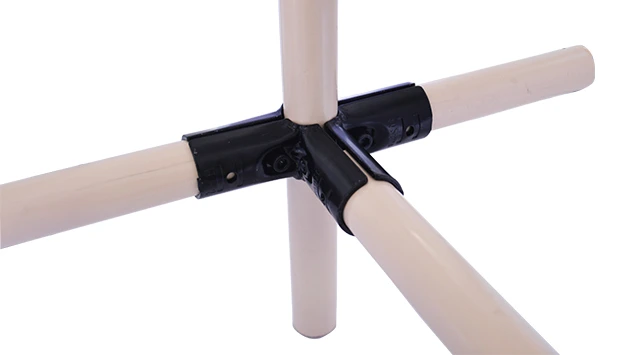
Four way lean pipe joint for 4 pcs 28MM lean pipe connection in straight angle, which used widely in workbench, flow rack, hand trolley frame connection.
Walk into any modern manufacturing facility, and you'll notice a rhythm—a symphony of moving parts, workers in sync, and systems designed to eliminate waste at every turn. At the heart of this efficiency lies something deceptively simple: lean systems. These systems, built on the principles of streamlining workflows and maximizing productivity, rely on a network of components that often go unnoticed until they fail. Among these unsung heroes are lean pipes and their connecting joints, the building blocks that form workbenches, flow racks, conveyors, and material handling structures. Today, we're zeroing in on a critical player in this ecosystem: the four way straight lean pipe joint. Specifically, we'll explore the differences between standard and heavy-duty versions, focusing on their load capacity—a factor that can make or break operational efficiency, safety, and long-term cost-effectiveness.
Lean pipe systems have revolutionized how factories and warehouses operate. Their modularity, flexibility, and affordability make them ideal for customizing workspaces to fit evolving needs. But none of this would be possible without reliable joints. The four way straight lean pipe joint, in particular, is a workhorse. As the name suggests, it connects four lean pipes—typically in straight or perpendicular directions—enabling the creation of multi-level structures, crossbeams, and complex frameworks. Whether you're building a simple assembly workbench or a sprawling material storage rack, this joint is often the linchpin holding everything together. Yet, not all four way straight lean pipe joints are created equal. Choosing between a standard and heavy-duty model isn't just about cost; it's about matching the joint's capabilities to the demands of your operation. And at the center of that decision is load capacity—the maximum weight the joint can safely support without deforming, loosening, or failing.
Understanding Lean Pipe Systems and the Role of Joints
Before diving into the specifics of four way straight lean pipe joints, let's take a step back to understand why lean pipe systems have become indispensable in manufacturing and logistics. Lean pipe, also known as "flexible pipe" or "Kaizen pipe," is typically made from steel, aluminum, or plastic-coated steel. Its lightweight yet sturdy design allows for easy assembly and reconfiguration, aligning perfectly with lean manufacturing principles that prioritize adaptability. Unlike fixed metal structures, lean pipe systems can be modified on the fly—adding a shelf here, extending a conveyor there—without the need for welding or specialized tools.
But lean pipe is only as strong as the joints that connect it. Joints are the connectors that transform individual pipes into functional structures. They come in various shapes and sizes: L-joints for corners, T-joints for branches, and four way straight lean pipe joints for multi-directional connections. Each joint type serves a unique purpose, but the four way variant is especially versatile. By allowing connections along four axes, it enables the creation of symmetrical structures, balanced weight distribution, and intricate layouts that maximize space utilization. For example, a material rack with three rows and three floors (a common setup in warehouses) relies heavily on four way joints to support the vertical and horizontal pipes, ensuring the rack can hold heavy boxes without sagging or collapsing.
In essence, joints are the "glue" of lean pipe systems. A weak joint can compromise an entire structure, leading to wobbly workbenches, unstable racks, and even safety hazards. This is why understanding the differences between standard and heavy-duty four way straight lean pipe joints is so critical. It's not just about choosing a part—it's about protecting your team, your equipment, and your bottom line.
What Is a Four Way Straight Lean Pipe Joint?
At first glance, a four way straight lean pipe joint might look like a simple metal connector, but its design is surprisingly sophisticated. Picture a central hub with four equally spaced ports, each sized to fit the outer diameter of a lean pipe. Inside each port, there's typically a locking mechanism—often a set of screws, bolts, or friction-fit collars—that secures the pipe in place. Some joints feature internal threads, while others use external clamps; the goal is the same: to create a tight, rigid connection that can withstand the forces exerted by the structure and its load.
The "straight" in four way straight lean pipe joint refers to the alignment of the ports. Unlike angled joints (which connect pipes at 45° or 90°), the straight variant aligns pipes along the same axis or perpendicular to it, creating straight lines and right angles. This makes it ideal for building square or rectangular frames, such as the base of a workbench or the shelves of a material rack. For instance, when constructing a workbench with a single deck (without casters), four way joints would connect the vertical support pipes to the horizontal beams, ensuring the surface remains level and stable even when tools and parts are placed on it.
Materials matter too. Most four way straight lean pipe joints are made from steel, though aluminum and stainless steel versions exist for specialized environments (like cleanrooms or food processing facilities). Steel joints are prized for their strength, while aluminum offers lighter weight and corrosion resistance. Some heavy-duty models even come with a chrome plating (think "four way straight lean pipe joint chrome") to enhance durability and prevent rust—a valuable feature in humid or dusty factory settings.

Standard vs. Heavy-Duty: Core Differences in Design and Materials
Now, let's get to the heart of the matter: how do standard and heavy-duty four way straight lean pipe joints differ? While they may look similar at first glance, the disparities lie in their construction, materials, and engineering—all of which directly impact load capacity. Let's break down the key distinctions.
Material Thickness and Strength
The most obvious difference is in the thickness of the metal used. Standard four way joints are typically made from low-carbon steel with a wall thickness of 1.2mm to 1.5mm. This is sufficient for light to moderate loads, such as small parts, hand tools, or empty turnover trolleys. Heavy-duty joints, by contrast, use high-strength steel (or even alloy steel) with a wall thickness of 2.0mm or more. This extra thickness isn't just about bulk—it's about tensile strength. High-strength steel can withstand greater pulling and bending forces without deforming, making it essential for supporting heavy loads like automotive components, machinery parts, or stacked pallets.
Another material consideration is the coating. Standard joints often have a basic powder coating or zinc plating to prevent rust, while heavy-duty joints may feature a thicker chrome plating or galvanized finish. Chrome plating, in particular, adds a layer of hardness that resists scratches and corrosion, extending the joint's lifespan in harsh environments. For example, a four way straight lean pipe joint chrome-plated would hold up better in a factory with high humidity or frequent exposure to oils and chemicals compared to a standard painted joint.
Locking Mechanisms
The way a joint locks onto a lean pipe is just as important as the material it's made from. Standard joints often use a simple set-screw design: a single screw that tightens against the pipe, creating friction to hold it in place. While easy to install (no special tools required), this design has limitations. Over time, vibrations from machinery or repeated use can loosen the screw, reducing the joint's grip. In contrast, heavy-duty joints typically feature reinforced locking mechanisms. This might include multiple screws (distributing pressure evenly around the pipe), threaded inserts (for a stronger connection), or even cam-action clamps (which create a mechanical lock that's harder to loosen). Some heavy-duty models also have serrated inner surfaces that bite into the pipe, preventing slippage even under heavy loads.
Load Capacity: The Critical Metric
Load capacity is the maximum weight a joint can support without failing. It's measured in two ways: static load (weight when the structure is stationary) and dynamic load (weight when the load is moving, such as parts sliding down a roller track or a trolley being pushed across the floor). Both are important, but dynamic load is often the more demanding of the two—sudden impacts or shifting weight can exert far more force than a static load.
To put this in perspective, let's look at typical numbers. A standard four way straight lean pipe joint might have a static load capacity of 100kg to 200kg and a dynamic load capacity of 50kg to 100kg. This is enough for light applications: a workbench holding a few power tools, a small flow rack for electronic components, or a turnover trolley carrying empty bins. Heavy-duty joints, on the other hand, can handle static loads of 300kg to 500kg and dynamic loads of 200kg to 300kg. This makes them suitable for heavy-duty tasks: a material rack with three rows and three floors stacked with metal parts, a conveyor transporting engine blocks, or a workbench used for assembling heavy machinery.
It's worth noting that load capacity isn't just about the joint itself—it's also about the lean pipe it's connected to. A heavy-duty joint paired with a thin, weak pipe will still fail, which is why lean pipe suppliers often recommend matching joint and pipe specifications. For example, a 2.0mm pe-coated lean pipe (thicker and stronger than standard 1.2mm pipe) should be used with heavy-duty joints to maximize load capacity.

A Detailed Comparison: Standard vs. Heavy-Duty Four Way Straight Lean Pipe Joint
To make the differences clearer, let's compare standard and heavy-duty four way straight lean pipe joints side by side. The table below summarizes key features, including load capacity, materials, applications, and cost.
| Feature | Standard Four Way Straight Lean Pipe Joint | Heavy-Duty Four Way Straight Lean Pipe Joint |
|---|---|---|
| Material Thickness | 1.2mm–1.5mm low-carbon steel | 2.0mm+ high-strength steel or alloy steel |
| Coating | Powder coating or basic zinc plating | Chrome plating, galvanized, or thick powder coating |
| Locking Mechanism | Single set-screw (friction fit) | Multiple screws, threaded inserts, or cam-action clamps |
| Static Load Capacity | 100kg–200kg | 300kg–500kg |
| Dynamic Load Capacity | 50kg–100kg | 200kg–300kg |
| Typical Applications | Light workbenches, small material racks, temporary structures | Heavy-duty workbenches, multi-level material racks, conveyors, permanent structures |
| Installation Difficulty | Easy (tool-free or basic tools) | Moderate (may require wrenches or torque tools) |
| Cost (Per Unit) | Lower (economical for light loads) | Higher (but better long-term value for heavy loads) |
| Durability | Moderate (may loosen over time; prone to corrosion in harsh environments) | High (resistant to vibration, corrosion, and wear) |
Real-World Applications: When to Choose Standard or Heavy-Duty
Understanding the specs is one thing, but knowing when to apply them is another. Let's explore scenarios where standard joints shine and when heavy-duty joints are non-negotiable.
Ideal for Standard Joints: Light to Moderate Loads
Standard four way straight lean pipe joints are perfect for applications where the load is light and stable. Think of a small electronics assembly line, where workers handle circuit boards, wires, and small components. A workbench here might hold a soldering iron, a few bins of parts, and a laptop—total weight maybe 50kg. A standard joint would easily support this, and its lower cost would help keep the project within budget. Similarly, temporary structures, like a pop-up packing station for a seasonal rush, benefit from standard joints: they're quick to assemble, easy to disassemble, and affordable enough to replace if needed.
Another good use case is a turnover trolley with a light load. If you're moving empty boxes or small parts between stations, a trolley built with standard joints and 1.2mm pe-coated lean pipe will work just fine. The key here is that the load is consistent, not overly heavy, and the structure isn't subjected to constant vibration or impact.
Ideal for Heavy-Duty Joints: Heavy, Dynamic, or Critical Loads
Heavy-duty four way straight lean pipe joints are necessary when the stakes are higher. Take automotive manufacturing, for example. A workbench used to assemble engine blocks might need to support 300kg or more—including the engine itself, tools, and parts bins. A standard joint here would almost certainly fail, leading to a collapsed workbench, damaged parts, and potential injury. Heavy-duty joints, paired with thick-walled lean pipe, ensure the structure remains stable even under this weight.
Material racks in warehouses are another critical application. A material rack with three rows and three floors, stacked with heavy boxes or pallets, can easily exceed 1000kg in total weight. Each four way joint in the rack's frame must support a portion of that load, and even a single weak joint could cause the entire rack to buckle. Heavy-duty joints distribute the weight evenly and resist the downward pressure of stacked items, preventing sagging over time.
Dynamic loads—where weight is in motion—also demand heavy-duty joints. Consider a roller track conveyor used to move metal parts between stations. As parts slide down the track, they exert force on the joints that support the track. A standard joint might loosen under repeated impacts, causing the track to misalign. Heavy-duty joints, with their reinforced locking mechanisms, stay tight, ensuring the conveyor runs smoothly and safely.
Case Studies: The Cost of Choosing the Wrong Joint
To illustrate the importance of selecting the right joint, let's look at two real-world examples (anonymized to protect privacy) of companies that learned this lesson the hard way.
Case Study 1: Electronics Manufacturer's Costly Overlooking
A mid-sized electronics manufacturer decided to upgrade its assembly line workbenches to improve efficiency. To save money, they opted for standard four way straight lean pipe joints, assuming the light components (circuit boards, resistors, etc.) wouldn't stress the structure. Six months later, several workbenches began to wobble, and one even collapsed, spilling parts and damaging a $5,000 testing machine. An inspection revealed that the standard joints had loosened due to constant vibration from nearby machinery. The company had to halt production for two days to replace all joints with heavy-duty chrome-plated versions, incurring downtime costs of over $20,000—far more than the initial savings from choosing standard joints.
Case Study 2: Warehouse Rack Failure
A third-party logistics provider installed new material racks (3 rows, 3 floors) using standard four way joints to store bulky but lightweight items (packing peanuts, bubble wrap). Over time, they started using the racks for heavier goods (cardboard boxes filled with books), exceeding the standard joints' load capacity. One afternoon, a rack section collapsed, injuring a worker and destroying $15,000 worth of inventory. An investigation found that the standard joints had deformed under the weight, causing the horizontal beams to slip. The company now uses heavy-duty joints for all racks, even those holding light items, citing "peace of mind" as a key reason.
These cases highlight a common theme: cutting corners on joint quality often leads to higher costs later. Heavy-duty joints may have a higher upfront price tag, but they pay for themselves in reduced downtime, fewer replacements, and improved safety.
Installation and Maintenance: Ensuring Longevity
Even the best heavy-duty joint will fail if installed incorrectly. Proper installation is critical to maximizing load capacity and lifespan. For standard joints, installation is straightforward: slide the pipe into the joint, tighten the set-screw with a hex key, and you're done. But for heavy-duty joints, which often have multiple screws or threaded inserts, it's important to follow the manufacturer's torque specifications. Over-tightening can strip the threads or crack the joint, while under-tightening leaves the connection loose. Many lean pipe suppliers provide torque wrenches or guidelines (e.g., "tighten to 25 Nm") to ensure proper installation.
Maintenance is equally important. Standard joints should be inspected monthly for loose screws, especially in high-vibration areas. Tightening them regularly can extend their life. Heavy-duty joints require less frequent inspection, but it's still a good idea to check them quarterly—particularly the locking mechanisms. Chrome-plated joints should be wiped down periodically to remove dirt and moisture, preventing corrosion. If a joint does become damaged (e.g., a bent port or stripped thread), it should be replaced immediately—never reused. A damaged joint is a weak link that can compromise the entire structure.
Choosing the Right Supplier: A Critical Partner
Finally, the quality of your four way straight lean pipe joint depends largely on your supplier. Not all lean pipe suppliers are created equal—some cut corners on materials or skip quality control steps to offer lower prices. When selecting a supplier, look for one with a track record of producing heavy-duty components. Ask about material certifications (e.g., "Is the steel SAE 1045 or equivalent?"), load testing procedures, and warranty policies. A reputable supplier will be happy to provide test reports or samples, and they'll offer guidance on matching joints to your specific needs.
It's also worth considering suppliers that offer a range of accessories, such as caster wheels, roller tracks, and workbench components. This ensures compatibility between parts, reducing the risk of mismatched joints and pipes. For example, a supplier that sells both heavy-duty joints and aluminum guide rails can ensure the rails fit snugly into the joints, maximizing stability.
Conclusion: Investing in the Right Joint for Your Lean System
The four way straight lean pipe joint may be a small component, but it plays a giant role in the success of your lean system. Choosing between standard and heavy-duty versions isn't just a matter of cost—it's a decision that impacts safety, efficiency, and long-term profitability. Standard joints work well for light, stable loads and temporary structures, but when the going gets heavy—literally—heavy-duty joints are non-negotiable. Their thicker materials, reinforced locking mechanisms, and higher load capacities make them the backbone of durable, reliable lean pipe systems.
As you evaluate your needs, remember the lessons from the case studies: the cost of failure far outweighs the cost of a quality joint. Whether you're building a simple workbench or a complex material handling system, take the time to assess your load requirements, consider dynamic forces, and choose a reputable lean pipe supplier. Your team, your equipment, and your bottom line will thank you.
In the end, lean manufacturing is about eliminating waste—and there's no bigger waste than a system that fails because of a weak link. Make sure your four way straight lean pipe joints are up to the task. After all, in the world of lean systems, strength in the small details leads to success in the big picture.