- Company Articles
- Products and Technology
- Product knowledge
- Straight Lean Pipe Joint Square End Chrome: How to Determine Thread Compatibility

Straight Lean Pipe Joint Square End Chrome: How to Determine Thread Compatibility
Related Product
Straight Lean Pipe Joint Square End Chrome
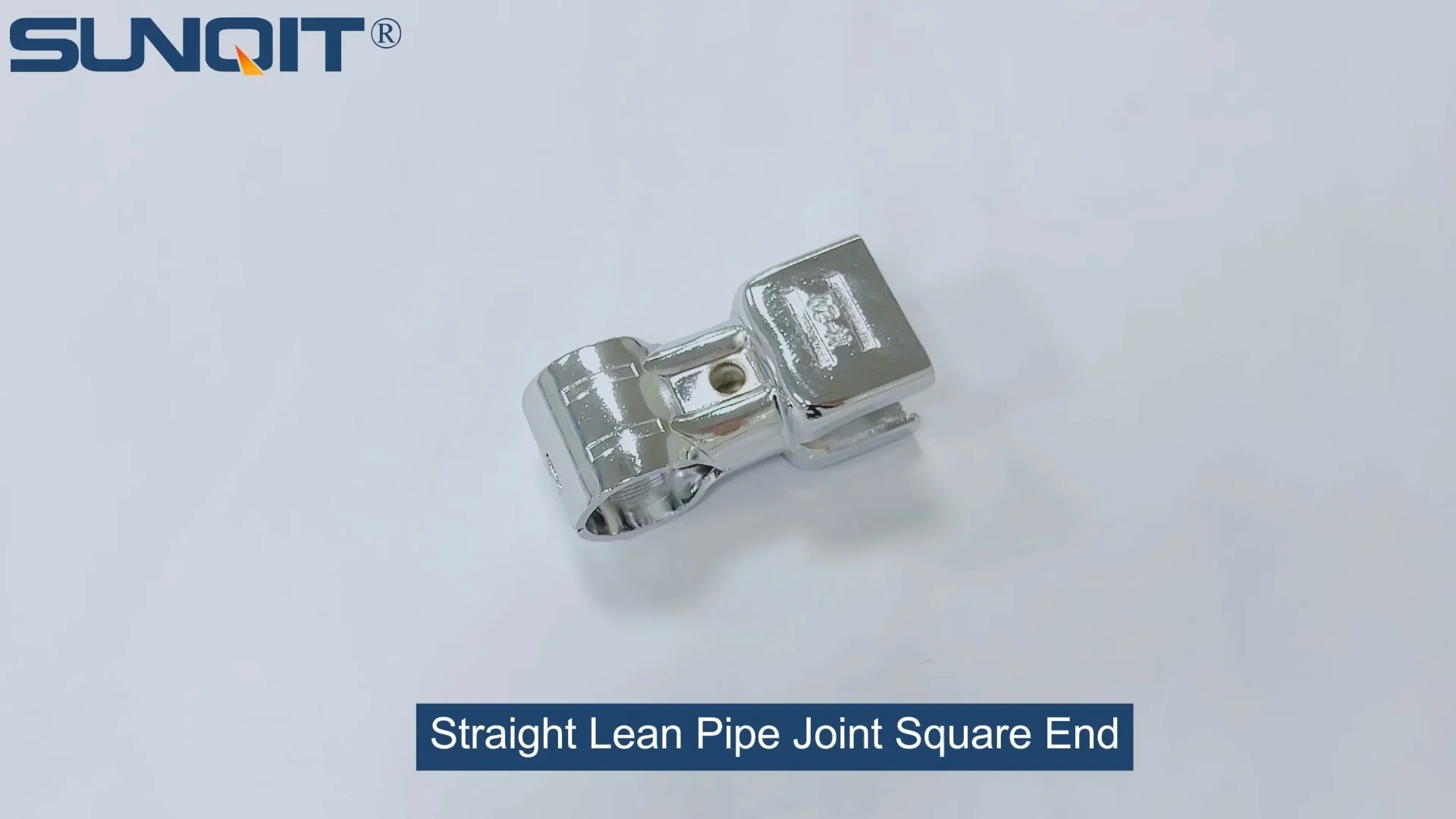
Straight lean pipe joint square end, one side connect with 28mm round pipe, the other side connect with square tube.
It's a Tuesday morning on the factory floor, and Raj, the lead maintenance technician, is staring at a half-assembled flow rack. The aluminum pipes are lined up, the tools are laid out, but something's off—the straight lean pipe joints just won't screw into the pipes properly. "They should fit," he mutters, jiggling a chrome-plated square-end joint in his hand. "We ordered the same ones last quarter." An hour later, after a call to the supplier, the issue clicks: the new joints have metric threads, while the existing pipes are imperial. That simple mismatch has already cost the team 45 minutes of setup time, and now they're scrambling to source replacements. Sound familiar? In lean systems, where efficiency and precision are everything, thread compatibility isn't just a technical detail—it's the glue that holds your production line together. And when it comes to critical components like the straight lean pipe joint square end chrome, getting it right can mean the difference between a smooth workflow and a day of frustrating delays.
What is a Straight Lean Pipe Joint Square End Chrome?
Before we dive into threads, let's get to know the star of the show: the straight lean pipe joint square end chrome. If lean systems are the backbone of modern manufacturing, these joints are the vertebrae—small but mighty connectors that transform basic aluminum or steel pipes into everything from workbenches and material racks to turnover trolleys and conveyor supports. What sets this particular joint apart? Its square end design provides a stable, flush connection, while the chrome plating adds a layer of durability, resisting corrosion and wear even in busy industrial environments. Unlike swivel or multi-angle joints, the "straight" designation means it's built for linear connections, making it a staple in structures where rigidity matters, like the legs of a workbench or the uprights of a flow rack.
Think of it as the unsung hero of modularity. In lean manufacturing, the ability to reconfigure workspaces on the fly is key—today's assembly line might need a 3-foot workbench; tomorrow, a 6-foot material rack. The straight lean pipe joint square end chrome makes that flexibility possible by letting you disassemble and reassemble structures without welding or heavy tools. But here's the catch: that flexibility only works if the threads on the joint and pipe match perfectly. A loose fit, a cross-threaded connection, or a mismatched pitch can turn your modular dream into a wobbly, unsafe nightmare.
Why Thread Compatibility Matters (Spoiler: It's Not Just About "Fitting")
Let's start with the obvious: if threads don't match, the joint won't secure the pipe. But the consequences run deeper than a loose connection. Imagine a workbench in your production assemble area, where operators are placing 50-pound toolboxes and sensitive equipment. If the joints holding up the bench have incompatible threads, the structure might feel stable at first, but over time, vibration from machinery or repeated use will loosen the connections. A few weeks later, you could be looking at a collapsed bench, damaged tools, or worse—an injury. Safety first, always.
Then there's efficiency. In lean systems, downtime is the enemy. When a joint doesn't thread properly, you're not just wasting time on installation—you're also risking delays down the line. A stuck joint might require drilling out a stripped thread, or a misfit might force you to redesign a whole section of your flow rack. And let's talk cost: ordering the wrong joints means wasted inventory, rush shipping fees for replacements, and labor hours spent fixing mistakes. For small businesses, those costs add up fast. Even large facilities can't afford to ignore thread compatibility—one mismatched batch of joints for a high-volume assembly line could derail production schedules for days.
Lastly, there's performance. Lean systems thrive on precision, and your structures need to perform consistently. A material rack with wobbly joints might cause parts to slip or shift, leading to defects. A conveyor support held together by cross-threaded joints could vibrate excessively, wearing out roller tracks and accessories faster. In short, thread compatibility isn't just about making parts "screw together"—it's about ensuring your lean system works as hard as your team does.
Real-World Impact: A mid-sized electronics manufacturer in Ohio once installed a new line of ESD workstations using what they thought were "standard" lean pipe joints. A month later, during a routine safety audit, inspectors noticed several joints were visibly loose. Further checks revealed the joints had 1/4-20 UNC threads, while the aluminum pipes were tapped for M6x1.0 metric threads. The team had forced the joints to fit, stripping the threads in the process. Replacing all 32 workstations cost $12,000 in parts and 80 hours of labor—all because no one checked thread compatibility upfront.

Understanding Thread Basics: The Language of "Screwability"
Before we jump into how to check compatibility, let's brush up on thread basics. Think of threads as a secret code—once you learn the vocabulary, you'll be speaking "joint" fluently. Let's break it down:
What Even Is a Thread?
At its core, a thread is a helical ridge wrapped around a cylinder (male thread) or a cylinder's inner surface (female thread). When you twist a male thread into a female thread, those ridges interlock, creating a secure connection. Simple enough, right? But the details—like how far apart those ridges are, or how thick the cylinder is—are what determine compatibility.
Key Terms You Need to Know
- Major Diameter: The widest part of the thread (for male threads) or the narrowest part (for female threads). Measured in millimeters (metric) or inches (imperial).
- Pitch: The distance between two adjacent threads, measured along the length of the cylinder. For metric threads, pitch is in millimeters (e.g., 1.25mm). For imperial threads, it's usually "threads per inch" (TPI)—how many threads fit into one inch (e.g., 18 TPI).
- Thread Form: The shape of the thread's cross-section. Most lean pipe joints use a 60-degree "V" form (common in metric and imperial UNC/UNF threads), but some older systems might use 55-degree Whitworth threads.
- Metric vs. Imperial: The two main thread systems. Metric threads are labeled with an "M" (e.g., M8), followed by the major diameter in millimeters and pitch (e.g., M8x1.25 = 8mm diameter, 1.25mm pitch). Imperial threads use fractions (e.g., 1/4-inch) and TPI (e.g., 1/4-20 = 1/4-inch diameter, 20 TPI).
- Coarse vs. Fine: Both metric and imperial systems have coarse (wider pitch) and fine (narrower pitch) threads. Coarse threads are stronger for general use (e.g., M6x1.0 coarse), while fine threads are better for thin materials or where precision adjustment is needed (e.g., M6x0.75 fine).

How to Determine Thread Compatibility: 5 Steps for Stress-Free Sourcing
Now that we've covered the basics, let's get practical. How do you actually check if a straight lean pipe joint square end chrome will thread into your pipes? Follow these five steps, and you'll avoid Raj's Tuesday morning headache.
Step 1: Start with Visual Inspection (Yes, Your Eyes Are Tools Too)
Before you break out the calipers, take a good look at the joint. Many manufacturers stamp thread information directly onto the joint—look for markings like "M8x1.25" or "1/4-20 UNC" near the square end. These markings are your first clue. If there are no stamps, check the packaging or the supplier's catalog—most reputable lean pipe suppliers list thread specs clearly. Also, inspect the threads themselves: are they clean and undamaged? A bent or rusted thread might not fit even if the specs match, so skip any joints with visible wear or corrosion.
Step 2: Measure the Major Diameter (Grab Your Calipers)
If there are no markings, you'll need to measure the thread's major diameter. For male threads (on the joint itself), the major diameter is the outer width of the threads. For female threads (inside the pipe or a nut), it's the inner width. A digital caliper is your best friend here—they're affordable, easy to use, and precise to 0.01mm. Here's how:
- For male threads: Gently close the caliper jaws around the thickest part of the threads (the peaks, not the valleys). Take a reading in millimeters and inches—this will help you tell if it's metric or imperial.
- For female threads: insert the caliper's outer jaws into the threaded hole and expand them until they touch the inner peaks of the threads. Again, note the measurement in both units.
Example: If you measure a male thread at 6.0mm (or ~0.236 inches), it's likely an M6 metric thread. If it measures ~0.25 inches (6.35mm), it might be a 1/4-inch imperial thread.
Step 3: Measure the Pitch (Count Those Threads!)
Next, you need the pitch—the distance between threads. For metric threads, this is in millimeters; for imperial, it's TPI. Here's how to measure both:
- Metric Pitch: Use a pitch gauge (a small tool with metal teeth of different widths) and find the tooth that fits snugly between two threads. If you don't have a gauge, measure the distance between the first and sixth thread peak (for example), then divide by 5 (since there are 5 gaps between 6 threads). For M8x1.25, the distance between 6 peaks would be ~6.25mm (5 gaps x 1.25mm = 6.25mm).
- Imperial TPI: Lay a ruler along the threads and count how many thread peaks fit into one inch. For a 1/4-20 UNC joint, you'll count 20 threads in one inch. A pitch gauge with TPI markings works here too—just match the gauge to the threads.
Pro tip: If the threads are fine (narrow pitch), count over 2 inches and divide by 2 to get a more accurate TPI reading. For example, 40 threads in 2 inches = 20 TPI.
Step 4: Check the Manufacturer's Specs (Don't Guess—Verify)
Even if your measurements suggest a thread type, always cross-check with the manufacturer's specifications. Reputable lean pipe suppliers (like the ones listed in your keyword list—hint, hint) provide detailed datasheets for their products, including thread size, pitch, and material compatibility. If you're unsure, shoot them an email or call their tech support. Most suppliers are happy to confirm specs—after all, they don't want you to order the wrong parts either.
For example, if you're looking at a straight lean pipe joint square end chrome from a supplier's catalog, the product page might list: "Thread: M8x1.25 (Metric Coarse), Compatible with 28mm OD Aluminum Lean Pipe." That's your confirmation—no guesswork needed.
Step 5: Test Fit (When in Doubt, Try Before You Buy)
If you're still unsure, nothing beats a test fit. Grab a small section of your existing pipe (or a known-compatible pipe from your inventory) and try threading the joint by hand. It should start easily, turn smoothly without binding, and feel tight when fully seated. If it's hard to start, cross-threads immediately, or feels loose, the threads don't match. Avoid forcing it—you could damage both the joint and the pipe.
Many suppliers will send sample joints for testing—take advantage of that! It's better to wait a few days for a sample than to order 500 joints that don't fit.
Common Thread Types in Lean Systems: A Quick Reference Guide
To make your life easier, we've compiled a table of the most common thread types you'll encounter in lean systems, including where they're typically used. Keep this handy when ordering straight lean pipe joints, roller track connectors, or any lean pipe and accessories.
| Thread System | Thread Type | Example | Major Diameter (mm/inch) | Pitch (mm/TPI) | Typical Applications |
|---|---|---|---|---|---|
| Metric | Coarse | M6x1.0 | 6.0mm / 0.236" | 1.0mm | Light-duty workbench legs, small turnover trolleys |
| Fine | M6x0.75 | 6.0mm / 0.236" | 0.75mm | ESD workstation components, precision material racks | |
| Metric | Coarse | M8x1.25 | 8.0mm / 0.315" | 1.25mm | Standard flow rack joints, conveyor supports |
| Fine | M8x1.0 | 8.0mm / 0.315" | 1.0mm | Heavy-duty material rack B (3 row, 3 floor) | |
| Imperial (UNC/UNF) | UNC (Coarse) | 1/4-20 UNC | 6.35mm / 0.25" | 20 TPI | Legs for workbench E (single deck, no caster) |
| UNF (Fine) | 1/4-28 UNF | 6.35mm / 0.25" | 28 TPI | Adjustable caster wheels, roller track placon mounts | |
| Imperial (UNC/UNF) | UNC (Coarse) | 5/16-18 UNC | 7.94mm / 0.3125" | 18 TPI | Stainless steel swivel roller balls (1 inch), heavy-duty caster accessories |
Troubleshooting Incompatible Threads: What to Do When Things Go Wrong
Even with careful checking, mistakes happen. Maybe a supplier sent the wrong batch, or a new team member grabbed the wrong box from inventory. Here's how to spot and fix common thread compatibility issues:
Signs of Incompatibility
- Cross-Threading: The joint "catches" or feels rough when screwing in, and you can see the threads overlapping unevenly. Stop immediately—cross-threading ruins both the joint and the pipe.
- Loose Fit: The joint screws in easily but wobbles or spins freely. This means the major diameter is too small, or the pitch is too wide.
- Overly Tight Fit: You have to force the joint with a wrench, and it won't fully seat. This could mean the diameter is too large, or the pitch is too narrow.
- Stripped Threads: The joint spins without tightening, or threads look flattened or gapped. This is often caused by repeated attempts to force incompatible threads.
Solutions for Mismatched Threads
If you spot these issues, don't panic—there are fixes:
- Use Thread Adapters: For one-off mismatches, thread adapters (e.g., metric-to-imperial) can save the day. Just make sure the adapter is rated for your load—don't use plastic adapters for heavy structures.
- replace the Joint: If the joint is the wrong thread type, swap it for the correct one. Check with your lean pipe supplier—they may accept returns on unopened boxes.
- Retap the Pipe: If the pipe has female threads, a tap (a tool for cutting threads) can rethread it to the correct size—just be sure to use cutting oil and go slowly to avoid damaging the pipe.
- Consult the Pros: If you're unsure, call your supplier's technical team. They've seen every thread mismatch under the sun and can guide you to the fastest solution.
Final Thoughts: Thread Compatibility is Lean Compatibility
At the end of the day, lean systems are about more than just efficiency—they're about building a production environment that's reliable, flexible, and safe. And that starts with the smallest components: the straight lean pipe joints, the roller track connectors, the caster accessories that hold everything together. Thread compatibility might seem like a tiny detail, but it's the foundation of that reliability. By taking the time to measure, check specs, and test fit your straight lean pipe joint square end chrome (and all your lean pipe and accessories), you're not just avoiding headaches—you're investing in a lean system that works as hard as your team does.
So the next time you're ordering joints for a new workbench or replacing a worn-out flow rack connector, remember Raj's Tuesday morning. Take five extra minutes to check the threads. Your team, your budget, and your sanity will thank you.